You may feel your case was handled unfairly. When a Texas court issues its final order on a divorce split 401k, those numbers on the page represent your future, your security, and years of hard work. If that order feels fundamentally wrong, you are not powerless. The legal system has a built-in remedy for correcting judicial errors: the appeals process.
Your Financial Future Is on the Line
It's a gut-wrenching feeling when you look at a final divorce decree and realize the court got the 401(k) division wrong. You may believe they miscalculated the portion earned during the marriage, misunderstood Texas community property law, or signed off on a sloppy order that leaves your retirement savings exposed.
These are not minor mistakes; they can have a devastating impact on your ability to retire comfortably. Your concerns are valid and critical. Seeking a fair and just division through an appeal is about ensuring the law was applied correctly.
This guide will explain the process of dividing a 401(k) in a Texas divorce. More importantly, we'll show you how a well-executed appeal can be the key to fixing an incorrect outcome and protecting what you've earned.
The Path to a Fair Outcome
A divorce completely reshuffles your financial deck, which makes comprehensive retirement planning more important than ever. The image below maps out the typical journey, showing how a court's decision can either set you on the right path or force you to take corrective action through the appellate courts.
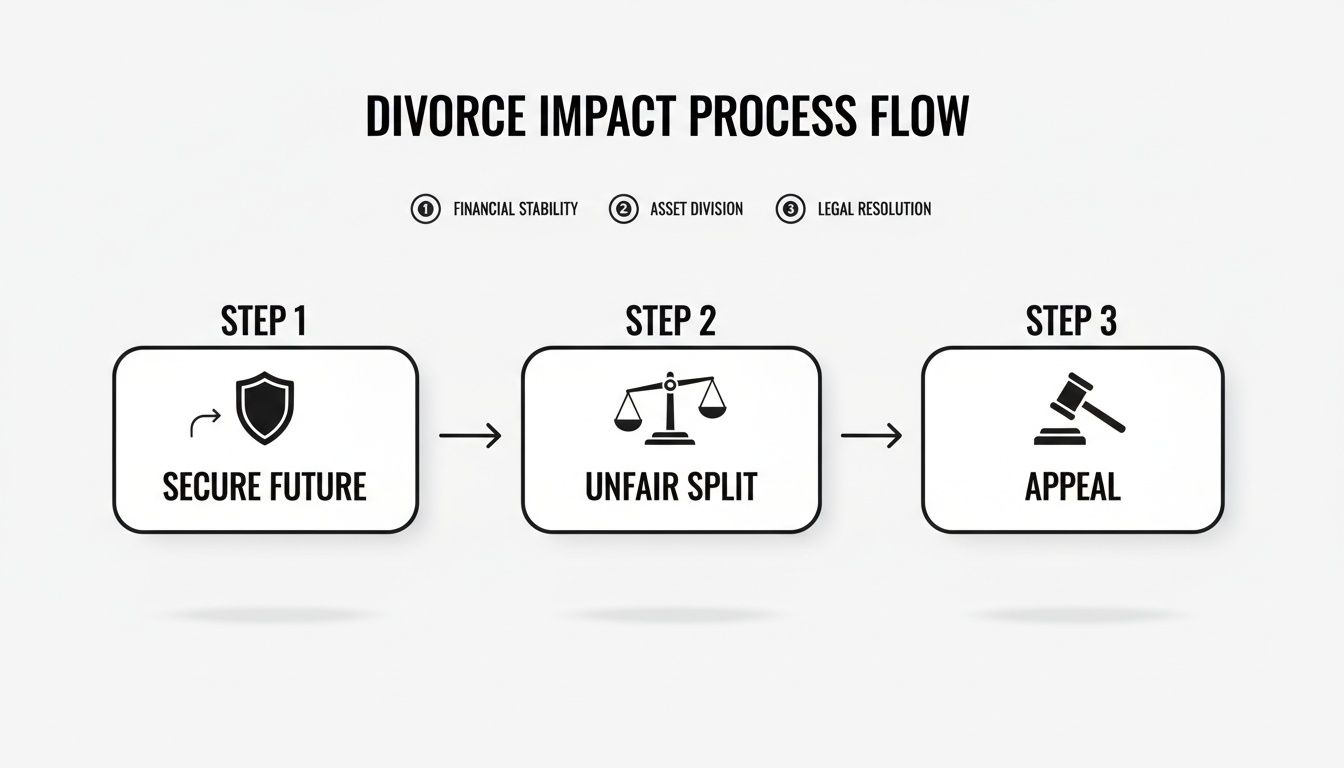
As you can see, an unjust split can seriously derail your plans. That’s precisely why the appeals process exists—to get you back on track toward the secure future you deserve.
Understanding the financial side of ending a marriage can feel overwhelming. To get a clearer picture of the expenses involved, you might find it helpful to read our in-depth guide on the cost of divorce in Texas. Arming yourself with this knowledge will help you make more strategic decisions every step of the way.
Understanding Community Property and Your 401(k)
In Texas, the law sees marriage as a partnership. This core principle means that almost everything you and your spouse earn or acquire from the day you marry until the day the divorce is final is considered community property—owned equally by both of you. This legal foundation is the most critical factor shaping how a 401(k) gets split in a divorce.
The court's first job in any property division is to "characterize" the assets, which is a legal term for labeling everything as either community or separate property. When it comes to a 401(k), this determination is based on the timeline of contributions.

Differentiating Separate and Community Funds
Anything you contributed to your 401(k) before you were married is your separate property. This includes the starting balance and all investment growth on those specific pre-marital funds. A Texas court cannot award your separate property to your spouse.
The moment you get married, the rules change. From that day forward, the community portion of the 401(k) starts to build. This "marital estate" almost always includes:
- Your direct contributions made from your salary during the marriage.
- Any employer matching contributions you received while married.
- All investment growth, interest, and dividends earned on those community contributions.
Drawing the line between these two types of funds is where trial courts often make mistakes. If a court incorrectly labels your separate property as community property, you could see a portion of your pre-marital savings unfairly awarded to your ex-spouse. This is a classic example of a reversible error that can be corrected on appeal.
The Presumption of Community Property in Texas
Texas law operates on a powerful assumption: any property you or your spouse possess at the time of divorce is presumed to be community property. This places the burden of proof not on the person claiming an asset is community property, but on the spouse who argues a portion of it—like part of a 401(k)—is their own separate property.
Key Takeaway: You must prove the separate property portion of your 401(k) with clear and convincing evidence. This usually requires producing old account statements from before and during the marriage to meticulously trace the funds. If you cannot provide that proof, the judge may treat the entire account as community property.
This legal hurdle shows just how vital a detailed financial analysis is during a divorce. Failing to properly trace and prove your separate property can lead to a deeply unfair outcome. You can explore our detailed guide on Texas community property law to get a better handle on these rules.
How the Community Portion Is Typically Divided
The starting point for dividing the marital portion of a 401(k) in Texas is a just and right division, which often means 50/50. Every dollar contributed from the wedding day to the divorce—plus all the growth on those contributions—is considered jointly owned.
For example, imagine a couple married in 2010 and divorced in 2023. The 401(k) grew from $100,000 (pre-marital funds) to $500,000. The court will only look at the $400,000 accumulated during the marriage. That marital portion is divided, potentially giving each spouse $200,000. This transfer is done tax-free using a special court order called a Qualified Domestic Relations Order (QDRO).
If you believe the trial court erred in your case—perhaps by awarding more than 50% of the community portion without a valid legal reason, or by improperly including your separate property—you may have strong grounds for an appeal. Correcting these kinds of errors is essential to protecting the retirement you’ve worked so hard to build.
The Critical Role of the Qualified Domestic Relations Order
Once the judge finalizes the division of your 401(k), you might think the process is complete. However, the divorce decree itself is just a piece of paper to the company that manages the retirement account. They will not transfer any funds without a second, highly technical legal document: a Qualified Domestic Relations Order, or QDRO.
The divorce decree establishes what each party receives, while the QDRO provides the specific instructions on how to execute the transfer. It is a detailed order written to satisfy both federal laws, like ERISA, and the plan administrator's internal rules.
This is a stage where significant errors can occur. A poorly written QDRO can be rejected by the plan administrator, trigger substantial tax penalties, or fail to accurately divide the account as the judge intended.
Why a QDRO Is Not Just a Formality
The QDRO serves as the legal bridge between your Texas divorce court and the federally regulated world of retirement plans. Without it, transferring a portion of your 401(k) to an ex-spouse would be considered an early withdrawal, resulting in immediate income taxes and a 10% early withdrawal penalty.
A properly drafted QDRO avoids these consequences, allowing the funds to be transferred from one spouse to the other tax-free.
This specialized order is essential for nearly every U.S. divorce involving an employer-sponsored retirement plan. In a community property state like Texas, where a 50/50 split of the marital portion is common, a well-crafted QDRO is non-negotiable. For further reading, these 4 things to know about splitting up a 401(k) in a divorce offer helpful insights.
Common, Reversible Errors in QDRO Drafting
An error in a QDRO is not a simple typo; it is a financial mistake and a potential basis for an appeal. Appellate courts can scrutinize QDROs to ensure they align perfectly with the terms of the divorce decree. If there is a discrepancy, it may be considered a reversible error.
Here are some common reversible errors we see in appellate practice:
- Wrong Dates: Using the trial date instead of the date of divorce can cause months of market gains or losses to be incorrectly allocated, dramatically changing the final payout.
- Vague Language: Phrases like "half of the community interest" are insufficient without a precise formula or a specific valuation date. Plan administrators will often reject this ambiguity.
- Forgetting Gains and Losses: The QDRO must clearly state how investment gains or losses are handled between the date of divorce and the date the funds are actually transferred. Omitting this can leave significant assets in limbo.
- Ignoring 401(k) Loans: If a loan exists against the 401(k), the QDRO must specify how that debt impacts the division. Otherwise, one party could be unfairly burdened.
When a QDRO fails to align with the property division detailed in the final divorce decree, it is legally incorrect. An appellate court has the power to review a flawed QDRO, reverse the trial court’s approval, and send it back to be corrected so it reflects the decree’s original intent.
It's crucial to understand how seemingly small errors can have huge financial repercussions. Many people don't realize the gravity of these mistakes until it's too late.
Common QDRO Errors and Their Financial Impact
| Common Error in QDRO | Potential Financial Consequence | How an Appeal Can Help |
|---|---|---|
| Incorrect valuation date | One spouse unfairly receives all market gains (or suffers all losses) that occurred after the divorce was final. | Reverses the order and remands for a new QDRO with the correct date, ensuring an equitable split of gains/losses. |
| Ambiguous survivor benefit language | The ex-spouse may lose their right to any funds if the employee spouse dies before retirement. | Corrects the QDRO to explicitly name the ex-spouse as a "surviving spouse" for the awarded portion, securing their interest. |
| Failure to account for loans | The receiving spouse gets a smaller share because the loan balance wasn't properly subtracted before division. | Mandates a recalculation that correctly accounts for the loan, ensuring the division is based on the true net value. |
| Formula contradicts the decree | The QDRO uses a percentage when the decree awarded a flat dollar amount, leading to a different outcome. | Reverses the incorrect QDRO and requires a new one that precisely mirrors the decree's specific award (e.g., a fixed sum). |
These examples highlight why precision is everything. An appeal is about correcting costly errors to protect your financial future.
Understanding the Standard of Review
When an appellate court examines a QDRO, it is usually looking for an "abuse of discretion." In plain English, this legal term means the trial judge signed an order that blatantly contradicts the final divorce decree or misapplies the law. Did the trial judge make a decision that was arbitrary, unreasonable, or without reference to any guiding legal rules?
For example, if your decree awards your ex-spouse exactly $150,000 from your 401(k), but the judge later signs a QDRO that uses a flawed formula to transfer $175,000, that is a clear abuse of discretion and a strong basis for an appeal.
Winning this type of appeal requires a meticulous, line-by-line comparison of the divorce decree, the QDRO, and supporting financial statements. It is a detailed, fact-driven process central to any appeal involving retirement division. To better understand this, we recommend our comprehensive guide on dividing a 401(k) in a divorce.
If you suspect the QDRO in your case misrepresents the court’s judgment or unfairly harms you because of a drafting mistake, the appellate process is the system designed to fix it and safeguard your retirement.
What You Can Appeal in a Texas Divorce 401(k) Split
An appeal is not a second chance to re-argue your case. It is a focused legal review designed to answer one critical question: Did the trial court make a serious legal mistake—what we call a reversible error—when it divided your 401(k)?
In the complex financial landscape of a divorce split 401k, these kinds of errors happen more often than you might think. An appeal gives you the opportunity to have a higher court scrutinize the trial record for mistakes that led to an unfair outcome. The first step is knowing what to look for in your final decree.

Common Reversible Error: Mischaracterization of Separate Property
One of the most common and costly mistakes is the mischaracterization of property. Funds in your 401(k) before the marriage, plus any growth on those specific funds, are your separate property. A Texas judge has no authority to give your separate property to your ex-spouse.
A reversible error occurs when the court ignores clear evidence and treats your separate property as community property, then divides it. An appeal allows us to point to the record and argue that the court misapplied the Texas Family Code.
Common Reversible Error: Incorrect Valuation and Timing
With 401(k)s, when an account is valued is just as important as what is valued. Retirement accounts can fluctuate significantly with the market, and using the wrong date can skew the division by tens of thousands of dollars.
Valuation blunders ripe for an appeal include:
- Using the Wrong Valuation Date: A judge might use the date of separation or trial, but a long delay before the divorce is final can create a windfall for one person and a loss for the other. The final order must address this fairly.
- Ignoring Post-Divorce Gains or Losses: It can take months to finalize a QDRO and divide the 401(k). The decree must specify how market gains or losses during this period will be handled. If it fails to do so, one spouse could unfairly benefit from a market rally or bear the brunt of a downturn.
These timing slip-ups are a classic basis for an appellate court to step in and correct an unjust result.
Understanding the "Abuse of Discretion" Standard of Review
In Texas family law, trial judges have broad discretion to make a "just and right" division of community property. However, this power is not unlimited. When a judge makes a decision that is arbitrary, unreasonable, or ignores guiding legal principles, it is known as an "abuse of discretion."
Abuse of Discretion (Plain English): This legal term means the trial court's decision was not based on the facts or the law. It is a ruling that appears unsupported by the evidence presented in court. An appellate court can reverse a decision if it finds the trial judge abused their discretion.
For example, if the court record clearly shows that $100,000 of your 401(k) is your separate property, but the judge includes it in the community estate without any legal reason, that is a textbook abuse of discretion. The same applies to awarding one spouse a disproportionate share of the community 401(k) without explaining the basis for the unequal division.
Common Reversible Error: Failure to Account for 401(k) Loans
Another detail that is often missed is an outstanding 401(k) loan. If a spouse borrowed money from their 401(k) during the marriage, that loan is a community debt and reduces the net value of the account.
A court commits a reversible error if it divides the gross value of the 401(k) without first subtracting the loan balance. This mistake effectively forces the non-borrowing spouse to pay for half of a debt from which they may not have benefited. An appeal can correct this by requiring a recalculation based on the account's true, loan-adjusted value. Identifying these specific, fact-based errors is key to building a successful appeal in your divorce split 401(k) case.
Navigating a Split When Nearing Retirement
For couples over 50, dividing a 401(k) in a divorce carries a different kind of weight. There is simply less time to rebuild before you plan to stop working. Seeing a lifetime of savings—often your largest single asset—get cut in half can feel like hitting a reset button you can’t afford. This makes getting the division exactly right not just important, but absolutely critical.
When you're this close to your retirement date, a mistake by the trial court isn't just a financial headache; it can fundamentally change your ability to live with security and dignity. An appeal of an incorrect property division isn’t just about abstract legal fairness. It’s about protecting the future you’ve spent decades working toward.
The Unique Challenges of a "Gray Divorce"
"Gray divorce"—splits that happen later in life—is on the rise. These cases come with financial pressures that younger couples do not face. The runway is shorter, so the stakes are much higher.
- Less Time for Financial Recovery: Someone divorcing at 58 doesn't have another 30 years in the workforce to recoup losses from an unfair split.
- Retirement is Imminent: Decisions about when to draw from retirement funds are immediate, not distant hypotheticals.
- Precision is Everything: A poorly drafted QDRO or a miscalculation of the community property portion of a 401(k) has a direct impact on your quality of life after you stop working.
These are the reasons why challenging a legally incorrect divorce split 401k order through an appeal is so vital for this group. You are fighting for a future that is right around the corner.
The Financial Realities and a Key Silver Lining
The numbers can be jarring. Divorces after age 50 have skyrocketed 105% since 1990. These splits often slash 401(k) assets by 50% and can double a person's living costs almost overnight. The financial shock tends to hit women harder, who can see their income drop by 45% compared to a 21% drop for men, according to federal data.
In a community property state like Texas, where retirement plans are typically divided 50/50, these figures are daunting. A $300,000 401(k) suddenly becoming $150,000 each feels a lot different when you have fewer working years left to make up the difference. You can find more on this in an excellent in-depth analysis of divorce after 50.
But there is a crucial silver lining that can provide a much-needed financial floor: Social Security.
The 10-Year Marriage Rule: If you were married for 10 years or more, you can claim Social Security benefits based on your ex-spouse's work record. You are entitled to receive up to 50% of their full retirement benefit, and it doesn't reduce their own monthly check by a single penny.
For many people divorcing near retirement, this is a critical piece of the financial puzzle. It provides a baseline of income that can make a real difference. Still, it doesn't take away the need to get the 401(k) division right. A mistake by the trial court could still jeopardize the savings you're counting on to supplement those benefits. If you believe the court got your property division wrong, our appellate attorneys are here to review your case for reversible error.
Correcting an Unfair 401(k) Division Through an Appeal
If you're staring at a final divorce decree and the 401(k) division feels deeply wrong, you're not out of options. The path forward is a highly specific legal review called an appeal. The purpose of an appeal is to correct legal mistakes made by the trial court, not to re-argue facts or introduce new evidence. An appeal is different from a trial.
Our appellate lawyers do not start from scratch. Our job is to conduct a forensic-level review of the entire trial court record. We comb through every line of testimony in the court reporter's transcript, analyze every financial document submitted as evidence, and scrutinize every motion filed. This deep dive is how we uncover the specific errors that led to an unjust outcome.

Step-by-Step: From Trial Record to Appellate Brief
Once we identify a reversible error—a mistake significant enough to have changed the outcome—we begin crafting the legal argument that will be presented to the court of appeals. This is done through a formal, meticulously researched document known as an appellate brief.
Briefing (Plain English): This is the process of writing the formal legal argument for the appellate court. The "brief" is the document that explains what happened at trial, identifies the judge's errors, and uses laws and past cases to argue why the decision should be reversed.
The brief is the bedrock of your entire appeal. It methodically lays out what happened in your case, points to specific sections of the Texas Family Code and the Texas Rules of Appellate Procedure, and uses previous appellate court decisions as precedent. The objective is to prove the ruling wasn't just disappointing, but legally incorrect under Texas law.
Making the Appellate Process Clear
The world of appeals can feel complicated, but it is a structured and strategic process. We distill the mountain of information from your trial into a clear, compelling argument for the appellate judges.
Here is a step-by-step insight on how the appeals process differs from a trial:
- Filing the Notice of Appeal: This is the first critical step and comes with a strict deadline. Under the Texas Rules of Appellate Procedure, you typically only have 30 days from the date the final judgment is signed to file this notice.
- Record Preparation: We coordinate with the court reporter and the district clerk to gather every single piece of paper and transcript from your case into the official appellate record. Unlike a trial, no new evidence is allowed.
- Briefing: This is the heart of the appeal, where we put our legal arguments in writing and file them with the court.
- Oral Argument: In some instances, the court asks the attorneys to argue their case in person and answer direct questions from the judges. This is a structured Q&A session, not witness testimony.
An appeal is a methodical process of holding the trial court’s decision up against established Texas law. It is designed to ensure that judgments are based on a correct application of legal principles and supported by the evidence, restoring fairness when a lower court makes a mistake. A skilled appellate attorney knows how to build the strongest possible case from the existing record to protect your financial future.
Common Questions About Appealing a 401(k) Split in Texas
After the judge signs the final divorce decree, you might be left feeling that the court got it wrong, especially when it comes to your hard-earned retirement. Let's walk through some of the most pressing questions people have when they're thinking about challenging a divorce split 401k order in Texas.
How Fast Do I Need to File an Appeal?
The clock starts ticking immediately. Under the Texas Rules of Appellate Procedure, deadlines are ironclad. You typically have just 30 days from the day the judge signed the final decree to file a Notice of Appeal.
This is not a suggestion; it is a mandatory deadline. If you miss this 30-day window, your right to appeal is almost certainly lost.
What Kind of Mistake is Big Enough for an Appeal?
You cannot appeal a decision just because you disagree with it. You need a "reversible error"—a significant legal or factual mistake by the judge that likely caused an improper judgment.
Examples of reversible errors in a 401(k) division case include:
- Mischaracterizing Property: The judge incorrectly treats your separate property (like the 401(k) balance you had before the marriage) as community property and divides it, in violation of the Texas Family Code.
- Contradictory Orders: The court signs a Qualified Domestic Relations Order (QDRO) that does not match the property division ordered in the final divorce decree.
- Valuation Errors: The judge fails to properly account for a large 401(k) loan, which misrepresents the account's true value and leads to an unfair split.
Can I Bring Up New Information on Appeal?
No. An appeal is not a new trial. The appellate court’s review is strictly limited to the "record" from your original case. This record includes every document filed, every piece of evidence admitted, and every word transcribed in the courtroom. An appellate attorney's job is to pinpoint the judge's legal errors within that existing record, not to introduce new facts.
If you believe the court made a mistake in your family law case, our appellate attorneys can help you seek a fair outcome. Contact The Law Office of Bryan Fagan today for a free consultation.
If you're thinking about an appeal for your family law case, please don't wait. Reach out to The Law Office of Bryan Fagan for a free consultation at our dedicated appellate law site.