If the judge’s decision on spousal support left you feeling that the outcome was fundamentally unfair, you are not alone. Many people walk out of a courtroom believing the court made a significant mistake, and they are often right. This brings us to the core question: Can you get spousal support in Texas, and what can you do if the court gets it wrong?
The short answer is yes, you can, but it is never guaranteed. The law in Texas, which calls it “spousal maintenance,” sets a very high bar. The system is designed to provide temporary, short-term support to help a spouse get back on their feet, not to create a long-term financial arrangement. If you believe the trial court failed to apply the law correctly, an appeal may be your path to a just result.
Understanding the Standard of Review for Spousal Support in Texas
It is completely understandable to feel your case was handled unfairly if the court denied your request for maintenance or awarded an amount that is impossible to live on. Before you can decide if an appeal is the right next step, you need to understand the incredibly strict framework Texas courts are required to operate within.
Unlike many other states, Texas law begins with the presumption that spousal maintenance is not appropriate. This is a crucial starting point. It means the entire burden of proof falls on the spouse asking for help. You must present clear, compelling evidence showing not only that you need financial support but that you meet one of the very specific legal qualifications spelled out in the Texas Family Code.
A High Bar by Design
The public policy in Texas is clear: divorced spouses should become self-sufficient as quickly as possible. The law is intentionally written to prevent long-term dependency on an ex-spouse.
Because of this, judges must follow a rigid, two-step process and cannot award support just because it seems “fair.”
- Step One: The judge must first find that the spouse asking for support is eligible under one of the specific statutory grounds. If you don’t clear this first hurdle, the inquiry ends.
- Step Two: If—and only if—eligibility is proven, the judge then considers a list of factors to determine the amount and duration of the payments. Even then, the final award is limited by strict legal caps.
How This Affects Your Appeal
This rigid structure is central to an appeal. An appeal is not a do-over where you get to tell your story again to a new judge. Instead, the appellate court is looking for one thing: reversible error. This is a legal term for a mistake made by the trial judge that was so significant it likely caused an improper judgment. Appellate attorneys review the trial record to see if the judge made a specific legal mistake when applying the law.
For example, if the trial judge ordered your ex to pay you maintenance even though you didn’t present evidence to prove eligibility, that could be an abuse of discretion. An “abuse of discretion” occurs when a trial judge makes a decision that is arbitrary, unreasonable, or without reference to any guiding rules and principles. On the flip side, if you presented overwhelming proof of your eligibility and need, and the judge denied it anyway, that could also be a reversible error. This is the kind of mistake that can be challenged in an unfair divorce decree.
Understanding this legal framework is the first step in building a strategy for a better outcome. It helps clarify whether the problem was a lack of evidence at trial or a genuine legal mistake by the court—which points the way toward your most effective next move.
What You Can Appeal in a Texas Spousal Support Order
Getting spousal maintenance in Texas isn’t as simple as just asking for it. The law sets up a tough, two-part test you have to pass. It’s a common misconception that if you need financial help after a divorce, the court will automatically grant it. That’s just not how it works here.
First, you have to prove that you don’t have enough property—including your separate property and what you’ll get in the divorce—to cover your “minimum reasonable needs.” This is the gatekeeper. If you can’t get past this first step, the conversation about spousal maintenance ends right there, no matter what your other circumstances are. A trial court’s failure to properly apply this test can be a reversible error.
This flowchart gives you a bird’s-eye view of how a court thinks through eligibility.
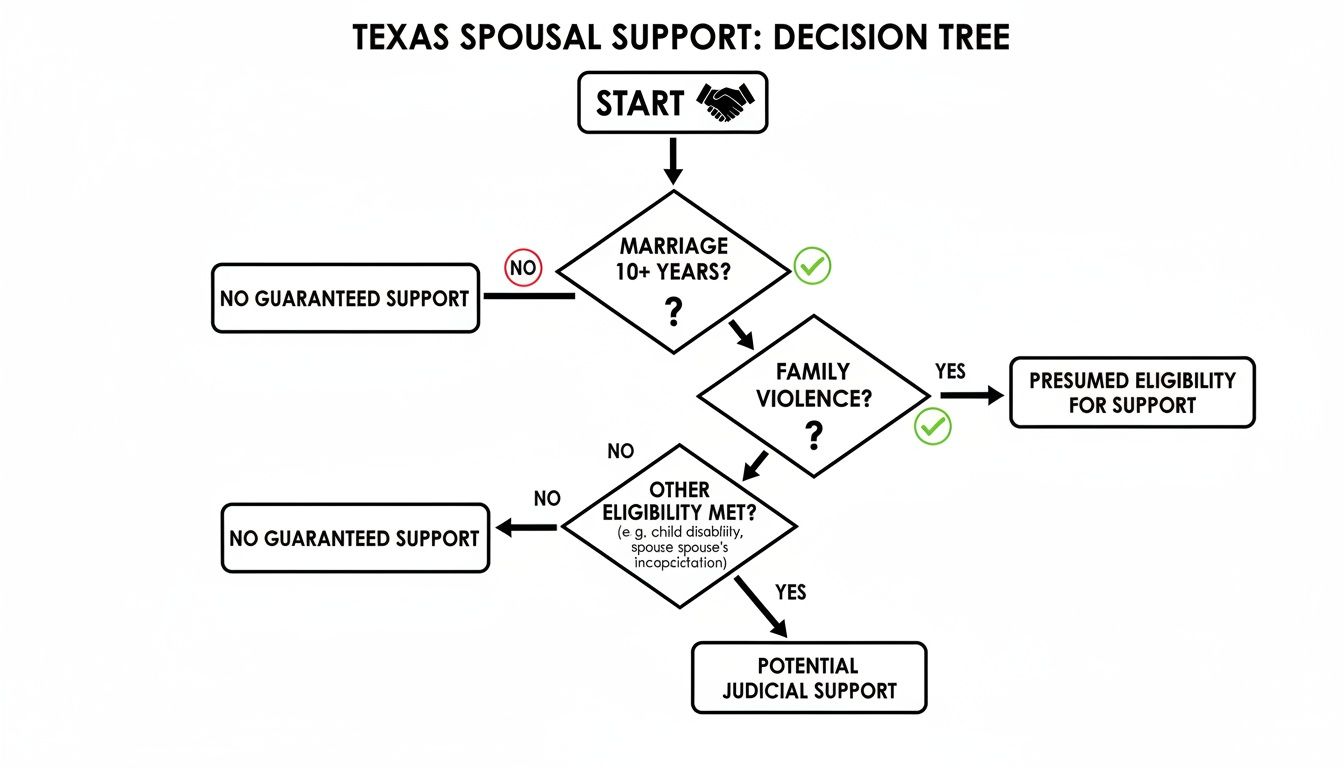
As you can see, the path is narrow. It’s designed to be a limited safety net, not a long-term lifestyle subsidy.
The First Hurdle: Defining “Minimum Reasonable Needs”
What exactly are “minimum reasonable needs”? The law doesn’t give a hard-and-fast number. Instead, it’s a flexible concept that depends entirely on the lifestyle you and your spouse had during the marriage. It’s a very fact-specific analysis.
A judge will want to see a detailed breakdown of your monthly expenses, including things like:
- Mortgage or rent payments
- Utility bills
- Groceries and clothing
- Car payments and gas
- Health insurance premiums and medical costs
If the property you’re awarded in the divorce—say, a house with a lot of equity you could sell, or a large 401(k) you could tap into—is enough to cover these basics, a judge will almost certainly deny your request for maintenance. This is why presenting a clear, realistic budget backed by solid evidence is so important at trial.
The Second Hurdle: The Four Paths to Eligibility
Once you’ve shown you lack sufficient property, you then have to prove that at least one of the following four situations applies to you.
The 10-Year Marriage Rule
This is the route most people think of. To qualify under this pathway, you have to show two things:
- You were married for 10 years or longer.
- You genuinely cannot earn enough money to provide for your own minimum reasonable needs.
But there’s a catch. You also have to prove you’ve been trying. The court wants to see that you’ve made a diligent effort to find a job or get the skills you need to become self-sufficient while the divorce has been pending.
Family Violence
This pathway has nothing to do with how long you were married. It’s about safety and justice. You can be eligible for maintenance if:
- Your spouse was convicted of (or got deferred adjudication for) an act of family violence against you or your child.
- The violent act happened within two years of you filing for divorce, or at any point while the divorce was ongoing.
For this claim, you’ll need concrete proof, like official police reports and certified court records from the criminal case.
A critical point to understand is that spousal maintenance is far from a guaranteed outcome in Texas divorces. Strict eligibility rules under Texas Family Code § 8.052 mean awards are rare—often occurring in less than 15% of divorces from long-term marriages, even when a need is demonstrated. Discover more insights about spousal support trends in Texas.
Spousal or Child Disability
The law also provides a path for those whose ability to work is compromised by serious health issues. There are two ways this can apply:
- Your Own Incapacitating Disability: You can qualify if you have a physical or mental disability that keeps you from earning enough to support yourself. You’ll need solid medical evidence to back this up.
- Caring for a Disabled Child: You might also qualify if you’re the primary caregiver for a child of the marriage (of any age) who has a disability requiring such substantial care that it prevents you from working outside the home.
In these cases, the court acknowledges that your limited earning capacity is due to circumstances completely outside your control.
To make these pathways easier to understand, here’s a quick summary.
Spousal Maintenance Eligibility at a Glance
This table breaks down the main ways to qualify for spousal maintenance in Texas.
| Eligibility Pathway | Key Requirement | Common Scenario Example |
|---|---|---|
| Long-Term Marriage | Married for 10+ years and unable to earn sufficient income. | A stay-at-home parent in a 20-year marriage who lacks recent job skills and needs time to re-enter the workforce. |
| Family Violence | Spouse committed an act of family violence (with a conviction or deferred adjudication) within 2 years of the divorce filing. | A spouse who had to flee the marital home and file for divorce after an incident of domestic abuse. |
| Spouse's Disability | An incapacitating physical or mental disability prevents the requesting spouse from earning a living. | A spouse who can no longer work due to a chronic illness or a severe injury sustained during the marriage. |
| Child's Disability | Caring for a child of the marriage with a disability that requires substantial personal care. | A parent who must provide round-the-clock care for a special-needs child and cannot maintain outside employment. |
Remember, even if you meet one of these conditions, you still have to pass that first hurdle of proving you lack the property to meet your minimum reasonable needs.
Building Your Case and The Role of an Appeal
Proving any of this in court requires a mountain of paperwork: budgets, bank statements, tax returns, medical records, and sometimes even testimony from vocational or medical experts. If a trial judge overlooks this evidence, misinterprets the law, or makes a ruling that simply isn't supported by the facts you presented, it could be considered an abuse of discretion.
This is exactly the kind of legal error our appellate attorneys are trained to spot. An appeal isn't a do-over or a second chance to argue about your financial need. It's a focused legal argument demonstrating that the trial court failed to follow the strict, mandatory rules laid out in the Texas Family Code.
How Spousal Maintenance Payments Are Calculated
So, you've cleared the first hurdle and proven you're eligible for spousal maintenance. Now comes the part where the court decides the amount and duration of those payments, and frankly, this is where many legal battles get messy and mistakes happen. It's critical to understand that Texas law puts very strict, non-negotiable limits on what a judge can award.

This isn't just a suggestion; it’s a rigid framework designed to keep awards reasonable and tied to the paying spouse's actual ability to pay. If a court order blows past these statutory caps, that's often a clear-cut reversible error and a strong reason to file an appeal.
Understanding the Statutory Caps on Amount
Texas law draws a hard line in the sand for how much spousal maintenance can be ordered. A judge’s award cannot exceed the lesser of two amounts:
- $5,000 per month, or
- 20% of the paying spouse’s average monthly gross income.
Let's break that down with a real-world example. Say your ex-spouse's average gross income is $15,000 a month. The maximum maintenance award would be $3,000 per month (20% of $15,000), because that’s less than the $5,000 cap.
But what if their income is $30,000 per month? In that scenario, 20% would be $6,000. The court's award would then be capped at $5,000, because that's the lesser of the two figures. This formula is black and white, and if a judge gets it wrong, it’s a prime target for a reversible error on appeal. You can get more details by reading our page that answers the question, "how much is alimony in Texas."
Defining Gross Income for Calculation Purposes
The term "gross income" is a lot broader than just what's on a paycheck. To get the 20% calculation right, courts have to look at money coming in from all angles.
This almost always includes:
- Wages, salary, commissions, and tips
- Overtime pay and bonuses
- Self-employment income
- Rental income from properties
- Dividends, interest, and capital gains
- Retirement benefits and pensions
Getting this calculation right is everything. If a judge improperly includes or excludes a major source of income, it can throw off the entire award and may be an abuse of discretion—another solid ground for an appeal.
Strict Time Limits on Maintenance Duration
Just like there's a cap on the dollar amount, there's also a stopwatch on how long maintenance can be paid. The timeline is tied directly to the length of the marriage.
- For marriages lasting 10 to 20 years: Maximum of 5 years of support.
- For marriages lasting 20 to 30 years: Maximum of 7 years of support.
- For marriages lasting 30 years or more: Maximum of 10 years of support.
The court's goal is to order payments for the shortest reasonable time it takes for the receiving spouse to get on their feet financially. Any order that goes beyond these time limits without a solid legal reason is a clear mistake that can be overturned.
There are rare exceptions that allow for indefinite support, but these are reserved for exceptional cases, such as where the receiving spouse has an incapacitating disability or is the primary caregiver for a disabled child of the marriage, which requires substantial medical evidence to prove.
Knowing these numbers inside and out is essential when you're looking at a spousal support order. If you believe the judge miscalculated income, awarded an amount or duration that breaks the legal limits, or just failed to apply the law correctly, these are the kinds of specific, provable errors that build a strong appeal.
The Deciding Factors Beyond The Math
So, you’ve checked all the boxes and proven you’re eligible for spousal maintenance. But don't assume the outcome is just a math problem. While the law sets a maximum limit on the amount and duration, the final award isn't spit out by a calculator. It comes down to a judge's discretion, which is where the real story of your marriage comes into play.
This is the human element of the law. It’s also where things can go wrong—where a judge might overlook crucial facts, leading to an unfair outcome that could be grounds for an appeal. The Texas Family Code actually lists out the specific factors a judge must consider, pushing the decision beyond simple numbers and into the reality of your life.

Building a Narrative with Evidence
Getting the support you need means telling a compelling story backed by solid proof. You have to show the court why you need it and how your circumstances are directly tied to the marriage.
Here are some of the key factors a judge has to weigh:
- Each spouse's ability to provide for their own "minimum reasonable needs." This is a look at your age, health (both physical and emotional), and work history.
- The education and job skills of both spouses. The court will consider how long it might take for the requesting spouse to get the training needed to find a job and stand on their own two feet.
- The length of the marriage. A 20-year marriage where one spouse stayed home is viewed very differently from a 10-year one.
- Contributions as a homemaker. The court is required to recognize the immense value a stay-at-home parent provides, which often directly enabled the other spouse's career to flourish.
These aren't just talking points; they need to be proven with things like medical records, testimony from a vocational expert, or detailed financial statements. If a judge ignores this kind of hard evidence, it can be a serious legal error.
When Bad Acts Tip the Scales
The court is also required to look at behavior. This is where marital misconduct can have a direct and significant impact on the financial outcome of your divorce.
Under the Texas Family Code, a judge must consider evidence of fault in the breakup of the marriage. This includes acts like adultery, cruelty, or the wasteful spending of community assets—often called "fraud on the community."
For instance, if your spouse drained a joint savings account to fund an affair, a judge can factor that waste into the spousal maintenance award. This could result in a higher amount or a longer payment duration to make things right. On the flip side, if the spouse asking for support was the one who cheated, the court might award a lower amount. If you want to dive deeper, you can learn more about how property is divided and the role fault plays by reading our guide on if Texas is a community property state.
Misinterpretation as Grounds for Appeal
This phase of the trial, where the judge uses their discretion, is ripe for potential mistakes. An abuse of discretion happens when a judge makes a decision that is arbitrary or unreasonable. This could mean they completely ignored clear evidence about a spouse's debilitating health condition or refused to consider proof of financial misconduct.
An appeal isn’t about re-arguing your case. Instead, it’s about pointing out that the judge made a legal error—a decision without any basis in the law or the facts presented. If the spousal support order just doesn't line up with the evidence you brought to court on these critical factors, it may be a reversible error that our appellate attorneys can challenge.
Common Reversible Errors in Spousal Support Cases
When a judge issues a spousal support order that feels completely off the mark, it’s easy to feel like the system failed you. You presented a strong case, laid out all the facts, and yet the final decision seems to ignore everything you said. This is an incredibly frustrating spot to be in, but it’s not the end of the road. The appellate process exists for this very reason—to get a second look at a decision that might be fundamentally flawed.
It’s important to understand right away that an appeal isn't a do-over. We won't be putting on a new trial or introducing new evidence.
Instead, an appeal is a highly technical legal review of what already happened in the trial court. Our job is to comb through the trial record—including transcripts and evidence—and write a formal argument, called a "brief," that identifies a reversible error. This is a specific legal mistake the judge made that was so significant it likely led to the wrong outcome.
The "Abuse of Discretion" Standard of Review
In family law cases, trial judges have a lot of leeway, or "discretion," in making decisions, especially when it comes to spousal support. But that discretion isn't a blank check. A judge can't just make a ruling based on a gut feeling or personal bias. Their decisions have to be grounded in the law and supported by the evidence presented in court.
When a judge makes a ruling that has no real connection to the guiding legal principles or is completely unsupported by the facts, it’s called an abuse of discretion. This is the main argument we make in most spousal support appeals under the standard of review. We aren't just saying we disagree with the judge; we are proving that the judge’s decision was legally indefensible based on the record.
Misapplying the Strict Eligibility Rules
One of the clearest grounds for an appeal is when a judge gets the basic eligibility rules for spousal maintenance wrong. The Texas Family Code has a very specific two-part test, and if a court doesn't follow it to the letter, that's a major problem.
Some common reversible errors we see include:
- Skipping the "Minimum Reasonable Needs" Test: A judge might order maintenance without first determining if the requesting spouse truly lacks enough property (including their own separate property) to cover their basic living expenses. This finding is a mandatory first step.
- Overlooking Statutory Requirements: A court might award support in a marriage over 10 years but fail to consider whether the receiving spouse actually made diligent efforts to find work or get training. The law requires this, and ignoring it is an error.
- Denying Maintenance Despite Clear Grounds: On the flip side, a judge might refuse to award maintenance even when there's overwhelming evidence of family violence or a qualifying disability. This can also be an abuse of discretion.
Glaring Errors in the Math
Even if the judge correctly finds a spouse is eligible for support, they still have to follow the rigid formulas that cap how much can be awarded and for how long. Any order that goes beyond these statutory limits without a compelling, legally sound reason is a prime candidate for an appeal.
A reversible error in calculation can completely change the financial outcome of a divorce. For instance, a judge who awards maintenance for seven years after a 12-year marriage has exceeded the five-year maximum allowed by law. This is not a matter of opinion; it is a direct violation of the Texas Family Code and strong grounds for an appeal.
These kinds of calculation mistakes often pop up in a few key areas:
- Exceeding the Caps: An award for spousal maintenance cannot be more than the lesser of $5,000 per month or 20% of the paying spouse's average monthly gross income. An order for $6,000 a month, no matter how high the payer's income, is legally invalid and must be challenged.
- Miscalculating Gross Income: The 20% cap is only as accurate as the income calculation it's based on. A judge might wrongly include a veteran's non-taxable disability benefits or, conversely, fail to include consistent yearly bonuses as part of the payer's income. Either mistake can throw off the final award.
- Ignoring the Duration Limits: The law sets hard limits on how long maintenance can be paid based on how long the couple was married. Ordering support for a period longer than the statute allows is one of the most common and correctable errors we see. Our attorneys can provide more information on how courts determine the appropriate level of alimony in Texas.
Successfully challenging a spousal support order means diving deep into the trial transcript, the exhibits, and the judge's final written order. By identifying these specific types of reversible errors, we can build a powerful argument showing the appellate court that the trial court’s decision was unjust and needs to be fixed.
Answering Your Questions About Spousal Support
When you're trying to figure out your financial future after a divorce, questions about spousal support are often at the top of the list. The uncertainty can be overwhelming, so getting clear, practical answers is crucial. Let's walk through some of the most common concerns we hear from clients about spousal maintenance in Texas.
Can I Receive Spousal Support If I Committed Adultery?
The short answer is yes, but it’s a big "but." Adultery won’t automatically disqualify you from receiving spousal maintenance, but you can be sure the judge will consider it. The law requires the court to look at the fault in the breakup of the marriage when deciding the amount and duration of support.
If your spouse’s adultery or cruelty led to the divorce, that can actually strengthen your claim for maintenance. On the flip side, if you were the one at fault, the judge has the discretion to award less support, or grant it for a shorter period of time. It’s not a black-and-white issue; the specific details and context of what happened will matter a great deal.
What Happens If My Ex-Spouse Remarries?
This one is straightforward. If you're paying court-ordered spousal maintenance and your ex gets remarried, your obligation to pay stops. The Texas Family Code is very clear on this point.
The same rule applies if your ex starts living with a new romantic partner in what the law calls "cohabitation." This means more than just dating—they have to be in a permanent, marriage-like living situation. To stop payments, you can't just decide to do it on your own. You have to file a formal request with the court and prove the remarriage or cohabitation. The support obligation officially ends on the date the judge signs the order, not the day the new relationship began.
Can a Spousal Maintenance Order Be Modified?
Yes, a spousal maintenance order can be changed later on, but there’s a critical catch: it can only be modified downward. A Texas court can reduce the monthly payment, but it has no power to increase it or make it last longer than the original order.
To get a modification, the paying spouse has to prove there's been a material and substantial change in either person's circumstances. Common examples include an involuntary job loss, a debilitating illness, or maybe the receiving spouse gets a major promotion. It’s important to act fast, because any change only applies to payments due after you've filed the motion with the court.
The property you receive in the divorce is the very first thing a court will look at when considering spousal maintenance. The law is designed this way: you are expected to use your own assets, including separate property, to meet your minimum reasonable needs before asking an ex-spouse for support.
How Does Property Division Affect Spousal Support Eligibility?
The way your marital property is divided has a huge impact on whether you'll get spousal support. Think of it as the first hurdle you have to clear. If you walk away from the divorce with a large cash settlement, rental properties that generate income, or a sizable chunk of a retirement account, the court is going to see you as having the means to support yourself.
This is a big deal. You could be married for 20 years and meet every other requirement, but if you're awarded enough property in the divorce settlement, you'll likely be found ineligible for maintenance. The judge's first question is always, "Can this person meet their needs with the property they already have?" If the answer is yes, the conversation about spousal support usually stops right there.
If you believe the court made a mistake in your family law case, our appellate attorneys can help you seek a fair outcome. Contact The Law Office of Bryan Fagan today for a free consultation at https://familylawcourtappeals.com.