When a business is part of your divorce, you may feel the court handled its valuation unfairly. Determining a business's true financial worth is a critical step, and a mistake here can dramatically shift the financial outcome. If you believe the trial court made an error, the Texas appeals process offers a path to seek a just and right division of your marital property.
In a community property state like Texas, a business started or grown during the marriage must be valued correctly. This valuation is the bedrock for ensuring marital assets are divided fairly. An incorrect valuation can be considered a reversible error, providing strong grounds to appeal the court’s decision.
Why a Proper Business Valuation is Crucial for a Fair Divorce Appeal

If you are dealing with the aftermath of a divorce involving a business, the financial stakes are incredibly high. You have a right to feel that the division of your assets should be based on accurate and fair information.
In Texas, any business that was started or grew significantly during the marriage is typically treated as community property. This means its value must be calculated and divided in a "just and right" manner, just like your family home or retirement accounts. An objective business valuation is not about creating conflict; it is about establishing a fact-based assessment of the company’s real market value to ensure fairness.
Achieving a Just and Right Division on Appeal
At its core, a business valuation for divorce provides a defensible number to guide the property division. Without an accurate valuation, a judge may be forced to estimate, which can easily lead to a lopsided and unjust result. If this happened in your case, an appeal can correct that mistake.
A professional, unbiased valuation should accomplish a few key things:
- Prevent Undervaluing: It stops one spouse from downplaying a business's success to unfairly reduce the other's rightful share.
- Uncover Hidden Assets: A thorough financial review can reveal personal expenses run through the business or other attempts to conceal income.
- Create a Fair Baseline: The final valuation provides a solid, evidence-based foundation for a fair property division.
A flawed or biased valuation is a devastating misstep in a divorce. If the trial court based its property division on an inaccurate assessment, that mistake could be considered a reversible error—a legal term for a mistake so significant that it likely caused an incorrect judgment and provides strong grounds for an appeal.
Valuations in High-Stakes and High-Net-Worth Appeals
In high-net-worth divorces, complex financial structures make an expert valuation absolutely essential. These situations demand deep analysis of company-specific risks, long-term financial performance, and discretionary spending to paint an accurate picture of the business’s true earnings. If the trial court failed to consider these factors, an appeal can seek to restore balance.
To provide clarity, here is an overview of essential elements that a valuation expert should consider.
Key Valuation Factors Your Appeal Will Scrutinize
| Factor | Why It Matters in a Texas Divorce Appeal |
|---|---|
| Historical Earnings | Past performance is a key indicator of future profitability and helps establish a baseline for the company's value. |
| Cash Flow | This shows the actual cash the business generates, which is often a more realistic measure of value than profit on paper. |
| Hard Assets | The value of physical property like real estate, equipment, and inventory must be accurately assessed. |
| Goodwill | The intangible value of a business's reputation can be significant and must be correctly classified under Texas law. |
| Market Conditions | The economic climate and industry trends directly impact what a buyer would pay, and an outdated analysis is a common error. |
| Company-Specific Risks | Factors like dependency on a key person (the owner-spouse) can adjust the final valuation. |
These factors help an expert arrive at a valuation that can stand up to scrutiny. Getting the valuation right is fundamental to the Texas standard of a "just and right" property division. An error here has lasting financial repercussions. Understanding the principles of community property in Texas is the first step toward protecting what you’ve built, and an appeal is the tool to correct an unjust outcome.
How Experts Determine a Business's True Worth
Figuring out a business's fair market value can seem complex, but financial experts rely on three established methods. Each provides a different perspective to arrive at a defensible number that can hold up in court. An appeals court will review the trial record to see if the chosen method was appropriate and correctly applied.
If a trial judge approves a divorce decree based on a flawed valuation, it may be considered an “abuse of discretion.” This is a legal term meaning the judge's decision was so arbitrary or unreasonable that it requires correction through an appeal.
Let's break down the three primary methods a valuation expert uses.
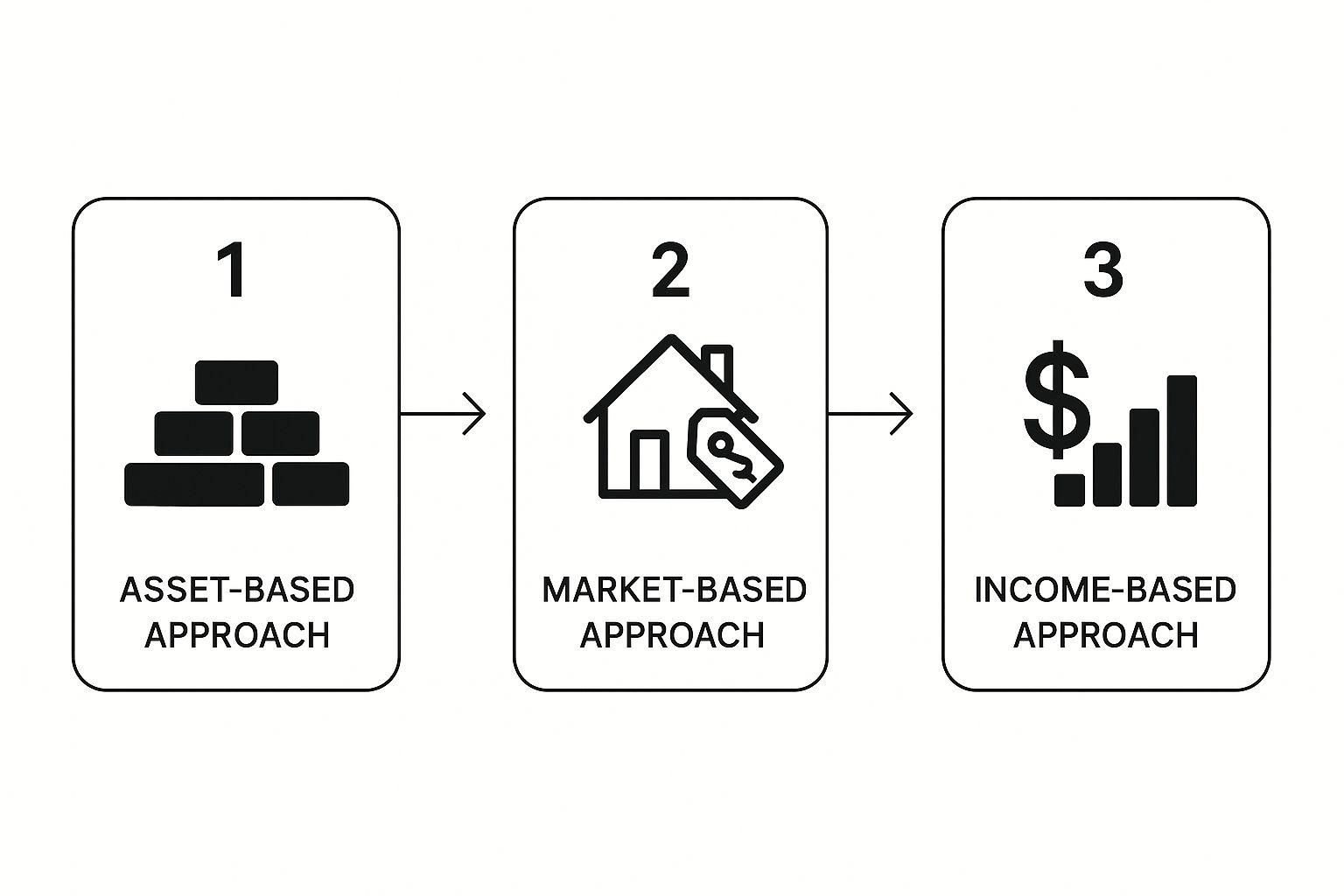
Each of these methods offers a unique vantage point. Understanding how they work is the first step in identifying whether a valuation error occurred in your case.
The Asset-Based Approach
The most straightforward method is the Asset-Based Approach. The expert adds up everything the business owns (assets like cash, equipment, and real estate) and subtracts everything it owes (liabilities like loans and debts).
The remainder is the net asset value. This nuts-and-bolts calculation is most useful for businesses with significant physical assets, such as a construction company or manufacturing plant. It is often inappropriate for service-based businesses where value lies in reputation and earning potential.
The Market-Based Approach
The Market-Based Approach determines what your business is worth by comparing it to similar companies that have recently sold. The expert looks for sales of businesses in the same industry, of a similar size, and in the same geographic region.
When reliable data on comparable sales is available, this method can be very persuasive. However, if the expert uses poor "comps," the resulting valuation can be highly inaccurate and challenged on appeal.
The Income-Based Approach
Finally, the Income-Based Approach is often used for profitable, service-oriented businesses. This method focuses on the company’s ability to generate income in the future. The expert projects future cash flows and then calculates their present-day value.
For most operating businesses, from a medical practice to a consulting firm, its earning power is where the real value lies. This method is often the most relevant, but it relies on sound financial projections.
A critical part of a defensible valuation is choosing the right method. A trial court that accepts a valuation based on an inappropriate approach—for example, using an asset-based method for a thriving law firm whose main value is its client base—may have committed a reversible error. This is a mistake so significant it likely led to an unfair outcome, and it is precisely the kind of issue that can be corrected on appeal.
If you believe the court relied on a flawed analysis of your business's worth, the path to a fair result begins with a strategic review of the valuation report. This scrutiny is a critical piece of building a strong appeal for your divorce and property division.
Understanding the Business Valuation Process for an Appeal

When a business is part of a divorce, its valuation should be a structured, methodical investigation aimed at finding a clear and defensible number. If the process at your trial was flawed, it may have led to an unfair result.
An appellate attorney will examine the trial record to see how the valuation was conducted. If corners were cut or crucial steps were missed, it can provide strong grounds for an appeal. A fair outcome always starts with a fair process.
Step 1: The Role of the Valuation Expert
The most important step in the valuation process is selecting the right expert. This should be a neutral forensic accountant or a credentialed business appraiser with experience in Texas family law. They must understand the nuances of community property and know the legal standards inside and out. An appellate court will give more weight to the testimony of a qualified expert.
Parties may agree to hire a single joint expert or each hire their own. In an appeal, your attorney will review the expert’s qualifications and testimony from the trial record to identify any weaknesses or errors.
Step 2: The Information Gathering Phase (Discovery)
Once an expert is engaged, they begin the discovery phase, requesting comprehensive financial documents to get a complete view of the business's health. This step is not just about crunching numbers; it's about understanding the story behind them.
The expert typically requests several years of records, including:
- Tax Returns: For both the business and the parties personally.
- Profit and Loss Statements: To track revenue and expenses over time.
- Balance Sheets: A snapshot of assets and liabilities.
- Bank and Loan Statements: To verify cash flow and debt.
- Shareholder Agreements: These may contain rules about ownership and value.
A common reversible error occurs when a trial court relies on a valuation where the expert was denied access to crucial financial documents. An opinion based on incomplete information is speculative and may not provide a reliable basis for a just and right division of property.
Step 3: Analysis and the Valuation Report
With all documents gathered, the expert applies the appropriate valuation methods. A key part of this is "normalizing" the financials by adjusting for one-time events or personal expenses run through the business (like a car or vacation) to determine the company's true, sustainable earning power.
This analysis is compiled into a detailed written report that outlines the methods, information, and professional opinion of the company's value. In an appeal, this report becomes a critical piece of evidence to be scrutinized for errors.
Step 4: How the Valuation Was Used in Court
The valuation report should serve as an objective foundation for dividing the marital estate. It can guide settlement negotiations or, if the case goes to trial, provide the judge with a credible basis for a decision. If you feel the judge’s final decision on property division was completely unfair, a flawed valuation process can be the very evidence you need to build a strong appeal.
The Role of a Forensic Accountant in Your Divorce Appeal

When your financial future is at stake, determining a business's true worth requires a specialist. A forensic accountant or credentialed valuation expert provides an objective, unbiased, and legally sound opinion of value that can withstand the scrutiny of a Texas court and the appellate process.
These experts are financial detectives. Their purpose is to deliver a credible valuation that prevents one spouse from undervaluing assets or hiding income to gain an unfair advantage. If this happened in your case, an appeal can help set things right.
Why Credentials and Objectivity Matter on Appeal
Not every accountant is qualified to perform a business valuation for a divorce. An appellate court will look for experts with specific credentials, like a Certified Valuation Analyst (CVA) or accreditation in business valuation. These designations signal specialized training and adherence to strict professional standards.
Their job is to dig deeper than the numbers on a tax return. They are trained to spot discrepancies and uncover the true financial story of a business.
A forensic accountant’s analysis is the bedrock of a fair property division. They identify inconsistencies, question suspicious transactions, and present a clear, evidence-based picture of a company's actual financial health. On appeal, their report and testimony are scrutinized to ensure the trial court’s decision was based on sound evidence.
The decision to hire a valuation expert is essential when a business may be sold, holds significant undervalued assets like real estate, or if there is any suspicion of hidden income. As you can discover more about when valuation is critical, businesses with complex ownership or cash flow problems demand this level of expert analysis.
Uncovering the True Financial Picture
A crucial part of a forensic accountant's job is "normalizing" a business's earnings to reveal a realistic picture of its value. This involves:
- Identifying Personal Expenses: They meticulously search for personal expenses paid by the business. These "add-backs," such as vacations or car payments, are added back to the company's income to reflect its true profitability.
- Adjusting Owner Salaries: They assess whether the owner-spouse's salary is artificially high or low and adjust it to reflect a reasonable, market-rate compensation.
- Accounting for Non-Recurring Events: They remove the financial impact of one-time events, like the sale of a major asset or a large lawsuit, that do not reflect the business's typical operations.
The expert uses these adjustments to calculate a normalized cash flow representing the business's true earning power. This number is often the foundation for the final valuation and can also impact related issues like spousal support. If the court got this calculation wrong, it may be possible to appeal both the property division and related support orders, such as by challenging unfair spousal maintenance orders on appeal.
Common Valuation Errors That Can Be Appealed
https://www.youtube.com/embed/POqkDsgUiLQ
If you received a final divorce decree and the property division feels fundamentally unfair, a flawed business valuation is often the cause. When a judge bases a decision on an incorrect valuation, it can throw the entire division of your marital estate out of balance.
Fortunately, a serious error in the business valuation for divorce can be a solid foundation for an appeal. In Texas appellate law, we look for "reversible error"—a mistake so critical that it almost certainly led to an unfair judgment. These errors often stem from the court accepting a valuation that misapplies financial principles or Texas law.
Understanding the "Abuse of Discretion" Standard of Review
A key legal concept in family law appeals is “abuse of discretion.” This is the "standard of review" an appellate court uses to examine a trial judge's decision. It doesn't mean the judge acted in bad faith. It means the court made a decision that was arbitrary, unreasonable, or without reference to guiding legal principles.
Relying on a valuation that misinterprets the law or ignores key facts is a classic example of an abuse of discretion. To win on appeal, your appellate attorney must demonstrate from the trial record that the judge’s decision was not just a judgment call you disagreed with—it was legally and factually flawed.
Common Errors an Appellate Court Can Correct
Certain valuation mistakes appear frequently in appellate cases. Identifying whether one of these errors occurred at your trial is the first step in building a strong appeal.
Common reversible errors include:
- Using the Wrong Valuation Date: Texas law requires assets to be valued on or near the date of divorce. A valuation from a year ago that ignores a recent business boom or downturn is legally incorrect.
- Applying Improper Discounts: Experts sometimes apply a "minority discount" (for owning less than 50%) or a "marketability discount" (for the difficulty of selling a private company). These discounts are often inappropriate in a divorce context as they can unfairly lower the business's value for division purposes.
- Ignoring Key Financial Data: A valuation is only as good as the information it is based on. If the expert overlooked a major new contract, a significant debt, or clear evidence of personal expenses being run through the business, their opinion is unreliable.
A major error in Texas divorce cases is the mishandling of goodwill. The law distinguishes between personal goodwill (tied to an owner's reputation and skill) and enterprise goodwill (tied to the business itself). Personal goodwill is separate property and cannot be divided. Treating it as a community asset is a significant legal error and a powerful basis for an appeal.
The Problem of "Double Dipping"
Another common mistake is “double dipping,” where the same asset is counted twice. This occurs when a business's income stream is used first to determine the value of the business for property division, and then used again to calculate spousal or child support. This unfairly penalizes the business-owning spouse, and Texas appellate courts have identified it as an error. You can learn more about how our firm approaches these cases in divorce order appeals.
If you feel the court got the valuation wrong in your case, you are not without recourse. An experienced appellate attorney can analyze the trial record, identify these types of errors, and build a persuasive argument to fight for a fair and just division.
How Market Conditions Impact Business Value and Your Appeal
A business valuation is not a timeless number; it is a snapshot taken at a specific moment. A company's value is deeply connected to the surrounding economy, its specific industry, and consumer behavior. This is why any valuation must be tied to a date on or very near the date of the divorce.
Relying on old data is one of the most significant errors a court can make. A business that was highly profitable a few years ago might be struggling today. Conversely, a disruptive new technology or change in regulations could cause a company's value to soar. These external forces directly impact a company's future earning potential, which is the foundation of its value.
Why a Current Valuation Is Crucial for a Fair Outcome
When a judge makes a property division decision based on an outdated valuation that ignores current market realities, it can constitute a reversible error. The fairness of your entire settlement depends on getting this number right.
Consider a local restaurant as an example. Its value would have fluctuated dramatically in recent years.
- Pre-Pandemic (2019): A valuation would likely have shown a thriving business with high value based on steady income.
- During the Pandemic (2020): That same restaurant, facing lockdowns and supply chain issues, would have been worth a fraction of its former value.
- Today: A current valuation would need to analyze modern factors like inflation, changing dining habits, and the strength of the local economy.
The key takeaway is that a business's past performance does not always predict its future. A valuation expert must ground their analysis in the current economic climate to produce a reliable number. A judge who accepts a valuation built on outdated or irrelevant assumptions has made a decision detached from reality, which can be challenged on appeal.
Valuing a Business After Major Economic Shifts
Valuing a business has become even more complex following major disruptions like the COVID-19 pandemic. Such events forced valuation experts to reconsider traditional approaches and adapt to new economic realities.
This has led to a greater focus on active/passive appreciation analysis. This complex tool helps determine how much of a separate property business's growth during the marriage should be treated as community property. This is a nuanced area of law, and you can read more about these evolving valuation standards to understand its complexity.
If you believe the court in your divorce used a valuation that failed to account for real-world market conditions, the property division may be fundamentally unfair. An appellate attorney can review the trial record to determine if the valuation expert—and therefore the court—properly considered these critical external factors.
Your Questions About Business Valuation Appeals Answered
When appealing a divorce that involved a business, it is natural to have questions about the process. Here are some of the most common concerns we address.
How Long Does a Business Valuation Appeal Take?
The timeline for an appeal varies. After the trial, there are strict deadlines to file a notice of appeal, typically within 30 days. From there, preparing the official trial record and writing the legal arguments (briefing) can take several months. Once the case is submitted to the appellate court, a decision can take anywhere from a few months to over a year. The complexity of the valuation issues and the court's caseload are major factors.
What Happens to the Business During an Appeal?
The trial court's order generally remains in effect during the appeal unless you take specific legal steps to pause it (known as a "supersedeas bond"). This is a complex decision with significant financial implications. The most common outcomes for a business after a divorce are:
- The Buyout: One spouse keeps the business and compensates the other for their share using other assets.
- Selling the Business: The business is sold to a third party, and the cash proceeds are divided.
- Co-Ownership: A rare option where the ex-spouses continue to run the business together.
An appeal seeks to correct the value used for the property division, which could change the terms of a buyout or the distribution of sale proceeds.
A critical note on Goodwill. This is the value of a business's reputation. Texas law distinguishes between personal goodwill (tied to a spouse's unique skill) and enterprise goodwill (tied to the business itself). Personal goodwill is separate property and is not divisible. A trial court's failure to correctly classify goodwill is a common and powerful reason for an appeal.
The Court Used an Old Valuation. Is That Grounds for Appeal?
Yes, it can be. Using an outdated valuation is a frequent reversible error. A valuation is a snapshot in time, and its accuracy depends on current market conditions and company performance. Texas courts require assets to be valued as of or near the date of divorce. Relying on an old appraisal violates this principle and prevents a "just and right" division of property, making it a strong basis for an appeal.
If you believe the court made a mistake in your family law case, our appellate attorneys can help you seek a fair outcome. Contact The Law Office of Bryan Fagan today for a free consultation.