Skip to content
Yes, you can appeal a custody decision you believe was shaped by unfair treatment, but the appeal has to target a specific legal mistake in the record, not just the feeling that the result was unfair. That matters because custody appeals are difficult to win. One study reported success for the appellant in 17.8% of second-instance custody appeals, and a related summary noted that roughly 10 to 20 appeals fail for every one that succeeds.
If you're reading this after a hard custody ruling, you may be carrying a mix of anger, disbelief, and urgency. Many parents leave court feeling the judge favored the other side, ignored key facts, cut off testimony, or treated one parent more harshly. Those reactions are real, and they often point to the right first question.
The right question isn't only, "Was this unfair?" It's, "What exactly happened in court that may qualify as reversible error under Texas appellate rules?"
Texas appeals are structured reviews. They aren't a chance to start over, bring in new witnesses, or tell the court how painful the result feels. The path forward is narrower than that, but it is still a path. If the trial court misapplied the law, abused its discretion, excluded important evidence, or denied a fair hearing, an appeal may be the right tool. If the issue stems from changed circumstances after the order, a modification may make more sense.
Feeling Your Custody Ruling Was Unfair
A common Texas custody appeal starts with a parent saying something like this: "The judge barely listened to me, let the other side say anything, and ignored what mattered for my child." That statement may reflect frustration, but it can also contain the outline of a real appellate issue.
Sometimes the complaint is bias. Sometimes it's that the court applied the best-interests analysis unevenly. Sometimes it's procedural. A judge may have limited testimony, excluded documents, or ruled on a mistaken legal theory. The emotional experience and the legal issue often overlap, but they are not the same thing.
Historically, custody rulings have often been challenged when parents believed the court relied on bias. One study found a sharp gap between how attorneys and judges perceived judicial bias. 35.6% of attorneys believed judges "always or usually" favored mothers in custody cases, while only 4.4% of judges believed that bias existed. The same study found that 78.3% of judges believed fathers received fair consideration, compared with 40.6% of attorneys. That gap helps explain why an appeal usually needs concrete legal grounds rather than a general claim of unfairness, as discussed in the Illinois State study on custody-bias perceptions.
What parents often mean by unfair
In practice, "unfair treatment" usually means one of a few things:
- The judge seemed one-sided: You felt the court gave the other parent more time, more patience, or more credibility.
- Important evidence didn't come in: Texts, school records, medical records, or witness testimony may have been excluded.
- You weren't fully heard: The court may have cut off examination or rushed the hearing.
- The legal standard felt off: The ruling may not seem tied to the child's best interests as Texas law requires.
The appellate court won't reverse a custody order because a parent felt disrespected. It may reverse if the record shows that unfair treatment turned into a legal error.
That distinction is why early case review matters. A parent may feel wronged and still have no strong appeal. Another parent may describe "unfair treatment" in ordinary language, but the transcript reveals a due-process problem or an abuse of discretion.
For families dealing with long-term decision-making issues beyond custody, including questions about supporting autistic adults legally, it's often useful to compare different legal frameworks before choosing a path. In a custody appeal, that same disciplined approach helps. Match the problem to the right remedy.
If your concern is specifically a Texas custody ruling, this overview of a child custody appeal in Texas gives a useful starting point.
Translating Unfair Treatment into Grounds for Appeal
Texas law doesn't recognize "unfair treatment" as a standalone appellate ground. The feeling has to be translated into a recognized legal complaint. That's where many cases are won or lost.
A family court appeal is not a moral review. It's a legal one. Appellate courts generally require a legally cognizable error, such as abuse of discretion or a due-process violation, and the review stays confined to the existing trial record. That's also why an appeal differs from a modification case, which is usually the right vehicle when the primary issue is changed circumstances rather than legal error in the original hearing, as explained in this discussion of appeals versus modification proceedings.
Four categories that often matter in Texas
Texas custody appeals often fit into four broad categories.
| Ground | Plain-English meaning | Example of what it might look like |
|---|---|---|
| Abuse of discretion | The judge made a decision outside the range of reasonable choices allowed by law | The court reached a custody ruling that doesn't appear supported by the admitted evidence |
| Error of law | The judge used the wrong legal rule or misread the Texas Family Code | The court applied the wrong legal standard to conservatorship or possession |
| Insufficient evidence | The record doesn't adequately support a key finding | The order rests on findings that the admitted proof doesn't support |
| Procedural error | Something in the process denied a fair hearing | A parent was prevented from presenting material evidence or testimony |
What these terms mean in real life
Abuse of discretion doesn't mean the appellate court would have decided differently. It means the trial court crossed a legal boundary. Texas trial judges have broad authority in custody cases, so this is a demanding standard. Still, broad authority isn't unlimited authority.
Error of law is usually cleaner. If the judge applied the wrong statute, used the wrong burden, or misunderstood a required legal factor, that can be appealable. Legal errors matter because appellate courts are there to correct mistakes in how law was applied.
Insufficient evidence is more nuanced in custody cases. Parents often believe the judge "ignored the evidence." Sometimes the better legal question is whether the findings have support in the record. That's not the same as asking the appellate court to believe your witnesses instead of the other side's.
Procedural error is where many unfair-treatment complaints belong. If the judge excluded key exhibits, cut off testimony in a way that harmed your presentation, or denied a meaningful chance to be heard, the issue may be procedural and constitutional, not just emotional.
Practical rule: If you can't point to a page in the clerk's record or reporter's record, the appellate court usually can't act on the complaint.
That is why lawyers often start with transcripts, admitted exhibits, objections, and the wording of the final order. A strategic appeal is built from the record outward, not from frustration inward.
For a fuller look at what Texas courts typically recognize, review these valid grounds for appeal in Texas family court.
How an Appeal Differs from Your Original Trial
The fastest way to misunderstand an appeal is to treat it like round two of trial. It isn't. A Texas court of appeals reviews what already happened. It doesn't reopen the facts just because one parent believes the judge got the story wrong.

One study reported that appellants succeeded in only 17.8% of second-instance custody appeals, and a related summary noted that roughly 10 to 20 appeals fail for every one that succeeds. That same source explains why. Appellate courts do not hear new witnesses or accept new evidence. Their job is to decide whether the trial judge made a reversible legal error based on the existing record, as described in this explanation of how legal error drives family court appeals.
Trial court versus appellate court
Here is the practical difference:
- At trial: witnesses testify, documents are offered, objections are made, and the judge weighs credibility.
- On appeal: appellate judges read the paper record, study transcripts, review briefs, and apply a standard of review.
That last phrase matters. Standard of review means the rule the appellate court uses to decide how much deference to give the trial judge.
Plain-English terms that matter
- Reversible error means a legal mistake serious enough to justify changing the outcome.
- Standard of review means the lens the appellate court uses when evaluating the complaint.
- Briefing means the written legal arguments filed by each side.
A trial judge who chooses between two believable witnesses is usually doing trial-level work. Appellate judges rarely second-guess that. But a trial judge who excludes material evidence based on a misunderstanding of the rules may create an issue an appellate court can correct.
This short video helps illustrate the difference between trial-level decision making and appellate review in family cases.
What usually doesn't work on appeal
Many disappointed parents focus on arguments that sound strong emotionally but are weak legally.
- "The judge liked the other parent more." Without a record-based legal issue, this usually goes nowhere.
- "My witnesses were more believable." Appellate courts don't typically reweigh credibility.
- "I have new proof now." New material may matter in a modification or other post-judgment remedy, but not in a standard appeal.
A more useful frame is this: what did the court do, where is it in the record, what rule did it violate, and why did it likely affect the result?
For a Texas-specific explanation of appellate review, see how appellate courts review family law cases in Texas.
Preserving Your Right to Appeal Your Custody Case
Many viable appeals die before the notice of appeal is ever filed. The reason is preservation of error.
That phrase means you usually can't complain on appeal about a problem you didn't properly raise in the trial court. Texas appellate courts generally expect the trial judge to have been given a fair chance to correct the issue when it happened.
What preservation looks like in court
Preservation often involves simple actions that carry major consequences:
- Timely objections: If the other side offers improper evidence, your lawyer usually needs to object then and there.
- Offers of proof: If the judge excludes your evidence, the record needs to show what that evidence would have been.
- Clear rulings: The transcript should reflect that the judge ruled on the objection or refused to rule.
- Post-judgment motions: In some cases, a motion for new trial or similar filing helps preserve or sharpen issues for review.
If the transcript shows silence where an objection should have been, the appellate court may treat the issue as waived. That's a hard result for parents because the unfairness may feel obvious in hindsight. Appellate courts still work from the record.
A strong appeal often begins months before the final order is signed, during the hearing itself, when counsel makes the right objection and gets it on the record.
Common preservation failures
Some of the most frequent problems are practical, not dramatic.
A parent says the judge ignored a critical document, but the document was never admitted. A party says the court cut off testimony, but no offer of proof was made. A litigant believes a due-process violation occurred, but the transcript doesn't show a clear objection or request to continue.
Public guidance commonly notes that you generally must object at the hearing to preserve an issue for appeal, and many grievances fail at that stage. Some attorneys also state that success rates on appeal can be extremely low in custody cases, which underscores how narrow the path is and how important it is to have any claimed unfairness documented in the transcript, as reflected in this attorney discussion of preservation and custody appeals.
What to gather right away
If you're considering an appeal, start collecting the material your appellate lawyer will need:
- The signed final order
- Any findings of fact and conclusions of law, if they exist
- Hearing and trial transcripts
- Key motions, exhibits, and rulings
- A timeline of what you believe went wrong
That timeline should stay factual. List dates, hearings, objections, excluded evidence, and unusual rulings. Don't worry about using legal terminology perfectly. The goal is to help counsel locate potential error in the record.
The Texas Custody Appeal Process and Timeline
Once the trial court signs an appealable custody order, the clock starts running quickly. In many states, the notice of appeal is commonly due within 30 days of the final judgment, and missing that window can forfeit appellate review altogether, as explained in this discussion of notice-of-appeal deadlines and record preparation. Texas procedure is rule-driven, and the timeline must be analyzed under the Texas Rules of Appellate Procedure and the posture of your case.
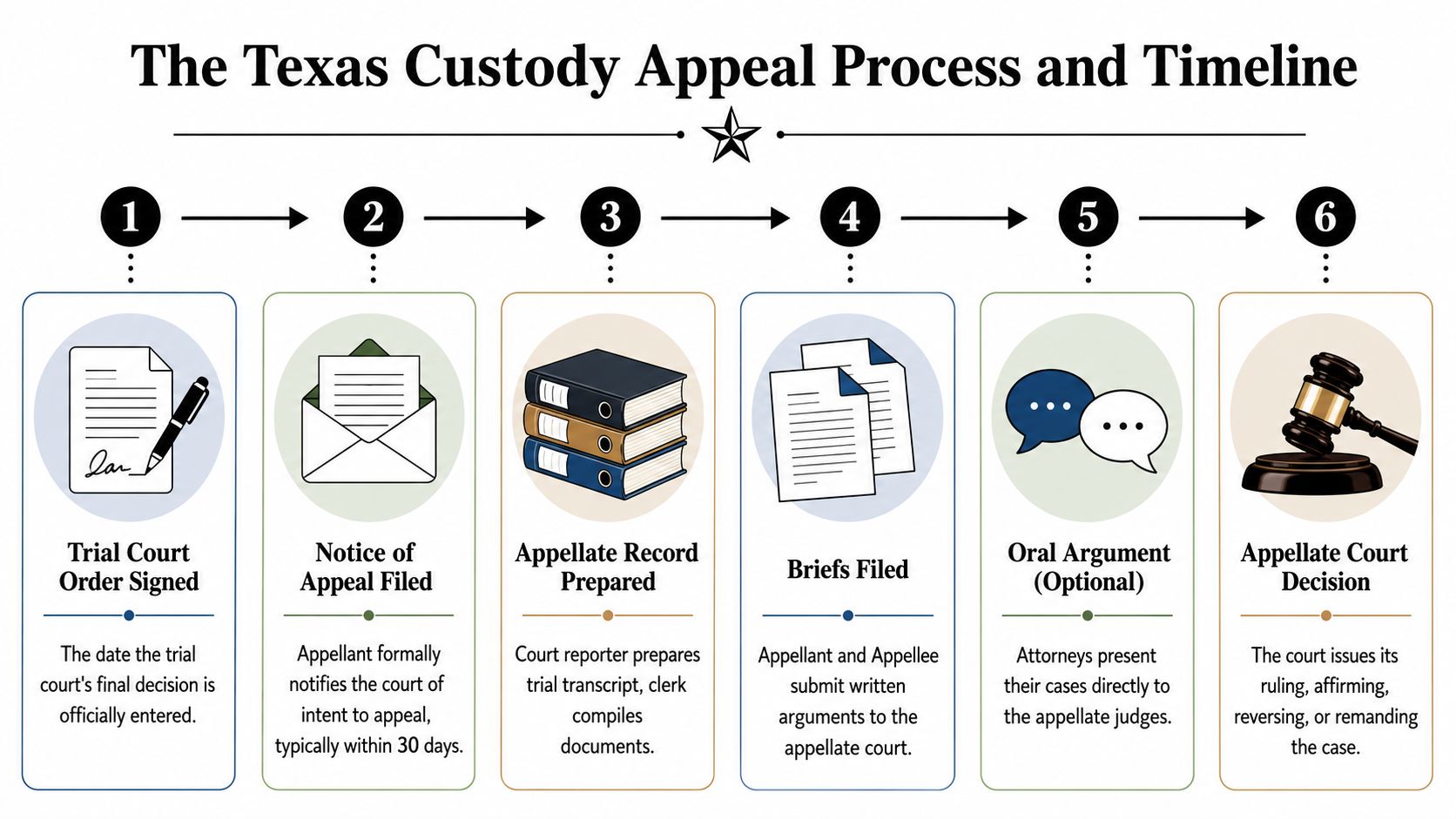
The usual sequence
Most Texas custody appeals follow a predictable path.
The final order is signed
Not every ruling can be appealed immediately. In many family cases, the right to appeal turns on whether the order is final rather than temporary.A notice of appeal is filed
This is the document that invokes appellate review. If it isn't timely, the rest of the appeal may never get off the ground.The appellate record is assembled
The clerk's record includes filed documents, orders, and pleadings. The reporter's record includes transcripts of hearings and trial testimony.The briefs are filed
Briefing is the written stage where each side explains the law, cites the record, and argues whether reversible error occurred.Oral argument may be set
Not every case gets oral argument, but when it does, the lawyers answer questions from the appellate panel.The court issues an opinion and judgment
The court may affirm, reverse, remand, or grant other relief consistent with Texas law.
Where Texas rules matter most
Texas appellate practice is technical. Deadlines can be affected by post-judgment filings. The contents of the notice matter. Requests for findings, motions for new trial, and the date of signing can all affect strategy.
The Texas Family Code also shapes what the trial court was required to consider in the first place. On appeal, your lawyer is often comparing what Texas family law required against what the record shows the trial court did.
Missing a deadline is not a small procedural problem. It can end the appeal before the court ever reaches the merits.
Appeal or another remedy
Not every unfair result should be challenged the same way. Depending on the problem, options may include:
- A direct appeal: Best when the issue is legal or procedural error in the existing record
- A motion for new trial or rehearing: Sometimes useful when the trial court should be asked to correct its own error first
- A modification case: Often the better route when circumstances changed after the order
The Law Office of Bryan Fagan, PLLC handles Texas family-law appeals and post-judgment review, including custody appeals and motions for new trial, which makes that kind of early case screening especially important.
Potential Outcomes and When to Contact an Appellate Attorney
An appeal doesn't guarantee a new custody arrangement. It produces one of a limited set of legal outcomes.
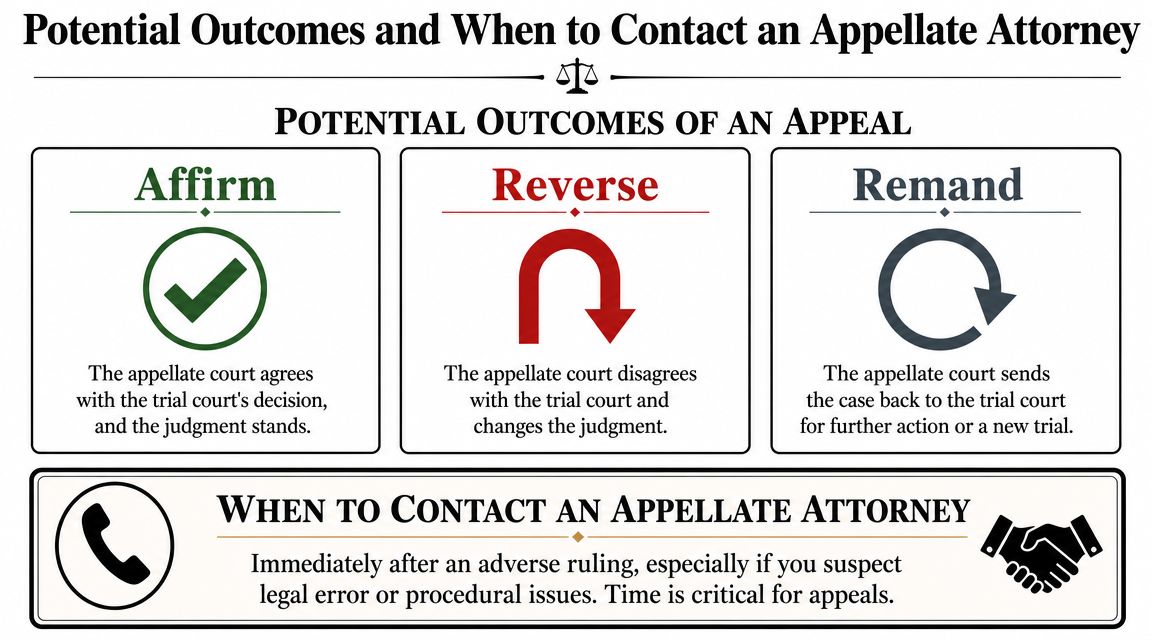
What the appellate court can do
Affirm means the trial court's order stands. The appellate court found no reversible error requiring a change.
Reverse and remand means the appellate court found error and sends the case back to the trial court for further proceedings. In custody cases, this is often the most practical form of relief because the trial court may need to conduct another hearing or reconsider issues under the correct legal standard.
Reverse and render means the appellate court changes the judgment and issues the ruling that should have been entered. That can happen, but it depends on the nature of the error and the state of the record.
When to call an appellate lawyer
Some parents wait too long because they're still trying to process what happened. That's understandable, but delay creates risk.
Call an appellate attorney quickly if any of these happened:
- The judge excluded important evidence
- You were denied a fair chance to testify or present witnesses
- The written order doesn't match what happened in court
- The judge appears to have applied the wrong legal standard
- You suspect the problem is legal error, not just a bad outcome
A good appellate consultation usually focuses on a few concrete questions. Is the order appealable? Was error preserved? What does the record show? Is appeal the right remedy, or would modification or another post-judgment step make more sense?
The strongest custody appeals are usually specific, disciplined, and record-driven. The weakest are built only on outrage.
If you're asking can you appeal a custody decision based on unfair treatment, the honest answer is yes, sometimes. But the main task is converting that unfairness into a precise legal argument that a Texas appellate court can act on.
If you believe the court made a mistake in your family law case, a careful appellate review can show whether that unfair result rises to the level of reversible error. The appellate team at The Law Office of Bryan Fagan, PLLC helps Texas clients evaluate custody rulings, identify preserved legal issues, and choose between appeal, post-judgment motions, and modification when appropriate. Contact the firm today for a free consultation.