Skip to content
A lot of people ask this question after they leave a family court hearing with the same sinking feeling: the problem wasn't just the ruling. It felt like the judge had already made up their mind.
That feeling often shows up after a custody decision, a property ruling, or a hearing on support or protective orders. You may remember the judge cutting one side off, pressing one witness harder than another, or making comments that felt personal instead of neutral. In family court, where the issues are intimate and the consequences are lasting, that experience can feel more than disappointing. It can feel very unfair.
Texas law does give you ways to challenge judicial bias. But the path is narrower than many people expect. Not every harsh comment, impatient question, or bad result proves legal bias. And even when bias is a real concern, the remedy depends on timing. Sometimes the right move is a recusal request during the case. Sometimes it is an emergency filing. Sometimes it is a standard appeal after a final order.
If you're searching for an answer to can you appeal a judge's bias in Texas family court, the short answer is yes, sometimes. The longer answer is that success depends on identifying the right procedural tool, preserving the issue correctly, and tying the judge's conduct to an unfair result that the appellate court can correct.
Introduction When You Feel the Court Was Unfair
A parent may sit through a custody trial believing the evidence matters most, only to leave convinced the judge stopped listening halfway through. A spouse may hear the court dismiss concerns, interrupt testimony, or adopt one side's version of events without serious engagement. When that happens, people often say the same thing: “I never had a fair chance.”
That reaction matters. It shouldn't be brushed aside. Family court decisions affect children, homes, finances, and the shape of daily life after the case ends. When the judge appears partial, the loss feels different from an ordinary disappointment. It feels like the process itself broke down.

Why the law treats bias claims carefully
Courts take judicial bias seriously, but they also set a high bar. Judges are allowed to make hard calls, ask questions, and rule against you. Appellate courts won't reverse a case just because the judge seemed stern or because you strongly disagree with the outcome.
What the law looks for is something more troubling. It looks for conduct that shows the judge stepped out of the neutral role and that the lack of neutrality affected the fairness of the proceeding.
Practical rule: A bias claim is strongest when the record shows both improper conduct and a real connection between that conduct and the ruling that harmed you.
Why strategy matters early
People often think of an appeal as a complete do-over. It isn't. In most family cases, the primary work starts with figuring out what happened in the courtroom, what got recorded, what objections were made, and whether another remedy should have been used before final judgment.
That's why these cases require a calm, strategic review. The question usually isn't just “Was the judge unfair?” It's also “What remedy fits this stage of the case, and what can the appellate court legally do about it?”
What Counts as Appealable Judicial Bias in Texas
The hardest part for many clients is separating an unfavorable ruling from appealable judicial bias. Those are not the same thing.
A judge can rule against you on custody, property division, child support, or credibility and still stay within the law. Bias usually requires more than tough questioning or skepticism. It points to a judge forming or expressing an improper view that goes beyond what the judge should fairly draw from the evidence presented in court.
A bad result is not enough
If the judge believed the other side's testimony, rejected your evidence, or applied a legal standard in a way you think was wrong, that may support some kinds of appellate issues. It does not automatically prove bias.
In plain English, judicial bias means the judge was not acting as a neutral decision-maker. One important constitutional principle is that bias becomes impermissible when it comes from an extrajudicial source and creates an opinion on the merits beyond what the judge learned in the case. That standard was highlighted in the May 2025 Corpus Christi Court of Appeals decision discussed in this analysis of a Texas custody reversal based on judicial bias.
The 2025 case that changed the conversation
In Matter of Marriage of B., the Corpus Christi Court of Appeals held that a party may raise judicial-bias arguments for the first time on appeal if the trial judge's conduct is so extreme that it amounts to a due-process violation. The case matters because it shows that Texas appellate courts will reverse custody-related rulings when judicial conduct crosses constitutional limits, even in a bench trial where judges normally have broad discretion to question witnesses. A useful companion discussion appears in this guide on navigating judicial misconduct appeal in Texas family court.
Not every improper courtroom moment is constitutional bias. But when the judge's conduct becomes extreme enough to deny a fair hearing, the appellate court can step in.
What usually works and what usually doesn't
A stronger bias claim often includes conduct like this:
- Statements showing a preconceived view: Comments that suggest the judge has already decided credibility or merits before hearing the full case.
- Reliance on outside thinking: Remarks that appear to come from personal views or outside information rather than courtroom evidence.
- Uneven treatment tied to rulings: A pattern where one side is cut off, disbelieved, or blocked in ways that shape the result.
A weaker bias claim usually sounds like this:
- The judge was rude: Poor judicial temperament can matter, but rudeness alone often isn't enough.
- The judge ruled against me repeatedly: Multiple adverse rulings can still be legally correct.
- The judge asked hard questions: Judges are allowed to test evidence, especially in bench trials.
How to Preserve a Bias Claim for Appeal
Bias appeals often fail for one simple reason. The party can describe what happened, but the appellate court can't see it in the official record.
Texas appeals are not new evidentiary hearings. They review the existing record for reversible legal error, abuse of discretion, or constitutional violations. Texas Law Help explains that an appeal is a request for higher-court review of a lower-court decision, and not a retrial. That is why a bias claim rises or falls on the clerk's record and reporter's record, including remarks, rulings, objections, and recusal materials, as described in Texas Law Help's explanation of appealing a judgment in Texas.
No record no review
This is the rule trial lawyers and appellate lawyers live by. If the judge's conduct is not preserved, the appellate court may have nothing usable to review.
That doesn't mean every issue must be handled the same way. Some extreme due-process violations may still be raised on appeal even without a trial objection, as discussed earlier. But as a working strategy, preservation is still the safer path.
What trial counsel should do in real time
A bias issue is usually built piece by piece. Helpful steps may include the following:
- Make a timely objection: If the judge makes a problematic comment or takes a questionable step, counsel should object clearly enough to identify the concern.
- Ask that the conduct stay on the record: If something important happens during a hearing, sidebar, or exchange, counsel should work to make sure the reporter's record captures it.
- File a recusal motion when warranted: If the concern is serious and ongoing, a recusal motion may be necessary.
- Tie the conduct to harm: The record should show how the conduct affected a ruling, limited evidence, cut off testimony, or otherwise damaged the fairness of the case.
- Protect the transcript quality: Names, exhibits, and references should be clear enough that an appellate court can follow the sequence without guessing.
For a deeper look at this issue, see this article on preserving error for appeal in Texas family court.
What people often misunderstand
Many clients think, “Everyone in the courtroom saw it, so the court of appeals will understand.” That's not how appellate review works. The appellate court reviews a written record, not collective memory.
If the transcript doesn't show the remark, the objection, the ruling, and the harm, the issue is much harder to win.
A second misunderstanding is assuming that bias alone is enough. Usually it isn't. The appellate court generally wants a clear causal chain. The judge's conduct must connect to an unfair ruling or procedural harm that probably affected the judgment.
Common reversible errors in family court
Judicial bias is one possible appellate issue, but it often appears alongside other errors. Common examples include:
| Error type | What it can look like |
|---|---|
| Excluding key evidence | The court blocks relevant testimony or exhibits in a way that affects the result |
| Applying the wrong legal standard | The judge uses an incorrect rule for custody, support, or property questions |
| Procedural unfairness | A party is denied a meaningful chance to present evidence or respond |
| Abuse of discretion | The ruling falls outside the range of reasonable decisions under the law |
Your Legal Toolkit Motion to Recuse Mandamus and Appeal
A parent walks out of a temporary-orders hearing convinced the judge has already chosen a side. That feeling matters, but the next legal step depends on timing, the record, and the kind of relief that can still make a difference.

Texas law gives you more than one tool, but these tools do different jobs. Some are designed to stop the problem during the case. Others ask a higher court to step in before final judgment. A standard appeal usually addresses harm after the final order is signed. Choosing the wrong remedy can cost time, money, and position.
Comparing Remedies for Judicial Bias
| Remedy | When to Use | What It Asks For | Legal Standard |
|---|---|---|---|
| Motion to Recuse | During the case, before the proceedings are over | Removal of the judge from the case | Whether the circumstances justify the judge stepping aside under the governing recusal rules |
| Mandamus | When immediate higher-court intervention may be necessary | An order directing the lower court to correct a clear abuse of discretion or perform a required duty | Extraordinary relief, usually requiring a clear abuse of discretion and lack of an adequate appellate remedy |
| Appeal | After a final order or judgment | Review, reversal, modification, or remand based on legal error in the record | Review under the applicable appellate standard, often including abuse of discretion, legal error, or constitutional violation |
Motion to recuse
A motion to recuse targets the judge's continued participation in the case. It is the right tool when the concern is ongoing and there is still something to protect, such as an upcoming trial, additional hearings, or major rulings that have not happened yet.
This option is often strongest when the problem shows up early and can be documented clearly. If counsel waits too long, the court may view the motion as a reaction to bad rulings rather than a genuine recusal issue. If counsel files it on a thin record, credibility can suffer. Those are real trade-offs, and they matter.
Recusal is about preventing future harm. It is not primarily a vehicle for undoing a final judgment.
Mandamus
A writ of mandamus asks an appellate court to intervene before the case ends. That is unusual relief, and courts treat it that way.
Mandamus makes sense in a narrower set of situations. The question is whether waiting for a regular appeal would leave the party without a meaningful remedy. In a bias context, that can matter if the trial court's continued action threatens immediate, hard-to-repair harm. Even then, mandamus is demanding. The legal standard is high, and the petition must show both a clear abuse of discretion and no adequate remedy by appeal.
I often tell clients to treat mandamus as a precision tool, not a pressure tactic. Used well, it can stop a serious problem. Used poorly, it can harden positions and add expense without changing the result.
Standard appeal
An appeal is usually the right vehicle after a final order when the record shows how the judge's conduct affected rulings or the outcome. This path is familiar, but it is backward-looking. The appellate court reviews what happened in the trial court. It does not retry the case or remove a judge for future proceedings unless the law and record justify that result.
Appeal is often the better fit when the bias claim is tied to identifiable rulings, excluded evidence, limits on testimony, or procedures that affected the judgment. In that setting, the job is to show more than unfair tone or frustration in the courtroom. The brief must connect the conduct to legal error and harm.
For lawyers shaping that argument, organization matters. A practical resource on structure and clarity is this discussion of HyperWhisper brief writing strategies, especially for turning a dense trial record into a focused appellate presentation.
Choosing the right tool
The practical question is not merely whether the judge seemed biased. The practical question is what remedy fits the case posture.
- Use recusal if the case is still underway and the judge's continued involvement is the immediate concern.
- Consider mandamus if waiting for final judgment would leave no meaningful way to repair the harm.
- Use appeal if a final order has been signed and the bias issue is preserved in a record that shows harmful legal error.
Firms such as The Law Office of Bryan Fagan, PLLC handle this type of post-judgment and appellate review by examining the trial record, separating frustration from appealable error, and choosing the procedure that gives the client the strongest chance of meaningful relief.
The Standard Appellate Process for a Bias Claim
Once a final family court order is signed, the clock starts quickly. In Texas family appeals, a notice of appeal generally must be filed within 30 days, but that deadline extends to 90 days if a timely post-judgment motion is filed under the Texas Rules of Appellate Procedure, as explained in this overview of appeals in Texas divorce and family cases. That same source also notes that Texas has 14 Courts of Appeals, so family-court bias claims are reviewed regionally before any possible review by the Supreme Court of Texas.
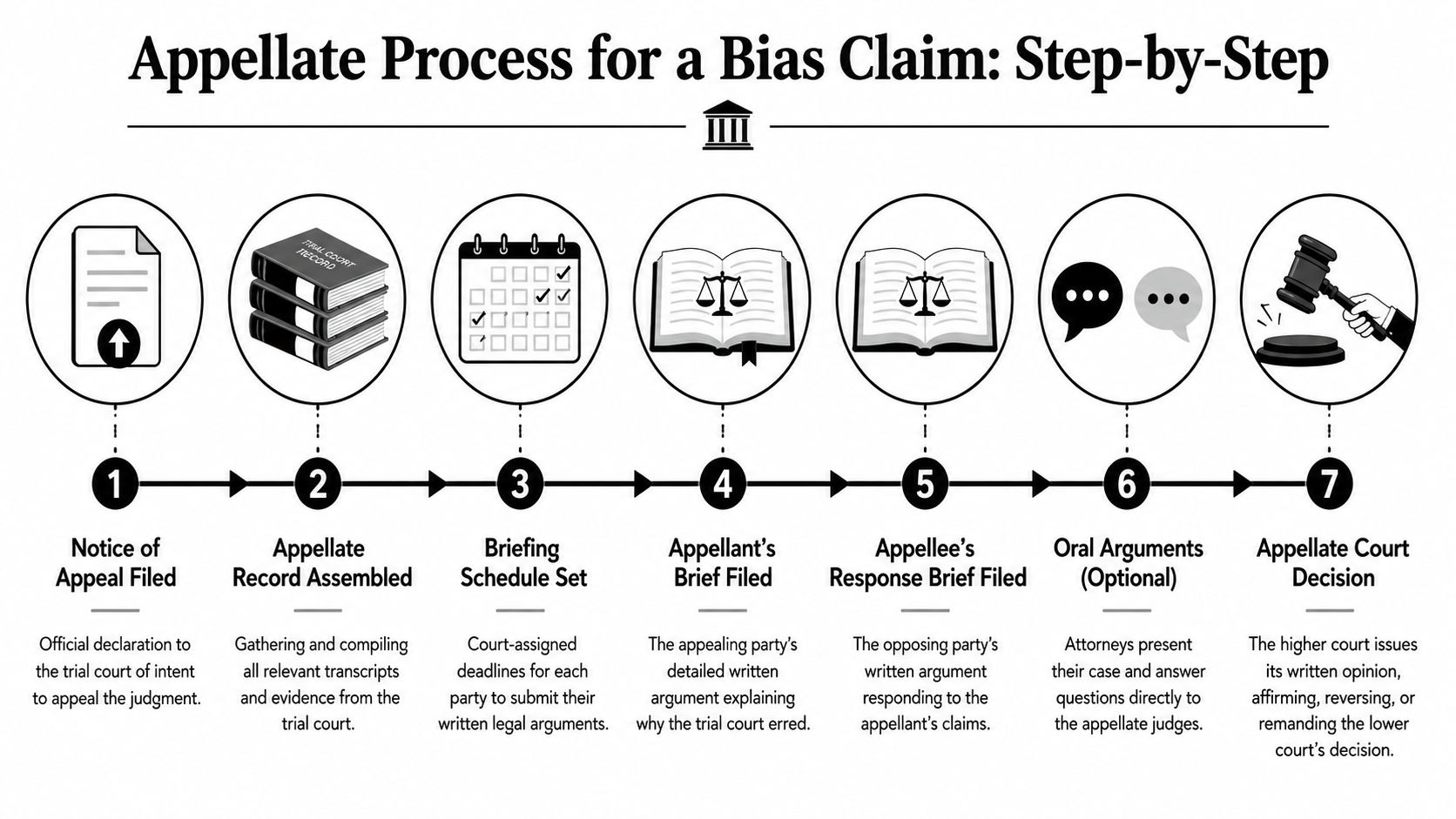
Step one through three
The early stages are procedural, but they shape the whole appeal.
Notice of appeal filed
This tells the trial court and the appellate court that the case is being appealed.Appellate record assembled
The clerk's record and reporter's record become the universe the appellate court reviews.Briefing schedule set
The court sets deadlines for the written arguments.
What briefing means
Briefing is the written legal argument submitted to the court of appeals. It is where the appellant explains what the trial court did wrong, why the error matters under the correct legal standard, and what remedy should follow.
A strong bias brief usually does three things well. It identifies the challenged conduct precisely. It connects that conduct to preserved rulings or constitutional harm. It asks for a remedy the appellate court can grant.
Important point: Appeals are not a second trial. They are a focused review of whether the trial court committed legal error that justifies appellate relief.
The standard of review
Clients often ask what abuse of discretion means. In plain English, it means the appellate court is not deciding whether it would have ruled differently. It is deciding whether the trial judge acted unreasonably, arbitrarily, or without following guiding legal principles.
Reversible error means a mistake serious enough to justify changing the result. Harmless error means a mistake may have happened, but not in a way that likely changed the judgment.
Because a bias claim often overlaps with custody, support, property, or protective-order rulings, the standard of review matters a great deal. A lawyer has to frame the issue around the type of ruling involved, not just the unfairness of the judge's conduct.
Understanding Reversible Error vs Harmless Error
Many disappointed litigants have a real complaint but not a winning appeal. The reason is often this distinction between reversible error and harmless error.
Consider a house inspection scenario. A scuff on the wall may be frustrating, but it does not make the house unsafe. A crack in the foundation is different because it affects the structure. Appellate courts look for the legal equivalent of a structural problem.

What reversible error means in practice
A reversible error is an error that probably affected the judgment or denied a fair process in a meaningful way. In a bias context, that often means the judge's conduct shaped the evidence, credibility findings, or final ruling.
Examples can include limiting one side's proof, showing partiality in a way that undercut due process, or making a ruling infected by an improper legal view.
What harmless error looks like
A harmless error may still be improper. But if the appellate court concludes the result would likely have been the same anyway, relief usually won't follow.
That is why a bias appeal must answer more than “Was this wrong?” It must also answer “Did this matter enough to change the fairness or outcome of the case?”
For a fuller discussion of how courts analyze this, see this article on reversible error in Texas family court.
Here is a helpful visual explanation of the distinction and the broader review process:
Why this matters to clients
Expectations need to stay grounded. Appellate courts are not in the business of correcting every uncomfortable courtroom exchange. They focus on whether the judgment itself can stand.
A persuasive appeal shows not just that the judge crossed a line, but that the line-crossing affected the case in a way the law recognizes as reversible.
Contact an Appellate Attorney to Evaluate Your Case
You leave court convinced the judge had already picked a side. The problem is that an appellate court will not reverse a family law order just because the hearing felt unfair. Counsel has to identify what happened, match it to the correct remedy, and decide whether the record supports action now.
That is usually the first value an appellate lawyer brings. A good review separates three different questions that clients often combine into one: Was there legally recognizable bias? Was the issue preserved? And should the next step be recusal, mandamus, a standard appeal, or no filing at all because the odds do not justify the cost?
A useful first step is to talk with a lawyer who handles appeals regularly, not just trial work. Many people start the search the same way they make other hiring decisions, by comparing reviews, reading firm materials, and learning how clients find lawyers. Use that process to prepare for the consultation, not to make the decision by marketing alone.
What to bring to a consultation
You do not need a perfect file, but a focused set of documents helps an appellate lawyer assess the case quickly:
- The signed final order and any post-judgment motions
- Hearing transcripts, reporter information, or audio details if no transcript has been ordered
- Any motion to recuse, written objections, or rulings tied to the bias issue
- A list of key dates, including the date the order was signed
- A short timeline identifying the statements, rulings, or courtroom conduct that concern you
Details matter here. A client may describe a judge as biased when the record shows a harsh but lawful evidentiary ruling. In other cases, a transcript reveals repeated comments or procedural choices that point to a stronger due process argument than the client realized.
Why timing matters
Deadlines in Texas appellate practice are strict. Wait too long, and a viable appeal can disappear. Delay can also affect other options, including emergency relief in the right case.
Early review gives you choices. It can tell you whether the claim is strong enough to pursue, whether the record needs immediate attention, and whether the practical goal is reversal, a new hearing, or damage control after a bad record has already been made.
If you want a candid assessment of whether judicial bias can be raised effectively in your case, The Law Office of Bryan Fagan, PLLC can review the order, the record, and the available remedies, then explain the trade-offs in plain terms. Contact the firm for a free consultation.