If you have received a shared custody order in Texas that feels fundamentally unfair to you and your child, you may feel that the legal system has failed you. After investing so much into your case, an unjust ruling from a trial court can be deeply disheartening. But that decision is not always the final word. The Texas appeals process is specifically designed to correct legal errors and ensure that justice is served according to the law.
When a Custody Ruling is Unfair, You Have Options for Justice
You may feel the judge overlooked crucial evidence about your child’s best interest or misapplied the Texas Family Code. This feeling is common, but it is critical to understand that your pursuit of a fair outcome does not have to end when the trial judge issues a final order.
An appeal offers a strategic path forward, but it is fundamentally different from a trial. An appeal is not a second chance to present new evidence or re-argue your case. Instead, it is a meticulous review of the trial court record to identify a specific, significant legal mistake—what is known as a "reversible error."
Understanding the Standard of Review in Custody Appeals
The purpose of an appeal in a shared custody Texas case is to ensure the law was applied correctly. The appellate court’s role is not to second-guess the trial judge’s every decision but to determine if a ruling was legally sound and supported by the evidence presented. This is accomplished through a specific legal lens called the standard of review.
In family law, the most common standard is "abuse of discretion." This means the appellate court will only overturn a decision if the trial judge acted in an arbitrary or unreasonable manner, without reference to any guiding rules and principles of law. An appeal is won not on emotion, but on powerful written arguments—known as briefing—that demonstrate precisely how and why the trial court committed a reversible error.
An appeal isn't a second trial; it's a focused review to determine if a reversible error led to an unfair outcome for you and your child. This process is about restoring balance and seeking justice through careful legal analysis.
This guide will explain what “shared custody”—legally known as Joint Managing Conservatorship—means under the Texas Family Code. We will explore how these arrangements are designed to function and, most importantly, how a skilled appeal can challenge a flawed custody ruling. Understanding your rights and the appellate process is the first step toward restoring fairness and securing your family's future. It all comes down to ensuring the "best interest of the child" standard was truly and properly applied.
What is Joint Managing Conservatorship in Texas?

In Texas, the legal term for “shared custody” is Joint Managing Conservatorship. This is the standard arrangement in nearly every custody case, grounded in the state’s policy that children benefit most from the active involvement of both parents.
Think of it as a court-ordered partnership for raising your child. In a Joint Managing Conservatorship, both parents share the rights and responsibilities to make significant decisions, such as those concerning the child’s education, medical care, and religious upbringing. However, "joint" does not automatically mean a 50/50 division of time or rights. The court’s final order specifies which rights are shared, which are exclusive to one parent, and how the child's time is divided.
Primary vs. Possessory Conservator: Understanding Your Role
Even in a joint conservatorship, the court designates specific roles. One parent is typically named the primary managing conservator, who has the exclusive right to determine the child's residence (usually within a specific geographic area) and generally receives child support.
The other parent is the possessory conservator. This parent has scheduled possession of the child and is typically ordered to pay child support. While the titles differ, both parents retain fundamental rights to remain deeply involved in their child’s life. An appellate court will closely scrutinize a trial court’s decision if it fails to properly balance these roles or assigns a key right to one parent without a clear, evidence-based reason.
Texas law, specifically Family Code Section 153.002, presumes that a Joint Managing Conservatorship is in the child’s best interest unless there is credible evidence of family violence or other harm. This reflects a modern understanding of co-parenting and has led to more balanced possession schedules.
Shared Rights and Duties: The Foundation of Co-Parenting
A Joint Managing Conservatorship is defined by shared responsibility. The Texas Family Code outlines a standard set of rights and duties that both parents are expected to have unless a judge finds a specific reason to limit them.
These shared responsibilities typically include:
- The right to receive information from the other parent about the child's health, education, and welfare.
- The right to consult with the other parent before making major decisions.
- The right to access all of the child's medical, dental, psychological, and school records.
- The duty to inform the other parent of significant events in the child's life.
In the legal world, especially when preparing court documents for a custody case or an appeal, knowing what is formal writing is crucial for making a clear and persuasive argument. The precise language in your final order defines your parental authority.
A judge who strips a parent of these standard rights without putting a solid reason in the court record might be committing a reversible error. For instance, denying a parent access to their child's report cards without any evidence to justify it could be considered an "abuse of discretion" by an appellate court.
When a court order deviates sharply from the standard Texas model without a clear, compelling justification, it is a red flag for a potential appeal. Identifying such deviations is the first step in determining if you have a strong case for a child custody appeal. It’s not just about disagreeing with the outcome; it’s about demonstrating that the court failed to follow the legal rules designed to protect both your child and your parental rights.
How Texas Courts Establish Possession Schedules

Once a judge establishes a Joint Managing Conservatorship, the next step is creating a possession schedule—the detailed calendar that dictates when each parent has the child. To provide consistency, the Texas Family Code offers a template known as the Standard Possession Order (SPO).
However, the law has evolved to reflect the understanding that children benefit from more consistent contact with both parents. This led to the creation of the Expanded Standard Possession Order (ESPO). Understanding the difference between these two schedules is critical, because if a court applies the wrong one without a legally sound reason, it can be a significant reversible error.
The Expanded Standard Possession Order: The New Presumption
The most important development in modern shared custody in Texas is that the ESPO is now the presumed schedule for parents who live 50 miles or less apart. The law presumes this expanded schedule is in the child's best interest unless evidence proves otherwise. This change is designed to give the non-primary parent more meaningful and regular involvement in the child's daily life.
The two most significant additions in the ESPO are:
- Thursday Overnights: The non-primary parent has the child overnight every Thursday during the school year.
- Monday Morning Returns: Weekend possession, which traditionally ended Sunday evening, now extends until the parent returns the child to school on Monday morning.
These changes transform a parent's role from a weekend visitor to an active participant in daily routines. A trial judge who defaults to the older, more restrictive SPO for parents living within 50 miles—without stating on the record a valid, evidence-based reason—may have committed an abuse of discretion. This is precisely the type of legal error an appeal is designed to correct.
Standard Possession Order vs. Expanded Standard Possession Order
| Feature | Standard Possession Order (SPO) | Expanded Standard Possession Order (ESPO) |
|---|---|---|
| Weekend Possession | Typically begins Friday at 6 p.m. and ends Sunday at 6 p.m. | Begins when school is dismissed on Friday and ends when school resumes on Monday. |
| Thursday Visits | A 2-hour visit (e.g., 6 p.m. to 8 p.m.) on Thursdays during the school term. | An overnight stay every Thursday during the school term. |
| Legal Presumption | Was the old default schedule. | The new default if parents live 50 miles or less apart. |
| Parenting Time | Provides less overall time for the non-primary parent. | Significantly increases the non-primary parent's time and involvement in school routines. |
This table highlights how the ESPO turns simple visitation into more integrated parenting time.
When Can a Judge Deviate from the Standard Schedule?
While the ESPO is the legal presumption, a judge can create a custom possession schedule if there is a compelling, evidence-based reason directly related to the child’s well-being.
The law requires a judge to find that the standard order would be "unworkable or inappropriate" and not in the child’s best interest before creating a custom schedule. Simply preferring a different arrangement is not a valid legal reason.
Legitimate reasons for deviating from the standard order include:
- The child is under three years old.
- A parent has a non-traditional work schedule that makes the ESPO impractical.
- There is a proven history of family violence.
- The parents live more than 100 miles apart.
If a judge orders a custom schedule that significantly reduces your possession time without a legally sound justification documented in the trial record, that decision may be vulnerable on appeal. An appellate attorney can scrutinize the record to determine if the ruling was arbitrary rather than a decision grounded in the facts and the law.
You can learn more about these schedules in our detailed article about the Standard Possession Order in Texas. A fair possession schedule is a right protected by law.
Child Support and Shared Custody in Texas
A common misconception in Texas shared custody cases is that a 50/50 possession schedule eliminates the need for child support. This is incorrect. Under the Texas Family Code, possession schedules and child support are separate legal issues. Even with equal time, a judge will almost always order one parent to pay child support to the other based on their respective incomes.
The goal is to ensure the child benefits from both parents' financial resources. A trial court’s mistake in calculating income can result in an unfair financial burden—and create strong grounds for an appeal.
How Texas Calculates Child Support
Texas uses a formula-based approach to set child support, starting with a parent’s net monthly resources. This includes salary, commissions, rental income, and other sources of revenue, minus certain deductions like federal income taxes and the cost of the child's health insurance. The court then applies a percentage based on the number of children.
The parent designated as the "primary" conservator is typically the one who receives child support. The "possessory" conservator is the parent who pays. This remains true even in schedules approaching 50/50 possession.
The Impact of the Child Support Cap
For higher-earning parents, the statutory "cap" on net resources is a critical factor. This cap is adjusted periodically for inflation. The cap recently increased from $9,200 to $11,700 in monthly net resources, significantly altering the calculation for many families.
While the percentages remain the same—20% for one child, 25% for two, and so on—the maximum presumptive award has increased substantially. For one child, the maximum guideline support is now $2,340 per month. You can learn more about how these adjustments affect DFW parents and the new child support cap in Texas.
An error in calculating your income is now more costly than ever. If a judge miscalculates your earnings or misapplies the cap, the resulting child support order is not just unfair—it is legally flawed.
Challenging Child Support Orders on Appeal
A judge may deviate from the child support guidelines, but they must state their specific reasons for doing so in the final order. When a judge orders a support amount that has no basis in the evidence or fails to justify a deviation, it can be considered an abuse of discretion.
An appellate attorney will meticulously review the trial record for these types of errors, including:
- Incorrectly calculating a parent's net resources.
- Failing to properly apply the statutory child support cap.
- Deviating from the guidelines without providing a legally sound reason.
- Ignoring evidence of a child's proven needs that would justify support above the cap.
A financial error can be just as damaging as an improper possession schedule. If you believe the court miscalculated your child support obligation, it is essential to have an experienced appellate lawyer review your case for a reversible error.
Common Reversible Errors in Texas Custody Cases
Receiving a final custody order that you believe is unjust can feel like the end of the road. However, an appeal is not about disagreeing with the judge’s decision; it is a targeted legal challenge to prove a specific, harmful mistake was made during your trial. Identifying that mistake—a reversible error—is the first step toward a just outcome.
An appeal is not a new trial. You cannot introduce new evidence or make arguments you failed to raise at trial. Instead, the appellate court reviews the official trial record to determine if the judge followed the rules of law and procedure. The role of an appellate attorney is to pinpoint where a legal error occurred and demonstrate to the higher court how that error led to an improper judgment.
Plain-English Definition: What is "Abuse of Discretion"?
Texas family court judges have broad latitude—known as judicial discretion—to make decisions they believe are in a child’s best interest. However, this power is not absolute. A judge commits an abuse of discretion when they make a ruling that is arbitrary, unreasonable, or without reference to any guiding legal principles. It is a decision that is not just a tough call, but one that is legally indefensible based on the evidence and the law.
Examples of Reversible Errors in Shared Custody Cases
To succeed on appeal, we must identify a specific error documented in the trial record. These mistakes often fall into common categories, any of which can have a profound impact on your family.
Here are examples of a reversible error in a shared custody Texas case:
- Misapplication of the Law: A judge orders a restrictive Standard Possession Order for parents who live 20 miles apart without explaining why they ignored the legal presumption that an Expanded Standard Possession Order is in the child's best interest. This is a failure to follow the Texas Family Code.
- Improper Admission of Evidence: The court allows a damaging, unverified rumor to be presented as fact, despite a proper legal objection. If the judge then relies on that improper evidence to make a key custody decision, the ruling is tainted by reversible error.
- Exclusion of Critical Evidence: The judge refuses to consider testimony from a teacher and a child’s therapist about one parent's consistent, positive involvement versus the other's instability. If the final order ignores this crucial evidence without explanation, it may constitute an abuse of discretion.
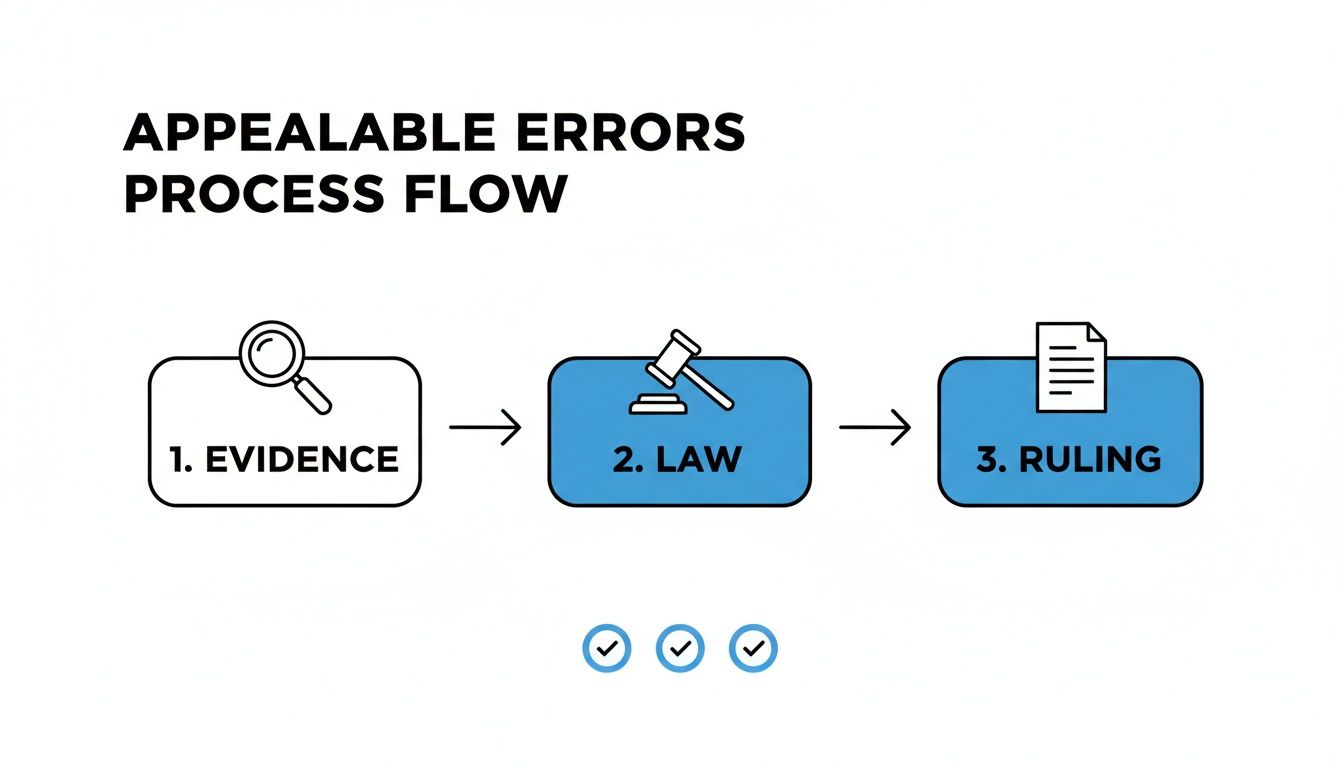
The strongest appellate arguments show that the trial judge’s decision wasn’t just a judgment call you disagree with, but a clear departure from established Texas law. Our entire focus is on proving the mistake was so significant that it almost certainly led to an improper outcome.
Rulings Made Without Sufficient Evidence
Another powerful basis for an appeal occurs when a judge makes a finding with no factual support in the record. Every significant decision a court makes—from restricting a parent's rights to creating a non-standard possession schedule—must be based on facts presented at trial.
For instance, if a judge drastically limits your time with your child and states only that it is in the "child's best interest," that is not sufficient. If there is no testimony or evidence in the record to show that your possession would endanger the child, the decision is conclusory and lacks evidentiary support. You can learn more about what constitutes valid grounds by exploring the grounds for an appeal in civil cases. An appellate court can determine if the judge’s decision was based on evidence or a mere hunch. If it is the latter, it is a clear abuse of discretion.
A Step-by-Step Guide to the Texas Appeals Process
If you are convinced the trial court made a reversible error in your shared custody Texas order, the idea of an appeal can seem overwhelming. However, the process is structured and methodical. Understanding the steps can demystify the process and restore a sense of control.
It begins with a critical, time-sensitive action: filing a Notice of Appeal. This document must be filed with the trial court, typically within 30 days of the judge signing the final order. This deadline is strict and unforgiving. Missing it could mean forfeiting your right to challenge the ruling, which is why immediate action is essential.
Step 1: Preparing the Appellate Record
Once the appeal is initiated, the next step is to prepare the appellate record. This is the official compilation of everything that happened at the trial court, including every document filed and every word of testimony. It is the only information the appellate judges will review to decide your case.
The record consists of two parts:
- The Clerk’s Record: This contains all official documents filed in your case, from the initial petition to the final judgment.
- The Reporter’s Record: This is the word-for-word transcript of all court proceedings, capturing testimony, arguments, and the judge’s statements.
Our appellate team conducts a deep analysis of this record to identify the specific legal errors that form the basis of your appeal. This detailed review is the foundation of a successful appellate strategy.
Step 2: The Briefing Stage
After the record is complete, the core of the appeal begins: briefing. The appellate brief is a persuasive legal argument written for the panel of appellate judges. In it, we present the facts of the case, pinpoint the trial judge's errors, and support our arguments with relevant statutes and case law. This is where we demonstrate exactly why the trial court's decision was a reversible error that requires correction.
The brief must be logical, precise, and legally sound. Our attorneys leverage their in-depth knowledge of the Texas Rules of Appellate Procedure and the Texas Family Code to build a compelling case. To learn more about this critical document, see our guide on how to write a compelling Statement of Facts for your appeal.
The appellate brief is our opportunity to present your case through the lens of the law. We do not re-litigate the emotional aspects of the trial. Instead, we construct a logical, evidence-based argument that proves a legal mistake was made and that justice requires a different outcome.
Frequently Asked Questions About Custody Appeals
It is natural to have questions and feel overwhelmed after receiving an unfair custody order. Understanding the basics of the appellate process can provide clarity and a sense of direction. Here are plain-English answers to common questions we receive from parents considering an appeal of a shared custody Texas order.
How Long Do I Have to Appeal a Custody Order?
This is the most critical question. The deadline to appeal is extremely strict. In most Texas family law cases, you have only 30 days from the date the judge signed the final order to file a Notice of Appeal. While certain post-trial motions can extend this deadline to 90 days, you should not rely on an extension. Missing this initial deadline will likely result in the permanent loss of your right to appeal. It is imperative that you consult an appellate attorney immediately after receiving an unfavorable ruling.
Can I Introduce New Evidence During My Appeal?
No. This is a common misunderstanding. An appeal is not a second trial. The appellate court’s role is to review what has already occurred in the trial court. They will only consider the evidence, testimony, and documents that were part of the “appellate record.” As appellate attorneys, our job is not to present new facts but to prove that the trial judge committed a serious legal error based on the information that was before them at the time of the decision.
An "abuse of discretion" is a key concept here. It means the judge made a decision that was arbitrary, unreasonable, or flew in the face of established law. To win your appeal, we have to show the decision wasn't just a bad one—it was legally indefensible given the facts and the law.
What Happens if I Win My Custody Appeal?
Winning an appeal does not automatically mean you get the outcome you want. The appellate court has two primary remedies to correct the trial court's error:
- Reverse and Render: This is the most direct resolution. The appellate court rules that the trial judge was wrong and issues the correct judgment itself. The case is then resolved.
- Reverse and Remand: This is more common. The appellate court identifies the legal error, reverses the decision, and sends the case back (remands) to the original trial court for a new hearing or trial with specific instructions on how to apply the law correctly.
A successful appeal, whether through a rendered judgment or a second chance at a fair trial, restores balance and ensures the law is followed.
If you believe the court made a mistake in your family law case, our appellate attorneys can help you seek a fair outcome. Contact The Law Office of Bryan Fagan today for a free consultation.