Skip to content
Yes, you can try to stop a house sale during a Texas divorce appeal, but only by obtaining a stay or supersedeas under Texas Rule 24 and Family Code section 6.709 before closing. Filing the appeal alone doesn't pause enforcement.
You may feel your case was handled unfairly, and now the home awarded for sale is already listed, under contract, or moving toward a closing date. You may also be weighing whether the property division was legally wrong while worrying that the sale will happen before an appellate court can review the record.
The immediate priority is protecting the property before the transaction becomes difficult to undo. Texas law provides tools for that purpose, but they require prompt, technically correct action. An appeal reviews the trial court's legal work and the record from the case. It isn't a new trial where you can present the evidence again.
When a Texas Divorce Order Puts Your House on the Market During Appeal
Suppose a divorce decree orders the marital home sold and directs the parties to divide the net proceeds. You believe the judge valued an asset improperly, ignored important evidence, or divided the marital estate in a way that wasn't just and right. You file, or prepare to file, an appeal. Meanwhile, the other party contacts a real estate agent and proceeds toward closing.
That situation creates two separate legal problems. The first is whether the decree contains a reversible error, meaning an error that affected the judgment and can support relief on appeal. The second is whether enforcement of the decree should be suspended while the appeal proceeds. A valid appellate issue doesn't automatically answer the enforcement question.
Practical rule: Treat the appeal and the request to stop the sale as separate matters that must be handled at the same time.
A property-division appeal generally receives review under the abuse-of-discretion standard. In plain English, the appellate court asks whether the trial court acted without reference to guiding legal rules or principles, or whether the result was so unjust and unfair that it amounted to an abuse of discretion. Texas Family Code section 7.001 requires the court to divide the community estate in a manner it considers just and right, with due regard for the rights of the spouses and any children. Texas appellate authority explains the abuse-of-discretion standard for property divisions.
That review differs from a trial. The appellate court works from the clerk's record, reporter's record, written orders, admitted exhibits, and properly presented arguments. Briefing is the written legal argument that identifies the error, cites the record, explains the governing law, and asks for a specific remedy.
The critical timing issue is practical. Before closing, a court can potentially preserve the status quo through emergency relief, a supersedeas arrangement, or an agreed pause. After a third-party buyer receives the property, undoing the transaction may be far more difficult.
The two-track strategy
You should usually evaluate both tracks immediately:
- Trial-court protection: Ask the trial court for emergency relief, enforcement restrictions, or other orders that can prevent the transaction from moving forward while the stay request is considered.
- Appellate suspension: File the required motion for a stay or supersedeas and address the security required to suspend enforcement.
The exact remedy depends on the decree, the sale status, the existence of a receiver, and the legal error presented. A Texas Family Law Appeals Lawyer handles appellate representation challenging final family law orders for legal error.
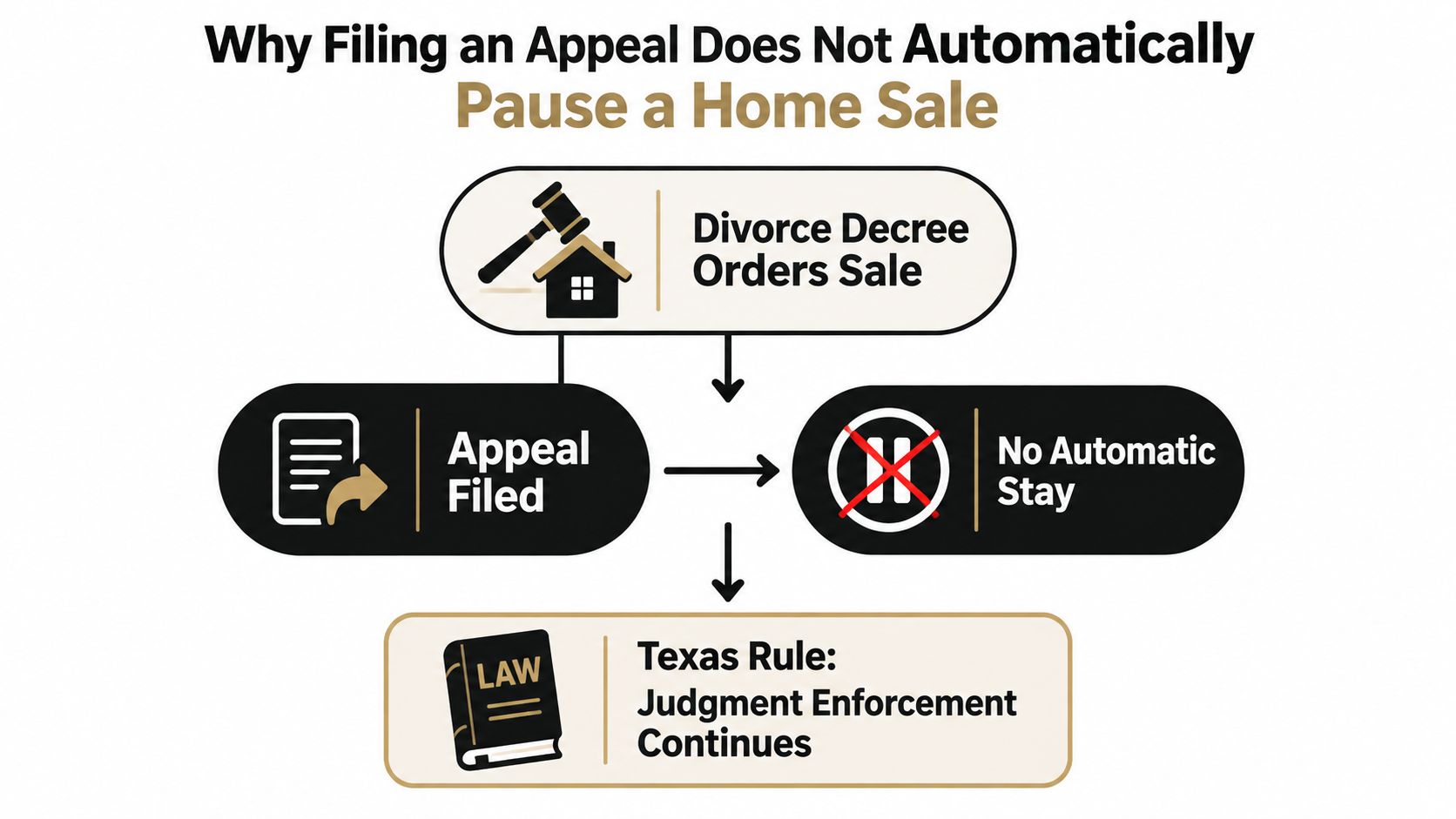
Why Filing an Appeal Does Not Automatically Pause a Home Sale
An appeal preserves your challenge to the judgment. It doesn't, by itself, prevent the trial court or the opposing party from enforcing the judgment. Texas distinguishes between perfecting an appeal and suspending enforcement.
A divorce decree ordering the marital home sold and the net proceeds divided has been treated by Texas appellate courts as a judgment for recovery of an interest in real property. That classification matters because the security analysis follows the real-property rules. Under Texas Rule of Appellate Procedure 24.2(a)(2), security for a judgment involving real property is measured by the value of the property's rent or revenue, rather than by the home's market equity alone. Texas Rule 24 provides the governing supersedeas framework.
The distinction can be easy to miss. A homeowner may assume the required bond will be calculated like a standard cash judgment. That assumption can produce an under-supported request, delay, or dispute over whether the security is adequate. The court must connect the security to the property interest and the relief being suspended.
Appeal versus stay
Family Code section 6.709 specifically authorizes suspension of all or part of an appealed property division. Rule 24 supersedeas is the separate mechanism used to suspend enforcement of the judgment. Trial courts may also issue temporary orders that remain effective during an appeal under section 6.709. These tools overlap in purpose but aren't interchangeable.
The appellate standard also doesn't automatically stop enforcement. Under Family Code section 7.001, the trial court has discretion to divide the marital estate in a just and right manner. A complaining party must show more than disagreement with the result. The record must support a legal basis for appellate relief, such as a division that was so unjust and unfair as to constitute an abuse of discretion.
Errors that may support an appeal
Common issues can include:
- Misapplication of law: The court used an incorrect legal rule when classifying, valuing, or dividing property.
- Insufficient findings: The court failed to make findings needed to explain a property division or support the judgment.
- Procedural unfairness: A party wasn't given a meaningful opportunity to present evidence or respond to a material issue.
- Failure to consider the record: The court ignored relevant evidence in a way that affected the property ruling.
- Unauthorized modification: An enforcement order changed the original property division instead of enforcing it.
These errors may support reversal or remand, but they don't operate as an automatic injunction. Texas rules also provide that perfecting an appeal from an order granting interlocutory relief doesn't suspend that order unless the order is superseded under the applicable rules. The Texas Rules of Appellate Procedure explain review of security and suspension issues.
If you need a separate explanation of the stay mechanism, review how supersedeas can stay enforcement pending appeal. The core point is simple: the appeal challenges the judgment, while the stay protects you from enforcement during review.
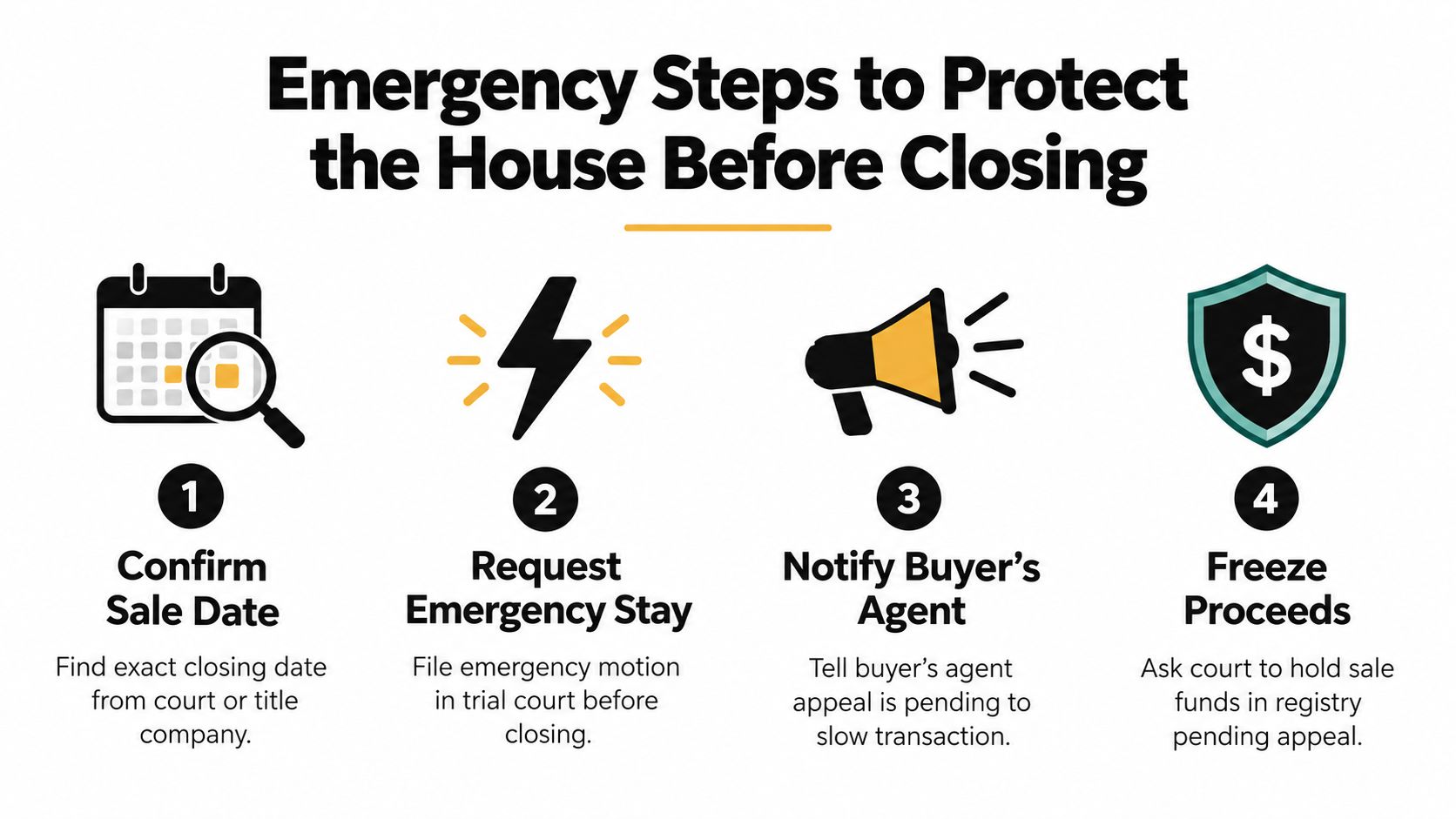
Emergency Steps to Protect the House Before Closing
If a closing date is approaching, don't wait for the full appeal to unfold. Use this same-day checklist with counsel.
Confirm the transaction status
Find out whether the property is merely listed, under contract, scheduled for closing, or being sold through a receiver. Obtain the exact closing date and identify every person controlling the transaction, including the opposing party, receiver, listing agent, title company, and closing agent.
The court order and title documents matter. A verbal statement that the sale is “on hold” isn't enough. Ask for written confirmation and preserve every email, text, notice, and court filing.
Send written notice
Notify the opposing party and relevant transaction professionals that the property division is being appealed and that emergency relief is being sought. Don't threaten, harass, or attempt to cancel the transaction yourself. The purpose is to create a clear record and alert participants that a court may issue an order affecting the closing.
This notice doesn't replace a stay. A buyer, agent, or title company may still rely on existing authority unless a court order or binding agreement changes the transaction.
Seek immediate trial-court relief
Ask counsel whether the facts support a temporary restraining order, a request to suspend enforcement, an agreed stay, or another emergency filing. The trial court may be able to address immediate enforcement activity while the appellate court considers the formal stay request.
A temporary injunction is different from a final ruling on the appeal. It preserves the situation while the court evaluates the dispute. Learn more about temporary injunctions in Texas family-law matters, including why the requested relief must be specific.
Preserve the appellate record
Don't rely on private explanations of what happened at trial. Your appellate attorney needs the signed decree, sale order, reporter's record, exhibits, findings, motions, notices, and communications showing the urgency.
Avoid self-help. Do not interfere with a receiver, change locks, contact a buyer improperly, remove property, or refuse lawful access. Those actions can create new issues and distract from the legal question that must be presented to the court.
How to Seek a Stay and Supersedeas to Halt Enforcement During Appeal
The formal stay process requires more than a notice of appeal. It requires a record-based request identifying the order to be suspended, the enforcement threat, the legal authority, and the proposed security.
Start with the appellate deadline
A notice of appeal in a Texas civil case is generally due within 30 days after the judgment is signed. That deadline can extend to 90 days when a party timely files a motion for new trial, motion to modify the judgment, motion to reinstate, or a qualifying request for findings of fact and conclusions of law. The Texas Young Lawyers Association's pro se appeals guide explains these appellate deadlines.
Some family-law matters have shorter deadlines depending on the type of order and the post-judgment posture. An accelerated appeal may also apply in particular circumstances. Review the specific deadline immediately rather than assuming the ordinary civil deadline controls.
The appellant's brief is generally due 30 days after the later of the clerk's record or reporter's record is filed. The appellee's brief is generally due 30 days after the appellant's brief is filed. Those briefing deadlines address the appeal itself. They don't give you permission to wait to seek emergency relief.
Request suspension in the correct court
The motion should identify the decree provision ordering the sale, explain why enforcement must be suspended, state the closing risk, and attach the relevant orders and record materials. Counsel should request relief from the trial court and, when necessary, from the court of appeals.
Family Code section 6.709 permits suspension of all or part of an appealed property division. A motion might ask the court to prevent the sale, restrict transfer, preserve the proceeds, or direct another specific measure. The requested order should match the actual threat. If a receiver has authority to sell, the filing must address that authority directly.
Address supersedeas security
For a real-property judgment, Texas Rule of Appellate Procedure 24.2(a)(2) measures security by the value of the property's rent or revenue. It doesn't use the home's market equity as a general cash-bond formula. The filing should explain the proposed security, provide supporting evidence, and connect the amount to the judgment and requested suspension.
The opposing party may challenge the security as insufficient or excessive. The appellate court can review the sufficiency or excessiveness of security, the sureties, the type of security, whether suspension should be permitted, and the trial court's exercise of discretion in setting the amount or type.
Build an emergency record
A strong stay request makes the urgency visible through admissible, organized materials. Include the closing notice, contract or receiver order when appropriate, the decree, the notice of appeal, and evidence showing why the sale could impair appellate relief.
Texas appellate courts may grant emergency stays or remand for proper findings, but those remedies aren't automatic. The request must be timely and grounded in the record. In a Texas appellate proceeding involving a divorce decree and multiple residential properties, the parties sought enforcement of a supersedeas bond filed to stay execution of the decree while the appeal was pending. The proceeding demonstrates that the mechanism is used in practice, but it also shows why adequate security and correct procedure matter. The appellate proceeding involving the divorce decree and supersedeas bond is available in the court's opinion.
This guide to supersedeas bonds in Texas family law provides a focused explanation of the security issue.
A practical sequence looks like this:
- File or confirm the notice of appeal.
- Identify the sale order and the exact enforcement activity.
- Request trial-court relief before closing.
- File the Rule 24 motion and address section 6.709.
- Propose and support the required security.
- Serve the signed order on the parties, receiver, clerk, title company, and other necessary participants.
Deadlines Costs and What Happens If the House Sells Anyway
The cost of delaying a sale usually centers on security, professional fees, and the financial consequences of keeping the property in place. The precise amount depends on the property's rent or revenue value, the order being suspended, the form of security, and the court's ruling. Don't assume a bond will be based on equity alone.
The bigger risk is delay. Missing the deadline, filing in the wrong court, submitting an unsupported motion, or proposing inadequate security can allow enforcement to continue. Texas appellate courts can review whether security is sufficient or excessive, but that review still requires a proper request and a usable record.
The mootness problem
If a receiver sells the home to a third-party buyer, an appeal challenging the authorization for that sale can become moot. Moot means the court can no longer grant meaningful relief because the event has occurred and the property has transferred. In that situation, the appellate court may be unable to undo the transaction, particularly where the buyer wasn't part of the original divorce dispute. Texas case materials discuss mootness after a receiver's authorized sale of real property.
That doesn't mean every property appeal disappears after a sale. It means the requested remedy may change, and preventing the transfer before closing is often more effective than asking an appellate court to reconstruct the transaction later.
Compare the available options
| Option | When to Use | What It Does | Key Risk If Delayed |
|---|---|---|---|
| Agreed pause | The parties and transaction participants will cooperate | Temporarily preserves the property and avoids immediate conflict | The agreement may fail, or a participant may proceed without a signed order |
| Trial-court emergency motion | Closing or enforcement is imminent | Requests immediate protection while the formal appeal remedy is pursued | The court may deny relief or require more specific findings |
| Rule 24 supersedeas | You need formal suspension of enforcement during appeal | Suspends execution when the required security and procedure are satisfied | Inadequate security or late filing can leave enforcement active |
| Section 6.709 relief | The appealed property division needs targeted suspension | Allows suspension of all or part of the property division | Overbroad or unsupported requests may not address the actual sale threat |
A property-division challenge still must satisfy the abuse-of-discretion standard. The appellate court isn't deciding whether it would have divided the estate differently. It asks whether the trial court followed guiding rules and principles and reached a division that wasn't so unjust and unfair as to constitute an abuse of discretion.
The stay protects the subject of the appeal. The brief explains why the judgment should change. You need both when a closing is approaching.
Getting the Right Appellate Help to Evaluate Your Options
An appellate family-law attorney should review the signed decree, any order requiring or authorizing the sale, the receiver appointment if one exists, the notice of appeal, the reporter's record, findings, and every written communication about closing. Title-company notices and sale documents can establish urgency that isn't apparent from the decree alone.
During a consultation, counsel should evaluate:
- Whether the record contains a reversible error rather than a disagreement with the judge's factual choices.
- Whether the property division satisfies the just-and-right requirement.
- Whether the record supports an abuse-of-discretion argument.
- Which deadlines apply to the notice of appeal and emergency motion.
- Whether a Rule 24 supersedeas request or section 6.709 relief fits the order.
- What security may be required and how to support it.
- Whether a receiver's sale creates a mootness concern.
- How the clerk's record, reporter's record, and briefing should be prepared.
The same appellate skills apply to disputes involving child custody appeals, divorce judgments, property division, and protective orders. The purpose isn't to relitigate every disagreement. It's to identify a legally significant error, preserve due process, and present a focused request for relief.
You should act before the closing date, not after the deed has transferred. Bring every relevant order and communication to counsel so the legal team can evaluate both the appeal and the immediate enforcement risk.
The Law Office of Bryan Fagan, PLLC offers Texas family-law appellate representation focused on reviewing trial records, preparing briefs, and seeking stays or supersedeas when a court-ordered home sale threatens to occur during an appeal. Visit The Law Office of Bryan Fagan, PLLC to schedule a free 30-minute consultation and discuss your decree, closing timeline, and available appellate options.