You may feel the court's recent ruling in your Texas family law case was fundamentally unfair. That ruling likely came in the form of a temporary injunction—a court order that dictates the rules you and the other party must live by while your case is pending. When those rules suddenly upend your life, it can feel incredibly unjust.
Feeling Trapped by an Unfair Court Order
Perhaps the injunction is severely limiting your time with your children. Maybe it has frozen your financial assets, or it's controlling your day-to-day life based on a decision that just seems wrong. We understand. The stress and confusion of navigating the Texas legal system can be overwhelming, especially when the stakes are this high. This guide is here to bring clarity and strategy to your situation.
Temporary injunctions are powerful tools. Their purpose is to keep things stable during a contentious divorce or child custody battle. But judges are human, and they can make mistakes.
Sometimes, a judge misapplies the law or issues an order that isn't supported by the evidence presented in court. In legal terms, this is called an “abuse of discretion,” and it's a specific type of reversible error that can be challenged on appeal.
Understanding Your Path Forward: How an Appeal Differs from a Trial
Just because a court got it wrong doesn't mean you're out of options. The Texas Rules of Appellate Procedure lay out a clear pathway for challenging an improper temporary injunction. It's important to understand that an appeal isn't a do-over; you don't get to present a whole new case. Instead, it’s a focused review of the trial judge's decision to find legal mistakes.
Here’s a step-by-step insight into how an appeal works:
- The Focus is on Legal Error: An appeal asks one core question: Did the judge apply the law correctly and follow legal precedent when granting the injunction?
- No New Evidence Allowed: The appellate court works only with the existing record from the lower court—the hearing transcripts, the exhibits, and all the evidence that was already presented.
- It's All About the Briefing: Your attorney's job is to build a powerful legal argument, submitted in a formal document called a brief, that pinpoints exactly how and why the judge committed a reversible error.
Understanding the rules that govern temporary injunctions is the crucial first step in seeking justice. Our goal is to show you that a strategic, well-argued appeal isn't just a long shot—it's a viable path to restore balance.
What Is a Temporary Injunction?
In plain English, a temporary injunction in a Texas family law case is a court order designed to maintain stability and prevent anyone from making big, potentially harmful moves while the case is ongoing.
Essentially, a temporary injunction creates a level playing field. Its main job is to stop one person from doing something that could harm a child or drain marital assets before a judge can make a final, informed decision. While these orders aren't permanent, they carry the full force of the law until the court issues a final decree.
This diagram gets to the heart of what a temporary injunction aims to accomplish.
As you can see, the court's priorities are clear: protect the people involved (especially children), preserve the property you've built together, and bring stability to a chaotic time.
Preserving Property and Protecting Children
A temporary injunction focuses on the two most contentious parts of any family law case: property and children. The court wants to ensure that by the time the final trial occurs, the situation hasn't been unfairly altered by one person's actions.
For example, a common reversible error occurs when a judge grants an injunction that unnecessarily restricts access to funds for living expenses. In Texas, a temporary injunction can stop a spouse from:
- Selling the family home or liquidating investment accounts.
- Emptying a joint bank account or running up massive new debts on shared credit.
- Changing the beneficiaries on a life insurance policy.
- Destroying financial records and other crucial documents.
When children are involved, injunctions are vital for establishing a temporary plan for where the children live and when they see the other parent. They can also put firm restrictions in place, like prohibiting a parent from removing a child from their school or moving them out of state. These orders become especially critical when tensions are high and may be related to securing an emergency custody order in Texas.
The Legal Framework in Texas
The power to issue temporary injunctions is established in the Texas Family Code and Texas Rules of Appellate Procedure. Courts recognize how crucial these orders are for providing immediate protection when a family is in crisis. This is particularly true in custody disputes, where judges base their injunction decisions on what they believe is in the best interest of the child.
At its core, a temporary injunction is about fairness. It stops one person from getting an unfair advantage by making unilateral decisions while the legal process is underway. The goal is to freeze the family's circumstances so the judge can make a fair and equitable final ruling with all the facts and assets intact.
If a judge grants an injunction that lacks a proper legal basis or goes beyond what’s needed to maintain the status quo, it could be a reversible error—which is solid ground for an appeal.
TRO vs. Temporary Injunction vs. Final Order
It’s easy to get these terms mixed up, but they represent different stages of court intervention. A Temporary Restraining Order (TRO) is the emergency first step, the temporary injunction is the more structured "pause button," and the final order is the court's final decision.
The table below breaks down the key differences:
| Feature | Temporary Restraining Order (TRO) | Temporary Injunction | Final Order / Decree |
|---|---|---|---|
| Purpose | To provide immediate, emergency protection and maintain the status quo for a very short period. | To maintain the status quo and set rules for conduct, custody, and property until the final trial. | To permanently resolve all issues in the case (e.g., divorce, custody, property division). |
| How It's Obtained | Ex parte (one side can get it without the other present) based on a sworn affidavit. No hearing required initially. | Requires a formal evidentiary hearing where both sides can present evidence and argue their case. | Obtained after a final trial or through a settlement agreement approved by the court. |
| Duration | Very short-term, typically lasts for 14 days. Can be extended once for another 14 days. | Lasts for the duration of the lawsuit, until a final order is signed by the judge. | Permanent and legally binding indefinitely, unless modified by a future court order. |
| Notice Requirement | The other party is not given notice before the TRO is issued but must be served with it afterward. | The other party must be given formal notice of the hearing and an opportunity to be heard. | Both parties fully participate in the process leading to the final order. |
Understanding these distinctions is crucial. A TRO is a quick fix to prevent immediate harm, but the temporary injunction hearing is the first real battle where a judge hears from both sides and sets the ground rules that will likely shape the rest of your case.
Understanding the Standard for an Injunction
In Texas, a judge cannot grant a temporary injunction just because someone asks for it. The law sets a clear standard, and the person requesting the order must prove three specific things. If a court misapplies this standard, it can be a significant legal mistake—a reversible error—that can be overturned on appeal.
To obtain a temporary injunction, you must present evidence to the court that satisfies all three of these requirements:
- A Valid Legal Claim: First, you must show you have a legitimate case under the Texas Family Code, like a divorce filing or a request to modify custody.
- A Probable Right to Win: Next, you need to show the judge that based on the evidence, you are likely to succeed in your case when it goes to a final trial.
- A Probable, Imminent, and Irreparable Injury: This is a critical element. You must prove you will suffer a specific type of harm if the court does not act now.
That third element is where the most confusion occurs and where trial courts often make mistakes.

Demystifying "Irreparable Injury"
In plain English, "irreparable injury" is a type of harm that cannot be fixed later with money or another court order. The damage has to be so significant that no final judgment could ever make things right again.
The core idea behind irreparable injury is that the harm is permanent and cannot be undone. If a court can fix the problem at the end of the case—for instance, by ordering one spouse to repay money they took—then the injury is usually not considered irreparable.
For example, if one spouse moves $10,000 from a joint bank account into their own private one, a judge can easily remedy this in the final property division. The court can award the other spouse an extra $10,000 worth of other assets to make up for it. Because there's a straightforward remedy, this action does not meet the high standard for irreparable injury.
When Harm Cannot Be Repaired: Examples of Reversible Error
So, what kind of harm is irreparable? A common reversible error in Texas family courts is granting an injunction based on purely financial concerns that can be corrected later. The clearest examples of true irreparable harm usually involve children.
- Parental Alienation: If one parent is actively turning a child against the other, the emotional and psychological damage to that relationship may never be fully repaired. This is a classic example of irreparable harm.
- Relocation: A parent moving a child across the country without permission creates massive disruption and can cause profound and lasting injury.
- Destruction of Unique Assets: Selling a one-of-a-kind family heirloom or the family home where children have grown up could also qualify, as their sentimental value cannot be replaced.
Successfully arguing these points requires a deep understanding of case law. To effectively meet the legal standard for an injunction, leveraging an AI legal case researcher can provide crucial insights into relevant statutes and past court decisions. Appellate reviews have found that in many cases involving financial misconduct, judges can correct the harm through asset redistribution, highlighting why purely monetary losses often fail the irreparable injury test. You can discover more insights about temporary injunctions in Dallas divorce cases on dallasdivorcelawyer.com.
If you are facing an injunction that was granted without solid proof of all three legal requirements, the judge may have committed an abuse of discretion. Our appellate attorneys are experts at analyzing the court record to determine if the trial court misapplied this critical legal test.
Why Courts Issue Injunctions in Family Law Cases
A court's primary job during a divorce or custody battle is to maintain stability and prevent impulsive decisions that could cause permanent damage.
An injunction is the court's tool for preserving the "status quo"—a legal term for keeping things as they are. This ensures that by the time you get to a final trial, the judge is looking at an accurate picture of the family's assets and circumstances.
Protecting Marital Property
One of the most common reasons a court issues an injunction is to protect the marital estate—everything you and your spouse acquired during the marriage. An injunction acts as a financial lockdown, stopping either party from draining shared resources.
An injunction can order a spouse not to:
- Sell Major Assets: This prevents one person from selling the family home, a shared vehicle, or a stock portfolio without a court order.
- Drain Bank Accounts: It can stop a spouse from clearing out a joint checking or savings account.
- Hide Money: An injunction can forbid a spouse from moving cash to a secret account to keep it out of the marital estate.
- Incur New Debt: It can prohibit someone from running up massive credit card bills or taking out new loans that would become a shared responsibility.
These rules ensure that the property to be divided is still there when it’s time to divide it.
An injunction is the court saying, “Nobody makes a major financial move until we sort this out.” It is a crucial mechanism for ensuring that the final property division is just and right.
Safeguarding Children’s Well-Being
When children are involved, the court's priority shifts to protecting their best interest. Injunctions become a critical tool for providing safety, stability, and a sense of normalcy. The goal is to shield children from the conflict and minimize disruption.
While an injunction can feel like a protective order, the legal basis is different. If your concerns involve family violence, you need to understand the process for getting a temporary ex parte protective order in Texas.
Common injunctions involving children will often prevent a parent from:
- Relocating the Child: This prohibits a parent from moving with the child out of the county or state without permission.
- Making Disparaging Remarks: The court can order both parents to stop speaking negatively about each other in front of the children.
- Disrupting Routines: An injunction can prevent one parent from changing the child's school or doctor without an agreement.
- Inappropriate Introductions: It is also common to see orders restricting a parent from having a new romantic partner stay overnight while the child is in the home.
Each of these examples ties back to the court's duty to create a predictable and emotionally healthy environment for children. If a court issues an injunction that is overly restrictive or not backed by solid evidence, it may be an abuse of discretion—and that could be a strong basis for an appeal.
Fighting an Unfair Temporary Injunction
Receiving a temporary injunction that feels wrong is not the end of the road. This is simply the point where the strategy shifts from the trial court to the court of appeals.
An appeal is a focused legal challenge targeting specific mistakes the judge may have made. As appellate attorneys, our job is to examine the trial court record—every document, exhibit, and word of testimony—to identify "reversible errors."
Understanding "Abuse of Discretion"
The most common basis for appealing a temporary injunction is arguing the judge committed an “abuse of discretion.” In plain English, this means the judge’s decision was unreasonable, arbitrary, or not based on the established legal rules that should have guided it.
An appellate court will typically find an abuse of discretion if the trial judge:
- Applied the wrong law to the facts of your case.
- Made a decision without sufficient evidence to support it.
- Ignored or misapplied the required three-part legal test for granting an injunction.
When preparing to challenge an injunction, organizing your facts is paramount. Using a tool like a Case Summary Template can help organize key events and arguments, making it easier to pinpoint where the court may have gone wrong. This structured approach is the foundation of a strong appeal.
The Interlocutory Appeal Process in Texas
The specific legal pathway for fighting a temporary injunction is called an interlocutory appeal. This is a special, fast-tracked appeal that allows you to challenge a major temporary order while the main case is still pending.
This is a crucial tool, as a wrongful injunction can cause significant harm long before a final trial.
An appeal of a temporary injunction is your chance to correct a legal wrong before it causes lasting damage. It provides a formal, strategic process to argue that the trial court's order was legally flawed and should be reversed.
However, the timeline is incredibly tight. Under the Texas Rules of Appellate Procedure, you generally have just 20 days from the date the judge signs the temporary injunction order to file your Notice of Appeal. Missing this deadline may result in losing your right to challenge the order.
Building Your Case for the Appellate Court
After the Notice of Appeal is filed, your appellate lawyer will begin briefing. The brief is a meticulously crafted legal argument that walks the appellate judges through the facts of the case—citing only what's in the official record—and applies relevant laws and past court decisions to show precisely how the trial judge made a mistake.
The goal is to persuade a panel of higher court judges that the trial court's abuse of discretion was significant enough to result in an improper, harmful order. To dive deeper into how this works, you can read our guide on how to appeal a family court decision in Texas.
Challenging an unfair temporary injunction demands a quick, strategic response. By focusing on legal errors and presenting a compelling case to the court of appeals, you can work to reverse the unjust order and restore fairness to your case.
When Someone Violates a Temporary Injunction
A court order is a direct command. When a judge issues a temporary injunction, it is backed by the full weight of the Texas legal system. If the other person in your case chooses to ignore it, the consequences can be serious.
The primary tool for dealing with a violation is a contempt of court action. This is the formal legal process for holding someone accountable when they knowingly defy a judge's orders.
The Motion for Enforcement Process
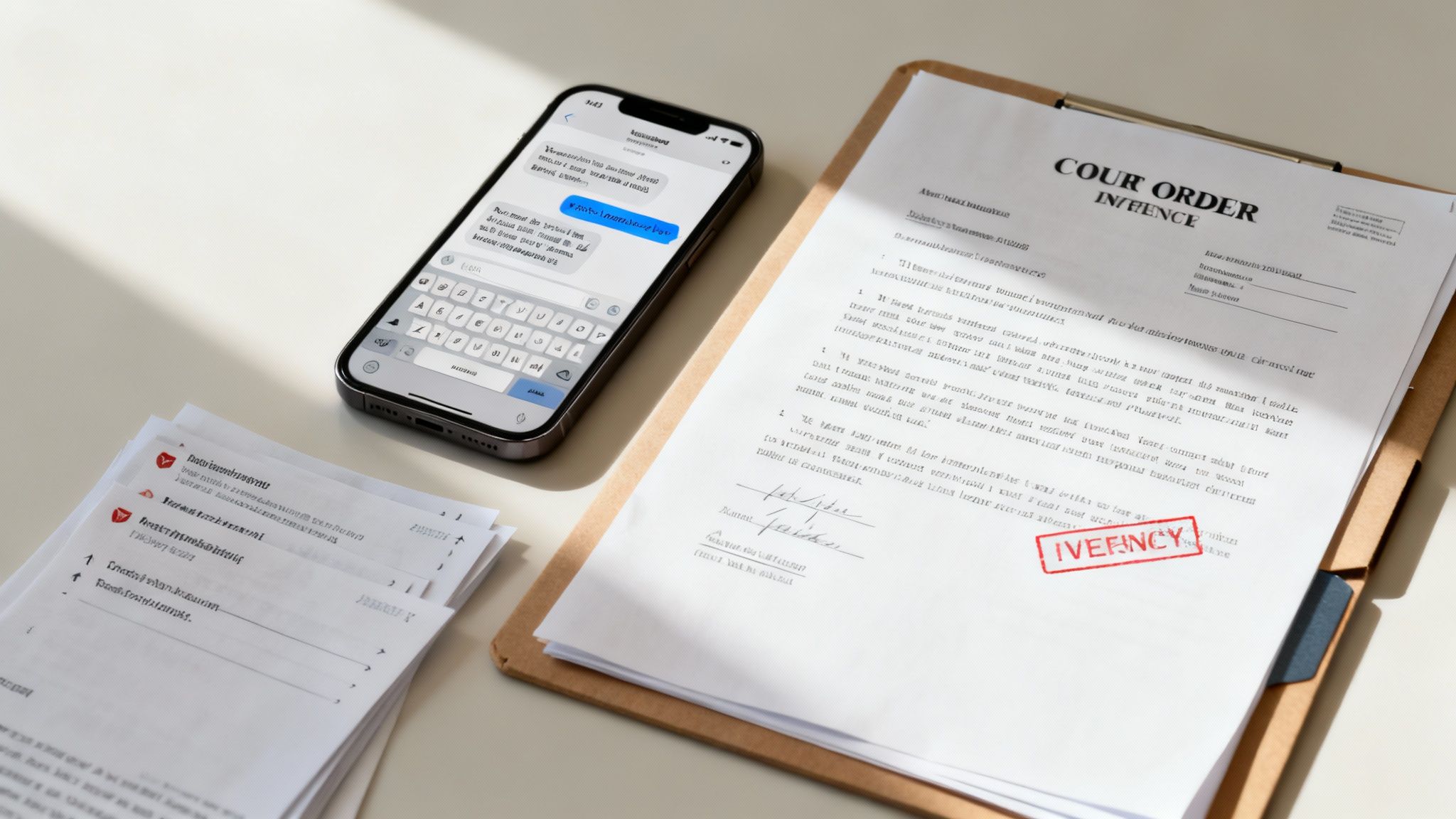
If you believe the other party has violated the injunction, you must file a Motion for Enforcement. This document details exactly how, when, and where the other person broke the rules and asks the court to intervene.
The key to a successful enforcement action is solid proof. Without it, you are in a "he said, she said" situation. Diligent documentation is your best friend.
Your evidence could include:
- Financial Records: Bank or credit card statements showing a forbidden transaction.
- Digital Communication: Text messages or emails where the other person admits to violating the injunction.
- Social Media Posts: A public post that clearly contradicts the court's order.
- Witness Testimony: Statements from friends, family, or teachers who witnessed the violation.
The Consequences of Contempt
When a judge finds someone in contempt, the penalties can be significant. The court has broad discretion to make the punishment fit the violation.
A temporary injunction is designed to maintain fairness. When one person ignores it, they are defying the court's authority. The penalties for contempt reflect that seriousness.
Potential outcomes include:
- Fines: The court can impose a substantial fine.
- Attorney's Fees: The judge can order the violator to pay your legal fees for bringing the enforcement action.
- Jail Time: For serious or repeated violations, the court has the power to order jail time.
- Make-Up Possession: In cases involving children, if you were denied court-ordered parenting time, the judge can grant you make-up visitation.
This process provides a direct path to hold the other side accountable and ensures the judge’s order is respected.
Common Questions About Temporary Injunctions
A temporary injunction can raise urgent questions. Knowing the rules, timelines, and your strategic options is crucial for protecting your rights. Here are answers to some of the most common questions we receive.
How Long Does a Temporary Injunction Last?
A temporary injunction remains in effect for the entire duration of your case, providing a stable environment until the judge makes a final decision.
Unlike a short-term Temporary Restraining Order (TRO), this injunction stays in place until the case is officially over—whether through a settlement, a final trial, or dismissal. Once a final order is signed, the temporary injunction is no longer in effect.
Can a Temporary Injunction Be Changed or Modified?
Yes, but it is difficult. To modify a temporary injunction, you must prove there has been a "material and substantial change" in circumstances since the order was signed.
This requires filing a formal motion and presenting new evidence showing why the original order is no longer fair or workable.
Key Takeaway: If your argument is that the judge made a legal error from the beginning, an appeal is the correct path. Modification is for when the facts have changed; an appeal is for when you believe a legal error was made.
Is a Bond Required for an Injunction in a Divorce?
While many civil lawsuits require the person requesting an injunction to post a bond (a security deposit), family law cases are often an exception.
Under the Texas Family Code, judges have the discretion to waive the bond requirement, and they frequently do. This recognizes that requiring a bond could prevent a financially disadvantaged spouse from seeking necessary protection.
What Is the Difference Between an Appeal and a Mandamus?
When you disagree with a temporary injunction, you have a couple of potential options.
An appeal is the standard route. You argue to a higher court that the trial judge made a significant legal mistake, such as an abuse of discretion. It is a formal process with strict deadlines.
A "writ of mandamus", on the other hand, is an extraordinary remedy. It is used when you can show the judge's order is completely void or such a clear abuse of discretion that you have no other adequate remedy, not even through a normal appeal. The standard is incredibly high, so it’s reserved for only the most severe legal errors. An experienced appellate lawyer can help you determine the correct strategic path for your case.
If you believe the court made a mistake in your family law case, our appellate attorneys can help you seek a fair outcome. Contact The Law Office of Bryan Fagan today for a free consultation.