You may feel your case was handled unfairly or that the final ruling in your Texas divorce simply doesn't feel like justice. For many, that final order feels less like a resolution and more like a profound injustice, especially when the decision ignores crucial evidence in your child custody battle or unfairly divides the assets you spent a lifetime building.
It's a difficult position to be in, but it’s critical to know this: a flawed court decision does not have to be the final word. The Texas legal system provides a path to seek a fair outcome through the appeals process.

This guide will explain the Texas appellate process in plain English, breaking down how an appeal differs from a trial, what kinds of mistakes can be challenged, and the steps to take if you believe the judge made a reversible error in your case. The end of your trial might have felt like a defeat, but the fight for a just result may not be over.
What You Can Appeal in a Texas Divorce Case
If you are staring at an outcome that feels fundamentally wrong—whether it involves property division, spousal support, or even a protective order—you are not without options. The Texas legal system has a built-in mechanism for seeking justice: the appellate process.
It's important to be clear about what an appeal is—and what it isn't. This is not a do-over or a second trial to re-argue your case. Instead, an appeal is a highly focused, strategic review meant to find and correct legal errors made by the trial court judge. Think of it as a quality control check on the judicial process itself.
Understanding the Purpose of an Appeal
An appeal isn't about convincing a higher court that they would have decided your case differently. It’s about proving that the trial court judge did not follow the law correctly.
The job of an experienced divorce appeal lawyer in Texas is to comb through the trial record and prove that a significant legal mistake occurred—a mistake so critical that it likely changed the entire outcome of your divorce. In legal terms, this is what's known as a “reversible error.”
The goal is to ensure the rules were applied fairly to you and that your case was decided based on a correct interpretation of the Texas Family Code and the Texas Rules of Appellate Procedure.
An appeal offers a path to restore balance and fairness. It holds the trial court accountable to the law, ensuring that your rights and future are not determined by a legal mistake. It is about due process, not a do-over.
If you believe a serious legal error was made in your family law case, our appellate attorneys can help you figure out the next steps. Contact The Law Office of Bryan Fagan today for a free consultation.
How a Texas Appeal Differs from a Trial
When a judge’s final order in your divorce feels fundamentally wrong, it's natural to want a do-over. You want to get back in front of a judge and re-argue your case, perhaps with more emphasis or new details.
While this is a completely understandable reaction, it’s crucial to know that a Texas appeal is not a second trial. Grasping this distinction is the first step toward building a successful appeal. An appeal is a review, not a retrial. We aren't calling new witnesses or introducing new evidence. Instead, your divorce appeal lawyer in Texas works exclusively with what’s called the appellate record—the official "game tape" from your trial, which includes every word of testimony, every document entered as evidence, and every motion filed.
Focus on Legal Error, Not Factual Disputes
The purpose of a trial is to determine the facts. Who should the children live with primarily? How much is the family business worth? A trial judge or jury listens to the evidence and makes those factual determinations.
An appeal functions on a completely different level. The appellate court is not there to second-guess the trial judge's factual conclusions. Its job is to search for significant legal mistakes. Did the trial judge apply the wrong law or misinterpret a statute? For example, if a judge incorrectly labels your separate property inheritance as community property in the final property division, that’s a clear error of law an appellate court can fix.
Understanding the Standard of Review
Appellate courts don't just step in because they would have decided the case differently. They operate within a strict framework called the standard of review. For most Texas family law appeals, that standard is "abuse of discretion."
What is "Abuse of Discretion"? In plain English, this legal term means the trial judge’s ruling was so arbitrary, unreasonable, or out of sync with guiding legal principles that it simply cannot stand. It’s not about merely disagreeing with the judge. You must prove the decision was legally indefensible based on the record.
For example, if a judge ignores overwhelming evidence of a parent's ongoing substance abuse problem when making a custody order, that could be an abuse of discretion.
The Power of Briefing
While trials are often won on spoken testimony, appeals are won almost entirely through writing. The single most important tool in an appeal is the appellate brief.
What is "Briefing"? This is the process of writing a powerful, persuasive legal document that meticulously pinpoints the trial judge's legal errors, supports every claim with citations to the Texas Family Code and relevant case law, and builds a compelling, logical argument for why the decision must be reversed.
Trial court errors are more common than you might think. For instance, the Texas Supreme Court has historically maintained a high reversal rate, often above 75%, for the cases it agrees to hear. You can find additional information about the Texas Supreme Court's reversal rates. These statistics show that trial judges can get complex family law matters wrong. An experienced appellate attorney knows how to find those errors in the record and frame them in a brief that convinces a panel of judges that justice demands a different result.
Common Grounds for a Divorce Appeal in Texas
While you may feel your divorce outcome was unfair, an appeal requires more than a feeling. It must be built on specific, significant legal mistakes made by the trial court. These mistakes are called "reversible errors," and they are the only things an appellate court will consider.
What is a "Reversible Error"? This is a legal mistake made by the trial court that is serious enough to have likely caused an incorrect judgment. It’s not just any error, but one that harmed your case and affected the final outcome.
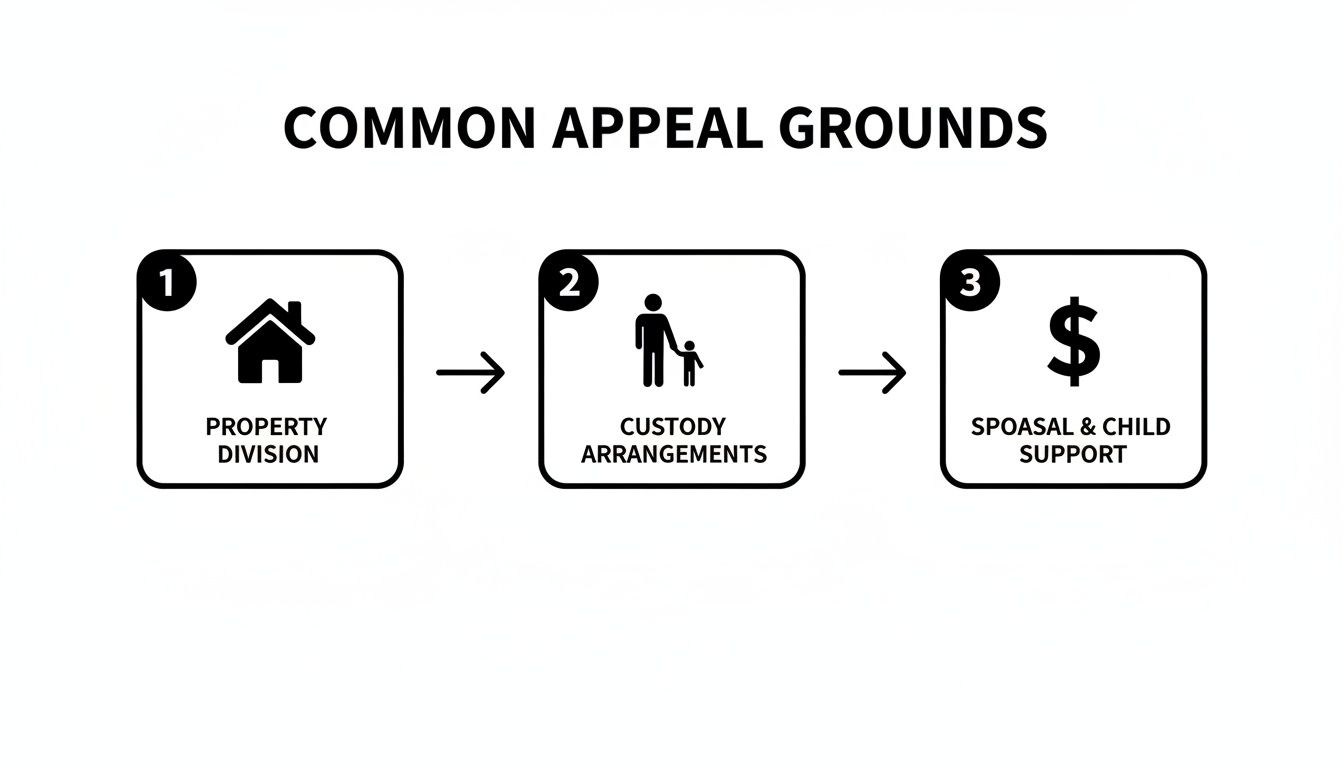
Certain issues in a divorce are more prone to these kinds of errors. Knowing these common grounds is the first step in evaluating if you have a viable appeal.
Property Division Errors
One of the most frequent grounds for appeal is the division of the marital estate. Texas law requires a "just and right" division of community property, but the process is filled with potential legal mistakes.
Common reversible errors in property division include:
- Mischaracterization of Property: The judge incorrectly classifies your separate property (like an inheritance or a pre-marriage asset) as community property and divides it.
- Improper Valuation: The court uses a clearly outdated or flawed value for a major asset like a family business, pension, or real estate, skewing the entire division.
- Ignoring Reimbursement Claims: The court overlooks or denies a valid claim for reimbursement, such as when you used separate funds to pay down the community mortgage.
Child Custody and Visitation Rulings
Nothing is more important than your children's well-being. In Texas, every custody decision must be guided by the "best interest of the child" standard. When a judge's ruling strays from that standard because they ignored crucial evidence or misapplied the law, it may be an "abuse of discretion" that can be challenged on appeal.
Examples of reversible errors in custody cases include:
- Ignoring clear, documented evidence of a parent's substance abuse or history of family violence.
- Imposing a geographic restriction that is so severe it effectively damages the parent-child relationship without supporting evidence.
- Refusing to consider the stated preference of a mature older child without a valid, on-the-record reason.
These are not minor disagreements; they are situations where the court's decision may have failed its primary duty to protect the child's well-being. Our guide on the general grounds for appeal in civil cases provides more context.
Spousal Maintenance and Child Support Orders
Financial support decisions must be grounded in the factors outlined in the Texas Family Code and supported by evidence. If a judge seems to pull an income number out of thin air or ignores statutory guidelines without a good reason, an appeal may be the only way to correct that financial injustice. An appellate court can review whether the trial judge did the math correctly and based the support amount on real evidence.
Ultimately, winning an appeal comes down to proving the trial judge made a legal mistake that truly mattered. A seasoned divorce appeal lawyer in Texas can meticulously review your trial record to spot these errors and build a persuasive argument for why the appellate court must step in.
A Step-by-Step Guide to the Texas Divorce Appeal Process
The Texas appellate process follows a clear, structured roadmap. An experienced divorce appeal lawyer in Texas knows how to navigate every stage to ensure your case is presented effectively. Understanding these steps can help demystify the process and restore a sense of control.
Step 1: Filing the Notice of Appeal
This is the official start of the appellate process. A Notice of Appeal must be filed to inform the court system and the other party of your intent to challenge the ruling.
Under the Texas Rules of Appellate Procedure, you typically have only 30 days from the date the final divorce decree was signed to file this notice. Missing this strict deadline can permanently bar your right to appeal. You can learn more in our article on how to file a Notice of Appeal.
Step 2: Assembling the Appellate Record
The court of appeals can only review what happened in the trial court. To do this, your attorney must compile the appellate record, which consists of two key parts:
- The Clerk’s Record: A collection of all documents filed in your case, from the initial petition to the final orders.
- The Reporter’s Record: The official, word-for-word transcript of everything said during your court hearings.
A skilled appellate lawyer will meticulously review this entire record, searching for the specific legal errors that will form the basis of your appeal.
Step 3: Crafting the Legal Argument in the Briefs
This is where the core of the appellate work happens. Appeals are won or lost based on the quality of the written legal arguments, known as briefs. Your attorney will write a compelling brief that explains to the appellate justices how and why the trial judge made a reversible error.
This highly technical document must:
- Clearly identify the legal errors that harmed your case.
- Cite specific statutes from the Texas Family Code.
- Reference prior appellate court decisions ("precedent") that support your position.
After your brief is filed, the other side files a response brief, and your attorney may file a final "reply brief." This written exchange forms the foundation of your appeal.
Texas Divorce Appeal Timeline at a Glance
The appellate process is governed by strict deadlines. This table outlines the critical timeframes for key stages in a Texas family law appeal, based on the Texas Rules of Appellate Procedure. It's important to remember that these are general guidelines, and the actual timeline for your case can vary.
| Appellate Stage | Typical Deadline or Duration |
|---|---|
| Notice of Appeal | Due 30 days after final judgment is signed. |
| Appellate Record Filed | Usually due 60 days after judgment, prepared by the court clerk and reporter. |
| Appellant's Brief | Due 30 days after the appellate record is filed. |
| Appellee's Brief | Due 30 days after the appellant's brief is filed. |
| Appellant's Reply Brief | Due 20 days after the appellee's brief is filed. |
| Court's Decision | Can take 6-12 months (or longer) after all briefs are filed. |
Step 4: Oral Argument and the Final Decision
In some appeals, the court schedules an oral argument. This is a formal proceeding where your lawyer appears before a panel of (usually three) appellate justices to answer their questions and clarify complex points from the briefs.
Following the briefing and any oral argument, the justices will issue a written opinion that will do one of three things:
- Affirm the trial court’s ruling, meaning the original decision stands.
- Reverse and Render a new judgment, where the appellate court corrects the error itself.
- Reverse and Remand the case, sending it back to the trial court for a new hearing with specific instructions.
The entire process is built on precision, in-depth legal knowledge, and powerful written advocacy, providing an essential safeguard for justice.
Why You Need a Specialized Divorce Appeal Lawyer
Winning at trial and winning on appeal require two completely different skill sets. Your trial attorney’s job was to tell a persuasive story to a judge or jury. An appellate lawyer’s job is to persuade a panel of higher-court judges that the trial judge made a legal error. It’s a different audience with a different focus.
A Different Skillset for a Different Court
An appellate lawyer is a legal strategist and detective, not a storyteller. They don't re-tell your story; they dissect the official court record to pinpoint the exact legal mistakes that could overturn the outcome.
This specialized work involves:
- Deep Record Analysis: Meticulously combing through trial transcripts, exhibits, and motions to hunt for reversible errors—not just things that felt unfair, but specific legal missteps.
- Strategic Brief Writing: Crafting a highly structured, persuasive legal brief that lays out the trial judge’s errors, supported by extensive case law and statutory citations.
- Mastering Appellate Procedure: Navigating the complex and rigid rules of appellate procedure, where one missed deadline can mean your right to appeal is lost forever.
Identifying a "reversible error"—like an incorrect property division or a custody decision that ignored key legal factors—is a specialized skill. For more on this, our guide on how to choose a family law attorney offers helpful advice.
Finding Errors That Matter
An experienced appellate lawyer knows what kind of mistakes get a higher court's attention. Even the best trial judges can make errors, especially with the complexities of Texas family law. Statistics from the state's highest civil court confirm this.
The Texas Supreme Court regularly reviews cases where regional appellate courts had low affirmance rates. For example, in a recent term, the affirmance rate for decisions from some of the state's largest appellate courts was well below 50%. You can discover more about these Texas Supreme Court statistics.
These numbers show that courts make correctable errors. For parents and spouses facing an unjust outcome, this is where hope lies. An appeal offers a real chance to fix mistakes related to child custody and financial rulings. When you hire a lawyer who focuses on appeals, you get a professional trained to spot these vulnerabilities and build a case that speaks directly to appellate judges.
How to Know If You Have a Strong Case for an Appeal

While the feeling of unfairness often starts the conversation about an appeal, it isn’t enough to win one. A successful appeal must be built on a solid legal foundation. A divorce appeal lawyer in Texas will first evaluate your case through the eyes of an appellate court, asking specific questions to determine if there is a realistic path forward.
Was There a Specific, Provable Legal Error?
At the heart of every appeal is a reversible error. This is not about whether the judge liked your ex-spouse more; it's about whether the judge made a concrete legal mistake, such as misapplying the Texas Family Code or failing to follow proper procedure. You must be able to point to a specific, identifiable error, such as the judge classifying your separate property as community property during the property division.
Can the Error Be Proven in the Trial Record?
An appeal is not a second trial. You cannot introduce new evidence. The appeals court is restricted to reviewing what is already in the official appellate record—the court reporter's transcripts and documents from the original trial. If proof of the judge's mistake isn't in that record, then for the purpose of an appeal, it never happened.
The strength of an appeal lies entirely within the pages of the trial record. It’s a closed universe of facts. Your appellate lawyer’s job is to find the legal flaw within that universe and demonstrate to a higher court why it led to an unjust result.
Was the Error Harmful?
Even with a clear legal error in the record, you must show that the error was harmful. This means the mistake was so significant that it likely caused the judge to issue an improper ruling and changed the final outcome. A minor procedural slip-up is not enough. The error must have had a substantial impact.
Examples of harmful error include:
- A judge miscalculates child support based on an incorrect interpretation of the guidelines, costing you thousands of dollars.
- The court makes a child custody ruling while completely ignoring documented evidence of family violence.
- A judge makes an error in the characterization of a multi-million-dollar asset, resulting in a fundamentally unfair property division.
Minor mistakes that wouldn't have changed the final divorce decree won’t be overturned. The error must have truly mattered.
If you believe the court made a mistake in your family law case, our appellate attorneys can help you seek a fair outcome. Contact The Law Office of Bryan Fagan today for a free consultation.
Frequently Asked Questions About Texas Divorce Appeals
Facing a potential appeal raises many questions. Here are straightforward answers to some of the most common concerns we hear from clients.
How Much Does a Divorce Appeal Cost in Texas?
The cost of an appeal depends entirely on the complexity of your case. Unlike many trial matters, appeals often involve intensive legal research and writing. For this reason, many appellate lawyers work on a flat-fee basis. This fee covers the in-depth legal research, preparation of the official appellate record, and the critical task of writing a persuasive legal brief. The best way to get a realistic cost estimate is to schedule a consultation with an experienced divorce appeal lawyer in Texas who can review the specifics of your case.
Can I Introduce New Evidence in an Appeal?
No. This is the single biggest misconception about the appeals process. An appeal is not a second trial. The appellate court is limited to reviewing the existing trial court record—the testimony, evidence, and arguments that were already presented. The goal is to prove the judge made a legal error based on the information they had at the time, not to introduce new facts.
How Long Does a Divorce Appeal Take in Texas?
Patience is crucial. A typical Texas divorce appeal can take anywhere from 6 to 18 months from the moment the Notice of Appeal is filed until the appellate court issues its final decision. The exact duration depends on the court’s caseload and the complexity of the legal issues.
What Are the Possible Outcomes of an Appeal?
An appellate court will issue a written decision with one of three main outcomes:
- Affirm: The appellate court agrees with the trial court's decision, and the original order stands.
- Reverse and Render: The court finds an error and corrects it, issuing a new, final judgment. This is a complete victory.
- Reverse and Remand: The court agrees an error was made but sends the case back to the trial court with specific instructions on how to fix the mistake, which may require a new hearing on that issue.
If you believe the court made a mistake in your family law case, our appellate attorneys can help you seek a fair outcome. Contact The Law Office of Bryan Fagan, PLLC today for a free consultation at https://familylawcourtappeals.com.