
You may feel your case was handled unfairly, that the judge misunderstood the facts, or that the final order simply defies logic. The Texas family law appeal process exists for this exact situation: to provide a pathway for seeking justice when you believe a court has made a serious legal mistake. An appeal is not a second trial, but a focused review of the court record to determine if a reversible error occurred, offering a chance to restore fairness and balance.
Your Path to Justice After an Unfair Ruling

You have invested your time, emotions, and financial resources into your family law case. When a final order concerning child custody, property division, or another critical matter seems fundamentally wrong, the feeling can be devastating. However, an unjust ruling does not have to be the final word.
The Texas legal system includes a vital check on judicial power: the appellate courts. An appeal is your formal request asking a higher court to review the trial court's actions for significant legal errors. It is a strategic opportunity to advocate for a just outcome when you believe the initial decision was legally flawed.
What an Appeal Is—And What It Isn’t
It's common to mistake an appeal for a second trial, but they are fundamentally different. You do not present new evidence or call new witnesses. The appellate court's role is similar to that of a referee reviewing the official record of the trial. They examine every document, exhibit, and word of testimony—the "record"—to determine if the judge made a critical legal error.
An appeal is about correcting errors of law, not re-litigating findings of fact. The appellate court will not re-weigh a witness's credibility but will intervene if a trial judge applied the wrong legal standard or misinterpreted the Texas Family Code.
For example, an appeal is the proper mechanism to address situations where:
- A judge incorrectly characterized your separate property as community property in a divorce.
- The court failed to properly apply the “best interest of the child” standard in a custody determination.
- A judge improperly granted or denied a protective order by misinterpreting the legal requirements.
The Texas family law appeal process can seem complex, governed by strict deadlines and the Texas Rules of Appellate Procedure. Yet, understanding that you have the right to challenge an unjust outcome is the first step toward restoring balance. One judge’s mistake should not dictate your family's future or your financial security.
If you believe the court made a mistake in your family law case, our appellate attorneys can help you seek a fair outcome. Contact The Law Office of Bryan Fagan today for a free consultation.
How An Appeal Differs From A Trial
If you are considering appealing a family court ruling, it is crucial to understand that an appeal is not a do-over. This is the single greatest misconception about the process. The Texas family law appeal process is not a second chance to introduce new evidence or call witnesses you wish you had presented the first time. It is a distinct legal proceeding with its own purpose and strict rules.
Think of your trial as the "production" of a film. Evidence is presented, witnesses testify, and arguments are made to convince the judge or jury—the director—of your version of events. The goal is to create a complete record of the proceedings.
An appeal, by contrast, is the post-production review. A panel of appellate justices sits in a review room. Their job is not to reshoot scenes or add new actors. They only review the "finished film"—the trial record—to identify critical legal mistakes made by the director.
The Foundation of Every Appeal: The Appellate Record
In the world of appeals, nothing is more important than the appellate record. This is the official, closed universe of information the appellate court is allowed to consider. If it is not in the record, it does not exist for the purpose of the appeal.
The record consists of two essential parts:
- The Clerk’s Record: A collection of all official documents filed in your case, including petitions, motions, discovery, and the final order you are appealing.
- The Reporter’s Record: The verbatim transcript of everything spoken in court. Every question, answer, objection, and ruling is captured here.
Your appellate lawyer’s entire job is to scrutinize this record for legal errors. The case they build will be based exclusively on what is contained within these documents.
Shifting from Facts to Law
During a trial, the focus is on establishing facts. You work to convince the judge that an asset is your separate property or that a specific custody arrangement is in your child's best interest. It is all about evidence and persuasion.
On appeal, the focus shifts entirely from factual disputes to pure questions of law. The appellate justices were not present to observe witness testimony or assess credibility. They will almost never second-guess the trial judge's decisions on whom or what to believe.
The core question in an appeal is not, "Did the judge make the right decision?" but rather, "Did the judge commit a legal error that likely resulted in an improper outcome?" This distinction is crucial and shapes the entire appellate strategy.
No New Evidence or Testimony Allowed
This is an absolute, non-negotiable rule of appellate procedure. You cannot inform the appellate court about a new job obtained after the trial or submit a bank statement you forgot to bring to court. The review is strictly limited to the evidence and arguments presented to the trial judge at the time the decision was made.
This is why effective trial counsel is so critical. A good trial attorney knows how to "preserve error" for a potential appeal by making specific objections and ensuring all necessary evidence is entered into the record. If an issue was not properly raised in the trial court, you generally waive the right to complain about it on appeal.
Trial vs. Appeal: A Head-to-Head Comparison
This table breaks down the key differences between a trial court proceeding and the appellate process in Texas family law cases.
| Aspect | Trial Court | Appellate Court |
|---|---|---|
| Purpose | To determine facts and apply the law to those facts. | To review the trial record for legal errors. |
| Decision-Maker | A single judge or a jury. | A panel of three or more justices. |
| Evidence | Live testimony, documents, and exhibits are presented. | No new evidence is allowed; review is limited to the existing record. |
| Key Arguments | Factual arguments about what happened and who is credible. | Legal arguments about whether the judge misapplied the law. |
| Primary Skillset | Courtroom presentation, witness examination, evidence strategy. | Legal research, persuasive writing, and oral argument on legal points. |
Understanding these fundamental distinctions is the first and most important step in deciding whether the Texas family law appeal process is the right path for you. An appeal is not driven by emotion; it is a methodical analysis of law and procedure.
Spotting a Reversible Error in Your Family Law Case
An unfavorable trial outcome is difficult. You may be convinced the judge made a mistake, but in the world of appeals, not just any error will suffice. The appellate court is searching for a specific kind of mistake: a reversible error.
Reversible Error is a legal mistake so significant that it likely caused the wrong outcome in your case. Think of it as a fundamental flaw in the process that compromised the fairness of the result. A minor, or "harmless," error is one that did not affect the final judgment. Appellate courts only intervene to correct reversible errors.
Understanding the Standard of Review: "Abuse of Discretion"
Family court judges in Texas are granted significant latitude, or discretion, in making decisions, especially regarding child custody, visitation, and property division.
However, this authority is not unlimited. A judge commits an "abuse of discretion" when they make a decision that is arbitrary, unreasonable, or without reference to any guiding legal principles. It is not enough that another judge might have decided the case differently. To prove an abuse of discretion, you must show that the trial judge’s decision was so far outside the bounds of the law that no reasonable judge, viewing the same facts, would have made the same choice.
For example, a judge might divide a community estate 60/40 after hearing evidence of fault in the breakup of the marriage. This is likely within the judge's discretion. But if the judge made that same 60/40 split simply because they disliked one party's personality, that would be a classic abuse of discretion because the decision was not based on any recognized legal factor.
Common Examples of Reversible Error
What do these errors look like in a real Texas family law case? They typically fall into a few key categories.
Mischaracterizing Property
This is a frequent issue in Texas divorce cases. By law, property acquired during the marriage is presumed to be community property, but this presumption can be rebutted with clear and convincing evidence.
- Real-World Example: You inherited a home from your parents years before you were married. It has always remained your separate property. In the final divorce decree, the judge classifies the house as community property and orders it sold, with the proceeds divided. This is a direct misapplication of the Texas Family Code and a strong basis for an appeal.
Errors in Applying the "Best Interest of the Child" Standard
In any case involving children, the judge's primary consideration must be the "best interest of the child." To guide this analysis, Texas law outlines specific factors (often called the Holley factors) that the court must consider.
- Real-World Example: A judge severely limits a parent’s possession schedule, citing the parent’s non-traditional work hours. However, no evidence was presented at trial showing that this schedule caused any harm or instability for the child. This is a potential reversible error because the decision was not tied to the child's well-being but rather to the judge's personal opinion.
Procedural and Evidentiary Mistakes
Trials are governed by a strict set of rules, including the Texas Rules of Evidence and the Texas Rules of Civil Procedure. When a judge ignores a major rule, it can compromise the fairness of the entire trial.
- Real-World Example: The judge allows a therapist to testify about confidential statements you made during joint counseling sessions, despite your attorney's proper objection. This improperly admitted evidence may have unfairly influenced the judge's custody ruling. This type of procedural error is often grounds for reversal.
The bottom line is this: a successful appeal demonstrates that the trial court committed a harmful legal error. It is not a second chance to argue the facts. The appellate court acts as a referee, ensuring the law was applied correctly.
To explore this topic further, you can learn more about the specific grounds for appeal in Texas civil cases. Identifying these errors requires an experienced appellate attorney who can meticulously review the trial record with a trained eye.
The Texas Family Law Appeal Process Step By Step
The Texas family law appeal process can seem intimidating with its legal jargon and rigid deadlines. However, it is a well-defined path with clear steps. Let's walk through this roadmap, transforming a daunting legal challenge into a series of manageable actions.
Step 1: Filing the Notice of Appeal
This is the starting point. The Notice of Appeal is a formal document filed with the trial court clerk that officially initiates your appeal. It notifies the court and the opposing party that you are challenging the judgment in a higher court.
You must act quickly. Under the Texas Rules of Appellate Procedure, you generally have only 30 days from the date the final order was signed to file your Notice of Appeal. Missing this deadline will almost always result in the loss of your right to appeal, regardless of the merits of your case. For a detailed guide, see our article on how to file a Notice of Appeal.
Step 2: Preparing the Appellate Record
Once the appeal is filed, the next task is to assemble the appellate record. This is the complete case file that the appellate justices will review. Nothing outside this record can be considered.
The record is comprised of two parts:
- The Clerk’s Record: A compilation of all official documents filed in the case, such as petitions, motions, and the final judgment.
- The Reporter’s Record: The word-for-word transcript of the trial or hearing, capturing all testimony, objections, and judicial rulings.
Your appellate lawyer will meticulously analyze this record to identify the critical errors that will form the basis of your appeal.
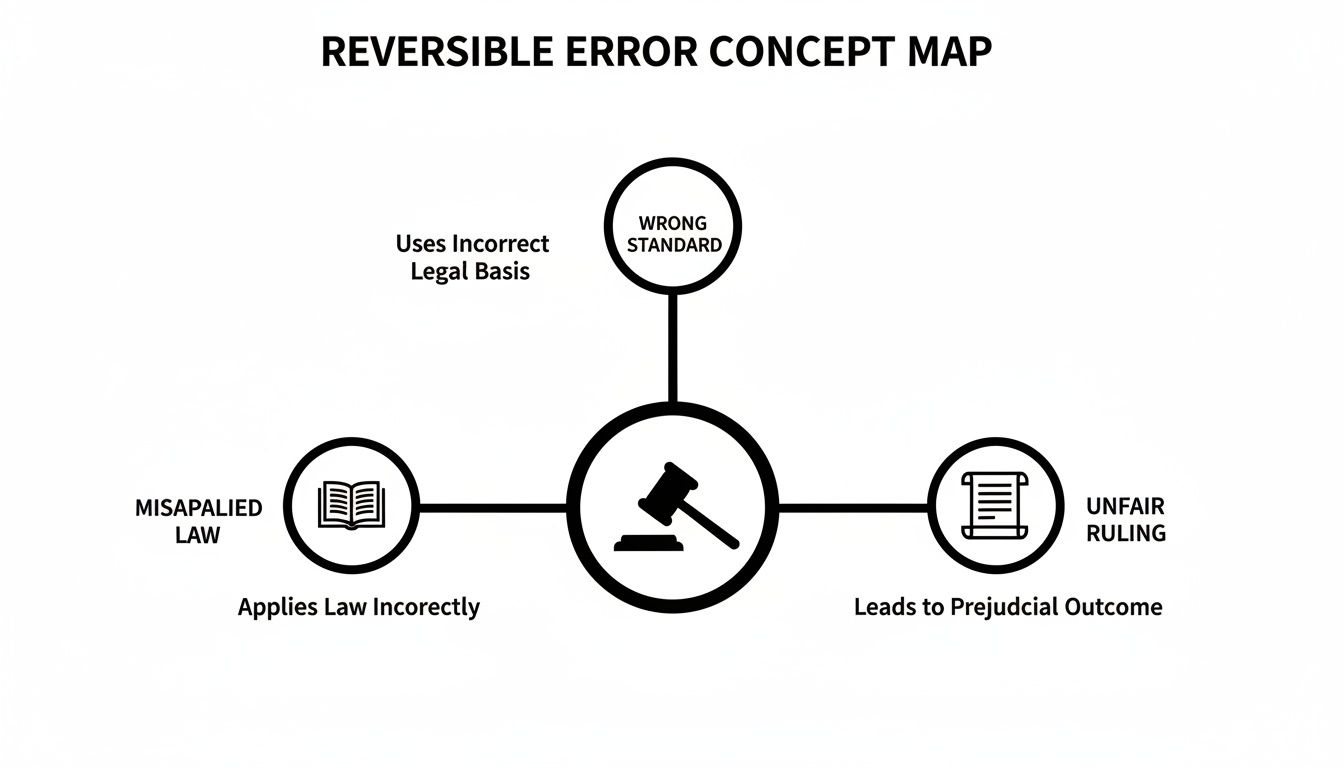
As this graphic illustrates, a reversible error is a significant mistake—such as a judge applying the wrong legal test for child custody or mischaracterizing assets in a property division—that likely caused an improper outcome.
Step 3: Crafting and Filing the Briefs
This is the core of the appeal. Briefing is the process of presenting your written legal arguments to the appellate court. The person appealing (the "appellant") files the opening brief, which must meticulously detail why the trial court's decision was legally incorrect.
A persuasive appellant's brief tells the story of the case using only facts from the record, identifies the specific legal errors made by the judge, and provides compelling legal arguments supported by statutes and case law to demonstrate that these errors were harmful and require correction.
The opposing party (the "appellee") then files a response brief, arguing that the trial judge's decision was correct. The appellant often has a final opportunity to respond with a reply brief. Most appeals are won or lost based on the quality of these written arguments.
Step 4: Oral Argument
In some cases, the court may schedule an oral argument. This is a formal session where attorneys for both sides appear before a panel of appellate justices to debate the key issues and answer questions. It is not a new trial with witnesses but a high-level legal discussion.
Oral argument provides a valuable opportunity for your attorney to emphasize the most critical points from the brief and directly address any concerns the justices may have.
Step 5: The Court's Decision and Beyond
After the briefs are filed and any oral argument is complete, the case is submitted to the court for a decision. The appellate court will eventually issue a formal written opinion with one of several possible outcomes:
- Affirm: The court agrees with the trial judge, and the original ruling stands.
- Reverse and Remand: The court overturns the trial court's decision and sends the case back for a new trial or hearing with specific instructions.
- Reverse and Render: The court overturns the trial court’s decision and issues its own final judgment, which is less common but very powerful.
If the appellate court's decision is unfavorable, you may have further options, such as filing a motion for rehearing or petitioning the Texas Supreme Court for review. Each step is a calculated move in the pursuit of a just and legally sound outcome.
Understanding Appellate Timelines And Costs
After an emotionally and financially draining trial, the prospect of investing more time and money into an appeal can be daunting. Let’s address the two most common questions: “How long will an appeal take?” and “What will it cost?”
An appeal is a marathon, not a sprint. From filing the Notice of Appeal to receiving the court's final decision, the process typically takes a year or more. This timeframe is filled with strict deadlines for preparing the record, conducting in-depth legal research, drafting briefs, and awaiting the justices' deliberation.
Breaking Down the Investment
While the timeline requires patience, the cost is often a significant consideration. It is important to view an appeal not as an expense, but as an investment in correcting a flawed ruling that could otherwise impact your parental rights and financial future for years.
The costs of an appeal generally fall into three categories:
- Attorney's Fees: This is the largest component, covering the extensive and highly skilled work of reviewing the trial record for errors, researching complex case law, and drafting the persuasive legal brief that is central to your case.
- Record Preparation Costs: We must pay the court reporter to transcribe the trial proceedings into an official Reporter's Record and the court clerk to assemble the Clerk's Record. These costs vary based on the length of your trial.
- Court Filing Fees: Appellate courts charge administrative fees for filing the Notice of Appeal and other necessary documents.
Why Do Errors Happen?
You may wonder how a judge could make a significant error. The reality is that Texas family courts are extremely busy, and high caseloads can contribute to mistakes.
For example, recent data from Tarrant County's district courts shows that of 20,995 family law cases resolved, 3,932 (18.7%) were decided by a judge in a non-jury trial. In each of those trials, a single judge made life-altering decisions on issues like child custody and the equitable property division of a family's assets. With that much discretion and volume, the potential for reversible error is always present.
Our role as appellate counsel is to manage these costs effectively by focusing on the strongest, most viable arguments for reversal. We provide a clear, realistic assessment from the start, allowing you to make an informed decision about protecting your future.
If you believe the court made a mistake in your family law case, our appellate attorneys can help you seek a fair outcome. Contact The Law Office of Bryan Fagan today for a free consultation.
Choosing The Right Appellate Attorney

When a trial court issues a flawed ruling, the single most important decision you will make is choosing the right attorney to handle the appeal. The hard truth is that a brilliant trial lawyer may not be the right person for this specialized task. The skill sets are fundamentally different.
The Texas family law appeal process is not about courtroom theatrics or emotional pleas. It demands a specialist—a lawyer who excels at deep legal research, precise writing, and identifying the critical error that can reverse an outcome. Your trial lawyer's job was to tell your story to a judge; your appellate lawyer's job is to prove to a panel of judges that a legal mistake was made.
Why Appellate Law Is a Specialty
Think of your trial lawyer as a master storyteller, presenting facts and evidence in a compelling narrative. An appellate lawyer, in contrast, is more like a legal scholar and detective. Their audience is not interested in a new story; they want to know if the rules of law were followed correctly.
Winning an appeal hinges on a very specific set of skills:
- Exceptional Legal Writing: Appeals are won or lost on paper. The written brief is the cornerstone of the case, requiring a unique talent for building a powerful, persuasive, and technically flawless legal argument.
- Master-Level Research: Appellate attorneys must navigate vast libraries of statutes and case law to find the precise legal precedent needed to prove the trial judge committed a harmful error.
- A Meticulous Eye for Detail: The entire case depends on finding mistakes buried within thousands of pages of the trial record. A single overlooked detail can be the difference between winning and losing.
The heart of appellate advocacy is persuading seasoned judges through rigorous legal analysis. It is a strategic, academic discipline that requires a completely different mindset from trial work.
Key Questions to Ask a Potential Appellate Attorney
Not all family lawyers are equipped to handle an appeal, so you must ask the right questions to find someone with the specific experience your case demands.
Be sure to ask any potential attorney these questions:
- What is your specific experience with family law appeals? How many have you personally handled? Family law has its own unique body of law, from the "best interest of the child" standard to the complexities of community property. General appellate experience is not enough.
- What is your process for reviewing the record? Ask for an explanation of how they search the clerk’s and reporter’s records for reversible errors. You want to hear about a systematic, detail-oriented approach.
- Who will actually write the brief? The person you hire should be the one performing the most critical work. Will they write the brief themselves, or will it be delegated to a less-experienced associate?
Selecting the right lawyer is the first and most crucial step in the appellate journey. For more guidance, you may want to read our article on how to choose a family law attorney. At The Law Office of Bryan Fagan, our appellate division is built around this specialized, judge-focused discipline.
If you believe the court made a mistake in your family law case, our appellate attorneys can help you seek a fair outcome. Contact The Law Office of Bryan Fagan today for a free consultation.
Common Questions We Hear About the Appeal Process
When you receive a final order that feels deeply unjust, your mind races with questions. What can you do? What comes next? The Texas family law appeal process can seem like a maze, but we can provide clear, straightforward answers.
Here are the answers to the questions our clients most frequently ask.
Can I Bring in New Evidence for My Appeal?
This is a common question, and the answer is almost always no. An appeal is a review of the game tape, not a new game.
The appellate court is limited to examining what happened during the trial—the evidence presented, the testimony given, and the arguments made. Its purpose is not to hold a new trial but to determine if the trial judge made a significant legal mistake based on the information available at that time. The official "record" from your trial is the only information the appellate court can consider.
What Are My Odds of Winning a Family Law Appeal?
Every client wants to know their chances. The honest answer is: it depends entirely on whether a "reversible error" exists in your case record.
This cannot be a minor slip-up. It must be a substantial legal error that likely caused the judge to reach an improper decision. While appellate statistics show that a meaningful percentage of civil cases are reversed, your individual odds can only be determined after a thorough review of the trial record by an experienced appellate lawyer.
The key question for the appellate court is not, "Would we have decided this differently?" but rather, "Did the trial judge's decision lack a sound legal basis?" Only a deep dive into the record can reveal if you have a strong chance of winning.
What Happens if I Win the Appeal?
Winning an appeal does not always mean the case is over. The appellate court will issue a formal written opinion, and one of a few things can happen.
Most commonly, the court will "reverse and remand." This means it voids the trial court’s incorrect order and sends the case back down with instructions, which may lead to a new hearing on an issue like child custody or require the judge to enter a new, corrected judgment.
In rarer instances, the court may "reverse and render," issuing its own final judgment and effectively ending that part of the dispute without sending it back to the trial court.
I Agreed to the Final Order. Can I Still Appeal It?
As a general rule, the answer is no. You cannot appeal a judgment that you voluntarily signed and agreed to settle.
The appeals process is designed to correct mistakes made by a judge in a contested case, not to let someone back out of a settlement they later regret. There are extremely narrow exceptions, such as proving you were forced into the agreement through fraud or coercion, but challenging an agreed order is an exceptionally difficult battle.
If you believe the court made a mistake in your family law case, our appellate attorneys can help you seek a fair outcome. Contact The Law Office of Bryan Fagan today for a free consultation at https://familylawcourtappeals.com.