You may feel your case was handled unfairly or that the judge made a critical mistake. When a family court's final ruling seems fundamentally wrong, it can feel like the end of the road. But an unjust decision does not have to be the last word. A family law appeal attorney is a specialist who steps in after a final order is issued to challenge the legal soundness of that decision.
Their role isn't to start the trial over. Instead, a family law appeal attorney meticulously reviews the entire case record, searching for specific legal mistakes made by the trial court judge. This could be a misapplication of the Texas Family Code or a decision that overstepped the judge's authority—a legal error known as an "abuse of discretion." An appeal is a formal, strategic process designed to correct those errors and restore a fair outcome. It is important to understand that an appeal is not a new trial.
Your Fight for a Fair Outcome Is Not Over
It is a deeply unsettling feeling to receive a final order from the family court that you believe is unjust. You may be left thinking the judge ignored critical evidence, misinterpreted Texas law, or made a decision that puts your family's future at risk.
If this sounds familiar, your fight for a fair and just resolution is not over. The Texas appeals process provides a structured path to challenge a court's decision and seek the correct result. However, it is a highly technical review by a panel of higher court judges. Their purpose is not to give you a "do-over" but to determine if a significant legal error—a reversible error—was made in the trial court. Your focus shifts from arguing the facts of your case to proving the law was applied incorrectly.
The Rarity of Family Law Appeals
While millions of family law cases are decided each year, only a small fraction are appealed. For perspective, U.S. courts recently handled around 1.09 million divorce cases in a single year, not including countless other custody and support battles.
Despite the high stakes, very few of these cases advance to an appellate court. Clio's legal blog offers valuable insights on these trends. This is not because errors don't occur; it's because appellate law is a highly specialized and demanding field that requires a unique skill set.
Why You Need a Dedicated Appellate Attorney
The skills that win a trial are entirely different from those needed to win an appeal. A trial lawyer excels at presenting evidence and examining witnesses. A family law appeal attorney, in contrast, excels in legal research, persuasive writing, and navigating the complex Texas Rules of Appellate Procedure.
Here is what a dedicated appellate attorney does:
- Surgical Record Review: They dissect every document, transcript, and ruling from your case to find a reversible error—a legal mistake so significant that it justifies overturning the trial court's decision.
- Expert Legal Writing: They draft a highly technical legal document called a brief. This is a persuasive argument, grounded in case law and statutes, designed to prove the trial judge made a critical legal error. The process of writing these arguments is known as briefing.
- Masterful Oral Argument: If the court grants it, your attorney will stand before a panel of appellate judges to defend your position. These judges will probe every angle of the case, and it takes unique expertise to succeed in this high-stakes environment.
This specialized focus is what gives you the best opportunity to correct an unjust outcome. A skilled family law appeal attorney is the strategic advocate you need for this complex legal journey.
Pinpointing the Grounds for a Texas Family Law Appeal

While it is natural to feel a court's decision was wrong, a disappointing outcome alone is not enough to file an appeal. The entire appellate process depends on identifying a specific, significant mistake known as a reversible error.
A reversible error is a legal or procedural mistake made during the trial that likely caused an improper judgment. It's not about disagreeing with the judge's decision; it's about proving the decision was based on a flawed legal foundation. Without a reversible error, there are no grounds for an appeal.
What Does "Abuse of Discretion" Actually Mean?
In Texas family law, judges are granted significant leeway, or "discretion," in making decisions on issues like child custody and property division. However, this power is not unlimited.
An abuse of discretion occurs when a judge makes a ruling that is arbitrary, unreasonable, or made without reference to guiding legal rules and principles. It means the decision falls well outside the zone of reasonable disagreement. Proving this is not about showing that the appellate court would have decided differently; it requires demonstrating that the trial judge's decision was a clear departure from established law and not the result of a reasoned process.
Plain-English Definition: An "abuse of discretion" happens when a judge makes a decision that is so far outside the accepted legal rules that it is considered legally baseless or unfair.
Common Reversible Errors in Family Law Cases
A skilled family law appeal attorney will meticulously review the trial record—every transcript, exhibit, and motion—to identify these critical mistakes. Some of the most common reversible errors in Texas family courts include:
- Misapplication of the Law: The judge misinterpreted or incorrectly applied the Texas Family Code. A common example is mischaracterizing a spouse’s separate property (like an inheritance) as community property, which leads to an improper property division.
- Improper Handling of Evidence: The court allowed evidence that should have been excluded (like unreliable hearsay) or refused to consider crucial evidence that should have been admitted. This error must be significant enough to have affected the final outcome.
- Significant Procedural Errors: The court failed to follow the rules required for a fair trial. This could include denying a party the right to present their case or the right to cross-examine a key witness.
- Insufficient Evidence for the Ruling: The final judgment is not supported by the facts presented in court. For example, a judge cannot severely restrict a parent's access to their child in a child custody case without clear evidence that doing so is in the child's best interest.
Does Your Case Have Appealable Issues?
Determining if your case contains a reversible error is highly technical work. It is not about re-telling your story; it's about a deep analysis of appellate case law and the Texas Rules of Appellate Procedure. Your attorney will analyze the complete trial record to find specific legal mistakes the appellate court can act on.
A reputable appellate lawyer will provide an honest, clear assessment of your case's potential. To learn more about what qualifies, you can explore the specific grounds for a Texas family law appeal. The goal is to build a compelling argument demonstrating that the error was not minor—it directly caused an unjust outcome that requires correction.
How an Appeal Differs from Your Original Trial
Many people mistakenly believe an appeal is a second chance to tell their story to a new judge. However, the appellate process is fundamentally different from a trial, governed by its own strict rules and objectives. Understanding this difference is key to recognizing why you need a specialized family law appeal attorney.
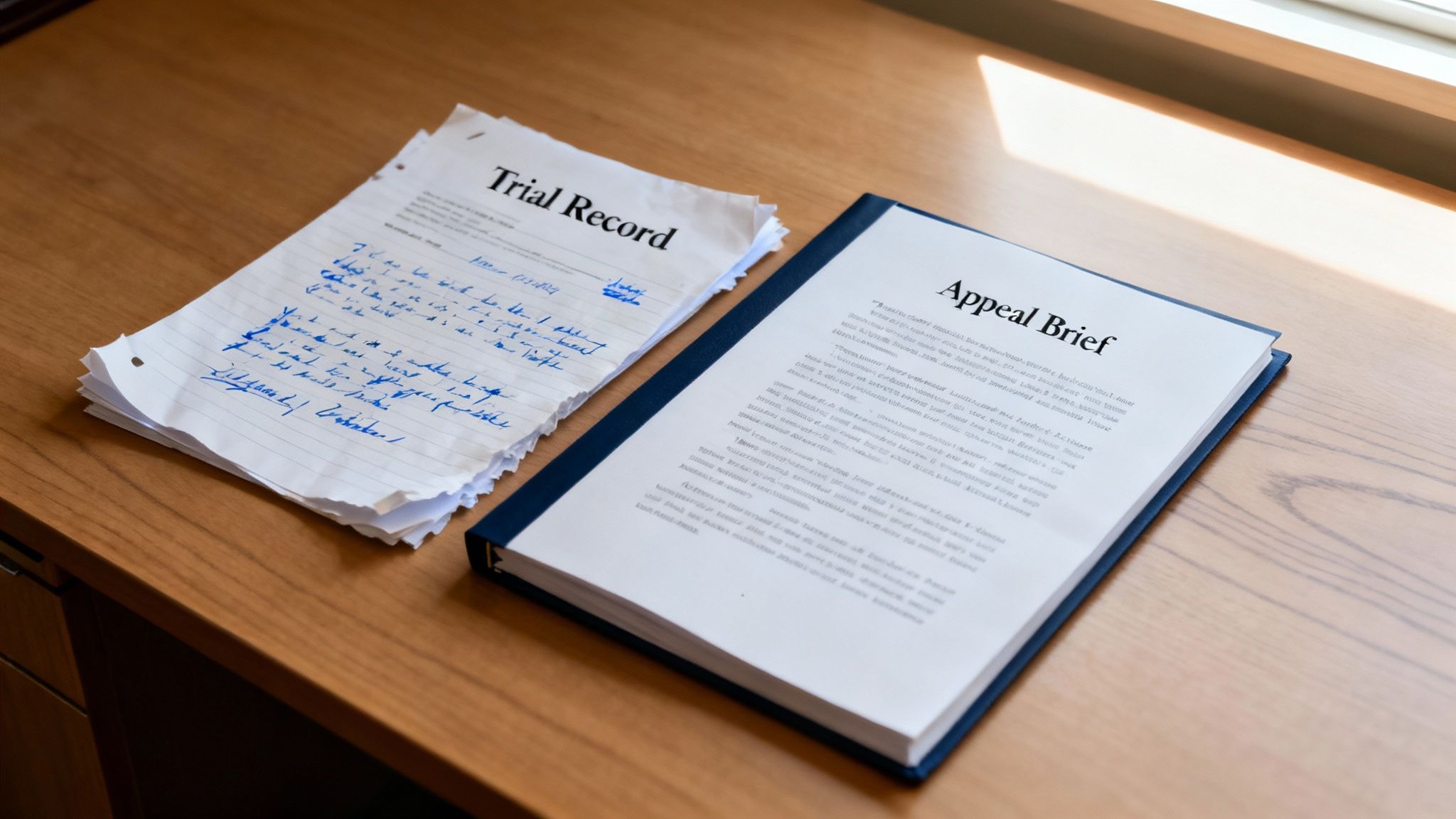
First, an appeal is not a retrial. No new witnesses will be called, and no new evidence can be introduced. The opportunity to present facts ended when the trial judge signed the final order. The appeal is based entirely on the existing trial court record—a complete collection of every document filed, every piece of evidence admitted, and every word spoken and transcribed. The appellate court's sole purpose is to review that record for significant legal errors.
The Focus Flips from Facts to Law
In your original trial—whether a contentious child custody dispute or a complex property division case—the primary goal was to establish the facts. Your lawyer presented evidence to convince the judge of your version of events.
On appeal, this dynamic is reversed. The appellate judges must generally accept the trial court's factual findings. Their focus is on a much narrower question: Did the trial judge make a mistake in applying the law to those facts?
An appeal is not about whether the appellate court would have reached a different conclusion. It's about whether the trial court followed the correct legal process to arrive at its decision. If a reversible error was made, the final judgment is considered legally flawed.
Written Arguments Replace Live Testimony
The core of an appeal is not courtroom testimony but meticulous, persuasive legal writing. The most important tool is the appellate brief—a comprehensive legal document that lays out the argument for why the trial judge committed a reversible error.
Plain-English Definition: Briefing is the process of writing and submitting these formal legal arguments (briefs) to the appellate court. Each brief explains one side's position on why the trial court's decision was either legally correct or incorrect.
Crafting a powerful brief requires:
- Intense Record Review: Your attorney will dedicate hours to reviewing every page of the trial record to find legal mistakes.
- In-Depth Legal Research: They must identify specific statutes and prior court decisions (case law) that prove an error occurred and that it harmed your case.
- Compelling Legal Writing: The brief must present a sharp, logical argument tailored to the precise legal standards the appellate court must follow.
While an oral argument may occur, it is a formal question-and-answer session with the judges, not an opportunity to re-argue the case.
Trial Court vs. Appellate Court: A Clear Comparison
Because the rules are so different, the skills required to succeed are different. A brilliant trial lawyer may not have the niche expertise in procedural rules and scholarly writing needed for an appeal.
| Aspect | Trial Court (Your Original Case) | Appellate Court (Your Appeal) |
|---|---|---|
| Purpose | To establish facts and apply the law to them. | To review the trial record for significant legal errors. |
| Decision-Maker | A single judge who acts as the "fact-finder." | A panel of three or more appellate judges. |
| Evidence | New testimony, documents, and exhibits are presented. | No new evidence is allowed. The case is limited to the existing record. |
| Key Skill | Examining witnesses, presenting evidence, oral persuasion. | Legal research, persuasive writing (briefing), and procedural analysis. |
| Main Document | Live testimony, motions, and trial exhibits. | The appellate brief and the official court record. |
| Outcome | A final judgment (e.g., divorce decree, custody order). | An opinion that affirms, reverses, or remands (sends back) the trial court's decision. |
An appeal is a highly technical legal proceeding focused on legal and procedural correctness. That is why your case requires an advocate who specializes in this demanding area of law.
Choosing the Right Family Law Appeal Attorney
Selecting the right lawyer for your appeal is the most critical decision you will make. You need more than just a good family lawyer; you need a specialist whose practice is dedicated to navigating the appellate courts.
Your trial attorney was focused on facts and evidence. Your appellate attorney's work is entirely different. They live in the trial record, searching for the specific legal errors that will convince appellate judges to overturn a decision. This requires less courtroom drama and more deep legal research and powerful, persuasive writing.
Identifying True Appellate Experience
Most family lawyers are not appellate lawyers. Appellate work is a highly specialized field where experience is paramount. You need an attorney with direct, hands-on experience arguing cases in the Texas Courts of Appeals. The process is a procedural minefield, and a single mistake can result in your case being dismissed.
When evaluating potential attorneys, look for a clear track record of handling appeals similar to yours, whether it involves a complex property division case or a difficult child custody dispute.
Here’s what to look for:
- A Focus on Appeals: Does their practice truly specialize in appellate law, or is it just one service among many? A true specialist dedicates a significant portion of their practice to this work and knows the Texas Rules of Appellate Procedure inside and out.
- Published Opinions: Ask if they have argued cases that resulted in a written opinion from the court. This proves they have experience navigating the entire appellate system.
- Deep Family Law Knowledge: They must have a profound understanding of the Texas Family Code to effectively argue that the trial judge applied the law incorrectly.
Critical Questions to Ask During Your Consultation
Your first meeting is an opportunity to interview the attorney for an important role. Come prepared to assess their expertise, strategic thinking, and communication style.
Consider asking these questions:
- "Can you walk me through your process for reviewing a trial record? What are you looking for?" A seasoned appellate lawyer should describe a methodical approach for identifying reversible errors.
- "What is the 'standard of review' for my case, and can you explain what that means?" Their ability to explain a complex legal term like "abuse of discretion" in plain English demonstrates their communication skills and legal confidence.
- "How many family law appeals have you personally handled in the last few years?" This helps separate true specialists from general practitioners.
- "How will you keep me informed about the status of my case?" The appeals process can be lengthy, so understanding their communication policy is essential.
A great appellate attorney will not promise a win. They will promise a meticulous, honest assessment of your case’s strengths and weaknesses and provide a realistic map of the road ahead.
Understanding Strategy, Fees, and Partnership
The attorney-client relationship must be built on trust and transparency. Before moving forward, you should be clear on the proposed legal strategy. The attorney should outline the core legal arguments they plan to make and explain why those arguments have a reasonable chance of success.
The conversation about cost must be equally direct. Appellate work requires significant front-loaded effort, often involving a substantial retainer. A reputable firm will clearly explain its billing practices and provide a solid estimate for reviewing the record and drafting the initial brief.
You are not just hiring a legal technician; you are choosing a partner committed to helping you achieve a fair outcome. The right team of trusted Texas attorneys for family law appeals can make all the difference.
Navigating the Texas Appellate Process and Deadlines
In Texas family law appeals, time is of the essence. The entire process is governed by a series of strict deadlines set forth in the Texas Rules of Appellate Procedure. Missing a single deadline can permanently forfeit your right to appeal, regardless of the merits of your case.
Understanding this timeline is critical. The process demands immediate and decisive action as soon as a judge signs a final order. A seasoned family law appeal attorney understands these deadlines and ensures every step is handled with precision.
The First Hurdle: Filing the Notice of Appeal
Your appeal begins with one critical document: the Notice of Appeal. This formal document informs the trial court and the opposing party that you are challenging the judge’s final decision.
Under the Texas Rules of Appellate Procedure, you generally have only 30 days from the date the final judgment was signed to file this notice. While certain post-trial motions can extend this deadline to 90 days, you should always operate on the 30-day timeline. Filing late will almost certainly result in the dismissal of your appeal. This tight deadline is why it is crucial to contact a family law appeal attorney immediately after receiving an unfavorable ruling.
Building Your Case: Assembling the Appellate Record
After filing the Notice of Appeal, the next major step is to assemble the official record from the trial court. This is the complete case file that the appellate court will review. No new evidence can be added.
The record consists of two parts:
- The Clerk’s Record: This includes all official documents filed in your case, such as petitions, motions, and the court's final order.
- The Reporter’s Record: This is the court reporter’s verbatim transcript of everything said during hearings and the trial.
Your attorney must formally request these records and pay for their preparation, another step governed by strict deadlines. Every argument made in your brief must be directly supported by evidence found within this record. You can learn more in our detailed guide on the Texas family law appeals process.
Making Your Argument: Drafting the Brief
Once the complete record is filed with the court of appeals, a new clock starts for what is arguably the most important task: writing the appellant's brief.
This document is the core of your appeal. It is where your lawyer presents the facts of the case, cites relevant laws, and constructs a compelling argument explaining the legal errors made by the trial judge. Typically, your brief is due 30 days after the record is filed. The opposing party then has 30 days to file a response brief. After all briefs are submitted, a panel of appellate judges will review the arguments and issue a written opinion.
To help you visualize these critical early deadlines, here is a simplified timeline.
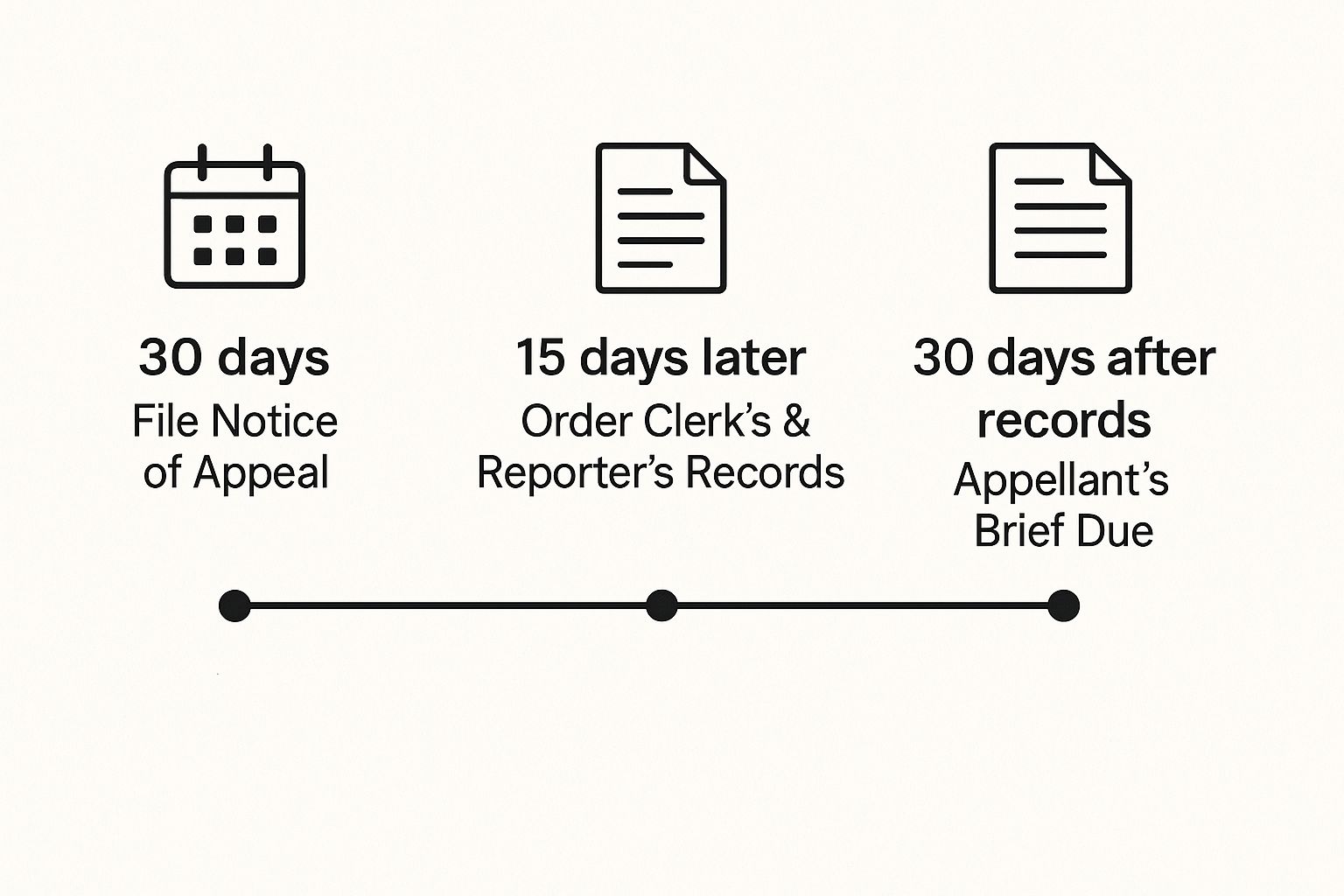
The first few months are a sprint of procedural steps that lay the foundation for your entire appeal.
Key Deadlines in a Texas Family Law Appeal
This table provides a simplified overview of the critical deadlines in the Texas appellate process. These are general timeframes and can vary.
| Appellate Stage | Typical Deadline | What Happens During This Stage |
|---|---|---|
| Filing the Notice of Appeal | 30 days from judgment | Officially begins the appeal and notifies the courts and opposing party of your intent to challenge the decision. |
| Requesting the Record | Shortly after Notice of Appeal | Your attorney formally requests and pays for the Clerk's Record (documents) and Reporter's Record (transcripts). |
| Filing the Appellant's Brief | 30 days after the record is filed | Your attorney submits the main written argument, detailing the legal errors and citing evidence from the record. |
| Filing the Appellee's Brief | 30 days after appellant's brief | The opposing party files their response, arguing why the trial court's decision was correct. |
| Submission & Decision | Varies (months) | The case is submitted to a panel of judges, who will deliberate and issue a written opinion. |
It is important to have realistic expectations. Appeals are challenging because appellate courts give significant deference to trial judges' decisions. You must prove a serious error of law or a clear abuse of discretion. While the statistics can be daunting, a meticulously prepared appeal led by a true specialist gives you the best possible chance at a fair result.
Common Questions About Family Law Appeals
Facing a potential appeal raises many questions. Understanding the practical aspects—from the likelihood of success to the potential costs—is the first step toward making an informed decision.
Here are straightforward answers to some of the most common questions we hear from clients.
What Are My Chances of Winning a Family Law Appeal in Texas?
Winning an appeal requires your family law appeal attorney to prove that the trial court made a significant legal mistake, or a "reversible error." It is not a re-argument of the facts. Appellate courts give great deference to the trial judge's decisions, so the burden is on the appellant to show a serious legal error occurred.
While appeals are statistically an uphill battle, the right appellate lawyer can make a significant difference. They will conduct a thorough review of your case record to identify potential errors and provide an honest assessment of your chances for success.
How Much Does a Family Law Appeal Cost?
The cost of an appeal varies depending on the complexity of the legal issues and the length of the original trial. Reviewing the record from a one-day trial is less time-consuming than reviewing one from a week-long trial.
Most appellate attorneys work on an hourly basis and require a retainer up front. The most intensive work occurs at the beginning of the case, with the detailed record review, legal research, and drafting of the appellate brief. A reputable attorney will be transparent about their rates and provide a realistic estimate of the total cost during your consultation.
Can I Recover My Trial Attorney's Fees If I Win the Appeal?
While it is possible, winning the appeal itself does not automatically recover the attorney's fees you spent at the trial level. The court of appeals typically does not award fees incurred in the trial court.
However, a successful appeal often results in the case being remanded—or sent back—to the trial court for new proceedings. A victory on appeal provides significant leverage. In these new proceedings, you can ask the trial judge to award the attorney's fees you spent on the first trial, arguing they were incurred due to the court's initial error.
A victory on appeal reopens the door to argue that the other party should be responsible for the fees incurred due to the court's initial mistake.
If We Win the Appeal Will You Handle the New Trial?
Appellate law and trial law require distinct skill sets. Our firm’s appellate division is exclusively focused on the unique demands of the appeals process—from record review and brief writing to oral argument.
If we win your appeal and the case is sent back for a new trial or hearing, our team of experienced trial lawyers is prepared to handle the new proceedings. This structure ensures you have a dedicated specialist for each phase of your case: an appellate expert to win the appeal and a proven litigator to secure the right outcome back in the trial court. This provides seamless and powerful representation from start to finish.
If you believe the court made a mistake in your family law case, our appellate attorneys can help you seek a fair outcome. Contact The Law Office of Bryan Fagan today for a consultation to evaluate your case.