Skip to content
If you believe a Texas family court judge made a mistake in your case, it’s natural to feel that the system has let you down. You may feel your case was handled unfairly, but there is a path forward. The Fourteenth Court of Appeals provides a critical opportunity to seek a fair outcome by correcting legal errors made in trial courts across Houston and ten surrounding counties.
This court is the next step for families who need to challenge incorrect rulings in cases involving divorce, child custody, and property division. Understanding its role is the first step toward restoring balance and protecting your family’s future.

Understanding the Role of the Fourteenth Court of Appeals
When you believe a judge handled your family law case unfairly or misinterpreted the law, that feeling is the start of the appellate process. Knowing what the Fourteenth Court of Appeals does—and what it does not do—is essential to setting realistic expectations.
An appeal is not a new trial. You will not present new evidence or call new witnesses to testify. Instead, a panel of appellate justices will carefully review the existing record from your original case to determine if a significant legal mistake occurred that changed the outcome.
Jurisdiction and Purpose
An appellate court serves as the legal system’s quality control. Its sole purpose is to review the trial court’s proceedings and ensure the law was applied correctly and fairly. The justices focus exclusively on the written record: trial transcripts, admitted evidence, and the final orders signed by the judge.
The Fourteenth Court of Appeals is located in Houston and hears both civil and criminal appeals from trial courts in ten specific Texas counties:
- Austin
- Brazoria
- Chambers
- Colorado
- Fort Bend
- Galveston
- Grimes
- Harris
- Waller
- Washington
If your case involving a protective order or custody dispute was decided in one of these counties, the Fourteenth Court of Appeals is where your appeal will be heard.
What an Appeal Truly Means for Your Case
An appeal is not a second chance to re-argue the facts. The entire process depends on identifying a reversible error—a legal mistake so significant that it likely led to an improper judgment.
Perhaps the judge misinterpreted a key section of the Texas Family Code, or maybe they wrongly excluded evidence that was vital to your case. These are the types of issues an appeal is designed to correct.
Your appellate attorney’s job is to pinpoint these errors in the trial record and build a persuasive legal argument explaining how the mistake violated your rights and requires a different result.
This process is highly technical and governed by the strict Texas Rules of Appellate Procedure. Navigating these rules successfully requires deep legal knowledge and a strategic approach focused on due process and fairness.
The Unique History and Function of the Court
To understand how the Fourteenth Court of Appeals operates, it is helpful to look at its history. It was created not from tradition but from a practical need to solve a significant problem in the Texas justice system.
Before 1967, every appeal from the rapidly growing Houston area went to a single court: the First Court of Appeals. As the region’s population boomed, the court’s docket became completely overwhelmed, causing justice to slow to a crawl.
A Creative Solution to a Caseload Crisis
The Texas Legislature recognized the need for a change but faced a constitutional roadblock. At the time, the Texas Constitution limited intermediate appellate courts to just three judges, meaning they could not simply add more justices to the overworked First Court.
The solution was creative. Instead of expanding the First Court, the legislature established an entirely new one in 1967—the Fourteenth Court of Appeals—with the exact same geographic jurisdiction. You can explore more about our state’s court system with these insights into Texas appellate law.
This established a judicial structure unique to Texas. Two separate appellate courts became responsible for the same ten counties. This system, known as coextensive jurisdiction, was designed to split the massive caseload and restore efficiency to the appellate process.
What This Means for Your Family Law Appeal
Because of this dual-court system, when you file an appeal from a trial court in Harris, Fort Bend, or any of the other eight counties, your case is randomly assigned to either the First or the Fourteenth Court of Appeals.
These are two independent courts with their own judges, internal procedures, and legal precedents. This unusual structure highlights the complexity of the Houston appellate system.
It also demonstrates why having an attorney who understands the judges, procedures, and subtle differences of the Fourteenth Court of Appeals is essential for a successful family law appeal.
The creation of the Fourteenth Court was a direct response to a system under pressure. That history continues to influence how cases are handled today. For a detailed examination of the constitutional issues that led to this arrangement, see the Houston Law Review’s analysis.
How an Appeal Differs From Your Original Trial
If you are considering an appeal of your family law case, it is important to understand that an appeal is fundamentally different from the trial you just experienced. A common misconception is that an appeal is a “do-over” or a second chance to tell your story. It is not.
An appeal is a highly technical review of what already happened in the trial court. The Fourteenth Court of Appeals will not call witnesses, review new evidence, or hear new arguments. Its review is strictly limited to the official appellate record—the collection of documents and transcripts from the original trial.

Identifying Reversible Error
The purpose of an appeal is to persuade the appellate justices that the trial judge made a significant legal mistake, known as a reversible error. This is not about whether you disagree with the judge’s decision. It is about proving the judge made a specific error of law that was so damaging it likely caused an unjust result in your divorce or child custody case.
Your appellate attorney acts as a legal strategist, meticulously examining the trial record to find these critical errors and build a compelling argument within a formal document called a brief.
Understanding the Standard of Review
Appellate justices do not simply substitute their judgment for the trial judge’s. They must follow strict rules, including the standard of review. This is the legal lens through which they analyze the trial judge’s actions. For many family law decisions, the standard is abuse of discretion.
Abuse of Discretion: This standard asks whether the trial judge acted unreasonably, arbitrarily, or without regard for guiding legal rules. An appellate court will only reverse a decision if the trial judge made a clear error in judgment based on the law and the evidence presented at the time.
This is a high bar to clear. It requires showing that the judge’s decision was not just one you disagree with, but one that was legally indefensible. For instance, a judge who ignores crucial financial documents in a property division case or misapplies the “best interest of the child” standard may be found to have abused their discretion.
To clarify these differences, here is a comparison of the two processes.
Trial vs. Appeal in Texas Family Law
| Aspect | Trial Court | Appellate Court (e.g., Fourteenth Court of Appeals) |
|---|---|---|
| Purpose | To determine the facts of the case and apply the law. | To review the trial court’s proceedings for legal errors. |
| Evidence | New evidence is presented, witnesses testify, and exhibits are introduced. | No new evidence or testimony is allowed. The review is based only on the existing trial record. |
| Decision-Maker | A single judge or a jury. | A panel of justices reviews written legal briefs and the record. |
| Key Activity | Presenting testimony, cross-examining witnesses, and making arguments. | Writing persuasive legal briefs and, sometimes, presenting a short oral argument. |
| Focus of Arguments | Factual arguments about “what happened.” | Legal arguments about “whether the judge made a legal mistake.” |
The skills and strategies required for an appeal are fundamentally different from those at trial. The process shifts from storytelling to a precise, rule-based legal analysis focused on fairness and due process.
Navigating the Texas Appellate Process Step-by-Step
The path through the Fourteenth Court of Appeals is a structured, step-by-step process defined by the Texas Rules of Appellate Procedure. It is a legal marathon, not a sprint, where every detail and deadline is critical. Understanding this roadmap can make the experience feel less overwhelming as your attorney works to secure a just outcome.
The process begins almost immediately after the trial court issues its final judgment. The first and most urgent step is filing a Notice of Appeal.
This document officially declares your intent to challenge the lower court’s decision. The clock starts ticking right away, and this notice must be filed within a strict deadline, typically 30 days after the judge signs the final order. Missing this deadline can permanently close the door to your appeal.
Preparing the Appellate Record
Once the Notice of Appeal is filed, the next task is to assemble the appellate record. This is the official compilation of your trial court case and the only evidence the appellate justices will review.
The record consists of two parts:
- The Clerk’s Record: A collection of all documents filed in your case, such as petitions, motions, and court orders.
- The Reporter’s Record: The word-for-word transcript of everything said during hearings, from witness testimony to the judge’s rulings.
Your appellate attorney will meticulously review every page of this record, searching for the legal errors that will form the basis of your appeal. This step is crucial because you cannot argue an error to the Fourteenth Court of Appeals unless it is supported by evidence within these official documents.
This infographic helps visualize the initial, critical steps in the process.
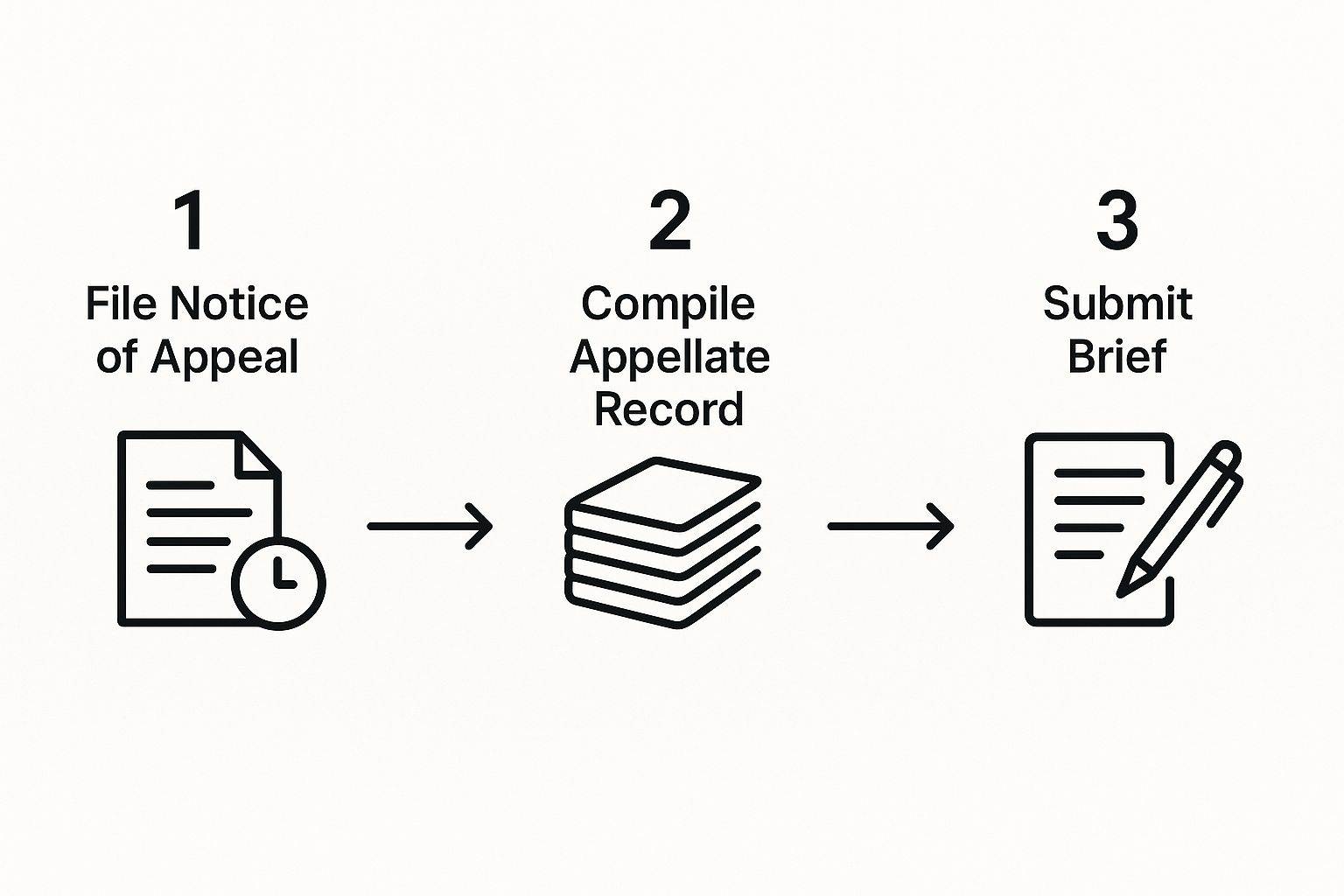
As shown, filing the Notice of Appeal sets everything in motion, leading to the detailed work of preparing the record and building your legal arguments.
Briefing and Oral Argument
After the record is finalized, the core of the appeal begins: briefing. The appellant’s brief is a carefully crafted legal document where your attorney presents your case. It combines facts from the record with legal precedent to argue why the trial judge’s mistakes require the Fourteenth Court of Appeals to correct the outcome.
The brief is where your attorney’s skill and strategy are demonstrated. It is not a simple summary but a persuasive argument designed to convince a panel of experienced judges that a serious legal error occurred and an injustice must be corrected.
After your brief is filed, the other party files their own brief in response. In some cases, the court may schedule an oral argument. This is a formal proceeding where attorneys for both sides argue their positions before the justices and answer challenging questions. It is the final opportunity to advocate for your case before the court issues its decision.
For a more detailed overview, you can learn more about the Texas family law appeals process in our complete guide.
Common Reversible Errors in Texas Family Law
Not every mistake made during a trial is enough to overturn a ruling. For an appeal to succeed in the Fourteenth Court of Appeals, the error must be a “reversible error.” This is a legal mistake so significant that it likely caused an improper outcome.
Identifying a reversible error is the key to determining whether you have a strong case for an appeal. It is not about disagreeing with the judge’s final decision but about pointing to a specific legal or procedural mistake that rendered the trial unfair. Think of it as a flaw in a building’s foundation—if the base is compromised, the entire structure is unsound.

What You Can Appeal in a Texas Divorce Case
In Texas family law, reversible errors often fall into a few common categories. Recognizing one of these can transform a feeling that something went wrong into a solid legal argument for the appellate court.
Examples of common reversible errors include:
- Misapplication of the Texas Family Code: The judge may have misinterpreted a statute, such as the rules defining separate and community property in a divorce.
- Improper Characterization of Property: If a court incorrectly classifies your separate property (like an inheritance) as community property and divides it, this is a clear error that can be appealed.
- Failure to Apply the “Best Interest” Standard Correctly: In all child custody cases, the judge must consider a specific list of factors to determine what is in the child’s best interest. If the judge ignores these factors or makes a decision without supporting evidence, it can be an “abuse of discretion.”
- Improper Admission or Exclusion of Evidence: A judge who allows inadmissible testimony or refuses to consider critical financial documents can skew the outcome, creating strong grounds for an appeal.
The High Standard for Reversal
Simply identifying a potential mistake is only the first step. The Texas appellate system sets a high standard for overturning a trial court’s decision. The review is intense and critical.
This commitment to correcting errors is evident at the highest levels. In its 2024–2025 term, the Texas Supreme Court reversed the lower appellate court in 72.3 percent of the state cases it reviewed, according to a full statistical analysis from Gibson Dunn. This shows how seriously our higher courts take the application of law.
A successful appeal must prove the trial court’s mistake was not minor but was the critical factor that led directly to the unjust outcome.
This is why appellate work is so meticulous. It requires an attorney to comb through the trial record, identify critical flaws, and build a powerful, persuasive argument that convinces the Fourteenth Court of Appeals that an injustice occurred and must be corrected.
Why You Need an Appellate Specialist
Appellate law is a distinct and specialized field. The skills that make a trial lawyer effective—such as commanding a courtroom and persuading a jury—are different from those needed to win an appeal. Appellate advocacy is a discipline of meticulous legal research, powerful writing, and a strategic eye for the subtle errors that can change an outcome.
Choosing your legal counsel for an appeal is a critical decision. This is not a task for a general practitioner; it requires a specialist who is deeply immersed in appellate law.
The Advantage of Specialized Knowledge
A seasoned appellate attorney understands the specific local rules and procedures of the Fourteenth Court of Appeals and is familiar with the judicial philosophies of the justices who will decide your case. This insider knowledge provides a powerful strategic advantage.
Their focus is entirely on the existing trial record, with the goal of building a sound argument for reversible error. It is a calm, meticulous, and confident process aimed at restoring fairness through the rule of law. An experienced family law appeal attorney brings this level of focused expertise to your case.
Navigating an Overburdened System
The need for a specialist is even more critical given the immense pressure on the Texas court system. Our state’s fourteen intermediate appellate courts are staffed by the same number of justices—just 80 total—as in 1984. During that time, Texas has experienced massive growth, leading to an 80 percent increase in the average population each justice serves.
This means your appeal must be exceptionally clear, concise, and legally sound to command the attention it deserves. For more on how this impacts the courts, you can review a report on Texas’s appellate court structure.
An appellate specialist knows how to craft a brief that cuts through the noise. They frame arguments in a way that respects the court’s limited time and gets straight to the heart of the legal error, giving your case the best possible chance of success.
Your family’s future is too important to leave to chance. A dedicated appellate lawyer doesn’t just file paperwork; they understand the strategy, nuance, and art of persuasion needed to fight for the fair result you deserve.
Frequently Asked Questions About Texas Family Law Appeals
Entering the world of appellate law can feel like learning a new language. After an emotionally draining trial, you are now facing a process with its own unique rules and timelines. It is perfectly normal to have questions.
Here are answers to some of the most common concerns we hear from clients navigating the Fourteenth Court of Appeals.
How Long Does an Appeal Take?
There is no simple answer, as an appeal is not a quick process. Depending on the complexity of your case, a typical family law appeal can take anywhere from several months to over a year to resolve.
The timeline is governed by a series of court-ordered deadlines for preparing the record and for attorneys to file their written arguments, or briefs. Once the final brief is filed, the case is “submitted” to the court, and the parties await the justices’ written opinion.
Can I Introduce New Evidence?
No. This is one of the most significant differences between a trial and an appeal. An appeal is not a second trial. The Fourteenth Court of Appeals functions like a referee reviewing a completed game; its role is only to examine what has already happened.
The justices will review the existing trial record—transcripts, evidence, and motions from the original case—to determine if the trial judge made a legal mistake. You cannot introduce a new document or have a witness testify for the first time on appeal.
The entire focus of an appeal is on identifying a reversible legal error that occurred in the original trial. We are not building a new case but are seeking to correct a past injustice based on the existing record.
What Happens if I Win My Appeal?
If the Court of Appeals agrees that a significant legal error occurred—a “reversible error”—it has several options for remedying the injustice. The outcome depends on the nature of the mistake.
The court might:
- Reverse and Render: This is the most decisive outcome. The appellate court overturns the trial court’s decision and issues the correct judgment itself. This concludes the case in your favor.
- Reverse and Remand: This is more common in family law. The court finds an error, reverses the original decision, and sends the case back to the trial court for a new hearing or trial with specific instructions on how to handle the case correctly.
If you believe the court made a mistake in your family law case, our appellate attorneys can help you seek a fair outcome. Contact The Law Office of Bryan Fagan today for a free consultation.