You may have walked out of a Texas family courtroom feeling the judge missed the mark. Maybe the temporary custody order flipped possession, changed support, or left you with a result that feels flatly unfair. At that point, the question isn't whether you're angry. It's whether the order belongs in an appeal or a mandamus petition.
Those are not interchangeable tools. In Texas family law, the wrong choice wastes time, money, and bargaining power, and the right one can preserve parental rights before the damage hardens into the next phase of the case. The court system treats final judgments and pending-case orders very differently, and that difference controls your path.
| Remedy | Best used when | What it does | Main risk |
|---|---|---|---|
| Appeal | The trial court has entered a final order | Asks a higher court to review legal error in the finished case | You may wait too long to stop immediate harm |
| Mandamus | The case is still pending and the order is causing immediate harm | Seeks emergency appellate intervention before final judgment | The standard is demanding, and relief is rare |
When a Family Law Ruling Feels Wrong
A parent walks out of a temporary hearing and realizes the order has changed daily life overnight. The child's schedule shifts immediately, school pickup is different, and the safety concern that prompted the hearing still has not been fixed. That parent does not need theory. They need the right procedural path.
In Texas family law, that path usually runs in one of two directions. A final judgment is generally reviewed by appeal. A temporary order or other nonfinal ruling usually points toward mandamus, because the case is still active and the harm may be happening now.
That difference controls the decision. Family cases often unfold in stages, and the order you are dealing with may shape the child's routine for months before final trial. Temporary conservatorship rulings, possession schedules, support orders, jurisdictional rulings, and protective-order decisions can all create immediate pressure long before a decree is signed. Texas family-law materials draw a hard line between final orders, which are usually appealed, and temporary orders, which generally are not subject to interlocutory appeal under Tex. Fam. Code § 105.001(e), leaving mandamus as the practical option when immediate review is needed Texas Family Law appellate webinar materials.
There is a clean decision rule here. Appeal is the tool for correcting the end result after the case is over. Mandamus is the tool for stopping a pending order from causing damage that ordinary appellate review cannot fix later. That gray zone shows up often in Texas family cases, and it matters most when a trial court ruling on custody, support, jurisdiction, or a protective order has immediate real-world consequences.
Use the cost-benefit test before you file anything. If the order can wait without exposing the child or a party to ongoing harm, appeal is usually the better path. If the case is still pending and the harm is happening now, mandamus deserves serious attention. For a plain-English guide to the writ itself, see this Texas mandamus overview for family law cases.
Practical rule: if the order can realistically be corrected later without leaving the child or party exposed in the meantime, appeal is usually the cleaner path. If the harm is happening now and the case is still pending, mandamus deserves serious attention.
What an Appeal and a Mandamus Do
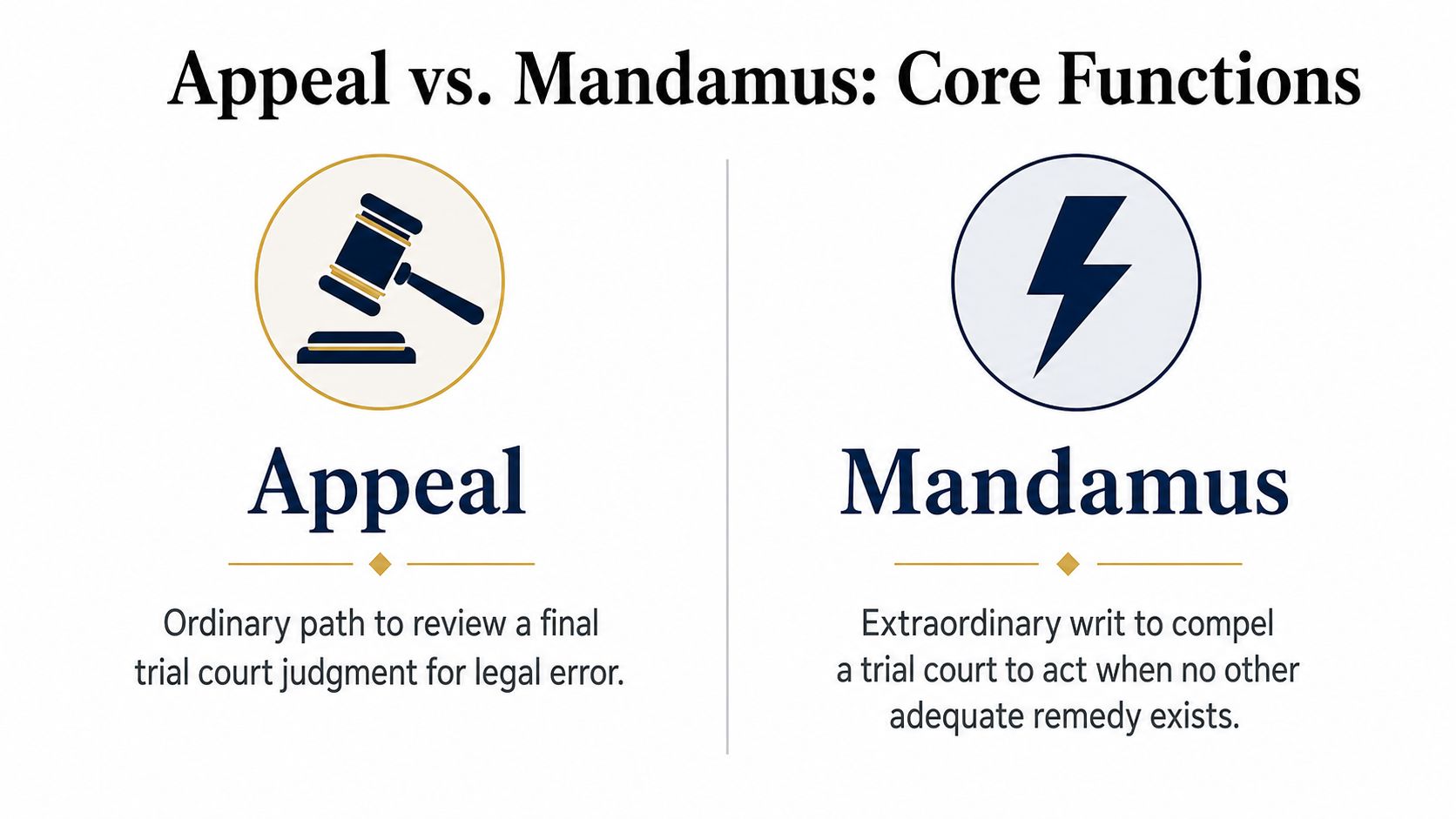
An appeal is the ordinary review process after a case ends. The appellate court reviews the record, looks for legal mistakes, and decides whether those mistakes affected the result. If the trial court made a reversible error in the final decree, appeal is the route that addresses it.
A mandamus petition works differently. It is an original proceeding, not a normal appeal, and it asks the appellate court to direct the trial judge to do something or stop doing something while the case is still pending. Appeal reviews a finished case. Mandamus intervenes during the case because waiting would let the harm continue.
That is why Texas courts call mandamus an extraordinary remedy. It is not a second bite at the apple. It is reserved for situations where the trial court clearly went wrong and ordinary appeal does not provide a real fix. The standard stays high for a reason, and the numbers reflect it. In a Texas Supreme Court survey covering the five fiscal years shown in the source table, new mandamus petitions ranged from 187 to 225 per year, while grants remained low, including 3.3% in 2019, 5.5% in 2020, 6.9% in 2018, and 7% in 2022 in a separate FY 2023 statistical report Texas Supreme Court mandamus statistics. For a plain-English explanation of the writ, see this writ of mandamus overview for Texas family law cases. The point is simple. Mandamus is narrow by design, and judges grant it sparingly.
For clients, the terms are easier to sort out this way. Abuse of discretion means the trial court made a decision outside the reasonable range allowed by law. Reversible error means the mistake mattered enough that a higher court can undo the result. Briefing is the written argument that explains the error, the law, and the remedy you want.
If you are challenging a final decree, a Texas Family Law Appeals Lawyer handles appellate representation for legal error in final family law orders. If you are dealing with a live dispute and a temporary ruling, the appellate analysis still matters, but the procedural path changes with the posture of the case.
The quickest way to separate the two is to ask one question. Is the court being asked to fix a finished case, or to stop a bad order from doing more damage before the case ends? Everything else follows from that answer.
The Legal Standards That Decide Each Path
Texas appellate procedure does not reward guesses. It rewards the lawyer or parent who chooses the right remedy, preserves the issue, and argues the right standard. The Texas Rules of Appellate Procedure and the Family Code control that analysis. They decide whether a court can hear the complaint, and how closely it will look at the ruling.
Appeal starts with finality and preservation
An appeal begins with one question, whether the order is final. Texas family-law practice treats final orders as appealable and temporary orders as generally outside that lane. Then comes preservation, because appellate courts usually will not rescue an argument that was never raised in the trial court. Objections, offers of proof, and the right post-judgment motions are required steps, not formalities.
Bottom line: if the complaint was never properly raised below, the appeal usually fails before the court reaches the merits.
Mandamus has a much harder gate
Mandamus requires clear abuse of discretion and no adequate remedy by appeal Texas family law appeals overview. The second requirement does most of the work. It is not enough to show the trial court got it wrong. You have to show that a normal appeal will not fix the problem in time.
That is why mandamus is the right tool for certain temporary custody, possession, support, jurisdictional, and procedural rulings. It is also why courts deny many petitions that raise serious concerns but never prove urgency. The Texas Supreme Court's FY 2023 report shows how sparingly mandamus relief is granted, as noted earlier. Importance alone does not carry the day.
The phrase that decides the case
If you remember one phrase, remember this one. No adequate remedy by appeal is not boilerplate. It is the core of mandamus. Texas appellate courts use it to separate true emergency intervention from complaints that can wait until final judgment.
That choice has real cost on both sides. File mandamus too early, and you risk spending time and money on a petition the court will deny because the record is thin or the harm is not irreparable. Wait for appeal, and you may let a bad temporary order shape custody, possession, support, or jurisdiction in a way that cannot be fully undone later. That is the practical decision point in gray-zone cases, especially when the order is temporary, jurisdictional, or protective-order related.
Texas appellate briefing also turns on standards of review. If you are preparing a final appeal, the appellate court will not retry the case. For a clear map of how those standards match different rulings, see standards of review mapped to ruling type.
Where Each Remedy Fits in Texas Family Cases
A final family judgment belongs in the appeal lane. A temporary order usually does not. That simple divide solves a lot of bad filing decisions in Texas family law.
A divorce decree is the classic appeal candidate. Final custody decrees, property division rulings, child support findings, enforcement judgments, and contempt judgments that are properly appealable also fit there. Once the trial court signs a final order, the appellate court can review the record and decide whether the outcome rests on legal error.
Temporary orders are a different problem. A temporary conservatorship ruling, a possession schedule during the case, interim support, or a protective-order-related ruling may need immediate review because the family cannot wait for final trial. Texas law generally keeps temporary orders out of interlocutory appeal, including under Tex. Fam. Code § 105.001(e), so mandamus is often the practical route in high-conflict cases, as noted in the Texas Family Law appellate webinar materials. The same approach often applies to some jurisdictional and discovery rulings when delay would make later relief meaningless.
The gray zone is where lawyers get burned. Some orders look final but are not. Some are mixed, part final and part interlocutory. Some are post-judgment orders that take effect immediately even though the decree is already signed. Those situations require a lawyer who can read finality carefully, not just one who knows the labels.
| Order type | Usual remedy | Why |
|---|---|---|
| Final divorce decree | Appeal | The case has ended, so appellate review fits the result |
| Final custody or support decree | Appeal | The order is final enough for ordinary appellate review |
| Temporary custody or possession order | Mandamus | Temporary orders are generally not interlocutorily appealable |
| Temporary support ruling | Mandamus | Immediate harm may occur before final judgment |
| Protective-order-related interim ruling | Often mandamus or later appeal, depending on finality | The key question is whether the order is final enough to appeal |
| Jurisdictional ruling during a pending case | Often mandamus | A live case may need immediate correction if appeal is too late |
The question is not whether the order felt important. It is whether the order is legally final enough for appeal or interim enough to justify mandamus. Get that wrong, and the appellate court may never reach the merits. For the preservation side of that analysis, see the objections that make or break an appeal.
Timing, Records, and Preservation in Practice
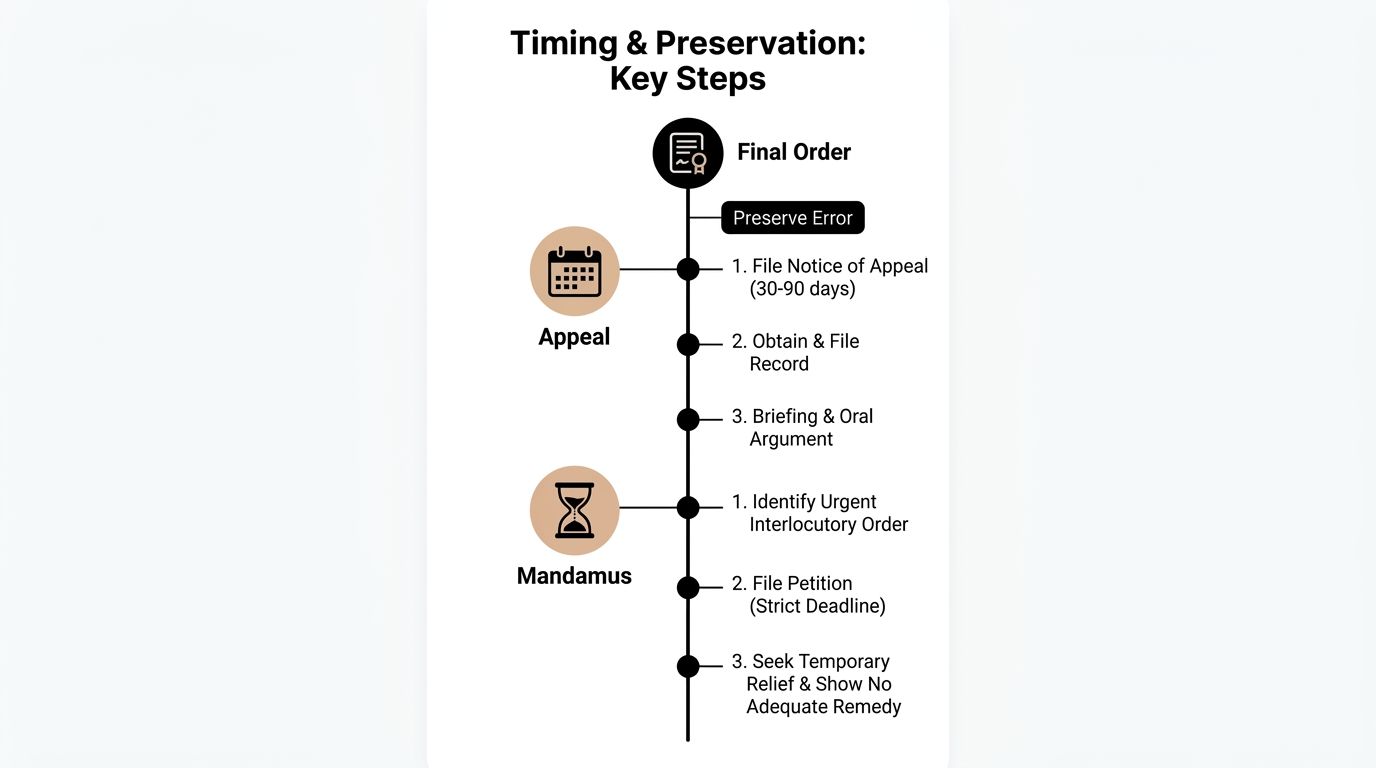
A wrong move on timing can kill an otherwise strong complaint. In appeal, Texas appellate practice materials explain that a notice of appeal is usually due within 30 days after the final order is signed, and some post-judgment filings can extend that deadline to 90 days. Mandamus works on a different clock because the case is still active, so delay can make the requested relief harder to obtain. Those timing rules are why lawyers need to identify the path before they lose it.
Appeal requires a record that proves the error
An appeal rises or falls on the trial record. The clerk's record, the reporter's record, and the brief all have to line up so the court can see the ruling, the objection, and the harm. If the evidence, objection, or order is missing from the record, the appellate court usually cannot correct the problem. A clean appellate issue starts in the trial court, not in the brief.
Mandamus demands speed and precision
Mandamus is filed while the case is still pending, and the petition has to show the challenged ruling and why it is wrong. The record must already contain the order and the materials that prove why the trial court clearly abused its discretion. There is no room to build the record later or hope the missing pieces can be reconstructed after the fact.
Preservation controls both paths. If the issue was never raised, objected to, or made part of the record, neither appeal nor mandamus will save it.
Trial lawyers need to think about preservation early and in real time. Make objections on the record. Ask for rulings. Offer proof when evidence is excluded. File the required post-judgment motions when the rules call for them. If you are building a record for appeal, preserving error at trial is the starting point, because the appellate court will not create a record for you.
Briefing is not paperwork, it is the case
In both appeal and mandamus, the brief is where the court learns what happened and why the law supports your position. A weak brief makes a good issue look minor. A strong brief cannot rescue a record that does not contain the ruling, the objection, or the proof the court needs. That is why deadline discipline and record-building matter just as much as the legal theory.
Risks, Benefits, and the Cost of Choosing Wrong
Mandamus can be the right tool, but it is not the safe tool. It can get faster relief, and in the right case that speed is the whole point. It can also fail outright, leaving the client worse off because the court has seen the weakness in the record and the other side now knows where the pressure points are.
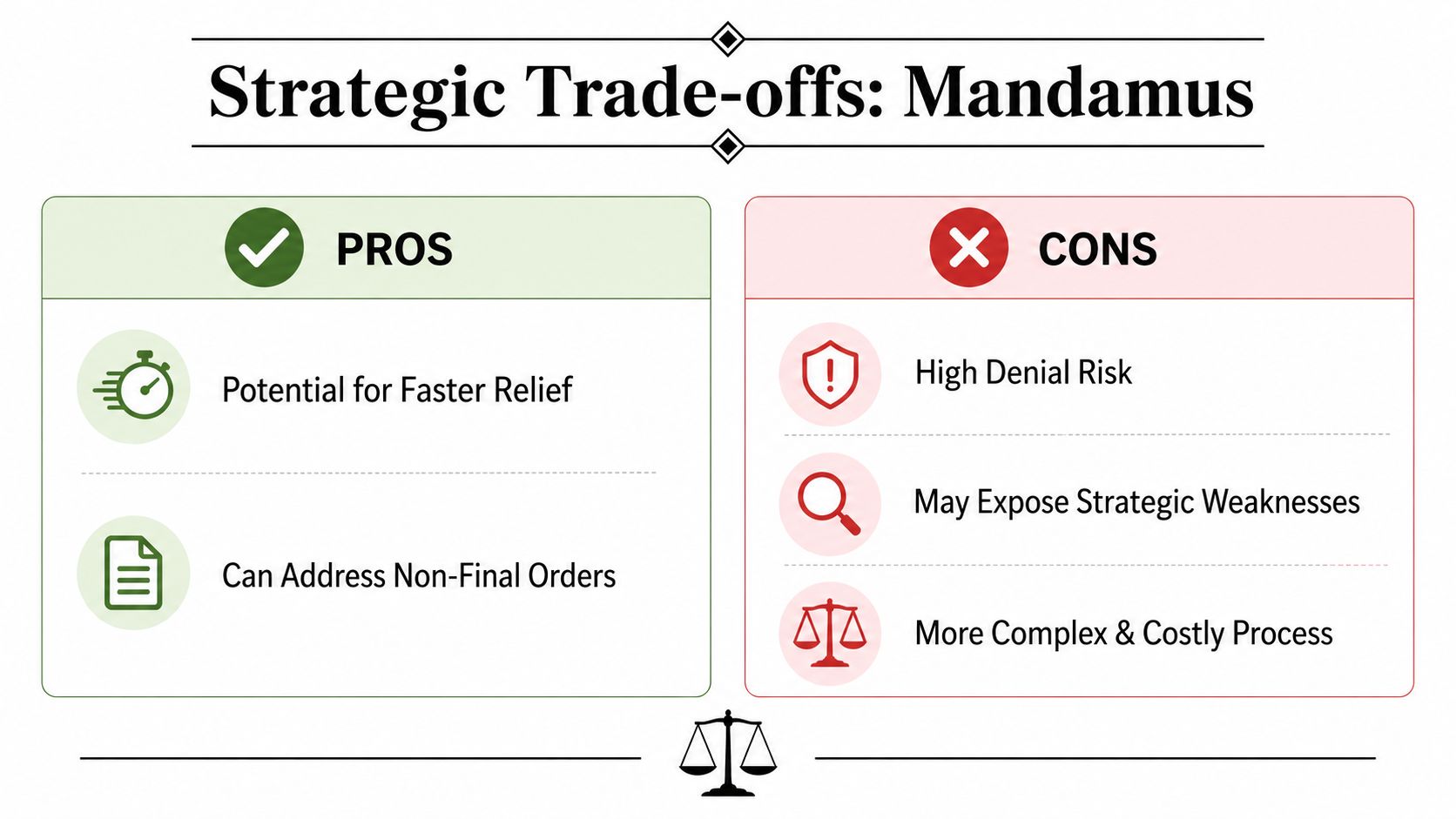
Texas Supreme Court mandamus filing data show a simple pattern. New petitions are filed in the low hundreds in the years reflected in the source table, but grants remain uncommon, including 7% in 2022 and earlier rates as low as 3.3% and 5.5% in the years specifically listed in the source table Texas Supreme Court mandamus statistics. That is what an extraordinary remedy looks like in practice. Most petitions do not win.
When mandamus is worth the risk
Use mandamus when a temporary order is causing immediate harm and the case cannot wait. That usually means a live possession fight, a jurisdictional ruling, or a procedural order that would make later review pointless. In those situations, delay can cost the child stability, the parent's access, or the client's position in settlement.
Mandamus also makes sense in the gray zone where the order is not plainly final but is still doing damage now. Temporary orders, jurisdictional rulings, and protective-order issues can all fit that category. If the harm is happening before final judgment and waiting would leave the client stuck with it, mandamus deserves serious attention.
When appeal is the cleaner choice
If the order is final and the injury can be corrected in one appellate record, appeal is usually the better path. It is more familiar, more orderly, and often less exposed to the all-or-nothing pressure that comes with mandamus. Appeal also fits the pattern of Texas family cases, which often contain multiple rulings, and not every wrong ruling needs emergency intervention.
That is especially true when the complaint is about a ruling that can be reviewed after final judgment without losing the client's practical remedy. If the issue is preserved and the record is intact, appeal gives you a cleaner track and avoids the risk of spending your best argument on a petition that never had a realistic shot.
The mistake people make most often
The most expensive error is choosing mandamus too early or too casually. Some parties rush to emergency relief when the order is not clearly nonfinal, or when the record has not been preserved well enough to support either remedy. Others wait too long and lose the chance to stop an order that was harming them from day one. Both mistakes are avoidable.
The cost-benefit calculation is simple. If the harm can wait for final judgment, build the appellate record and prepare for appeal. If the harm cannot wait, get mandamus counsel involved immediately and treat the record like the case depends on it, because it does.
The Law Office of Bryan Fagan, PLLC handles appellate representation in final family law orders and can also help evaluate whether a live temporary ruling belongs in the mandamus lane. That kind of early triage saves clients from filing the wrong remedy and losing time they cannot get back Texas Family Law Appeals Lawyer.
Your Decision Framework and Next Steps
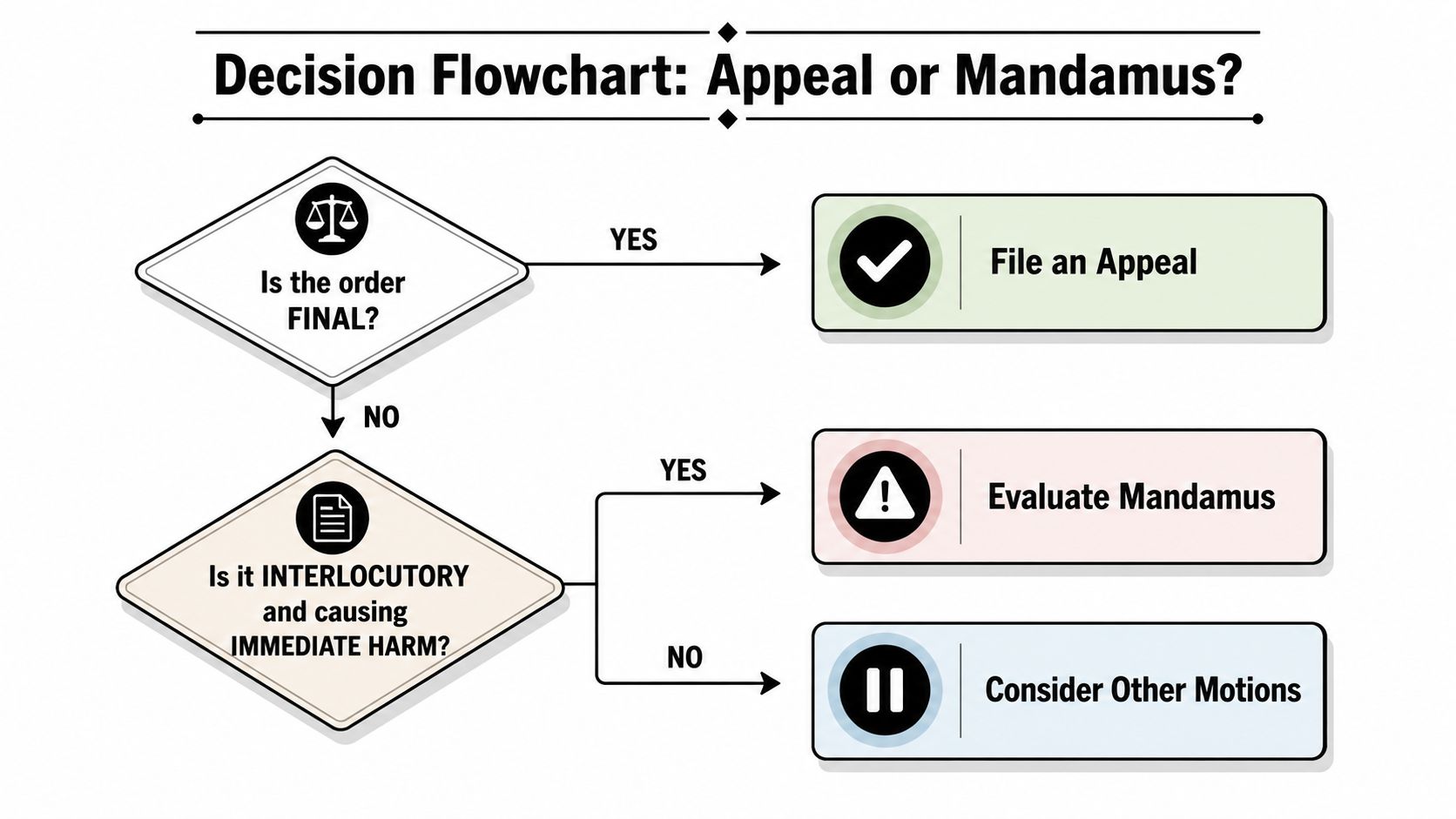
The right decision starts with the order itself.
If the order is final, think appeal. If the order is interlocutory, temporary, or otherwise still live and causing immediate harm, think mandamus. If the order sits in the gray zone, such as partial finality, a jurisdictional dispute, or a post-judgment emergency, get appellate counsel involved before you burn time on the wrong filing.
Use this quick checklist:
- Identify the order type: final decree, temporary order, or mixed ruling.
- Check the deadline immediately: appeal deadlines are short, and mandamus timing can also become a problem if you delay.
- Confirm preservation: make sure the issue was raised, objected to, and made part of the record.
- Match the remedy to the harm: if waiting will defeat relief, evaluate mandamus. If not, build the appeal.
For a straightforward overview of the topic in motion, the embedded video below is a useful reference.
When you are standing in the gray zone, speed matters, but judgment matters more. A rushed filing can be just as damaging as no filing at all, especially in family law where possession, support, and safety can change overnight. The right move is the one that fits the order, the record, and the remedy the appellate court can grant.
If you believe the court made a mistake in your family law case, our appellate attorneys can help you seek a fair outcome. Contact The Law Office of Bryan Fagan today for a free consultation. Visit The Law Office of Bryan Fagan, PLLC to evaluate whether appeal or mandamus is the right path for your case and take the next step toward a stronger result.