You may feel your case was handled unfairly. A judge may have entered a temporary custody order that upended your child's routine, signed a discovery order that exposes private information, or refused to put an oral ruling into a written order you can enforce.
When that happens, waiting for the end of the case can feel impossible. In the narrow set of family law situations where immediate appellate intervention is necessary, Texas law allows a specialized procedure called a writ of mandamus. It isn't a second trial. It isn't a broad redo. It's a focused request asking an appellate court to step in before the case is over because the harm can't reasonably wait.
For parents and spouses trying to understand writ of mandamus Texas family law issues, the hardest part is often knowing whether the order is merely frustrating or legally urgent. That distinction matters. So does the record, the briefing, and the standard the appellate court will apply under the Texas Rules of Appellate Procedure and the Texas Family Code.
When a Court Ruling Causes Immediate Harm
You may be living in that exact moment right now. A ruling has already changed your week-to-week life, your access to your child, your financial stability, or your ability to protect private information in court.

In many family cases, a regular appeal comes later, after a final judgment. But some rulings cause harm now. If a temporary order wrongly changes where a child primarily lives, or a court compels disclosure of material that should remain protected, the damage may happen long before a standard appeal is available.
That's where mandamus enters the conversation. It is an original proceeding filed while the case is still pending, not after everything is over. Texas appellate procedure allows this kind of filing in limited circumstances when immediate relief is necessary and an ordinary appeal won't fix the problem later. For a focused look at urgent custody-related relief, see this discussion of emergency mandamus in Texas custody cases.
What clients usually struggle with first
Individuals don't call an appellate lawyer because they enjoy procedure. They call because something feels wrong and they need to know two things quickly:
- Can a higher court act now instead of making me wait until the end?
- Will this ruling affect my child or my rights in a way that can't be undone later?
- Do I need a regular appeal, mandamus, or some other immediate review option?
A mandamus case begins with urgency, but it succeeds only with precision.
Trials and appeals work differently. At trial, the court hears witnesses, weighs evidence, and makes factual decisions. In an appellate proceeding, judges usually review the written record, the controlling law, and the legal standard that applies to the issue in dispute. That difference is especially important in mandamus practice, where the court often decides the matter from the papers alone.
What Is a Writ of Mandamus in a Family Law Case
A writ of mandamus is best understood as an emergency request to a higher court to correct a serious legal error before the family case reaches a final judgment. In Texas family law, it is filed during the case, not after it ends.
A regular appeal asks the appellate court to review a final order or judgment after the trial court has finished its work. A mandamus petition is narrower. It asks the appellate court to direct the trial court to correct an action, refrain from an unlawful action, or perform a duty the law clearly requires.
Think of it as an emergency brake
Mandamus is not a way to say, “I disagree with the judge.” It is closer to saying, “The judge crossed a legal line, and waiting until later won't protect my rights.”
Texas procedure recognizes mandamus as an original proceeding governed by Texas Rule of Appellate Procedure 52, and authority for this relief comes from the Texas Constitution, the Government Code, and the Family Code in certain child-related contexts, as described in this discussion of mandamus relief in Texas appellate courts.
Here are common family-law settings where lawyers consider mandamus:
| Situation | Why mandamus may be considered |
|---|---|
| A discovery order invades protected rights | Once private or privileged material is disclosed, the harm may not be fixable later |
| A temporary ruling changes a child's primary residence | Time and disruption in the child's life may create immediate consequences |
| A judge gives an oral ruling but never signs the written order | The lack of a written order can block enforcement or review |
It is not a trial do-over
Understandably, many people get confused. A mandamus petition doesn't ask the appellate court to rehear all the evidence from scratch. It focuses on whether the trial court had a clear legal duty, applied the law correctly, and acted within the limits of its discretion.
That's why standard of review matters so much. If you want a plain-English explanation of why that standard often decides the outcome, see Standards of Review in Texas Family Appeals.
If the issue turns on unsettled facts, mandamus is often the wrong tool. If the issue turns on a clear legal mistake causing immediate harm, mandamus may be the right one.
You can also compare this special proceeding with broader appellate options through Mandamus in Texas Family Cases, which addresses rulings that can't wait for a final appeal.
The High Bar for a Writ of Mandamus
Mandamus is powerful, but the standard is intentionally severe. In Texas family law, a writ of mandamus is available only when the relator proves two strict elements: (1) a clear abuse of discretion by the trial court, and (2) no adequate remedy via ordinary appeal. Even if a trial court errs, mandamus will not issue unless waiting for appeal would cause irreparable harm, as explained in this article on procedural requirements in Texas mandamus petitions.
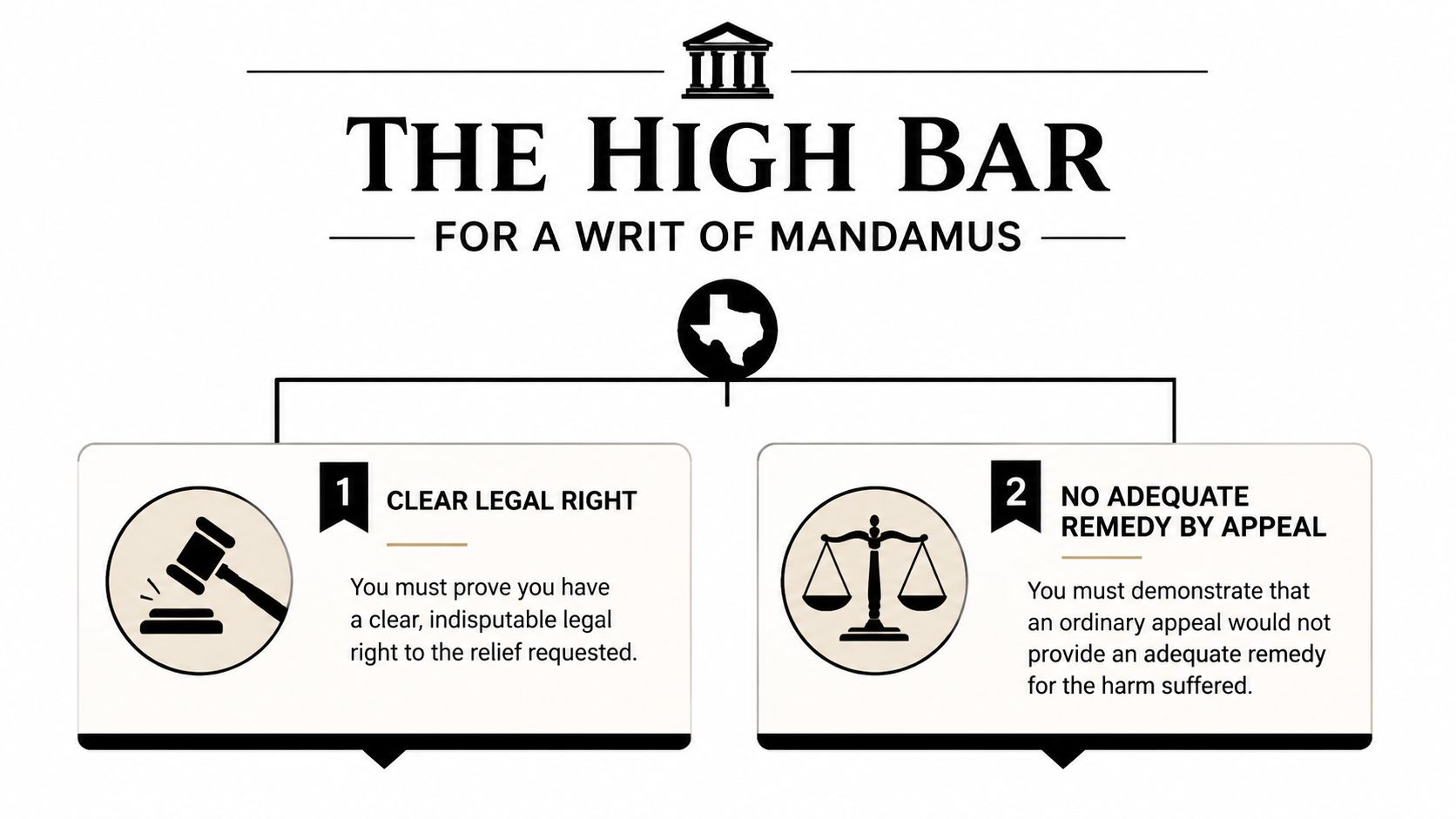
Clear abuse of discretion
Abuse of discretion is a legal term. In plain English, it means the trial court made a decision so arbitrary and unreasonable that it became a clear legal error. Texas courts describe it as a ruling that is “so arbitrary and unreasonable as to amount to a clear and prejudicial error of law,” a definition discussed in this overview of Texas mandamus and abuse of discretion.
That does not mean every bad ruling qualifies. Judges are allowed to make judgment calls within the bounds of the law. Mandamus is for the ruling that falls outside those bounds.
Examples help:
- A court compels protected material when the law clearly shields it from disclosure.
- A court changes a child's primary residence through a temporary order in a way that conflicts with controlling law.
- A court acts without legal authority and enters a void order.
A related phrase you may hear is reversible error. That means a legal mistake significant enough to justify appellate correction. In a regular appeal, reversible error may lead to reversal after final judgment. In mandamus, the mistake must usually be more urgent because the court is being asked to intervene mid-case.
No adequate remedy by appeal
The second requirement often decides the case. You must show that a normal appeal, later, won't adequately repair the damage.
That does not merely mean an appeal would be inconvenient or expensive. It means the harm is the kind that can't be fully undone once it happens.
Consider these examples:
Wrongful disclosure of protected information
Once the information is produced, confidentiality may be lost for good.Temporary orders that disrupt a child's stability
If a child is wrongly moved or separated from a stable arrangement, time itself can become part of the harm.Contempt without due process
Some orders create immediate liberty or procedural concerns that can't be treated as ordinary trial errors.
Courts ask a practical question: if the relator waits for a normal appeal, will the law still be able to provide a meaningful remedy?
Why the record matters so much
Mandamus is document-driven. The relator carries the burden, and Texas Rule of Appellate Procedure 52.7 requires a certified or sworn record containing the material documents from the underlying proceeding. If the record is incomplete or not properly authenticated, the appellate court may deny relief even where the complaint sounds serious.
That's why many strong-sounding mandamus complaints fail. The issue isn't always whether the client feels harmed. It's whether the petition proves, on the law and the authenticated record, that the trial court clearly crossed a line and that later review won't be enough.
When to Use Mandamus Instead of a Regular Appeal
The easiest way to understand the difference is to look at how these two paths function in real family cases.
A regular appeal usually follows a final judgment, such as a final divorce decree, a final custody order, or another appealable final order. The appellate court then reviews the record for legal error under the applicable standard of review. A mandamus proceeding is different. It is filed before the case is final for urgent problems that need immediate appellate attention.
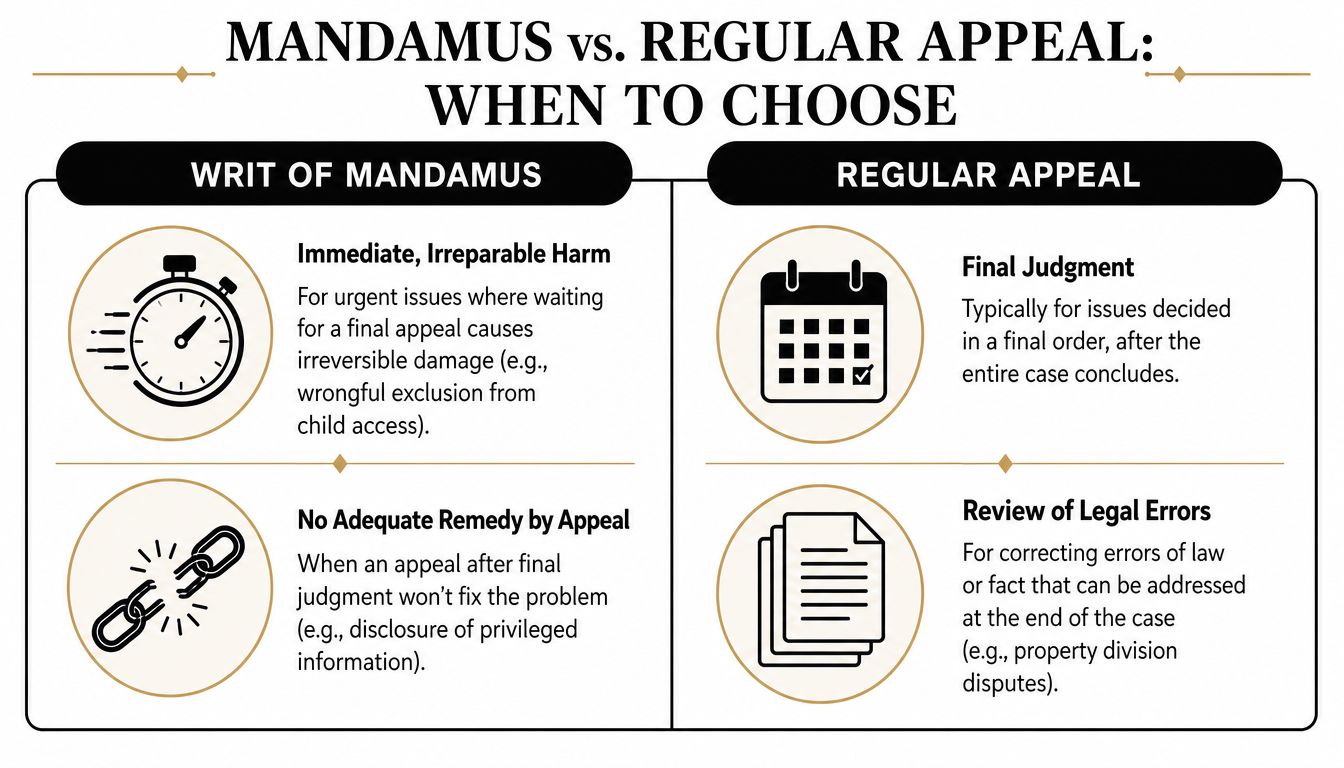
Texas family lawyers frequently use mandamus to challenge trial court rulings on discovery, conservatorship decisions affecting a child's primary residence, or a failure to enter a written order. That description comes from this discussion of when and how to seek mandamus relief in Texas appellate courts.
Common family law situations
A parent may call after a temporary hearing and say, “The judge changed where my child lives, and I can't wait until the whole case is over.” That may raise a mandamus question.
Another spouse may say, “The court ordered me to turn over material my lawyer says should remain protected.” That may also point toward mandamus, because once disclosure happens, the damage may not be reversible in a practical way.
A third person may be dealing with an order entered without legal authority at all. Void orders are different from merely unfavorable orders. When a trial court lacks authority for what it did, immediate intervention may be the proper strategy.
To compare one kind of immediate review with another, this article on interlocutory appeal in Texas family law helps show why some rulings fit mandamus better than a standard appeal.
A simple side-by-side view
| Question | Mandamus | Regular appeal |
|---|---|---|
| When is it filed | During the case | After final judgment |
| What problem does it target | Immediate legal error causing harm that can't wait | Error that can be reviewed at the end |
| What does the court review | A focused legal complaint and mandamus record | The final judgment and appellate record more broadly |
For a visual overview of this choice, this short video is a useful starting point.
Common reversible errors in family court
Not every trial court mistake calls for mandamus, but many family appeals and original proceedings begin with one of these issues:
- Misapplying the Family Code in a custody, support, or property ruling
- Ignoring procedural safeguards required by the Texas Rules of Appellate Procedure or due process principles
- Entering an order outside the court's authority
- Refusing to reduce a ruling to a written order when the law requires action
Those are legal problems, not just disappointing outcomes. That distinction is what shapes the next step.
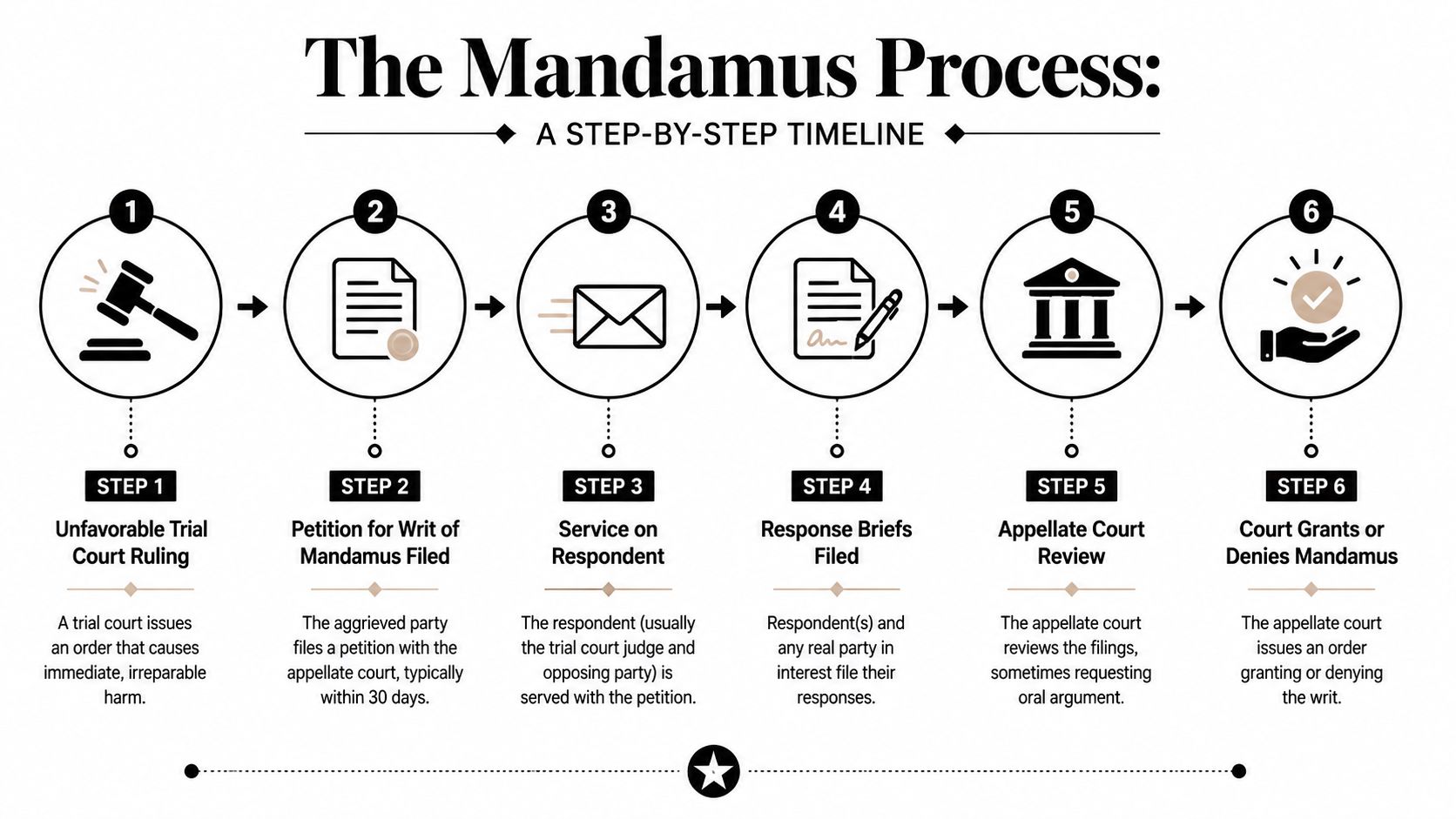
The Mandamus Process A Step by Step Timeline
A mandamus case moves faster than a standard appeal, but it is not informal. Every step is controlled by rules, deadlines, and record requirements.
Step one through step three
First, the party seeking relief becomes the relator. The trial judge is usually identified as the respondent, and the opposing party is often called the real party in interest.
Then counsel prepares the petition for writ of mandamus. This is the core brief. It explains the order being challenged, the legal error, the basis for immediate relief, and the precise action the relator wants the appellate court to require or forbid.
The next critical piece is the mandamus record. This usually includes the relevant pleadings, orders, exhibits, and hearing transcripts. Under the Texas Rules of Appellate Procedure, the documents must be properly certified or sworn.
Practical rule: If a key document or transcript is missing from the record, the appellate court may assume the relator failed to prove the complaint.
What happens after filing
Once the petition and record are filed, the relator serves the respondent and the actual party in interest. In urgent cases, counsel may also request temporary emergency relief to pause the effect of the challenged order while the court considers the petition.
The appellate court may ask for a response. Sometimes it requests a reply from the relator as well. Most mandamus matters are decided on written submissions. As noted in this article on mandamus relief in Texas family law cases, oral argument is rarely granted, so the briefs usually carry the full weight of the case.
Why this differs from a trial
At trial, lawyers build facts through testimony and exhibits. In mandamus, the facts have usually already been made. The appellate court studies the paper record and asks whether the law clearly required a different result.
That changes how attorneys prepare the case:
- Record first because missing documents can sink the petition
- Legal framing next because the issue must be presented as a clear legal wrong
- Relief requested last because the court needs a specific, lawful action to order
Why timelines matter
A standard appeal has its own timetable tied to a final judgment, notice of appeal, clerk's record, reporter's record, and briefing schedule. Mandamus doesn't follow that same end-of-case sequence because it is an original proceeding. The need for speed is real, but so is the need for accuracy. Filing too late can undercut the urgency argument. Filing too fast without the right record can undercut the legal one.
Building a Winning Petition Key Arguments
In a mandamus case, briefing is the case. Briefing means the written legal argument filed with the appellate court. Because live argument is uncommon, the petition must do the heavy lifting from the start.
The strongest petitions do not solely repeat that the ruling felt unfair. They translate that unfairness into a disciplined legal claim. To obtain mandamus relief, the relator must prove that the act sought to be compelled is purely ministerial, meaning the trial court had a clear and indisputable legal duty to act or refrain from acting, and that no other adequate legal remedy exists, as explained in this article on the writ of mandamus and ministerial duties.
What good petitions do
A persuasive petition usually does four things well:
- Preserves error by showing the issue was properly raised in the trial court record
- Identifies the exact ruling at issue instead of attacking the case as a whole
- Connects the ruling to a clear legal duty rather than a mere disagreement with judicial judgment
- Explains why waiting would fail in practical, legally grounded terms
What weak petitions often do
Weak petitions often drift into trial-level storytelling. They reargue facts, relive personal frustration, and ask the appellate court to “see how wrong this feels.” Appellate judges need something narrower. They need the statute, the rule, the order, the preserved objection, and the legal reason the court must act now.
That's why petition drafting often benefits from focused appellate counsel. A resource like this guide to a petition for writ of mandamus in Texas family court can help frame what the court expects to see.
The most effective mandamus petition sounds less like outrage and more like controlled proof.
Mandamus issues can also grow out of other family law disputes, including Texas child custody appeals, Texas divorce appeals, Texas property division appeals, and Texas protective order appeals.
Potential Outcomes and Your Next Steps
After the appellate court reviews the petition, record, and any responses, it will either grant relief, deny relief, or sometimes request further action before deciding. If the court grants mandamus, it usually directs the trial court to correct the error. If the court denies relief, the challenged ruling generally remains in place, and the party must continue in the trial court while preserving issues for any later appeal.
Realistic expectations matter here. In Texas family law proceedings, a writ of mandamus is granted only 10.3% of the time, based on a survey, which underscores how extraordinary and rarely awarded this remedy is, as described in this discussion of Texas CPS writ of mandamus practice.
That number shouldn't discourage a party with a strong case. It should sharpen the analysis. Mandamus is not the right answer for every unfair ruling. But when a trial court has caused immediate legal harm that a later appeal can't adequately fix, it can be the right tool.
Your next step is usually straightforward:
- Gather the order, motion, notice, and hearing materials.
- Identify what legal duty or rule you believe the trial court violated.
- Get an appellate review quickly, before delay weakens the urgency of the complaint.
If you believe the court made a mistake in your family law case, our appellate attorneys can help you seek a fair outcome. Contact The Law Office of Bryan Fagan today for a free consultation.
If you believe the court made a mistake in your family law case, our appellate attorneys can help you seek a fair outcome. Contact The Law Office of Bryan Fagan, PLLC today for a free consultation.