You may feel your Texas family law case was handled unfairly. You may have left court after an unfavorable divorce decree, property-division ruling, custody order, or protective order and been told to “look into an appeal.” Then the practical question arrives: Do you have 30 days, 90 days, or even less?
The answer depends on the type of case, the date the judge signed the judgment, and whether a qualifying post-judgment motion was filed on time. The TRAP 26.1 ninety day deadline when a new trial motion is filed can give you more time in an ordinary civil appeal, but it doesn't apply automatically to every family law case and it doesn't excuse a late motion.
When the Clock Really Starts After a Family Court Judgment
A client walks out of a Texas family courtroom after losing a property dispute in a divorce. The clerk gives her a final decree, several notices, and a stack of papers filled with legal terms. She knows she disagrees with the ruling, but she doesn't know whether the appeal clock started when the judge announced the decision, when she received the decree, or when the court entered it into the clerk's file.
For most Texas family law appeals, the important date is the date the trial court signs the final judgment. Texas Rule of Appellate Procedure 26.1 generally measures the notice-of-appeal deadline from that signing date, not from the date a party learns about the ruling. The Texas Rules of Appellate Procedure are available in the official Texas appellate rules.
That distinction matters in a divorce decree, a final property-division order, a custody or visitation judgment, a child-support ruling, and many other appealable family orders. A party may be waiting for a written copy while the calendar is already running. A lawyer should confirm the signed judgment immediately and preserve the file-stamped copy.
The first decision after judgment
The ordinary calculation begins with a 30-day notice-of-appeal period. A timely motion for new trial, motion to modify the judgment, motion to reinstate, or another qualifying post-judgment motion can change the deadline to 90 days from the date the judgment was signed. The motion itself has its own filing deadline, so waiting to see whether the judge grants or denies it can be dangerous.
Requests for findings of fact and conclusions of law may affect appellate preparation and, in some situations, appellate timing. They aren't a substitute for checking the exact rule that applies to the judgment and the type of appeal. The same is true for motions labeled “motion to vacate” or “motion to reconsider.” The label alone doesn't decide whether the motion qualifies.
Practical rule: Start with the signed judgment, identify the proceeding type, and then determine whether a timely qualifying motion changes the deadline.
The consequences are especially serious in parent-child cases. Some family appeals are accelerated, and the ordinary 90-day calculation may not apply. A missed deadline can prevent appellate review before the court ever reaches whether the trial court made a legal mistake.
How Texas Rule of Appellate Procedure 26.1 Sets the Deadline
Rule 26.1 is easier to understand when reduced to a few practical questions.
Is the appeal ordinary or accelerated
In an ordinary appeal from a final family law judgment, the notice of appeal is generally due 30 days after the judgment is signed. Rule 26.1(a) extends that period to 90 days after signing if a party timely files a motion for new trial, motion to modify the judgment, motion to reinstate, or another motion recognized by the rule. The Texas Supreme Court has described the importance of this timing requirement in its published discussion of the appellate deadline.
The extension is tied to the timely filing of the motion. You don't need a separate order granting extra time, but you do need to file the qualifying motion within the applicable post-judgment window. The trial court's later ruling on the motion doesn't restart the 90-day period.
An accelerated appeal follows a different clock. Texas materials explain that certain family proceedings, including parental-termination and some child-protection matters, carry a 20-day notice-of-appeal deadline, and a motion for new trial generally doesn't extend that deadline in an accelerated case. Texas appellate rules identify the accelerated framework, while the specific family proceeding determines whether it applies.
What does “timely” mean
“Timely” means filed within the period the governing rule allows. A motion filed after the applicable 30-day window may be considered by the trial court in some circumstances, but it generally won't create the 90-day appellate deadline. The critical event is the filing date, not the date of a hearing or the date the judge signs an order denying the motion.
This is why a Texas Family Law Appeals Lawyer may begin by reviewing the file-stamped judgment and every post-judgment filing before discussing the merits. Appellate representation challenging final family law orders for legal error depends first on preserving jurisdiction.
Why the notice matters
The notice of appeal starts the appellate process. It tells the trial court and the court of appeals that a party seeks review, but it doesn't function as a new trial request. A family law appeal then depends on the record, the preserved complaints, the applicable standard of review, and focused briefing.
A useful deadline overview appears in this explanation of notice-of-appeal deadlines. The central point is simple: Rule 26.1 calculates the deadline from the signed judgment, and a timely qualifying motion changes the ordinary calculation from 30 days to 90 days.
Calculating Your Ninety Day Deadline Step by Step
Suppose a Texas family court signs a final judgment on January 5, 2025. Under the general counting method in Texas Rule of Appellate Procedure 4.1, the signing date is treated as the starting date, and the first counted day is January 6.
Without a timely qualifying post-judgment motion, the ordinary 30-day deadline falls on February 4, 2025. If a timely motion for new trial is filed within 30 days after the judgment was signed, Rule 26.1 generally moves the notice-of-appeal deadline to 90 days after January 5, which is April 5, 2025. If the calculated date falls on a weekend or legal holiday, the deadline moves to the next day that isn't a Saturday, Sunday, or legal holiday under the applicable counting rule.
Work the calendar, not your memory
The calculation should be written down in at least two separate places:
- Signed judgment: January 5, 2025.
- Motion deadline: Within 30 days after signing.
- Ordinary notice deadline: February 4, 2025.
- Extended notice deadline: April 5, 2025, if the motion is timely and the appeal is not accelerated.
- Trial court plenary-power limit: Generally up to 105 days after signing when the motion is timely.
The 105-day period concerns the trial court's authority to act on the judgment. It doesn't mean the notice of appeal waits until plenary power expires. The appellate deadline still runs from the judgment's signing date, not from the date the judge rules on the motion.
A late motion creates a different result. If the same judgment was signed on January 5 but the motion for new trial was filed after the 30-day filing window, the motion generally doesn't trigger the 90-day extension. The original February 4 notice deadline controls, subject to any narrowly available extension procedure.
You can find another calendar-focused explanation in this guide to Texas notice-of-appeal deadlines. Don't estimate these dates from the hearing date, the date you received the decree, or the date the judge denied the motion. Use the signed judgment and count calendar days carefully.
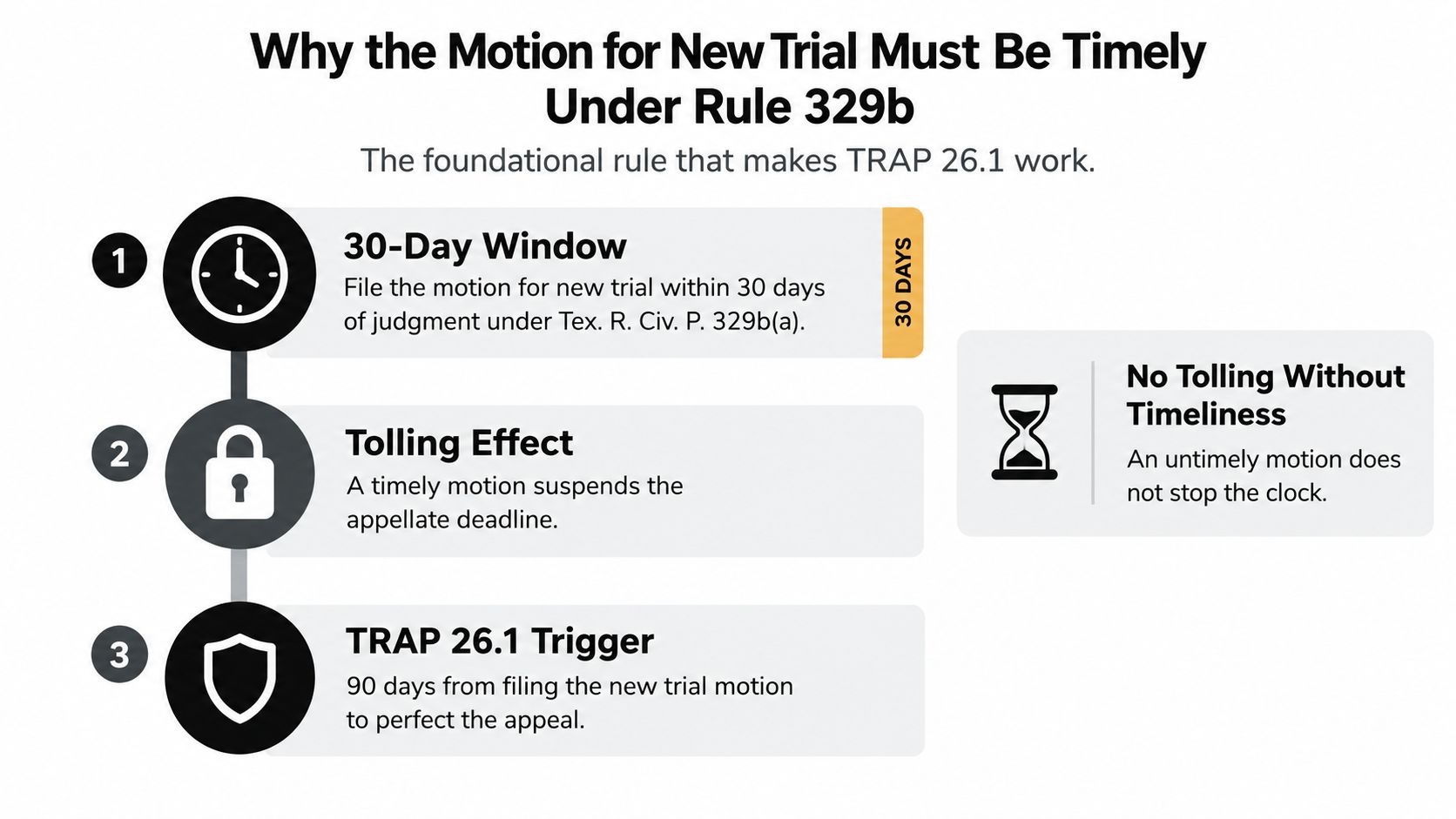
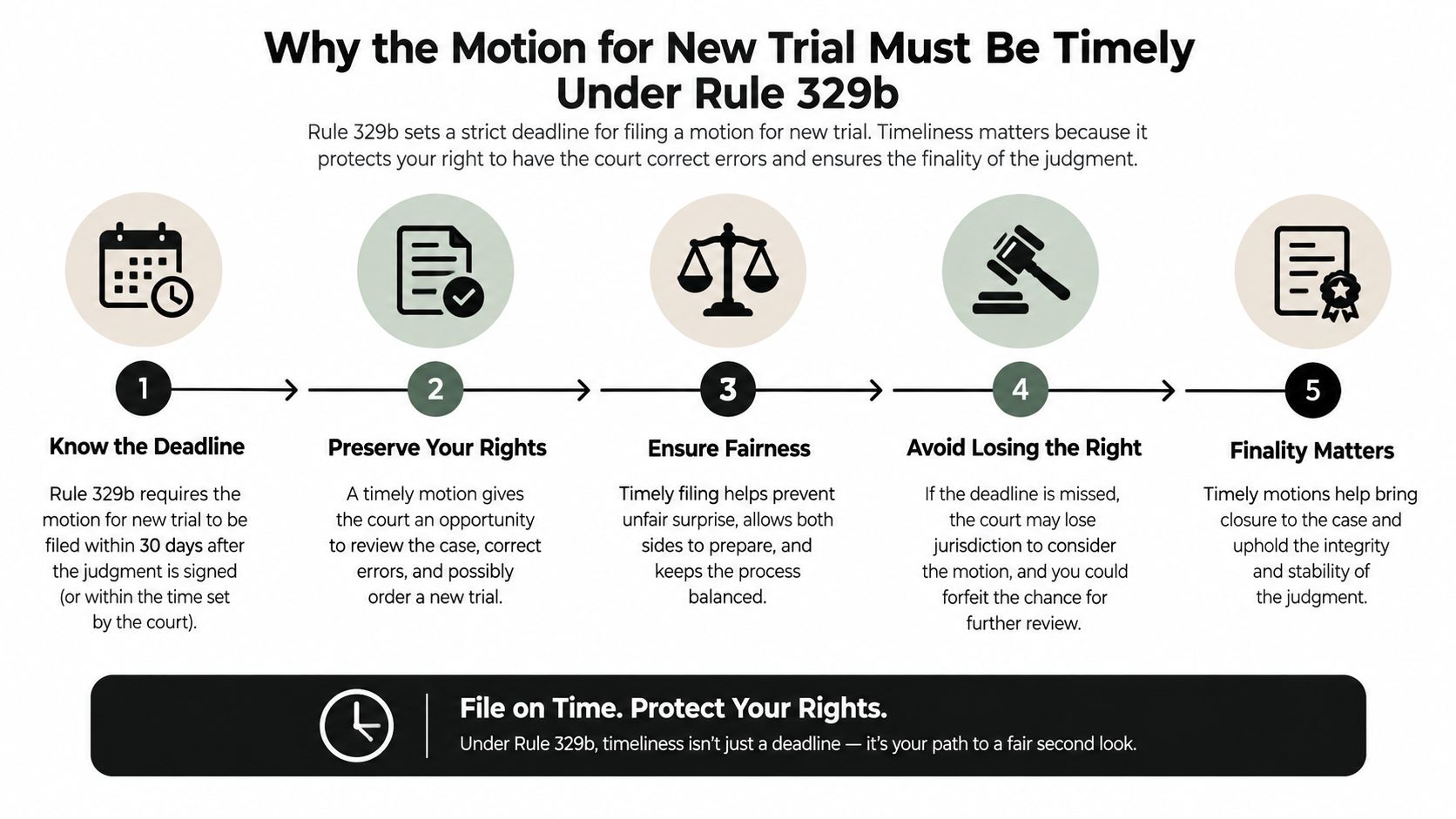
Why the Motion for New Trial Must Be Timely Under Rule 329b
Texas Rule of Civil Procedure 329b supplies the foundation for a qualifying motion for new trial in an ordinary family law case. A motion for new trial must be filed within 30 days after the judgment is signed. The same post-judgment timing concerns can arise with a motion to modify, motion to vacate, or motion for reinstatement, depending on the judgment and the rule that applies.
What the timely motion changes
A timely motion gives the trial court additional authority to reconsider the judgment. Under Rule 329b, the court's plenary power generally continues until 30 days after the motion is overruled, whether by a written order or by operation of law. If the court hasn't ruled earlier, the motion is overruled by operation of law after 75 days, and the court generally retains plenary power for another 30 days, creating a maximum window of 105 days from the signed judgment.
The purpose is practical. A judge can correct a legal or factual problem while the case remains in the trial court, and the parties can evaluate whether the ruling needs appellate review. But that trial-court authority doesn't erase the need to file a notice of appeal within the Rule 26.1 period.
A more detailed discussion of this interaction appears in the explanation of Rule 329b plenary power and the 105-day limit.
Why lateness is so costly
A motion filed one day late may not perform the job the party expected. It may fail to extend plenary power and may leave the appeal subject to the original 30-day deadline. Texas appellate courts have emphasized that a late motion can result in dismissal for lack of jurisdiction.
That doesn't mean every post-judgment problem is hopeless. A lawyer should examine whether the judgment was properly signed and entered, whether the party received timely notice, and whether a limited extension or other procedural remedy may exist. Those remedies are fact-specific and can't safely be assumed.
Traps and Exceptions That Catch Texas Family Law Appellants
The most serious mistake is assuming that every family law appeal receives the same 90-day treatment. Accelerated appeals are the major exception. Texas appellate materials explain that motions for new trial don't extend the notice deadline in accelerated matters, including parental-termination and certain child-protection proceedings. In an accelerated parental-termination appeal, the notice deadline is 20 days after the judgment is signed, and courts are directed to aim for final disposition within 180 days after the notice of appeal is filed. The governing appellate materials are available in this Texas court document concerning accelerated parental-termination appeals.
A parent may believe a motion for new trial creates time to prepare because that is what happens in an ordinary appeal. In an accelerated case, that assumption can cause the notice deadline to pass. The judgment type and statutory classification must be identified before anyone relies on the 90-day calculation.
Common timeline errors
- Wrong starting date: Counting from the hearing, oral ruling, or receipt of the decree instead of the date the judgment was signed.
- Late post-judgment filing: Assuming a motion filed after the applicable 30-day period still creates the 90-day period.
- Nonqualifying motion: Treating every request for reconsideration as a Rule 329b motion that changes appellate timing.
- Waiting for the ruling: Believing the notice period begins after the judge grants or denies the motion.
- Ignoring acceleration: Applying ordinary deadlines to termination, child-protection, or another accelerated proceeding.
- Confusing rendition and signing: Treating an oral announcement or an earlier rendition as the operative date without reviewing the signed judgment and applicable rules.
| Case Type | Motion for New Trial Effect | Notice of Appeal Deadline | Appellate Record Due |
|---|---|---|---|
| Ordinary family law appeal | A timely qualifying motion generally extends the period | 30 days ordinarily, or 90 days with a timely qualifying motion | Depends on the applicable appellate rules and record designation |
| Accelerated family law appeal | Generally doesn't extend the accelerated period | 20 days after the judgment is signed | Governed by the accelerated appellate timetable |
| Parental-termination appeal | A motion for new trial generally doesn't buy the ordinary extension | 20 days after the judgment is signed | Governed by the accelerated timetable |
The table is a screening tool, not a substitute for classifying the exact order. A custody order in a standard SAPCR may follow a different path from a termination judgment, even though both affect parent-child relationships.
Practical Steps for Clients and Trial Attorneys After Judgment
The safest response to a final family court judgment is organized and immediate. You don't need to decide every appellate issue on the day the judge signs the order, but you do need to protect the procedural path while the merits are being evaluated.
A working post-judgment checklist
- Confirm the signed judgment. Obtain the file-stamped copy and record the date the judge signed it. Check whether the order is final and whether the case is accelerated.
- Calendar the post-judgment deadline. Identify the deadline for a Rule 329b motion or another qualifying motion. Filing a motion isn't useful for appellate timing if it was filed too late.
- Calendar the notice deadline separately. Mark the ordinary deadline and, if appropriate, the extended 90-day date. Don't replace the notice date with the date on which the trial court may rule.
- Track plenary power. A timely motion can affect the court's authority for up to 105 days from signing. That period may provide an opportunity to seek correction, but it doesn't postpone the notice deadline.
- Preserve the record. Request the clerk's record and reporter's record when appropriate. Tell the reporter which hearings and exhibits may matter, and confirm any required arrangements.
A trial attorney should use a motion for new trial to preserve specific complaints when the rules require preservation. The motion should identify the alleged legal error, evidentiary problem, procedural defect, or insufficiency concern rather than just state that the outcome was unfair.
When the deadline has already moved
If a party missed the ordinary deadline, counsel should promptly examine whether a limited extension under Rule 26.3 may be available. The verified appellate materials explain that the notice and a motion for extension must be filed within 15 days after the notice deadline, and a reasonable explanation for the delay may be required.
A late-entered judgment may raise separate questions under Rule 306a. Rule 2 may also matter in a narrow procedural setting, but neither rule should be treated as a general permission to revive an expired appeal. The record must show facts supporting the requested relief.
Trial and appellate lawyers should also coordinate on settlement, enforcement, and any agreement under Rule 11. A pending appeal doesn't automatically resolve enforcement questions, so the parties need a separate plan for protecting parental and financial interests while review proceeds.
Protecting Your Right to Appeal With Strategic Guidance
The 90-day period is better understood as a fairness mechanism than as a calendar trick. In an ordinary appeal, a timely motion for new trial can give the parties time to evaluate the ruling, examine the record, identify preserved complaints, and decide whether appellate review is justified.
An appeal isn't a second trial. The court of appeals reviews the existing record rather than hearing witnesses again. A standard of review is the legal lens the appellate court applies to a particular issue. For example, “abuse of discretion” asks whether the trial court acted without reference to guiding rules or principles, while also recognizing that family judges often have room to weigh evidence and make practical decisions.
What appellate counsel evaluates
- Reversible error: A legal mistake or procedural error that probably caused an improper judgment and can support a remedy on appeal.
- Briefing: The written argument submitted to the appellate court, supported by the record, legal authority, and a clear explanation of the requested relief.
- Record support: The clerk's record and reporter's record must contain the material needed to evaluate the complaint.
- Preservation: Under Rule 33.1, many complaints must have been presented to the trial court in a timely and specific way before the appellate court will consider them.
- Family law impact: The review may involve custody, visitation, property division, spousal maintenance, child support, protective orders, contempt, or enforcement issues.
A careful lawyer also considers whether settlement or a Rule 11 agreement could resolve part of the dispute while an appeal is evaluated. If the trial court's plenary power presents a problem, counsel may need to coordinate a limited remand or another procedural request. Those choices depend on the order, the record, the preserved issues, and the current deadline.
If you believe the judgment contains reversible error, don't wait for the motion for new trial to be decided before asking whether the notice of appeal is due. An appellate attorney can step in after trial, review the file, and determine whether the 30-day window, 90-day window, accelerated period, or a narrow extension rule controls.
The Law Office of Bryan Fagan, PLLC reviews Texas family law judgments, post-judgment motions, appellate records, and deadline issues involving custody, divorce, property division, support, and protective orders. Schedule a free consultation through The Law Office of Bryan Fagan, PLLC to evaluate your timeline, preserve available issues, and develop a focused appellate strategy.