Skip to content
In most Texas family law appeals, the notice of appeal is due 30 days after the judgment is signed, but that deadline can become 90 days if a qualifying post-judgment motion was timely filed. In some accelerated appeals, the deadline is only 20 days, and post-judgment motions don't extend it.
You may be reading this because a judge signed an order that feels deeply wrong. Maybe it affected your parenting time, child support, property division, or the terms of your divorce decree. When that happens, the first question is often simple and urgent: what is the deadline for filing a notice of appeal in Texas?
The answer matters because appeals are built on deadlines. A strong appellate issue can still be lost if the notice of appeal is filed too late. A disappointed litigant often focuses on the unfairness of the result, which is understandable, but the calendar is usually the first thing appellate counsel checks.
An appeal is not a new trial. It is a structured review by a higher court of what happened in the trial court. The appellate court reviews the written record, the reporter's record if one exists, the rulings that were made, and the legal arguments preserved in the case. That review starts with one critical step: filing the notice of appeal on time.
Your Case Is Over But You Feel the Fight for Fairness Is Not
A bad ruling can leave you stunned. Many clients call after a final hearing or after receiving a signed order, saying some version of the same thing: “The judge didn't hear me,” or “That's not what the evidence showed.” In family law, those reactions usually come after decisions that affect children, finances, or both.
That feeling does not automatically mean an appeal exists. It does mean you should act quickly enough to find out.
Appeals review legal error, not general unfairness
Texas appellate courts do not retry your divorce or custody case. They review whether the trial court made a legal mistake that affected the outcome. That could involve the wrong legal standard, the exclusion of important evidence, a ruling outside the court's discretion, or a judgment that doesn't match the law or the record.
In plain English, the appellate court asks whether the trial court committed reversible error. That means an error serious enough that it likely led to an improper result.
Practical rule: The day you receive a disappointing order is not the day to debate strategy with friends or search message boards. It's the day to confirm exactly when the judge signed the order.
In family cases, that signed date often controls more than people expect. It can determine whether you still have time to appeal, whether you should file a post-judgment motion first, and whether your appellate lawyer can still shape the record going forward.
The first move is procedural, not emotional
Clients sometimes assume the appeal starts when they tell the court they disagree. It doesn't. It starts when the right filing is made in the right court within the correct deadline. That's why calm procedure matters so much in the first days after judgment.
There is also a practical reality many people don't think about right away. Court decisions can affect more than your legal rights. They can affect your professional life, your online presence, and how others interpret a public dispute. For lawyers and professionals dealing with sensitive litigation fallout, this guide on ContentRemoval.com on reputation protection offers useful perspective on managing public-facing consequences while legal matters are still unfolding.
If you're upset, that's normal. But what works now is not venting. What works is getting the signed order, identifying the correct appellate deadline, and deciding quickly whether post-judgment filings are necessary to preserve your options.
The Three Critical Deadlines for Texas Appeals
A notice of appeal is the document that tells the courts you are invoking the appellate process. It does not contain your full legal argument. It is the filing that preserves your path to appellate review, assuming it is timely.
For most Texas civil and family law cases, the controlling deadlines come from Texas Rule of Appellate Procedure 26.1. Texas appellate practitioners summarize the basic framework this way: the default deadline is 30 days after the judgment is signed, that period can become 90 days if a qualifying deadline-extending motion is timely filed, and accelerated appeals have a separate 20-day deadline that is not extended by post-judgment motions, as explained in this discussion of Texas notice of appeal deadlines under TRAP 26.1.
Texas Notice of Appeal Deadlines at a Glance
| Deadline | Applicability | Governing Rule (TRAP) |
|---|---|---|
| 30 days | Standard civil and family law appeals after the judgment is signed | 26.1 |
| 90 days | Standard civil and family law appeals when a qualifying deadline-extending motion is timely filed | 26.1 |
| 20 days | Accelerated appeals, including interlocutory appeals | 26.1(b) |
What the deadlines mean in practice
The 30-day deadline is the one most family law clients are dealing with first. If the judge signed a final divorce decree, a final custody order, or another final appealable order, the clock usually begins on the date the judgment was signed.
The 90-day deadline applies only when the case includes a timely qualifying post-judgment filing. Many mistakes happen here. People hear that “motions can extend the deadline” and assume any filing will do it. That is not how appellate practice works. The motion has to be one that extends appellate deadlines under the rules.
A notice of appeal deadline is not measured from when you received the order, when you understood the ruling, or when your lawyer called you. It is generally measured from when the judgment was signed.
The 20-day deadline is different. Accelerated appeals move on a compressed schedule. Post-judgment motions do not extend that deadline. In family law, this matters when an order falls into a category that must be appealed on an accelerated basis.
Why clients get tripped up
Three problems come up again and again:
- Using the wrong date: Clients often count from the hearing date instead of the signing date.
- Assuming every order is final: Some orders are interlocutory, and that changes the timetable.
- Waiting for “the full appeal”: You do not need to finish the whole appeal by the deadline. You need to file the notice of appeal on time.
A family law appeal also differs from trial work in important ways. Trial courts decide facts and make discretionary calls. Appellate courts review the record and apply a standard of review, which is the legal lens used to decide whether the trial court made a reversible mistake. That means timing, preservation, and the appellate record matter just as much as the underlying dispute.
How to Properly Extend Your Appeal Deadline to 90 Days
The move from a shorter appeal deadline to a longer one doesn't happen by accident. It happens only if a qualifying post-judgment motion is timely filed. In family cases, this can create needed breathing room, but it has to be handled deliberately.
Which filings can change the timetable
In practice, lawyers often look first at motions that ask the trial court to revisit what it did. The common examples in family cases include a motion for new trial and a motion to modify the judgment. A request for findings of fact and conclusions of law can also matter in the right case.
These filings serve different purposes:
- Motion for new trial: asks the trial court to set aside the judgment and do the trial or relevant proceeding again.
- Motion to modify the judgment: asks the court to change the signed judgment because part of it is legally or factually wrong.
- Request for findings of fact and conclusions of law: asks the judge to state the factual and legal basis for the ruling, which can help frame appellate issues.
What does not work is filing something informal and hoping it counts. A letter to the court, an email to opposing counsel, or a verbal objection after the order is signed will not preserve appellate rights the way a proper post-judgment motion can.
The narrow late-filed safety valve
Texas also recognizes a limited backup option under TRAP 26.3. If the appellant files the notice of appeal in the trial court and files a motion for extension in the appellate court within 15 days after the original deadline, the appellate court may permit the appeal if there is a reasonable explanation for the delay. It is not an automatic grace period. This overview of the TRAP 26.3 extension mechanism and related Texas appeal timing rules explains the rule and why these deadlines are so unforgiving.
That rule helps some litigants. It does not rescue everyone.
Waiting to see whether the other side will “work something out” is not a filing strategy. If the deadline is approaching, protective filings usually matter more than optimism.
What works and what does not
A few practical points usually make the difference:
- Get the signed order immediately. You cannot calculate anything accurately without it.
- Identify whether the order is final or accelerated. That changes the entire path.
- Use a post-judgment motion for a legal purpose, not just delay. Good motions preserve issues, clarify rulings, and protect appellate options.
- Do not rely on assumptions about who is handling the appeal. Trial counsel may continue, but appellate deadlines do not pause while that gets sorted out.
If you need a focused discussion of late filing issues and procedural options in family cases, this guide on extension of time to file appeal in Texas family law is a useful next step.
Calculating Your Deadline A Step-By-Step Example
The rules feel less abstract when you put them on a calendar.
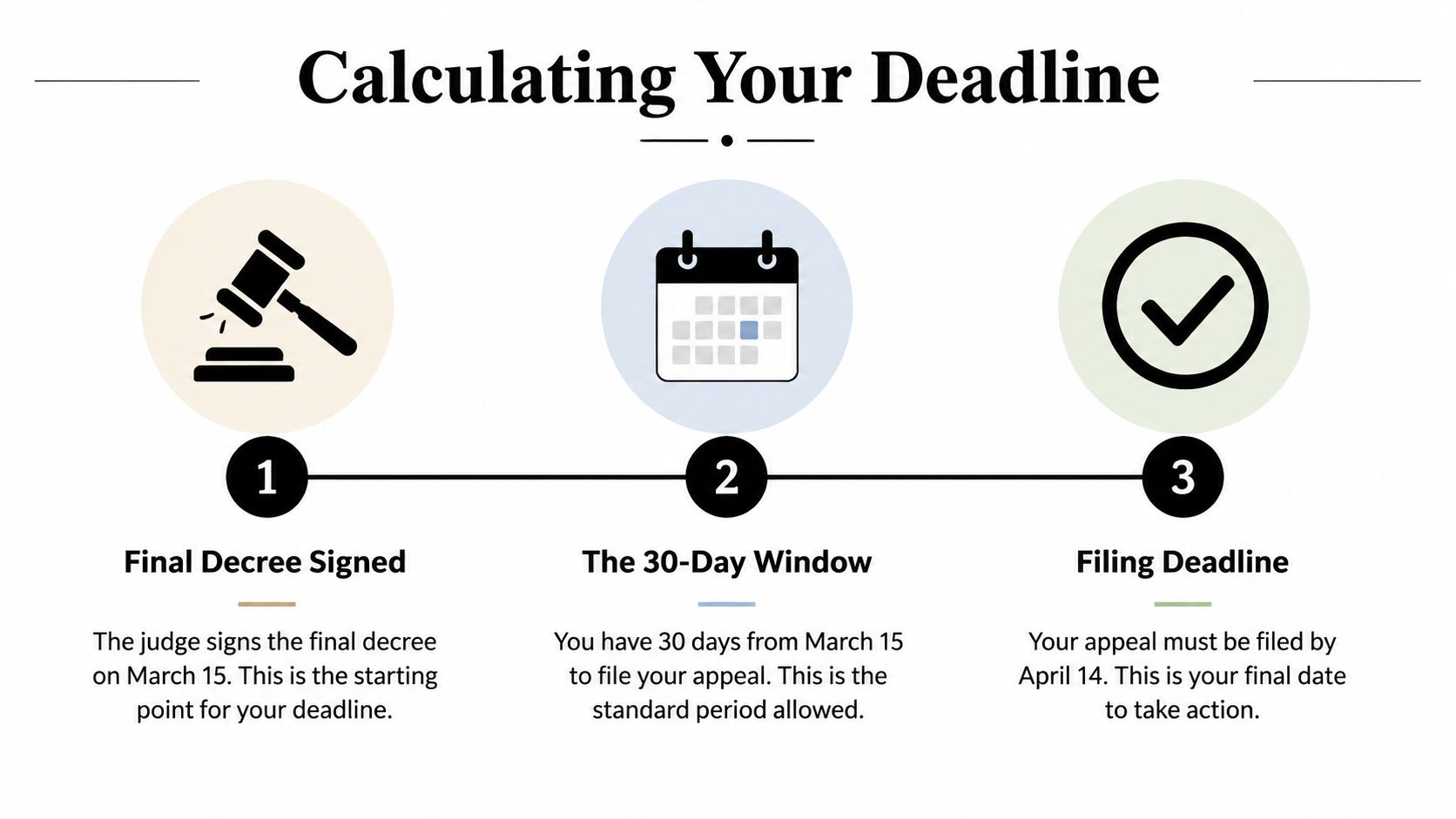
Assume the judge signed your final divorce decree on March 15, 2026. The signing date is the starting point. Not the hearing date, not the day the clerk mailed it, and not the day you opened the envelope.
Example one with no deadline-extending motion
If no qualifying post-judgment motion is timely filed, you count forward from March 15. Under the ordinary timetable discussed earlier, the notice of appeal would be due 30 days after the judgment is signed.
That means your working deadline lands on April 14, 2026.
This is why clients get into trouble when they “take a few weeks to think about it.” By the time they begin gathering documents, looking for appellate counsel, and deciding whether to move forward, much of that time may already be gone.
Example two with a qualifying post-judgment motion
Now change one fact. A timely motion for new trial is filed on April 14, 2026. In that situation, the notice of appeal deadline can move to the 90-day timetable described above.
The key lesson is not just that the date changes. It is that the strategy changes too. A post-judgment motion can give the trial court a chance to correct error, sharpen the issues for appeal, and preserve a longer appellate timetable when the rules allow it.
A simple way to think about the calendar
Use this checklist:
- Step one: find the date the judge signed the order.
- Step two: determine whether the order is an ordinary appealable judgment or part of an accelerated appeal.
- Step three: identify whether a qualifying post-judgment motion was timely filed.
- Step four: confirm where the notice of appeal must be filed and whether any extension motion is needed.
For a fuller walkthrough of the sequence after judgment, including record preparation and briefing, review this step-by-step Texas family law appeal process timeline.
What clients often expect at this stage is a broad second chance. What the appellate system offers is narrower and more disciplined. The appellate court reviews the existing record and the legal issues preserved in it. That makes the early timeline especially important.
Common Reversible Errors in Texas Family Law Appeals
Missing a deadline ends the case before the court ever reaches the fundamental question: did the trial court make a reversible error? That is where substance matters.
A reversible error is a legal mistake significant enough that it likely affected the outcome. An abuse of discretion means the trial court made a decision outside the range of reasonable choices allowed by law. In family law, many rulings are reviewed under that abuse-of-discretion standard, especially where the judge had room to weigh competing evidence.

Errors involving property division
In a divorce appeal, one common issue is whether the trial court treated property incorrectly. If separate property was wrongly characterized as community property, that can affect the overall division and may support appellate review.
Another problem arises when the written decree does not match what the law allows or what the record supports. A property order can look detailed and still contain legal error.
Errors involving children
Custody and conservatorship appeals usually turn on whether the court had a legally sufficient basis for the ruling and whether the judge properly applied the child's best-interest framework. A parent may strongly disagree with the result, but disagreement alone is not enough. The question is whether the record and the law support the order that was signed.
Child support rulings can also be challenged when the court used the wrong legal framework, misunderstood the evidence, or entered an order that does not line up with the controlling rules.
Some bad outcomes are painful but legally unappealable. Some rulings that look ordinary on paper contain a clear appellate issue once the record is reviewed closely.
Procedural errors that matter
Appellate courts also review process. Examples include:
- Improper exclusion of evidence: A judge kept out evidence that should have been considered.
- Lack of required findings: The court failed to make findings needed for meaningful review.
- Defective final order language: The signed order creates ambiguity, exceeds the relief requested, or conflicts with prior rulings.
- Due process concerns: A party did not receive fair notice or a meaningful opportunity to be heard.
A word clients hear often in appeals is briefing. Briefing is the written argument filed in the appellate court. It explains the facts from the record, identifies the legal errors, states the standard of review, and asks for a specific remedy. Good briefing is disciplined. It does not re-argue every frustration from trial. It focuses on the errors the appellate court can correct.
That is one major difference between trial and appeal. Trial work persuades a judge or jury in real time. Appellate work persuades a reviewing court through the record, the rules, and the law.
Preserving Your Right to Appeal Immediate Actions to Take
If the order was just signed, the right move is to stabilize the situation and act in order.

Your first checklist
- Get the signed order: Ask for a file-stamped copy of the final judgment or appealable order. The signing date is usually the anchor for the deadline.
- Collect the trial materials: Gather pleadings, motions, admitted exhibits, hearing notices, and any clerk or court correspondence you have.
- Request the transcript information: If a court reporter was present, find out what hearings were recorded and how to request the reporter's record.
- Write down what happened: Create a short timeline while events are fresh. Include hearing dates, key rulings, and when you learned the order was signed.
Mistakes that often cost people their options
Clients sometimes assume their trial lawyer is automatically handling the appeal. Sometimes that is true. Sometimes it is not. Appeals require different deadlines, different writing, and a different strategy.
Another common mistake is trying to file the notice of appeal without understanding whether a post-judgment motion should also be filed, whether the order is final, or what appellate court has jurisdiction. Filing something quickly can help. Filing the wrong thing without a plan can create more problems.
One option families consider at this stage is consulting a law firm that handles Texas family-law appellate matters specifically. The Law Office of Bryan Fagan, PLLC provides information about the notice-of-appeal process and related appellate issues in family cases.
This video gives a helpful overview of what prompt action looks like after an adverse ruling:
A calm strategy beats a rushed reaction
The most effective first response is usually straightforward. Confirm the date. Preserve the file. Get appellate eyes on the order. Decide quickly whether protective filings are needed.
You do not need to know every answer on day one. You do need to protect the deadline while the case is being evaluated.
Frequently Asked Questions About Texas Family Law Appeals
Can I add new evidence on appeal
Usually, no. An appeal is generally a review of the existing trial court record, not a new trial with new witnesses and new exhibits. The appellate court looks at what was filed, what was admitted, what the judge ruled on, and what was preserved for review.
What happens after the notice of appeal is filed
The case shifts into the appellate process. The clerk's record and, if needed, the reporter's record are prepared. Then the parties move into briefing, which is the written stage where each side explains its legal position to the appellate court.
Is an appeal a guaranteed do-over
No. An appeal is not automatic relief and not a fresh trial. The appellate court applies a standard of review, which means some trial-court decisions receive significant deference, especially discretionary rulings in family cases.
Can I appeal because the judge seemed unfair
Maybe, but the appeal must identify a legal error. The appellate court does not reverse because a party believes the judge reached the wrong result. The focus is on whether the law was misapplied, discretion was abused, required procedure was ignored, or the final order cannot stand under the record.
Do I need an appellate lawyer if I already had a trial lawyer
Not always, but it often helps. Trial advocacy and appellate advocacy are different skill sets. Appeals center on issue preservation, the record, standards of review, and careful written argument.
What if I am not sure whether my order is final
That question should be answered immediately. Finality affects whether an appeal can proceed and which deadline applies. If there is uncertainty, waiting usually makes the problem worse, not better.
If you believe the court made a mistake in your family law case, our appellate attorneys can help you seek a fair outcome. Contact The Law Office of Bryan Fagan, PLLC today for a free consultation.