Skip to content
You may feel your Texas family law case was handled unfairly, and then discover that the ordinary deadline to appeal passed while you were focused on your children, your finances, or the meaning of the final order. If the judgment was signed more than 30 days ago, that discovery can feel final.
Sometimes, it isn't. The TRAP 26.3 fifteen-day grace period to file a notice of appeal may preserve a narrow opportunity, but only when you complete the required filings correctly and quickly. This isn't a free pass. It is a tightly conditioned safety mechanism under the Texas Rules of Appellate Procedure.
When the 30 Days Are Already Gone
A parent sits at the kitchen table early in the morning, looking at a calendar. The final divorce decree was signed, and the thirtieth day was last Friday. No motion for new trial was filed. The clerk's office has just said the appeal deadline passed.
The panic is understandable. The decree may affect custody, visitation, child support, property division, or spousal maintenance. You may believe the judge ignored important evidence or applied the law incorrectly. Yet the first question isn't whether the ruling was fair. It is whether the appellate court can still receive a timely notice of appeal.
TRAP 26.3 may offer a narrow path forward. In a civil family case, a late notice can sometimes be accepted when it is filed during the limited grace period and accompanied by a compliant motion asking the court of appeals to extend the filing time. The two actions must be handled together.
The practical point: A missed ordinary deadline isn't automatically the end, but waiting can close the remaining window.
The trap is that many summaries say only, “You have fifteen extra days.” That description leaves out the filing that often determines whether the appeal survives. The notice of appeal goes into the trial court, while the motion to extend goes into the appellate court. Both must be filed within the same narrow period.
If the grace period has also passed, other forms of relief may require a different analysis. A discussion of restricted appeal and bill of review relief can help explain why those remedies aren't interchangeable with a regular appeal.
The safest response is deliberate action, not despair. The rest of this guide translates the rule into plain English, shows how ordinary and accelerated family deadlines differ, and gives you a practical checklist for the days that may remain.
Reading TRAP 26.3 in Plain English
TRAP 26.3 is easier to understand when each part is separated. The rule doesn't erase the original deadline. Instead, it gives the court of appeals limited authority to consider a late filing when the appellant takes two required steps.
First, identify the ordinary deadline under the applicable appellate rule. In many Texas civil appeals, that deadline is 30 days after the judgment is signed. It can extend to 90 days when a timely motion for new trial, motion to modify the judgment, motion to reinstate, or request for findings of fact and conclusions of law is filed. The governing rules are available in the Texas Rules of Appellate Procedure.
Second, if the applicable deadline has passed, count the narrow grace period. The appellant must file the notice of appeal in the trial court and a motion to extend time in the court of appeals within that same period. Filing only one document leaves the jurisdictional problem unresolved.

Who files what and where
The appellant is the party seeking review. The appellant files the notice of appeal with the trial court clerk, because that filing starts the appellate process. The appellant also files the extension motion with the court of appeals, because that court must decide whether the late notice can be accepted.
The extension motion must comply with Rule 10.5(b). That generally means explaining the reason for the delay and giving the appellate court enough information to identify the case, the judgment, and the requested extension. The motion isn't just a courtesy letter. It is part of the mechanism that gives the appellate court authority to act.
There can be confusion about when the fifteen-day period is measured. The exact calculation depends on the applicable rule and the status of the extension request, including whether a motion has been ruled on or overruled by operation of law. Because a small date error can eliminate the remedy, use the earliest reasonable calculation and verify it with the clerk or appellate counsel.
A Texas Family Law Appeals Lawyer handles appellate representation challenging final family law orders for legal error. For a practical discussion of filing an extension request, see extension of time to file an appeal in Texas family law.
The central lesson is simple: TRAP 26.3 is a safety hatch, not a replacement for the regular deadline. Treat the ordinary deadline as controlling, and treat the grace period as an emergency window that requires immediate, coordinated filing.
How TRAP 26.3 Sits on Top of TRAP 26.1 and 26.2
These rules form a sequence. They aren't three independent chances to appeal.
TRAP 26.1 establishes the starting point. For an ordinary Texas civil appeal, the notice of appeal is generally due 30 days after the judgment is signed. A timely post-judgment filing, such as a motion for new trial, motion to modify, motion to reinstate, or request for findings, can move the notice deadline to 90 days.
TRAP 26.2 addresses a possible extension request. Under the structure described in the rules, the court may have authority to extend the deadline on a proper motion, subject to the limits and conditions that apply to the particular case. That request must be made through the required procedure, not through an informal conversation with the trial court clerk.
TRAP 26.3 is the narrow late-filing mechanism. It becomes relevant only after the appellant has reached the end of the applicable filing period and files the required documents within the permitted grace window.
| Rule | What it does | Trigger | Maximum time |
|---|---|---|---|
| TRAP 26.1 | Sets the ordinary notice-of-appeal deadline | Signed judgment or qualifying post-judgment motion | Generally 30 days, or 90 days when a listed timely motion extends the period |
| TRAP 26.2 | Addresses an extension request under the applicable appellate procedure | Proper motion seeking additional time | Limited by the rule and the court's authority |
| TRAP 26.3 | Allows a narrow late-filing request | Late notice plus compliant extension motion filed within the grace period | 15 days after the applicable deadline |
The relationship matters because a party can't assume that filing a motion for new trial automatically creates a new appeal deadline without checking whether the motion was timely and whether the resulting deadline was calculated correctly. A useful explanation of that calculation appears in TRAP 26.1 and the ninety-day deadline when a new-trial motion is filed.
Think of the rules as a ladder: 26.1 creates the main deadline, 26.2 may address an extension request, and 26.3 offers a narrow route after the deadline. Without a qualifying procedural step, there may be no grace period to climb onto.
The most dangerous assumption is that every late notice receives the same treatment. It doesn't. The deadline depends on the type of order, the post-judgment motions filed, and whether the case is on an accelerated track.
A Day by Day Timeline Inside the Grace Period
Start with the event that controls the deadline. In an ordinary family appeal, that is usually the date the trial court signed the final judgment or order. The trigger date isn't counted as day one. Count forward under the applicable Texas computation rules, and check whether the last day falls on a weekend or legal holiday.
Ordinary family appeal
Assume a final divorce decree is signed on a Monday. No timely motion for new trial, motion to modify, motion to reinstate, or request for findings is filed.
| Day | What happens |
|---|---|
| Judgment day | The court signs the final decree. This is the trigger date. |
| Days 1 through 30 | The ordinary notice-of-appeal period runs. |
| Day 30 | The regular notice deadline arrives, subject to applicable computation rules. |
| Grace days 1 through 15 | The notice is filed in the trial court and the extension motion is filed in the court of appeals. |
| After grace day 15 | The Rule 26.3 route may be unavailable, requiring analysis of other remedies. |
If a timely qualifying post-judgment motion was filed, the ordinary notice period can extend to 90 days under the Texas appellate rules. The grace period is measured after the applicable deadline, not after a date chosen because it feels convenient.
Accelerated family appeal
Some family matters proceed on an accelerated schedule. The required notice deadline can be 20 days rather than 30, and the post-deadline window can therefore expire much sooner. In practical terms, a fifteen-day grace period after a 20-day accelerated deadline can leave only five days compared with the ordinary 30-day calculation.
For example, if an accelerated order starts a 20-day notice period, count from the correct triggering event. Day 20 is the ordinary deadline. The next fifteen days are the potential Rule 26.3 window, but the accelerated timetable may interact with other appellate deadlines and should be checked immediately. A guide to the notice of appeal deadline in Texas family cases explains why ordinary family appeals generally begin with the 30-day framework.
What the motion must say
The extension motion should identify the trial court cause number, the judgment or order being appealed, the date the notice was due, the date the notice was filed or will be filed, and the reason for the delay. It should also include the required Rule 10.5(b) explanation and comply with filing and service requirements.
Don't calculate from the day you first learned about the order. Don't calculate from the date a clerk returned a document. Use the legally operative event and assume that the earliest plausible deadline controls until counsel confirms otherwise.
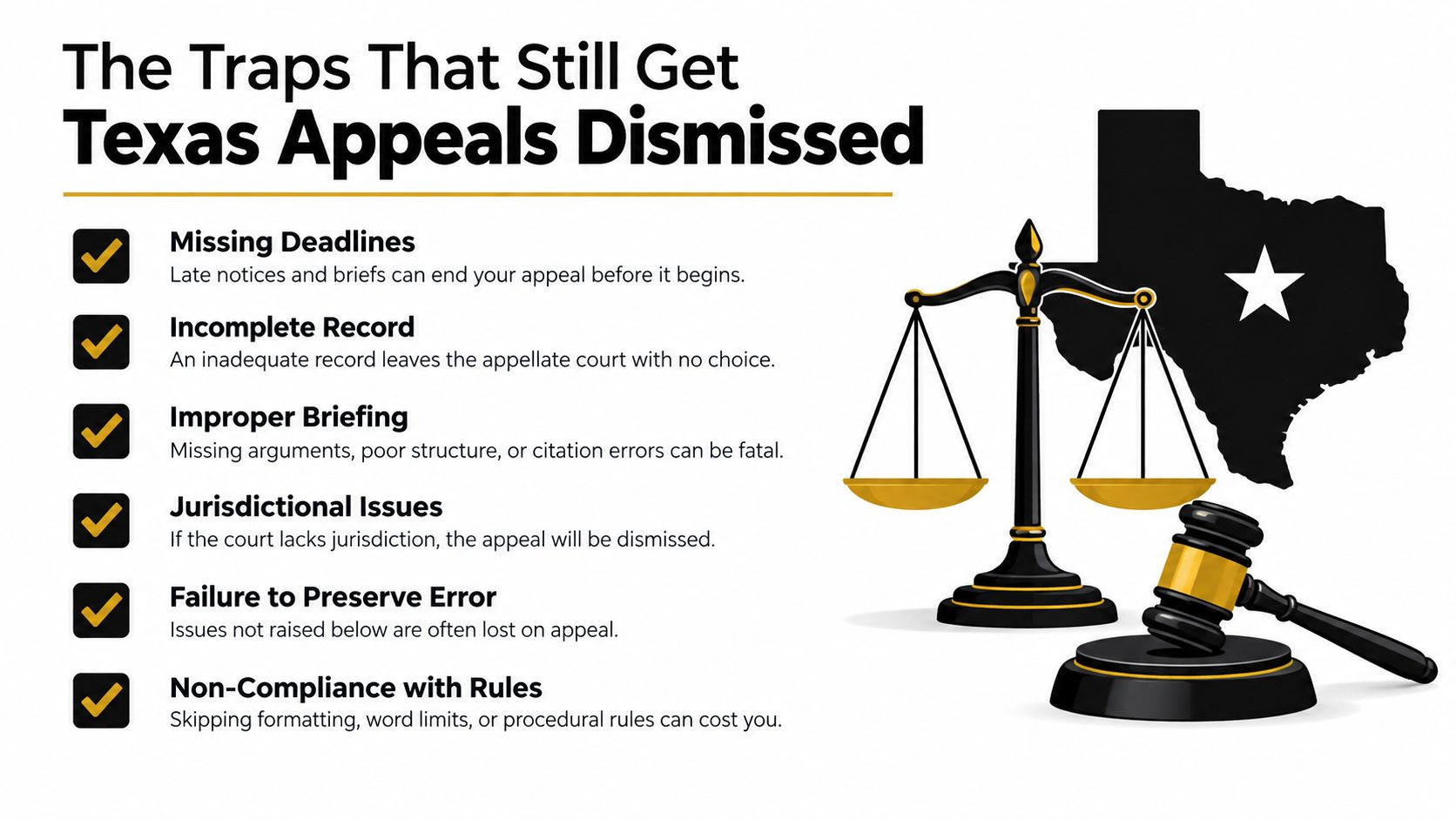
The Traps That Still Get Texas Appeals Dismissed
The most serious mistakes happen after a litigant has heard about the fifteen-day window. The person knows there may be a safety net but misunderstands what the net requires.
Mistaking a post-judgment motion for a reset button
A motion for new trial can affect the deadline only when it qualifies under the rules. It doesn't mean the appellant can ignore the resulting notice deadline. Once the applicable period ends, the notice and extension motion must still be handled inside the narrow late-filing window.
Filing the notice but not the extension motion
This is the central two-filing trap. A late notice in the trial court, standing alone, may not invoke the court of appeals' authority. The appellant must also file a compliant motion in the appellate court during the same window.
Treating an accelerated case like an ordinary appeal
A SAPCR, enforcement matter, or another accelerated family proceeding may have a shorter notice period. Counting 30 days when the case requires 20 can consume the available time before the litigant realizes the mistake.
Missing the final day
A late filing by one day can be outside the permitted window. Weekend and holiday rules may affect computation, but they shouldn't be treated as permission to wait. Confirm the clerk's filing requirements before the deadline arrives.
Relying on a clerk's verbal assurance
Clerks can provide valuable procedural information, but a verbal statement isn't a substitute for filing the required documents. The court clerk doesn't decide whether the appeal is legally timely, and a conversation generally doesn't preserve appellate jurisdiction.
Appealing an order that isn't appealable
Not every family court ruling is immediately appealable. Interlocutory orders require a separate analysis under the Texas Rules of Appellate Procedure and applicable statutes, including the provisions governing permitted interlocutory appeals. A party should confirm that the order is appealable before investing in a notice and appellate strategy.
The cases named in some online summaries, including Feist v. Estate of Feist and Garcia v. Kastner Grain Co., may arise in discussions of timeliness and appellate procedure. Case names alone don't replace reading the current rule and the authority applicable to your order.
Why Family Cases Get a Second Chance but Criminal Cases Do Not
The civil and criminal versions of Rule 26.3 don't operate identically. That difference matters because a family law appeal is a civil appeal, even when the underlying dispute feels urgent and personal.
In civil cases, including family cases, Texas courts may treat a timely late notice as procedurally significant when it is accompanied by the required extension request. In some civil decisions, the notice filed within the grace period has been described as creating a necessarily implied motion for extension, although the safer practice is still to file an express, compliant motion in the appellate court.
Criminal cases require closer attention to their own rules and authorities. A late criminal notice generally doesn't become acceptable merely because a late notice was filed. The appellant must comply with the criminal procedure governing the extension motion, and the court may dismiss when the required filing isn't made within the permitted period.
| Factor | Civil, including family law | Criminal |
|---|---|---|
| Nature of review | Review of a civil judgment or order | Review of a criminal conviction or order |
| Late notice | May be treated as procedurally significant within the narrow grace period | Strict compliance with the criminal appellate requirements is essential |
| Extension filing | Notice in the trial court and compliant motion in the appellate court | Actual extension motion requirements may apply without relying on an implied filing |
| Practical result | A narrow opportunity may preserve appellate review | A missing or late extension motion can require dismissal |
| Best practice | File both documents immediately and expressly | Follow the criminal rule exactly and confirm the sentencing-based deadline |
The civil and criminal distinction doesn't make a family appeal informal. The civil rule still protects finality and gives appellate courts a defined jurisdictional framework. It recognizes a procedural path that can sometimes preserve a civil appeal when the appellant acts inside the permitted window.
This is also why advice from a criminal appeal page can mislead a family litigant. The triggering event, available motions, and consequences of a late filing may differ. Use the rules for the case before the court.
Practical Steps to Protect Your Right to Appeal
When you discover a missed deadline, work through the following sequence without waiting for perfect certainty.
Find the operative judgment. Obtain the signed final order or other order you want reviewed. The written judgment, not an informal announcement, usually supplies the date for an ordinary civil appeal.
Classify the case. Determine whether the appeal is ordinary or accelerated. A custody, enforcement, grandparent-access, or protective-order matter may involve a timetable that differs from a standard divorce decree.
Review post-judgment filings. Check whether a timely motion for new trial, motion to modify, motion to reinstate, or request for findings was filed. The filing date and type of motion can change the notice deadline.
File the notice in the trial court. The notice of appeal belongs with the trial court clerk. Confirm the filing fee or prepare the appropriate affidavit of inability to pay if you qualify.
File the extension motion in the appellate court. State that the notice is late, identify the trial court cause number, explain the delay, and show why the request falls within the Rule 26.3 window. Follow Rule 10.5(b), service rules, and the appellate court's local requirements.
A simple trial-court caption might look like this:
[Name of Trial Court]
[County], Texas
[Party A] v. [Party B]
Cause No. [cause number]
Notice of Appeal
Appellant [name] gives notice of appeal from the [date] final judgment or order signed by [judge].
The appellate motion should be separately captioned for the correct court:
[Name of Court of Appeals]
[Party A] v. [Party B]
Cause No. [appellate cause number, if assigned]
Motion to Extend Time to File Notice of Appeal Under TRAP 26.3
Appellant [name] requests an extension through [date], states that the notice was filed in the trial court on [date], and explains the delay as follows: [verified explanation].

Don't assume that filing the notice completes the appeal. After the appellate clerk confirms the applicable deadline, calendar the record-related dates, including preparation of the clerk's record and reporter's record when required. The appeal will also require a focused explanation of the alleged error, not a second trial.
What Comes Next and When to Call Appellate Counsel
A timely notice of appeal starts the appellate process, but it does not prove that the trial court made a reversible error. Once the extension is granted, follow the appellate clerk's order closely. The clerk's record and reporter's record must be ordered within the deadlines set by the appellate clerk, and the appellant's brief is typically due 30 days after the record is filed. Treat the clerk's notice like a map: it identifies the dates that control the next stage.
Appeals aren't new trials
An appeal generally does not allow witnesses to testify again or permit the parties to submit new evidence. The appellate court reviews the existing record and the arguments presented in the briefs. That means a mistake matters only if the record shows it, the complaint was preserved when required, and the law permits appellate relief.
Abuse of discretion means the trial court acted without reference to guiding rules and principles or made a decision that was arbitrary or unreasonable. The appellate court examines the record under the standard that applies to the challenged ruling. Reversible error is a legal or procedural mistake that affected the judgment and provides a basis for appellate relief.
Briefing is the written presentation that identifies the alleged error, explains the governing law, cites the record, and asks the appellate court for a specific remedy. A strong brief is more like a carefully indexed argument than a second trial. It must connect each complaint to the ruling, the evidence, the applicable law, and the relief requested.
Common family-law appellate issues can include a trial court applying the wrong legal standard, refusing to consider legally significant evidence, entering a property division unsupported by the record, or violating required procedural protections. Whether an error is reversible depends on the order, preservation of the complaint, record, and applicable standard of review.
Call counsel immediately if another appeal was dismissed for late filing, the case involves complicated custody or property issues, you need an affidavit of inability to pay, or the trial court granted a new trial or reinstated the case after the relevant deadline period. Missing a deadline is not a moral failure. It is a procedural event, and options sometimes remain only while the clock is still running.
A focused 30-minute consultation can help confirm the trigger date, evaluate the record, and decide whether the proposed appeal has a legally supportable issue before more time is lost.
The Law Office of Bryan Fagan, PLLC evaluates Texas family appeals involving custody, visitation, divorce, property division, support, enforcement, contempt, and protective orders. If you may be inside the TRAP 26.3 window, visit The Law Office of Bryan Fagan, PLLC to schedule a free 30-minute consultation and discuss appellate strategy with counsel.