After a divorce, you may feel your case was handled unfairly, especially when it comes to the court's decision on spousal support. In Texas, what many call "alimony" is legally known as spousal maintenance. It's a common misconception that these payments are awarded automatically. The reality is that Texas law has very strict rules, and when a judge misapplies them, the outcome can feel profoundly unjust.
If you believe the court made a mistake, it’s important to understand that the trial's outcome doesn't have to be the final word. Spousal maintenance is a temporary, court-ordered payment designed to provide limited financial help to a spouse who cannot meet their own "minimum reasonable needs." Understanding the law that governs these orders is the first step toward seeking a fair result through an appeal.
Understanding the Two Types of Spousal Support in Texas
If you are facing a spousal support order that seems wrong, the first step is to understand the legal framework the judge was required to follow. You may feel the outcome was unjust, but knowing the law is how you begin to build a case for a fair resolution.
A frequent source of confusion—and a common area for reversible legal errors—is that Texas has two distinct types of post-divorce support.
Court-Ordered Spousal Maintenance
This is the official, statutory form of support detailed in the Texas Family Code. It is difficult to obtain. The law imposes strict limits on who qualifies, the amount they can receive, and for how long.
Think of it as a temporary bridge, not a permanent arrangement. It is designed to give a financially dependent spouse an opportunity to become self-sufficient. A judge can only order this if the requesting spouse meets a very high legal standard. A court that orders maintenance without the required evidence has made a classic example of a reversible error.
Contractual Alimony
This is a completely different arrangement. Contractual alimony is not imposed by a judge; it is a voluntary agreement negotiated between spouses, typically as part of their divorce settlement.
Because it is a private contract, it can be much more flexible. The couple can agree to amounts and durations that extend beyond what the law permits for court-ordered maintenance. The key difference is its enforcement—it is treated like any other contract, not a court order. Legal disputes can arise if a court misinterprets the terms of the agreement in the final decree.
Understanding this distinction is critical. The legal rules and potential grounds for an appeal depend entirely on whether your order is for court-ordered maintenance or contractual alimony. If you suspect the judge made a legal error with either, you may have a strong basis to challenge the ruling.
Here is a quick breakdown to help keep these concepts clear:
Key Aspects Of Texas Spousal Maintenance At A Glance
| Aspect | Description |
|---|---|
| Legal Basis | Strictly defined and limited by the Texas Family Code, Chapter 8. |
| Purpose | To provide temporary, rehabilitative support to a spouse who cannot meet their "minimum reasonable needs". |
| Eligibility | Requires proof of specific circumstances, such as a 10+ year marriage with an inability to earn sufficient income, family violence, or a spousal/child disability. |
| Amount Caps | Capped at the lesser of $5,000 per month or 20% of the paying spouse's average monthly gross income. |
| Duration Limits | Duration is tied to the length of the marriage, with firm maximums (e.g., 5 years of support for a 10-20 year marriage). |
| Enforcement | Enforced by the court through powerful tools like wage withholding and contempt of court actions (which can include jail time). |
| Modification | Can be modified (increased, decreased, or terminated) by a court if there is a material and substantial change in either party's circumstances. |
This table highlights the strict, rule-based nature of court-ordered maintenance, which stands in stark contrast to the flexibility of a private alimony contract.
The key to a successful appeal is identifying precisely where the judge might have misapplied these rules. Was the evidence for eligibility insufficient? Was the amount or duration calculated incorrectly? These are the questions that form the foundation of a strong appellate case.
Who Qualifies For Spousal Maintenance in Texas
It's a common feeling after a divorce decree: the court's decision on spousal support just feels wrong and disconnected from your financial reality. In Texas, the law sets a high bar for who can receive court-ordered spousal maintenance. It is not awarded simply because it seems fair; it is a specific legal remedy with strict, clear requirements.
For anyone considering an appeal, the first step is understanding these legal standards. A judge cannot award maintenance arbitrarily. They are bound by the Texas Family Code, and if they deviate from it, that deviation can be the basis for a successful appeal.
The Two-Part Eligibility Test
To be eligible for spousal maintenance, a spouse must clear two hurdles. First, they must prove they lack sufficient property—including their separate property and their share of the community estate—to provide for their "minimum reasonable needs." This is not a vague idea; it requires a detailed analysis of their financial situation to determine if they can truly support themselves.
If they prove that, they still are not guaranteed support. They must then prove that one of several specific situations applies to their case. A judge’s failure to properly analyze either of these two parts can be a powerful basis for an appeal.
The Primary Paths to Qualification
The Texas Family Code specifies the exact scenarios that can trigger a spousal maintenance award. Most often, eligibility depends on the length of the marriage, a history of family violence, or a disability.
- The 10-Year Marriage Rule: This is the most common path. The spouse seeking support must show the marriage lasted 10 years or longer and that they cannot earn enough to meet their basic needs. Additionally, they must prove they made diligent efforts to find employment or get training during the divorce proceedings.
- Family Violence Exception: The 10-year rule does not apply if the paying spouse was convicted of (or received deferred adjudication for) an act of family violence. This act must have occurred within two years of filing for divorce or while the case was pending.
- Disability of a Spouse: If a spouse has an incapacitating physical or mental disability that prevents them from earning a sufficient income, they may qualify for support, regardless of the marriage's duration.
- Care of a Disabled Child: Similarly, the 10-year rule is waived if a spouse is the primary caregiver for a child of the marriage who has a significant disability. The court recognizes that this duty often prevents the parent from working enough to meet their own needs.
These are not just guidelines; they are mandatory rules. An appeal can focus on whether the trial court correctly applied these standards to the evidence presented.
This infographic breaks down the key differences between the two types of spousal support you might encounter in Texas.
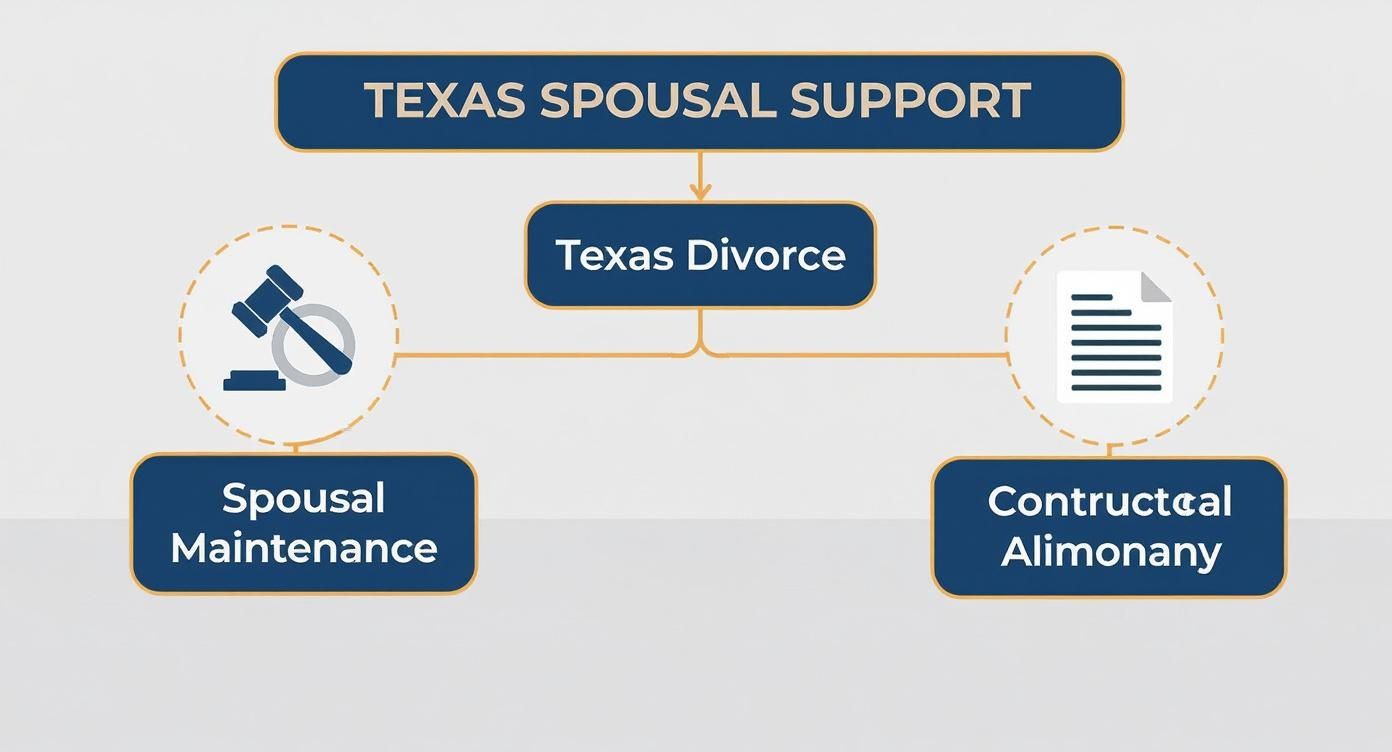
As you can see, there’s a big difference between court-ordered maintenance, with its strict legal requirements, and contractual alimony, which is a private agreement between the spouses. And while Texas is a no-fault state, factors like adultery or cruelty can still influence how a judge divides property and decides on support. You can learn more about this in our guide to the Texas no-fault divorce system.
If you believe the judge in your case awarded maintenance without sufficient evidence to support it—or denied it when one of these conditions was clearly met—you may have a solid foundation for an appeal. The key is proving the court made a legal error, and misapplying these strict eligibility rules is a classic example of one.
How Texas Courts Calculate Support Payments

It is a common feeling to look at the spousal support amount in your final divorce decree and feel it is arbitrary or unfair. Unlike child support, which is determined by a strict formula, Texas law gives judges significant discretion in setting the amount of spousal maintenance.
This flexibility can be beneficial, allowing a judge to tailor a solution to a family’s unique circumstances. However, it can also lead to outcomes that seem disconnected from the facts presented in court. This is often where the basis for a successful appeal is found.
When a judge has this much discretion, they must base their decision on a specific set of factors outlined in the Texas Family Code. If an order ignores these factors or is not supported by the evidence, it may be considered an "abuse of discretion"—a critical concept in appellate law.
Plain English: What is "Abuse of Discretion"?
In simple terms, this legal standard means a trial judge made a decision that was unreasonable, arbitrary, or without reference to any guiding legal rules. For spousal support, it could mean the judge ignored critical evidence about one spouse's needs or the other's ability to pay. This is a type of reversible error that can be corrected on appeal.
The Legal Caps on Spousal Maintenance
While there is no precise formula, Texas law does place firm ceilings on court-ordered maintenance. A judge cannot order payments that exceed the lesser of these two amounts:
- $5,000 per month
- 20% of the paying spouse's average monthly gross income
This cap acts as a legal safeguard. If your court order requires payments that exceed this statutory limit, it is a clear legal error and a powerful basis for an appeal. The cap is intended to ensure spousal support serves its purpose as temporary, rehabilitative aid, not as a punishment.
Factors the Court Must Consider
Beyond the financial caps, the core of a judge’s decision comes from a comprehensive list of factors they are legally required to analyze. The court must consider all relevant factors to arrive at a fair amount. An appellate court will review the trial record to determine if the judge properly weighed these elements.
Here are some of the key factors on that list:
- Each spouse's ability to provide for their own minimum reasonable needs.
- The education and employment skills of both spouses, and the time and resources needed for the receiving spouse to become self-sufficient.
- The duration of the marriage.
- The age, employment history, earning ability, and physical and emotional condition of the spouse requesting support.
- The effect of child support payments on each spouse's financial situation.
- Any marital misconduct, such as adultery or cruelty, by either spouse.
- One spouse's contributions as a homemaker, which enabled the other to advance their education or career.
- The property each spouse brought into the marriage.
Because Texas law does not provide a rigid worksheet, a judge must balance these factors to reach a just conclusion. This flexibility was demonstrated in a 2023 case where an appellate court upheld a $5,000 monthly award. The court found the amount was justified because it was directly tied to the receiving spouse's documented minimum reasonable needs, which totaled over $4,500 for essential living expenses. You can find more detail on how courts handle these calculations in high-asset divorces at akcfamilylaw.com.
If you believe the judge in your case overlooked important evidence about your finances, your contributions to the marriage, or your former spouse's true earning capacity, you may have grounds to challenge the ruling. An appeal is not a second trial; it is a review to determine whether the judge’s final calculation was supported by the law and the facts.
If you believe the court made a mistake in your family law case, our appellate attorneys can help you seek a fair outcome. Contact The Law Office of Bryan Fagan today for a free consultation.
How Long Do Spousal Support Payments Last?
When examining a spousal support order, it is easy to focus on the monthly payment. However, the duration—how long those payments will last—is equally critical and often a major point of dispute.
Texas law is clear on this: court-ordered spousal maintenance is a temporary bridge, not a permanent destination. The goal is to provide a spouse with the shortest realistic timeframe to become financially self-sufficient.
This is a core legal standard. If a trial judge orders maintenance for a period longer than the law allows, it constitutes a reversible error. This type of mistake can be a powerful basis for a successful appeal.
The Law Sets Hard Timelines
The Texas Family Code ties the maximum duration of spousal maintenance directly to the length of the marriage. These are firm legal caps, and a judge must operate within these boundaries.
A judge must order support for the shortest possible duration that allows the receiving spouse to earn enough to meet their "minimum reasonable needs." However, the order can never exceed these statutory maximums:
- Marriages lasting 10 to 20 years: A maximum of 5 years of support.
- Marriages lasting 20 to 30 years: A maximum of 7 years of support.
- Marriages lasting 30 years or more: A maximum of 10 years of support.
If your divorce decree orders payments beyond these timelines, the court may have exceeded its authority. This is precisely the type of legal overreach an experienced appellate attorney is trained to identify and challenge.
To make it crystal clear, here’s a breakdown of the strict, tiered system Texas uses for spousal maintenance duration.
Texas Spousal Maintenance Duration Limits
This table shows the maximum duration for court-ordered spousal maintenance based on the length of the marriage, as specified by the Texas Family Code.
| Length of Marriage | Maximum Duration of Support |
|---|---|
| 10 up to 20 years | 5 years |
| 20 up to 30 years | 7 years |
| 30 years or more | 10 years |
| Family Violence Case | 5 years (if marriage <10 years) |
| Disability (Indefinite) | As long as eligibility lasts |
As you can see, the law is quite rigid. The only significant exceptions to these timelines are for cases involving family violence in a shorter marriage or when a spouse’s disability prevents them from becoming self-sufficient.
When Can Support Last Indefinitely?
While Texas law strongly disfavors long-term support, it allows for exceptions in truly exceptional circumstances. A court can order indefinite spousal maintenance, but only in very specific situations.
This is reserved for cases where the receiving spouse has a serious, incapacitating physical or mental disability that prevents them from ever earning a sufficient income.
The same applies if that spouse is the primary caregiver for a disabled child of the marriage who requires substantial and continuous care. Because these are exceptions, the person requesting indefinite support must provide compelling evidence to justify it.
Automatic End Dates for Spousal Support
It is also crucial to understand that certain life events will automatically and immediately terminate spousal support payments, regardless of what the original court order states. The duty to pay ends if any of these three things happen:
- The death of either the paying or the receiving spouse.
- The remarriage of the person receiving the support.
- The receiving spouse cohabitates with a romantic partner on a continuing, full-time basis.
If the duration of your spousal support order seems excessive or disregards these legal limits and automatic termination rules, you may have strong grounds to challenge it and seek a more just outcome on appeal.
Appealing An Unfair Spousal Support Order
https://www.youtube.com/embed/30Tjnpp_Nso
When a judge issues a spousal support order that feels fundamentally unfair, it's easy to feel let down by the system. While frustrating, it is crucial to understand that the trial court’s decision does not have to be the final word. The Texas legal system provides a process for seeking justice: an appeal.
An appeal is not a second trial where you can introduce new evidence. Instead, it is a technical review of what has already occurred. The appellate court examines the official record from your trial—including transcripts, evidence, and rulings—to determine if the judge made a significant legal mistake.
Understanding Reversible Error and Abuse of Discretion
To succeed on appeal, you cannot simply disagree with the outcome. You must prove the trial court committed a reversible error. This is not a minor mistake; it is an error so significant that it likely led to an improper judgment.
In spousal support cases, these errors often fall under the legal standard known as abuse of discretion. This means the judge made a ruling that was arbitrary, unreasonable, or without reference to the guiding legal principles and facts of the case.
Here are a few common examples of reversible errors in spousal support cases:
- The judge ordered a support payment that exceeds the legal cap of 20% of gross income or $5,000 per month.
- The support was ordered for a period longer than the Texas Family Code allows for the length of your marriage.
- The court awarded spousal maintenance even though the evidence did not meet the strict eligibility requirements.
- The judge failed to properly consider mandatory factors, such as a spouse's contributions as a homemaker or proven marital misconduct.
These are fundamental errors that can form the basis of a powerful appeal, as they demonstrate that the court did not follow the law.
Common Grounds for a Spousal Support Appeal
Appeals regarding spousal maintenance almost always focus on specific, provable mistakes made at trial. A skilled appellate lawyer will meticulously review the entire case record to identify these critical errors. Because this process is so detailed, having a perfect record of the proceedings is essential, which is why many rely on professional legal court transcription services to ensure every word is documented accurately.
Some of the most common reasons a spousal support order is appealed in Texas include:
- Misapplication of Eligibility Rules: The court awarded maintenance even though the requesting spouse did not meet the 10-year marriage requirement or qualify for another statutory exception.
- Incorrect Calculation of Amount: The judge ordered payments that exceeded the legal limits or were not supported by the evidence of finances and needs.
- Improper Duration: The support order is set to last longer than the maximum timeframe permitted by law based on the length of the marriage.
- Decision Against the Weight of the Evidence: The final ruling is not logically supported by the financial documents and testimony from the trial.
An appeal provides a critical check on the power of the trial court, ensuring that spousal support decisions are not just made, but made correctly according to Texas law. The goal is to restore fairness and due process when the initial outcome was unjust.
If you are questioning the fairness of your spousal maintenance order, you must act quickly. Appeals operate on very strict deadlines. The first step is always a thorough review of your case. For a deeper dive into the nuances of these orders, you can learn more about alimony in Texas in our detailed guide.
Frequently Asked Questions About Texas Spousal Support
Going through a divorce brings up numerous questions, especially about finances. Spousal support can feel like a maze of complex rules during an already stressful time. Let's clarify some of the most common questions people have.
What's the Real Difference Between Spousal Maintenance and Contractual Alimony?
This is one of the most significant points of confusion. In the eyes of Texas law, these two terms are worlds apart.
Court-ordered spousal maintenance is the official, legally mandated support a judge can order one spouse to pay another. It is strictly regulated by the Texas Family Code, which sets tough eligibility rules, payment caps, and duration limits. A judge cannot order it unless the requesting spouse meets specific legal hurdles.
Contractual alimony is a voluntary agreement created and signed by both spouses, usually as part of a divorce settlement. It functions like a private contract. Because it is a private agreement, it is not restricted by the legal caps on amount or duration. You can agree to almost any terms, making it a flexible negotiation tool. The catch? If payments stop, it is enforced through a breach of contract claim, which is a different legal process than enforcing a court order.
Can a Spousal Support Order Be Changed or Ended?
Yes. A spousal maintenance order is not set in stone. Texas law recognizes that life is unpredictable.
Either spouse can petition the court to modify the order. To succeed, you must prove there has been a "material and substantial change" in the circumstances of either person since the original order was issued.
What does that look like in practice?
- The paying spouse loses their job or takes a significant, involuntary pay cut.
- The receiving spouse secures a high-paying job or receives an inheritance.
- A change in health impacts one party's financial needs or ability to work.
Maintenance also terminates automatically under certain conditions. Payments stop if the receiving spouse remarries or begins cohabitating with a new romantic partner. The obligation also ends if either you or your ex-spouse passes away.
What Happens If My Ex Just Stops Paying?
If your ex-spouse ignores a court order to pay spousal maintenance, the law provides powerful enforcement tools. Your first step is to file a motion for enforcement with the court.
This action informs the judge that your ex-spouse is violating the order. If the judge agrees, they can compel payment through several methods.
A judge can order wage garnishment (where money is taken directly from their paycheck), place a lien on their property, freeze their bank accounts, and order them to pay your attorney's fees. In severe cases, a judge can hold the non-paying spouse in contempt of court, which can result in fines or even jail time.
You do not have to pursue payments on your own. The legal system is designed to enforce its own orders.
Are There Any Loopholes to the 10-Year Marriage Rule?
Yes, and these exceptions serve as a critical safety net. The most common path to spousal maintenance is a marriage of 10 years or longer, but the law recognizes situations that warrant an exception.
A court can award maintenance in a marriage lasting less than 10 years if the paying spouse was convicted of or received deferred adjudication for an act of family violence. This acknowledges the unique financial devastation caused by domestic abuse.
The 10-year requirement is also waived if the requesting spouse has a debilitating physical or mental disability that prevents them from earning a sufficient income. The same applies if they are the primary caregiver for a child of the marriage with a severe disability, which often makes full-time employment impossible. These exceptions ensure the law protects those who need it most.
Figuring out the financial aspects of a divorce is challenging. To better understand the potential costs, you can read our guide on how much it costs to get a divorce in Texas.
If you believe the court made a mistake in your family law case, our appellate attorneys can help you seek a fair outcome. Contact The Law Office of Bryan Fagan today for a free consultation at https://familylawcourtappeals.com.