You may feel your Texas family law case was decided unfairly, leaving you with a result that doesn't feel just or right. Many people believe that because Texas is a "no-fault" divorce state, a judge’s hands are tied, but this is a common misunderstanding. While you don't have to prove your spouse did something wrong to end the marriage, their conduct can still be critical to a fair outcome.
The basis for most divorces in Texas is "insupportability"—a legal term meaning the marriage has broken down due to conflicts with no reasonable chance of reconciliation. However, when a trial court fails to properly consider key facts or misapplies the law, the final order can be deeply flawed. The appellate process exists to correct these errors and restore balance.
What You Can Appeal in a Texas Divorce Case

Navigating the end of a marriage is challenging, and the legal system is meant to provide a clear path forward. The no-fault system was designed to reduce conflict by removing the need to publicly assign blame. It shifts the court’s focus from past grievances to building a fair and stable future. However, "no-fault" does not mean "fault is irrelevant." A spouse's actions can and should have a major impact on the final outcome. If the trial court overlooked these factors, you may have grounds for an appeal.
An appeal is not a new trial. Instead, it is a focused review of the trial court record to determine if a significant legal mistake, known as a reversible error, occurred. These errors can fundamentally change the outcome of your case.
The Foundation of No-Fault: Insupportability
The most common reason for divorce in Texas is insupportability. This legal ground recognizes that a deep-seated conflict has permanently damaged the marriage, and there is no reasonable expectation of reconciliation.
Here’s what that means in practical terms:
- You Do Not Need to Prove Blame to File: You can begin the divorce process without proving your spouse is "guilty" of wrongdoing.
- One Spouse Can Initiate: If one person believes the marriage is insupportable, the court can grant the divorce even if the other spouse disagrees.
- The Court’s Focus is on Resolution: A trial judge's primary role is to resolve practical matters like property division and create a workable parenting plan.
Even in a no-fault divorce, a spouse's conduct during the marriage is highly relevant. Evidence of wrongdoing, such as wasting community assets or committing family violence, can be critical when a judge divides property or determines the best interest of a child.
This distinction is crucial. Many appeals arise because a party believes the trial judge did not give proper weight to these "fault" factors, resulting in an unjust outcome that warrants appellate review.
Why Texas Adopted a No-Fault Divorce System
To understand the appellate process, it is helpful to know why the no-fault system exists. Before this modern approach, getting a divorce in Texas required one spouse to prove the other was guilty of specific misconduct.
This old "fault-based" system forced parties to air painful and private details in open court. Spouses had to present evidence of cruelty, adultery, or other grounds, turning a family struggle into a public spectacle. Lawmakers recognized the emotional and financial damage this caused families, especially children.
A More Dignified Path Forward
The purpose of no-fault divorce is to provide a more humane process for dissolving a marriage. The previous system encouraged conflict and focused on assigning blame rather than finding practical solutions for the future.
Under the old fault-based system, you had to prove grounds such as:
- Cruelty: Proving a spouse’s behavior made living together unbearable.
- Adultery: Presenting hard evidence of an affair, which often involved invasive testimony.
- Abandonment: Showing a spouse intentionally left for at least one full year.
This adversarial framework not only fueled conflict but sometimes led parties to misrepresent facts to escape a broken marriage. The system was flawed and placed an immense burden on families in crisis.
The legal system shifted its focus from who was at fault for the end of the marriage to what truly matters: dividing property fairly and creating a stable plan for the children's future.
Texas officially adopted no-fault divorce in 1970, following California's lead. This significant reform moved the process away from a blame-based model. It allows couples to end their marriage with dignity and enables courts to focus on creating forward-looking solutions. You can learn more about how this change ended the need for fault-based grounds at McConathy Law.
Navigating the No-Fault Divorce Process in Texas
If you believe your divorce outcome was unfair, understanding how the process is supposed to work is the first step toward seeking justice. While a no-fault divorce is designed to be simpler, it involves a series of critical steps where errors can occur. A mistake at any stage can lead to an unjust result, potentially providing grounds for an appeal.
The process begins when one spouse files an Original Petition for Divorce. This document formally initiates the case and typically states the grounds as "insupportability." This means the marriage has broken down without hope of reconciliation, and no specific blame must be assigned at this stage.
The Mandatory 60-Day Waiting Period
Once the petition is filed and the other spouse is formally notified (served), a mandatory 60-day waiting period begins. The Texas Family Code requires this "cooling-off" period before a judge can finalize the divorce.
This period is intended to allow both parties time to process the situation and begin negotiating key issues. However, 60 days is the absolute minimum timeframe. Most contested divorces take much longer to resolve.
This flowchart provides an overview of the typical divorce journey.
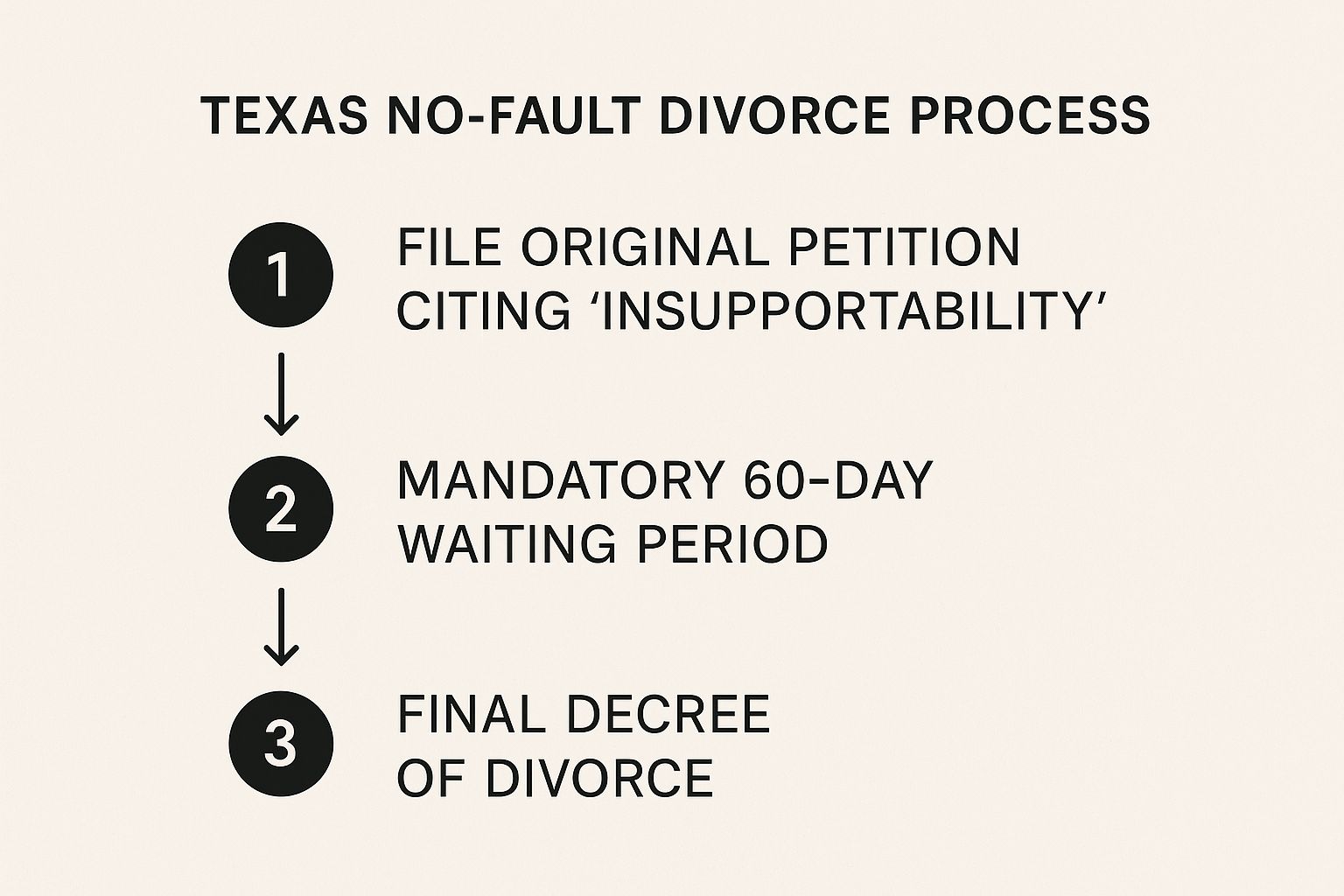
As shown, the process moves from filing the petition to obtaining a final court order, with the waiting period serving as a mandatory pause.
During this time, the substantive work of dividing your lives begins. You and your spouse, through your attorneys, will negotiate the terms of your Final Decree of Divorce. This is the legally binding court order that officially dissolves the marriage and details everything from property division to parental rights.
If you and your spouse reach an agreement on all issues, the process is smoother, as seen in an uncontested divorce in Texas.
When disagreements arise, however, the case proceeds to trial, where a judge makes the final decisions. This is where the risk of judicial error is highest. If the final decree feels wrong or unjust, our appellate team can scrutinize the record for reversible mistakes.
Key Stages of a Texas No-Fault Divorce
| Stage | What It Involves | Typical Timing |
|---|---|---|
| 1. Filing the Petition | One spouse files the Original Petition for Divorce, citing insupportability. | Day 1 |
| 2. Serving the Other Spouse | The other spouse is formally served with a copy of the petition and a citation. | Within a few days of filing |
| 3. The 60-Day Waiting Period | A legally required "cooling-off" period begins. No final divorce can be granted. | Minimum of 60 days from filing |
| 4. Negotiation & Mediation | Spouses and their attorneys exchange information and attempt to agree on all issues. | Throughout the waiting period and beyond |
| 5. Finalizing the Decree | Once all issues are resolved by agreement or a judge's ruling, the Final Decree of Divorce is signed. | Any time after the 60-day period ends |
This table outlines the basic timeline, but significant disagreements can extend these stages by months or even longer.
How Is Property Divided in a No-Fault Divorce?

A common myth is that a no-fault divorce in Texas automatically means a 50/50 split of all assets. This is a costly misconception. Filing for a no-fault divorce is simply the procedural start; it does not dictate how property is divided.
Texas is a community property state. This means most assets and income acquired by either spouse during the marriage belong to the "community estate." A judge's duty is not to split this estate equally, but to divide it in a manner that is “just and right.”
Understanding the Standard of Review: Abuse of Discretion
While a 50/50 split is a common starting point, the "just and right" standard gives a trial judge significant discretion. And this is where fault can become a deciding factor.
For example, if one spouse wasted community funds on an affair, the judge can award the other spouse a larger share of the remaining assets to achieve a fair division. If the court ignores such evidence, its decision may constitute an abuse of discretion. This legal term means the trial judge's ruling was arbitrary, unreasonable, or made without regard for guiding legal principles. It is a key standard of review in family law appeals.
A judge’s failure to properly consider financial misconduct when dividing property can be a reversible error. If you presented clear evidence of wasted assets and the court still ordered a disproportionately unfair division, that could be a powerful basis for an appeal.
Protecting Your Financial Future
A fair property division is fundamental to your financial stability post-divorce. It is often the most complex aspect of a case, requiring careful identification and valuation of all assets.
The final property division is memorialized in your Final Decree of Divorce and will impact your finances for years. Understanding the potential cost of divorce in Texas can help you prepare. If you believe the trial court made a critical error in this area, our appellate attorneys can review the record for mistakes that can be corrected on appeal.
Protecting Your Children During the Divorce

For parents, the primary concern during a divorce is the well-being of their children. You may feel that the court’s orders do not adequately protect their best interests.
In Texas, every judicial decision about children is governed by one guiding principle: the best interest of the child. This standard overrides all other considerations. The court is tasked with ensuring children have a safe, stable, and nurturing environment, regardless of the grounds for divorce.
How Fault Can Impact Custody Decisions
While the no-fault ground of insupportability is not typically relevant to custody, a parent's harmful conduct is. This is a critical point that, if mishandled at trial, can lead to an unjust outcome that necessitates an appeal.
A judge must consider any behavior that could endanger a child’s physical or emotional well-being. This is not about punishing a spouse; it is about protecting the child.
Behaviors that can heavily influence a custody case include:
- Family violence or abuse: Any history of physical, emotional, or sexual abuse is a major factor.
- Substance abuse: A parent's drug or alcohol abuse can be seen as a direct threat to a child's safety.
- Neglect: Failing to provide for a child’s basic needs is a serious concern for the court.
Under the Texas Family Code, a judge’s primary duty is to protect the children. If a trial court issues an order that ignores clear evidence of dangerous behavior, that decision could be an abuse of discretion. This provides a strong basis for an appeal, as the ruling would be considered unreasonable and contrary to the child's best interest.
Building a Stable Future for Your Kids
The goal of the final orders is to establish clear and enforceable terms for conservatorship (custody), possession schedules, and child support that prioritize your children’s stability.
Most parents strive for a cooperative arrangement. You can learn more about what this entails in our guide to joint custody in Texas.
If you feel the final orders in your divorce fail to protect your children or that the judge made a significant legal mistake, the trial court's decision does not have to be the final word. The appellate process provides a path to seek a just and fair outcome.
Common Questions About Texas No-Fault Divorce
https://www.youtube.com/embed/TfmV5vE-gAs
A divorce proceeding often raises many questions and uncertainties. Here, we address some common concerns regarding the no-fault divorce process in Texas and how it relates to a potential appeal.
It's helpful to understand the broader context. The divorce rate in Texas has declined in recent years. As of 2021, Texas had one of the lowest rates in the country at 1.4 divorces per 1,000 people. This trend may reflect various societal shifts. You can explore more data on the divorce rates in Texas on Divorce.com.
Can My Spouse Stop Me from Getting a No-Fault Divorce?
No. In Texas, if one party asserts that the marriage is insupportable, the court will grant the divorce. As long as you meet the state's residency requirements, your spouse cannot legally prevent the divorce from moving forward. A judge will not compel you to remain married against your will.
Does No-Fault Always Mean a 50/50 Property Split?
No. Texas law requires a "just and right" division of community property. While a 50/50 split is a frequent starting point, it is not mandatory. A judge has the discretion to award a disproportionate share to one spouse based on various factors, including disparities in earning capacity or evidence of fault in the breakup of the marriage, such as the wasting of community assets. An unfair division may be an abuse of discretion subject to appeal.
How Long Will My No-Fault Divorce Take?
Every divorce is subject to a mandatory 60-day waiting period after the petition is filed. If you and your spouse agree on all terms, the divorce can be finalized shortly after this period. However, if your case involves complex property division or child custody disputes that must be litigated, the process will likely take six months to a year, or even longer.
Are There Benefits to Pleading Fault Grounds?
Yes, in certain strategic situations. While a no-fault divorce is procedurally simpler, pleading a specific fault ground—such as adultery or cruelty—can be advantageous. It may provide leverage in negotiations for a more favorable property division or influence a judge’s decisions regarding child custody, particularly if the fault-based conduct directly impacts the best interest of the child.
If you believe the court made a mistake in your family law case, our appellate attorneys can help you seek a fair outcome. Contact The Law Office of Bryan Fagan today for a free consultation at https://familylawcourtappeals.com.