Skip to content
When a judge finalizes your divorce, you expect the division of your property to be fair and legally sound. You may feel your case was handled unfairly, however, if the final order gives away a significant portion of a 401(k) you spent decades building. It’s a valid concern, particularly when you believe the court simply got it wrong.
The good news is that a Texas trial court’s decision is not always the final word. If a judge made a significant legal mistake when dividing your retirement assets, that error can be challenged through the appellate process. An appeal is not about re-trying your case; it is a focused review to correct legal errors that led to an unjust outcome.
Understanding How a 401(k) Is Divided in a Texas Divorce
Going through a divorce can leave you feeling like the court didn't get it right, especially with something as complicated as a retirement account. Texas is a community property state, which means any asset acquired from the date of marriage until the date of divorce is presumed to belong equally to both spouses. This legal foundation dictates how a 401(k) is handled.
When we apply this to a 401(k), the account must be divided into two distinct parts:
- Separate Property: This includes the funds in your account on the day you were married, plus all traceable growth on that pre-marital balance (like interest and market gains). This portion is not subject to division.
- Community Property: This includes all contributions made by you or your employer during the marriage, along with all investment gains on those marital funds. This is the only portion the court can divide.
Getting this distinction right is absolutely critical. If a trial court incorrectly labels your separate property as community property and divides it, that is a classic example of a reversible error—a mistake so significant that it provides strong grounds for an appeal.
A Real-World Scenario
Let's walk through a common situation. Say you opened your 401(k) ten years before getting married, and the marriage itself lasted 15 years. It’s a huge misconception to assume the entire account gets split down the middle.
Instead, a good attorney or a forensic accountant will perform what’s called a "tracing" analysis. They'll pinpoint the exact value of your account on your wedding date and then meticulously track its growth over the years, keeping it separate from all the new money that went in during the marriage.
This idea—that retirement funds grown during a marriage are marital assets—is a cornerstone of U.S. family law, though the specifics vary. Community property states like Texas aim for a just and right division (often 50/50) of the marital portion. Other states use an "equitable distribution" model, which can be more flexible. You can find more details on how different states handle retirement assets on legal sites like gevurtzmenashe.com.
What Can You Appeal in a 401(k) Division?
An appeal isn't just a chance for a do-over. It’s a targeted challenge to specific legal mistakes made by the trial court. A common basis for appeal is an “abuse of discretion,” which means the judge’s ruling was arbitrary, unreasonable, or made without considering the facts. For a 401(k), this could be a situation where the judge completely ignored clear evidence proving your separate property claim, leading to a division that was fundamentally unfair.
Navigating the division of a 401(k) requires a solid grasp of some specific terminology. These aren't just buzzwords; they are the concepts that will define how your assets are handled.
Key Terms for Your Texas 401k Division
This table breaks down the essential legal and financial terms you'll encounter. Understanding them will help you have more productive conversations with your attorney and make more informed decisions.
| Term | Plain-English Definition | Why It Matters for Your Case |
|---|---|---|
| Community Property | Any asset or debt acquired by either spouse during the marriage. | This is the portion of your 401(k) that is subject to division by the court. |
| Separate Property | Assets owned by a spouse before the marriage, or acquired during the marriage by gift or inheritance. | The separate property portion of your 401(k) is not divisible and remains yours, but you have the burden to prove it. |
| Tracing | The financial analysis process used to prove the separate property character of an asset. | This is the crucial evidence needed to protect your pre-marital 401(k) balance and its growth from being divided. |
| QDRO (Qualified Domestic Relations Order) | A special court order that tells a retirement plan administrator how to pay a portion of a plan's benefits to a spouse, ex-spouse, or dependent. | This is the legal document required to actually split the 401(k) funds without triggering taxes and penalties. It’s separate from your divorce decree. |
| Abuse of Discretion | The legal standard used in appeals to show a trial judge made a decision that was unreasonable, arbitrary, or without regard for the facts or law. | This is often the basis for appealing an unfair property division. If the judge ignored your evidence, it may be an abuse of discretion. |
| Reversible Error | A legal mistake made by a trial court that is serious enough to require an appellate court to reverse the decision. | Mischaracterizing separate property or using a flawed valuation formula can be a reversible error in a 401(k) split. |
Getting these terms straight from the start can make a huge difference in the clarity and outcome of your case.
If you believe the court made a mistake in your family law case, our appellate attorneys can help you seek a fair outcome. Contact The Law Office of Bryan Fagan today for a free consultation.
The QDRO: Your Legal Key to Dividing Retirement Funds
When you think about splitting up assets in a divorce, it's easy to picture moving money from one bank account to another. But a 401(k) is a different beast entirely, governed by a strict set of federal rules. You can't just write a check or wire funds to your ex-spouse from a retirement account. Trying to do so would be seen as an early withdrawal, triggering a painful combination of income taxes and a steep 10% penalty.
This is where the Qualified Domestic Relations Order (QDRO) becomes absolutely essential. A QDRO isn't part of your divorce decree; it's a completely separate court order that gives the 401(k) plan administrator a specific set of instructions. It is the only legal way to divide retirement funds in a divorce without triggering those nasty penalties.
Think of it this way: the QDRO is the legal key that unlocks the account. It tells the plan manager exactly how to transfer a portion of the assets to the other spouse, who is referred to as the "alternate payee" in the legal world.
Without a properly executed QDRO, any agreement you have in your divorce papers to split a 401(k) is basically worthless to the plan administrator. They will simply reject the request, leaving the money locked in the original account holder's name.
Why You Should Get Your QDRO Pre-Approved
One of the biggest—and most expensive—mistakes I see couples make is waiting until the ink is dry on the divorce to draft the QDRO. Here's the catch: every single retirement plan has its own unique, and often frustratingly rigid, set of rules for what a QDRO must include. A document that works perfectly for a Fidelity plan might get flat-out rejected by Vanguard because of a tiny difference in wording or formatting.
The smarter strategy is to draft the QDRO before the divorce is final and send it to the plan administrator for pre-approval. This simple step gives them a chance to review it and confirm it meets all their specific guidelines.
Getting that pre-approval saves you from a world of headache. You avoid the nightmare scenario where a judge has signed the final decree, but the 401(k) administrator kicks back the QDRO. Fixing that mess can be incredibly difficult, often requiring you to go back to court, which means more legal fees and a lot more stress.
This infographic gives a great overview of how 401(k) funds are separated and divided.
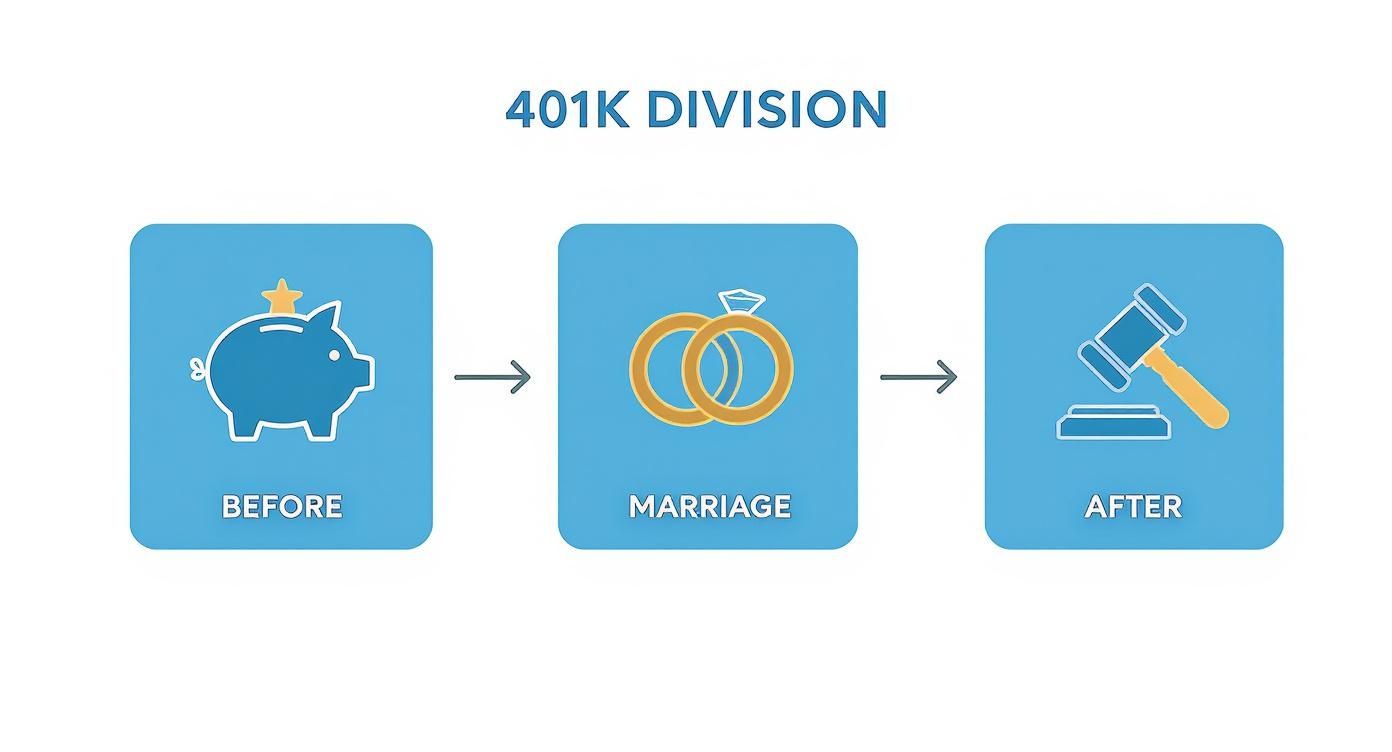
It clearly shows how the account's value is broken down into pre-marital, marital, and post-divorce portions, highlighting why it's so important to correctly identify the community property share that needs to be split.
What Happens If a QDRO Is Drafted Incorrectly?
A poorly written QDRO can cause serious financial problems. If the language is vague or, even worse, contradicts the divorce decree, it can lead to major disputes and delays. For instance, let's say the decree awards your ex-spouse 50% of the marital portion of the 401(k). If the QDRO doesn't clearly state how market gains and losses should be handled between the date of divorce and the date the money is actually paid out, the final amount could be off by thousands of dollars.
Reversible Error in QDROs
A major conflict between your final divorce decree and the signed QDRO can be grounds for an appeal. If the QDRO distributes funds in a way that fundamentally goes against the judge's property division orders, it could be considered a reversible error. An experienced family law appeal attorney can dig into these documents to see if a mistake was made that unfairly cost you money.
While the QDRO is the main tool for the split, it's also wise for both parties to understand how to get your 401k money without penalty through other means. This knowledge helps you both make smarter financial decisions as you move forward.
Getting the QDRO drafted and executed perfectly is non-negotiable. If you suspect that your final orders have errors or that the QDRO process was botched in your case, a skilled appellate attorney can evaluate your situation and determine if you have grounds to get it corrected.
Calculating the Divisible Portion of Your 401k
Figuring out the exact community property value of a 401k is often one of the biggest sticking points in a divorce. If you suspect the court got the math wrong and it led to an unfair division, this could be what we call a reversible error. This isn't as simple as subtracting the balance on your wedding day from the balance when you filed for divorce—far from it.

To get it right, you need to conduct a detailed financial investigation called tracing. The whole point is to meticulously separate the pre-marital funds (your separate property) from the funds accumulated during the marriage (community property), and—this is the tricky part—account for all the market ups and downs that affected both pots of money over the years.
Tracing Your Separate Property Interest
Let's say you started your 401k ten years before you got married, and the marriage itself lasted 15 years. Your 401k isn't just a piggy bank; it's an active investment. That pre-marital balance didn't just sit there—it grew (or shrank) with every market swing.
To do this properly, your attorney or a financial expert will have to roll up their sleeves and:
- Pinpoint the starting balance: Nail down the exact value of the 401k on the date of your marriage. This figure is the foundation of your separate property claim.
- Track all contributions: Document every single contribution made during the marriage, whether from you or your employer. These are all community property funds.
- Analyze market activity: This is where the real work happens. They have to apply the account's gains and losses proportionally to both the separate and community property buckets. This is the most complex step and where mistakes are most common.
For instance, if the market had a banner year, that growth has to be allocated to both your original pre-marital funds and the new marital contributions. By the same token, if the market took a dive, both portions would take a hit.
When a Judge Gets It Wrong: Abuse of Discretion
A court commits an "abuse of discretion" when it makes a decision that's arbitrary, unreasonable, or flies in the face of established legal rules. If a judge simply ignores clear evidence of a separate property claim or uses a bogus formula to value the community slice of a 401k, their ruling on the 401k split during divorce could be successfully challenged on appeal.
A Real-World Example of a 401k Calculation
Let's walk through a simplified scenario to see how this plays out. Imagine a spouse had $100,000 in their 401k on their wedding day. Over a 10-year marriage, another $150,000 was contributed from their salary (marital earnings). At the time of divorce, the account is now worth $400,000.
It's tempting to think the community portion is just the $150,000 in contributions, but that completely ignores the market growth. The account grew by $150,000 during the marriage ($400,000 total – $100,000 starting balance – $150,000 in new contributions).
A forensic accountant would trace that growth to see where it came from. Let's say they determine that $60,000 of the growth is directly linked to the initial separate property funds. Here’s the final breakdown:
- Separate Property: $100,000 (initial) + $60,000 (growth) = $160,000
- Community Property: $150,000 (contributions) + $90,000 (growth) = $240,000
In this situation, only the $240,000 community portion is on the table for division. A sloppy calculation could have wrongly classified tens of thousands of dollars, completely skewing what's supposed to be a fair property settlement.
Before diving deeper into the legal process, it's helpful to understand the different ways you and your spouse can approach this division. There isn't a one-size-fits-all solution.
Common Methods for Dividing a 401k
| Division Method | How It Works in Practice | Who This Is Best For | Potential Pitfalls to Watch For |
|---|---|---|---|
| QDRO Rollover | The court-ordered QDRO directs the plan administrator to transfer the non-employee spouse's share directly into their own retirement account (like an IRA). | Spouses who want to keep their retirement savings invested for the long term and avoid immediate taxes. | The process can be slow and requires precise legal drafting. Any mistake in the QDRO can cause major delays or rejection by the plan administrator. |
| Cash-Out (With QDRO) | The QDRO allows the non-employee spouse to take their share as a direct cash payment. This is a taxable event and subject to a 10% penalty if under age 59.5. | Someone who needs immediate liquidity and understands the significant tax and penalty implications. This is rarely the best financial option. | The immediate financial hit from taxes and penalties can be substantial, greatly reducing the actual amount received. |
| Asset Offset | The employee spouse keeps the entire 401k. The non-employee spouse receives other marital assets of equal value (e.g., more equity in the house, a brokerage account). | Couples with enough other high-value assets to create a fair trade. This simplifies the process by avoiding the need for a QDRO. | Accurately valuing all assets is critical. You might trade a future high-growth asset (the 401k) for a current asset with less growth potential. |
Each of these paths has its own set of pros and cons, and the best choice really depends on your specific financial situation and long-term goals.
What About 401k Loans?
An outstanding 401k loan throws another wrench in the works. If the loan was taken out during the marriage to cover community expenses—think a kitchen remodel or a new family car—the remaining debt is usually treated as a community debt.
This means the loan balance is typically subtracted from the 401k's total community value before it gets divided.
If a judge fails to properly account for a loan or mischaracterizes it, this can also create an unjust division that might be correctable on appeal. Getting every detail right—contributions, gains, losses, and loans—is absolutely critical for a fair division of your marital estate.
If you believe the court made a mistake in your family law case, our appellate attorneys can help you seek a fair outcome. Contact The Law Office of Bryan Fagan today for a free consultation.
Common Reversible Errors in 401k Division Rulings
When a judge finalizes your divorce, you trust the outcome will be fair and legally sound. But what happens when you look at the final decree and realize the court made a huge mistake in splitting your 401k? It can feel like years of your hard work and savings were just handed away unfairly.
The good news is that a final divorce decree isn't always the last word. If a judge made a serious legal mistake, that unjust ruling can often be challenged through the Texas appellate process.
An appeal isn't just a second chance to argue your case because you don't like the result. Instead, it's a laser-focused review of the trial record to find specific legal mistakes the judge made. In property division, we call these reversible errors—mistakes so significant that they likely caused an improper judgment, which an appellate court has the power to fix.
Understanding the "Abuse of Discretion" Standard of Review
In Texas family law appeals, we typically review property division errors under a standard called “abuse of discretion.” This is a legal term that describes a decision that was arbitrary, unreasonable, or made without following guiding legal rules and principles. An appeal is not a new trial; it is a review of the existing trial court record for these specific kinds of errors.
Essentially, the appeals court asks two key questions:
- Did the judge have enough evidence in the record to make the decision they made?
- Did they apply the law correctly to that evidence?
If the answer to either of those is "no," it's likely an abuse of discretion. This opens the door for the appellate court to reverse the ruling and send the case back to be decided correctly, a process known as "remanding" the case.
Mischaracterizing Separate Property as Community Property
One of the most common—and most costly—mistakes in a 401k split during divorce is getting the character of the property wrong. Remember, only the portion of a 401k earned during the marriage is community property. The funds you contributed before the marriage, along with the growth on those funds, are your separate property.
A reversible error happens when a trial judge ignores clear and convincing evidence proving a chunk of the 401k is separate property.
Imagine you provided detailed account statements proving a $150,000 separate property balance from before you got married. If the judge ignores that proof and divides the entire 401k as if it were all community funds, that is a textbook abuse of discretion and a strong basis for an appeal.
A judge can't just ignore properly presented evidence. When a ruling isn't supported by the facts in the record, it undermines the entire principle of a just and right property division and may be overturned on appeal.
Using a Flawed Valuation or Calculation Method
Figuring out the community property slice of a pre-existing 401k requires a detailed financial analysis, a process often called tracing. This isn't just simple math; it involves correctly allocating market gains and losses to both the separate and community shares of the account over many years.
An appealable error can occur if the court uses a legally incorrect formula or relies on a faulty valuation. For instance, what if the court’s calculation fails to account for a major market downturn that hit the separate property portion of the account especially hard? This could artificially inflate the community property's value, giving your ex-spouse a much larger share than they're legally entitled to.
You can learn more about the a deep-dive into this process in our guide on dividing a 401k in a divorce.
QDRO Errors and Contradictions with the Decree
The Qualified Domestic Relations Order (QDRO) is the all-important legal instrument that tells the 401k plan administrator how to actually divide the money. It must perfectly mirror the terms of the final divorce decree. When it doesn't, you have a reversible error.
I've seen this happen in a few common ways:
- Incorrect Percentage or Amount: The decree might award your ex 50% of the community portion, but the QDRO is drafted to give them 50% of the entire account balance—including your separate property.
- Improper Handling of Gains/Losses: The decree might be silent on how to handle market swings between the date of divorce and the date the funds are actually paid out. If the QDRO drafter adds language that unfairly benefits one person, that's a problem.
- Failure to Address Loans: A 401k loan taken out during the marriage is a community debt. If the QDRO fails to properly account for that loan in the division calculations, the distribution will be inequitable.
If the terms in the QDRO don't match the judge's orders in the divorce decree, the resulting division is improper. A skilled appellate attorney will scrutinize these documents line-by-line to spot these discrepancies and build a case to get the error corrected.
What To Do With the Money After the QDRO Is Finalized
Getting your share of a 401(k) after the divorce is a huge milestone, but it’s really just the beginning of a new financial chapter. Once the Qualified Domestic Relations Order (QDRO) is signed, sealed, and delivered, and the plan administrator processes the transfer, you become the "alternate payee." Now, you have some big decisions to make about what to do with those funds.
Taking your time here is critical for your long-term security.

The options can feel overwhelming, and each path has its own set of rules and, more importantly, tax implications. A hasty decision can lead to serious financial setbacks—the last thing anyone needs after navigating a divorce.
Evaluating Your Main Options
Once the money is officially yours, you generally have three main routes you can take. Understanding the pros and cons of each is the first step toward making a smart choice that lines up with your new life.
- Roll It Over into Your Own IRA: This is almost always the most recommended strategy. A rollover lets you move the funds directly into a new or existing Individual Retirement Account (IRA) in your name. It's a non-taxable event, so you won't owe any income tax on the transfer, and it keeps the tax-deferred growth potential of your retirement savings alive and well.
- Transfer to a New Employer's 401(k): If you're working and your company's 401(k) plan accepts rollovers, you might be able to move the funds there. This can be a great way to consolidate your retirement accounts and keep everything in one place.
- Cash Out the Funds: This option means taking the money as a direct cash payment. While the QDRO protects you from the 10% early withdrawal penalty, you will still have to pay ordinary income tax on the entire amount. That can lead to a massive tax bill, seriously shrinking your nest egg.
Making the right choice after a QDRO is about more than just dodging penalties; it's about strategically positioning your assets to support the future you want. An IRA rollover usually offers the most investment flexibility and control, letting you build a portfolio that truly reflects your post-divorce financial reality.
The Financial Impact of a "Gray Divorce"
These decisions are especially crucial with the rise of "gray divorce." A 2022 study revealed that a staggering 36% of all U.S. divorces now involve couples aged 50 and older. Because people in this age group often have significant retirement savings built over decades, how those assets are managed post-divorce can make or break their financial stability.
For anyone splitting a 401(k) later in life, preserving every single dollar is paramount. The tax hit from cashing out can be particularly devastating when you have less time to recover from that kind of loss before you need the money for retirement.
Making an Informed Decision
Deciding what to do with your slice of a 401(k) is a major financial event, and the tax consequences alone can be tricky. It's important to understand the landscape of your new retirement funds, which can include things like the tax implications of an inherited 401k, as this can offer some insight into how distributions are taxed.
The emotional toll of a divorce is heavy, but the financial side demands a clear, strategic head. For a full picture of the costs involved in the divorce process itself, you can check out our guide on https://familylawcourtappeals.com/how-much-for-a-divorce-in-texas/.
This is where talking to a qualified financial advisor becomes invaluable. They can help you look at your entire financial picture, figure out your risk tolerance, and build a plan that puts your newly acquired assets to work for your future.
If you believe the court made a mistake in your family law case, our appellate attorneys can help you seek a fair outcome. Contact The Law Office of Bryan Fagan today for a free consultation.
Answering Your Top Questions About 401(k) Splits in Texas
When you're going through a divorce, the financial side of things can be a minefield. The rules for splitting up retirement accounts, especially a 401(k), often seem designed to be confusing. You might walk away from the process feeling like something wasn't handled right, particularly if the final numbers just don’t look fair.
Let's cut through the jargon and tackle some of the most common questions we hear from clients about how 401(k)s are really divided in a Texas divorce. Getting these details straight is the first step in making sure you get a fair shake. It’s also crucial knowledge if you suspect the court made an error and are considering an appeal.
My Spouse Wants Part of My 401(k), but I Started It Before We Got Married. Can They Do That?
This is probably the number one concern for anyone who diligently saved for retirement before tying the knot. The short answer is no, your spouse is not entitled to the money you had in your 401(k) before the marriage. That pre-marital balance, plus any growth it earned on its own, is considered your separate property under Texas law.
But here’s the catch: the burden is entirely on you to prove it. You can't just say, "I had $50,000 in there when we got married." You need to back it up with hard evidence—think old account statements or a forensic accountant's report—that clearly traces the separate property portion of the account. If you can't provide this "clear and convincing evidence," the court is likely to treat the entire account as community property, meaning it all goes into the pot for division.
We Agree on How to Split It. Do We Still Need a QDRO?
Absolutely, yes. A Qualified Domestic Relations Order (QDRO) is not optional. I've seen couples try to handle this informally to save time or money, and it always ends badly. Even with a signed agreement, you can't just ask the plan administrator to cut your ex-spouse a check.
If you do, the IRS will treat that transfer as an early withdrawal from your account. That means you’ll be on the hook for income taxes on the entire amount, plus a potential 10% early withdrawal penalty.
A QDRO is the only legal tool recognized by the IRS and federal law that allows a 401(k) plan administrator to pay your ex-spouse their share without triggering those massive tax consequences. It’s a separate court order that comes after your divorce decree, and it is non-negotiable.
How Long Until My Ex-Spouse Actually Gets Their Money?
This part of the process often takes much longer than anyone expects, which can be a real source of frustration. Once the judge signs the QDRO, it's not over. The signed order has to be sent to the company that manages the 401(k) plan for their own internal review and approval.
This review can take anywhere from 30 days to several months. It all depends on the plan administrator's backlog and how complicated the QDRO is. If they find even a small error or something that conflicts with their plan's specific rules, they will reject it. The QDRO will then have to be fixed by the attorneys, re-signed by the judge, and submitted all over again, adding weeks or even months to the timeline. This is exactly why getting the QDRO pre-approved by the plan administrator before the judge signs it is a best practice we always recommend.
What About Market Gains or Losses While We Wait for the QDRO to Go Through?
This is an excellent question and one that can lead to major headaches if it isn't addressed upfront. A 401(k) balance is constantly changing with the market. So what happens in the months between when the divorce is final and when the money is actually split?
A well-drafted QDRO should spell this out precisely. It needs to state exactly how investment gains and losses that accrue during that limbo period will be allocated to your ex-spouse’s share.
If that language is missing, the 401(k) plan’s default rules kick in, which might not be what either of you intended. A failure to properly account for these market fluctuations can be a huge problem and could even be grounds for an appeal if it leads to a division that goes against what your divorce decree ordered.
Do Other States Handle This Differently?
While the QDRO requirement is a federal law that applies everywhere, the underlying divorce laws about what's "fair" can vary. Texas is a community property state, aiming for a "just and right" division that often starts at 50/50.
In an equitable distribution state like North Carolina, however, a judge has more leeway to divide the marital portion of a 401(k) in a way they deem "fair," which might not be an equal split. This is why, no matter where you live, getting expert advice is so important. As you can discover more insights about 401k splits on Van Camp Law Firm's website, the core mechanics of using a QDRO are universal, but state laws add a critical layer of complexity.
If you believe the court made a mistake in your family law case, our appellate attorneys can help you seek a fair outcome. Contact The Law Office of Bryan Fagan today for a free consultation.