Receiving a court order terminating parental rights in Texas is a devastating experience. You may feel your case was handled unfairly, that the judge misunderstood the facts, or that your rights were not protected. This final decree legally and permanently dissolves the bond between you and your child, but a trial court's decision does not have to be the last word. The Texas legal system provides a path to seek justice through an appeal.
If you believe a mistake was made, it is critical to understand that you have the right to challenge an unjust termination. An appeal is not a new trial, but a focused review of the original proceedings to identify and correct significant legal errors that may have changed the outcome.
What You Can Appeal in a Termination of Parental Rights Case

When you feel the court ignored your progress or misunderstood your circumstances, it's easy to believe the system was stacked against you. Those feelings are valid, and it’s important to know that a trial court’s judgment is not irreversible. A wrongful termination can be challenged through the appellate process, which is designed to ensure the law was applied correctly and fairly.
An appeal does not allow you to introduce new evidence or re-argue your case from scratch. Instead, an appellate court conducts a highly focused review of what already happened at trial. The core purpose is to ensure that the law was followed and that your right to due process was upheld.
The appellate court examines the trial record to answer critical legal questions, such as:
- Did the trial judge misinterpret or misapply a provision of the Texas Family Code?
- Was the evidence presented legally sufficient to meet the high standard required for termination?
- Did a procedural error prevent you from having a fair opportunity to present your case?
A successful appeal is not about convincing a higher court that you are a good parent. It's about demonstrating that a reversible error—a significant legal mistake—occurred during the trial. Understanding this distinction is the foundation of appellate strategy and your best chance to restore your parental rights.
Challenging a termination order is a technical and time-sensitive process governed by the Texas Rules of Appellate Procedure. These rules establish strict, non-negotiable deadlines. Missing even one can permanently forfeit your right to appeal. An experienced appellate attorney can immediately begin analyzing your case for reversible errors, such as an abuse of discretion by the judge, to fight for the fair outcome you and your child deserve.
The High Legal Standard for Terminating Parental Rights in Texas
In Texas family law, terminating parental rights is considered the "death penalty" of civil cases because it permanently severs the legal relationship between a parent and child. Because the stakes are so high, the law requires the person or entity seeking termination—whether an ex-spouse or Child Protective Services (CPS)—to satisfy a demanding two-part legal test.
Both parts of this test must be proven with "clear and convincing evidence." This is a much higher burden of proof than the "preponderance of the evidence" standard used in most civil cases. "Clear and convincing" means the evidence must produce a "firm belief or conviction" in the judge or jury's mind that the allegations are true. This heightened standard exists to protect the fundamental constitutional right of parents to raise their children.
Hurdle #1: Proving a Statutory Ground
First, the petitioner must prove that the parent’s conduct falls under at least one of the specific grounds for termination listed in Section 161.001 of the Texas Family Code. A judge cannot terminate parental rights based on disapproval of a parent's lifestyle or personal choices. The conduct must align with a specific legal reason.
Common statutory grounds include:
- Endangerment: Knowingly placing the child in physical or emotional danger.
- Failure to Comply with a Court Order: Violating a court-ordered service plan designed by CPS to address issues that led to the child's removal.
- Abandonment: Leaving the child with another person without providing support and with no intent to return.
- Criminal Conduct: Being convicted and imprisoned for a serious crime that demonstrates an inability to provide a safe environment for the child.
If the evidence fails to prove one of these grounds with clear and convincing clarity, the termination case should fail. A common reversible error found on appeal is that the evidence presented at trial was too weak to meet this demanding standard. This is a key area appellate attorneys scrutinize when evaluating a trial court’s abuse of discretion.
Hurdle #2: Proving Termination is in the Child’s Best Interest
Even if a statutory ground is proven, the petitioner's work is only half done. They must then independently prove, again by clear and convincing evidence, that severing the parent-child bond is in the child’s best interest. This is a separate and distinct legal requirement. It cannot be assumed that because a parent made a mistake, termination is automatically best for the child.
The "best interest" analysis is not a simple checklist but a comprehensive evaluation of the child’s emotional and physical needs, both now and in the future. The law begins with the strong presumption that it is in a child's best interest to be raised by their biological parent.
To guide this determination, Texas courts use a set of principles known as the "Holcomb factors." These factors help the judge weigh all the evidence to decide what outcome will best serve the child's well-being.
Key Holcomb Factors Include:
- The child's wishes (considering their age and maturity).
- The child's current and future emotional and physical needs.
- Any present or future physical or emotional danger to the child.
- The parenting abilities of the individuals seeking custody.
- Programs available to assist the parties in promoting the child's best interest.
- The stability of the proposed home.
- The acts or omissions of the parent which may indicate that the existing parent-child relationship is not a proper one.
- Any excuses for the parent's acts or omissions.
Many successful appeals are built by showing the trial evidence was not strong enough to overcome the presumption that keeping the family together is in the child's best interest.
Grounds for Termination vs. Best Interest Factors
It is essential to understand that statutory grounds and best interest are two separate legal hurdles. The petitioner must present compelling evidence for both. This table clarifies the distinction.
| Legal Test | What Must Be Proven | Examples |
|---|---|---|
| Statutory Grounds | The parent's specific conduct fits one of the categories listed in the Texas Family Code. | Proving the parent engaged in drug use that endangered the child; proving the parent abandoned the child for six months. |
| Best Interest | Severing the parent-child relationship is better for the child's long-term well-being and development. | Showing the child has a strong bond with a stable foster family; showing the parent is unable to provide a safe home in the foreseeable future. |
A failure to prove either part of this test with clear and convincing evidence means the termination cannot be legally upheld. Understanding this two-part structure is the first step in evaluating the strength of a potential appeal.
Understanding How an Appeal Differs from a Trial
If you have received an order terminating your parental rights in Texas, your first instinct may be to ask for a new trial. This is a common but critical misunderstanding of the appellate process. An appeal is not a second trial; it is a legal review of what has already occurred.
The purpose of an appeal is not to re-tell your story or introduce new evidence. The entire focus is on one question: did the trial judge make a significant legal mistake, known as a "reversible error"?
The Appellate Record is the Entire Case
While a trial focuses on presenting new facts and testimony, an appeal is strictly limited to the existing trial court record. This "record on appeal" includes everything that happened in your case and is considered closed.
The appellate record is composed of two parts:
- The clerk's record: A compilation of all documents filed in the case, including petitions, motions, and the judge's orders.
- The reporter's record: The official, word-for-word transcript of all hearings and trial proceedings. An accurate legal court transcription is essential.
Our appellate attorneys meticulously review this record to identify legal errors that may have led to an unjust outcome. The entire appeal is built upon what is contained within these documents.
An appeal is not a retrial of the facts; it is a review of the law. The appellate court asks, "Based on the evidence presented at trial, did the judge apply the law correctly?"
Understanding the Standard of Review and Briefing
Appellate judges do not simply substitute their judgment for the trial judge's. They must analyze the lower court's decisions through a specific legal lens called the standard of review.
In parental rights termination cases, a key standard is abuse of discretion. This legal term means the trial judge made a decision that was arbitrary, unreasonable, or without reference to any guiding legal rules. For example, if a judge terminated your rights without the required "clear and convincing evidence," that would be a classic abuse of discretion. Our role on appeal is to prove that this standard was met.
We present our arguments through a process called briefing. An appellate brief is a comprehensive, persuasive legal document written for the appellate judges. In the brief, we:
- Identify the specific legal errors found in the trial record.
- Support our arguments with relevant statutes from the Texas Family Code and precedent from past appellate court decisions.
- Explain clearly how the error led to an improper judgment.
This process requires meticulous legal analysis and powerful writing. The goal is to convince a panel of appellate judges that a legal error was so significant that the trial court’s decision cannot stand.
Common Reversible Errors in Texas Family Courts
Winning an appeal after the termination of your parental rights hinges on identifying a reversible error—a legal mistake made by the trial court that was serious enough to have likely caused the wrong outcome. These are not minor technicalities; they are fundamental violations of the law and your right to due process.
Understanding what constitutes a reversible error is the first step in determining whether you have a viable appeal.
Insufficient Evidence to Meet the High Legal Standard
The most common basis for reversing a termination order is insufficient evidence. The petitioner (often CPS) must prove its case with clear and convincing evidence. This extremely high bar applies to both the statutory grounds for termination and the determination that termination is in the child's best interest.
A successful appeal often demonstrates that the evidence presented at trial was simply too weak to support the court's decision. Perhaps the case relied on speculation, unreliable testimony, or outdated information that ignored a parent's recent progress. The appellate court will review the entire trial record to determine if a reasonable judge could have formed a “firm belief or conviction” based on the evidence. If not, the termination order cannot be upheld.
A finding of insufficient evidence means the petitioner failed to meet its legal burden of proof. The appellate court is stating that the evidence was too weak to justify the permanent severance of a parent-child relationship. This is one of the most powerful grounds for reversing a trial court’s judgment.
Procedural Errors and Denial of Due Process
The process for terminating parental rights in Texas is governed by strict procedural rules designed to ensure fairness. When these rules are violated, it can create a reversible error. At the core of these rules is due process—the constitutional guarantee of a fair legal proceeding.
Common procedural errors include:
- Improperly Admitted Evidence: The court allowed prejudicial evidence, such as hearsay or inflammatory testimony, that should have been excluded.
- Failure to Make Required Findings: The judge's final order did not specify which statutory ground for termination was proven, a strict requirement under the Texas Family Code.
- Lack of Proper Notice: A parent was not given legally adequate notice of hearings, denying them a meaningful opportunity to prepare a defense.
Such errors can taint the entire trial. An appeal based on procedural grounds argues that the outcome is unreliable because the process itself was fundamentally flawed.
Abuse of Discretion by the Trial Judge
Another critical type of reversible error is abuse of discretion. This legal term applies when a judge makes a ruling that is arbitrary, unreasonable, or made without reference to guiding legal principles. It does not imply malice; it means the decision was not based on a correct application of the law to the facts.
For example, a judge may commit an abuse of discretion by terminating a parent's rights based solely on past mistakes while ignoring substantial evidence of rehabilitation, such as sobriety, stable housing, and completion of all court-ordered services. Such a one-sided decision is not a balanced exercise of judgment.
It is also important to recognize the systemic context. In some cases, the system can seem biased toward termination over reunification. Reports on child welfare reform in Texas have highlighted a trend toward severing parental rights rather than preserving families. This context can be crucial when an appellate court reviews whether a judge’s ruling was a fair exercise of discretion.
Navigating the Strict Timelines for a Termination Appeal
When a judge signs an order terminating your parental rights, a legal clock begins ticking immediately. The Texas appellate process has rigid schedules, and in cases involving children, these timelines are significantly shortened. Missing a deadline, even by one day, can result in the permanent loss of your right to appeal, regardless of the merits of your case.
These cases are designated as “accelerated appeals.” This classification exists to provide children with permanency and stability as quickly as possible. While well-intentioned, it places immense pressure on the parent seeking to challenge the decision. The window to take action is extremely narrow.
The Unforgiving Deadlines of an Accelerated Appeal
In most civil appeals, you may have several months to organize your case. In an accelerated appeal, the entire process is condensed into a fraction of that time. From filing the initial notice to ordering the trial record and submitting your legal arguments, every step is on a fast track. There is no room for error or delay.
Key deadlines include:
- Filing the Notice of Appeal: This document officially starts your appeal. It must typically be filed within 20 days of the judge signing the final order. This is a mandatory rule.
- Requesting the Court Record: You must immediately order the official records from your trial, including the clerk’s record (all filed documents) and the reporter’s record (the verbatim transcript). Any delay can jeopardize the appeal.
- Filing the Appellate Brief: This is the detailed written argument explaining the trial court's legal errors. The deadline for this critical document arrives much more quickly than in a standard appeal.
Because the timeline is so compressed, every day is critical. The most important step you can take is to contact an experienced appellate lawyer immediately after receiving the termination order so they can begin working to protect your rights.
This timeline highlights some of the most common legal errors that can form the basis of a strong appeal.
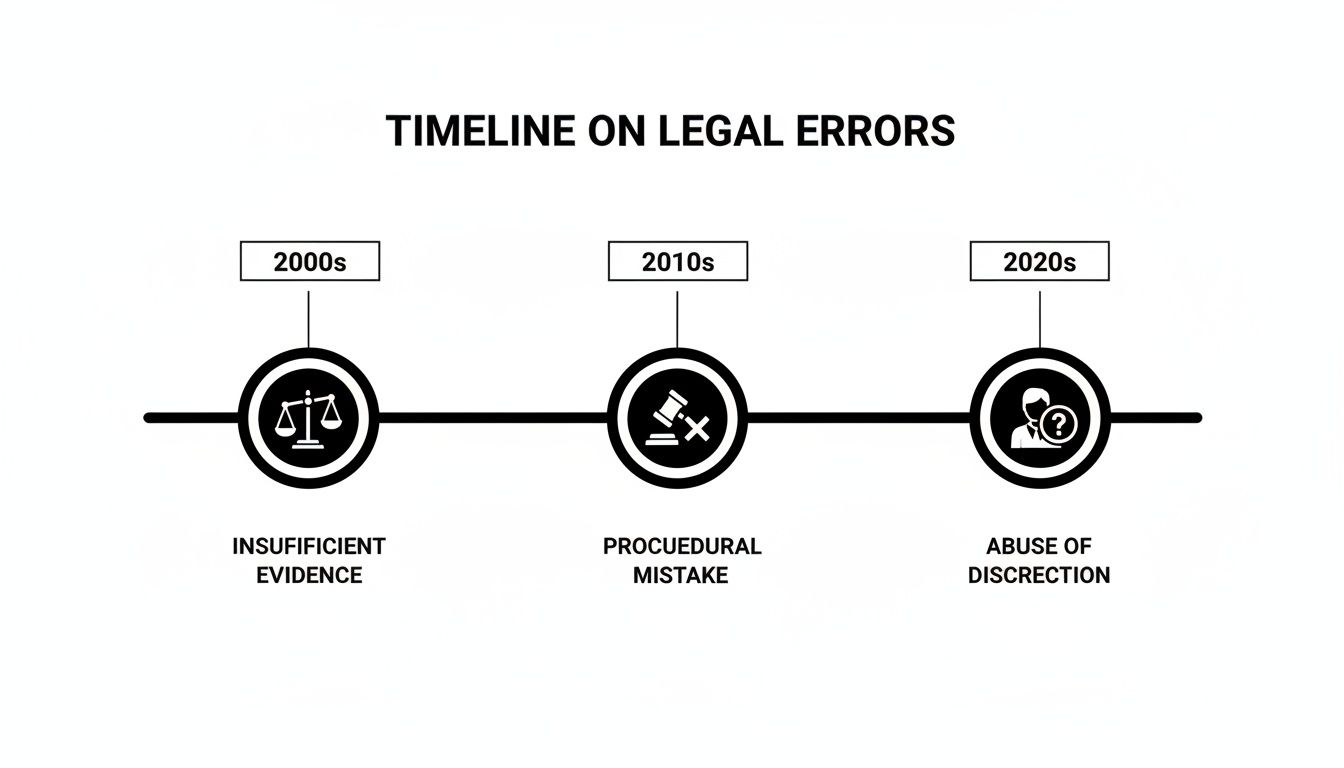
Each of these points represents a potential failure by a trial court to adhere to the high legal standards required before taking the drastic step of terminating parental rights.
Why Immediate Action Is Critical
The high volume of termination cases in Texas courts underscores the challenging landscape for parents. For example, court data can show hundreds of termination cases filed annually in a single county. This heavy caseload can sometimes lead to rushed decisions or overlooked legal standards, making a thorough appellate review essential.
Waiting even a week to seek legal counsel can be detrimental. An appellate attorney needs time to obtain the trial record, meticulously review it for reversible errors, and draft the necessary legal documents before the first deadlines pass.
Filing the Notice of Appeal is the first and most critical step. It informs the courts of your intent to challenge the decision and is mandatory for proceeding. To better understand this initial step, you can read our guide on what a Notice of Appeal is. Acting quickly ensures you meet every procedural requirement and gives your appeal the strongest possible foundation for success.
Why You Need a Skilled Appellate Attorney on Your Side
Success at trial and success on appeal require entirely different skill sets. When appealing an order terminating parental rights in Texas, the focus shifts from courtroom testimony to meticulous legal analysis, persuasive writing, and mastery of the Texas Rules of Appellate Procedure.
This is why an attorney specializing in appeals is not just beneficial—it is essential. An appellate lawyer brings a fresh, objective perspective to your case. Their sole focus is to conduct a forensic review of the trial record to identify legal errors that can overturn the judgment.
The Advantage of an Appellate Specialist
The core function of an appellate attorney is to identify reversible errors. These are not minor disagreements with a judge's decision but significant legal mistakes—such as misapplying the law or violating procedural rules—that likely caused an unjust outcome.
Our team is dedicated to this specialized legal work. We construct compelling legal arguments, known as appellate briefs, that systematically demonstrate to the appellate judges where the trial court erred. This written brief is the centerpiece of your appeal. The precision required extends to every detail, from legal research to knowing how to black out something in PDF to protect sensitive information in the record.
An appeal is not won by re-telling your story. It is won by proving the legal system failed to follow its own rules. An appellate attorney is the specialist who finds that proof.
From drafting a powerful brief to presenting oral argument before a panel of judges, every action is a calculated step toward correcting a legal injustice. Understanding how to choose the right family law attorney for this highly specialized process is the most critical decision you will make.
Common Questions After a Termination Ruling
The shock and confusion following a termination of your parental rights can be overwhelming. You likely have urgent questions about what happened and what your options are moving forward. Getting clear, plain-English answers is the first step toward regaining control.
Here are some of the most common questions parents have when considering an appeal in Texas.
Can I present new evidence to the appellate court?
This is a frequently asked question, but the answer is no. An appeal is not a new trial. The appellate court acts as a reviewer of the original proceedings, not a fact-finder.
The court of appeals is limited to reviewing the existing trial "record"—the transcripts, exhibits, and documents from your case—to determine if the trial judge made a critical legal error. New evidence cannot be introduced. This is why it is crucial for an appellate lawyer to meticulously examine the existing record for errors that are already present.
How long does an appeal take?
Cases involving the welfare of a child are placed on a fast track. In Texas, these are called "accelerated appeals." The legal system prioritizes permanency for children, so the process moves much more quickly than a standard civil appeal.
While each case is different, you can generally expect a decision within six to nine months from the date the Notice of Appeal is filed. This condensed timeline means that there is no time to delay.
What happens if I win the appeal?
Winning an appeal typically means the appellate court found a "reversible error"—a mistake so significant that it likely led to the wrong result. In this situation, the court will usually "reverse and remand" the case.
This action vacates (or nullifies) the termination order and sends the case back to the trial court for new proceedings, which often means a new trial.
A successful appeal effectively hits the reset button. It voids the original judgment and gives you a second chance to fight for your family, this time with the law being applied correctly.
In some rare cases, the court might "reverse and render," issuing a final judgment in your favor without requiring a new trial. This is the most definitive victory possible on appeal.
What is the cost to appeal a termination case?
The cost of an appeal depends on the complexity of your case, including the length of the trial and the legal issues involved. The primary expenses include attorney's fees, the cost of preparing the official court record, and court filing fees.
We understand that financial concerns can add to your stress. That is why we offer a free, confidential consultation to review your case, discuss potential appellate strategies, and provide a clear explanation of the potential costs involved so you can make an informed decision for your family.
If you believe the court made a mistake in your family law case, our appellate attorneys can help you seek a fair outcome. A trial court’s error should not cost you your child. The attorneys at The Law Office of Bryan Fagan are dedicated to restoring balance through appellate advocacy. Contact us today for a free case evaluation to have your case evaluated.