Walking out of a family courtroom with a ruling that feels deeply wrong is a disheartening experience. You may feel your case was handled unfairly, whether the judge's decision affects your child custody arrangement, the division of your hard-earned assets, or your final divorce decree. You are not just looking for a second opinion—you are searching for justice. This guide is your first step on that path, and it starts with a key concept in any Texas family law appeal: the abuse of discretion standard.
What Do You Do When a Judge Gets It Wrong?
It’s a feeling of helplessness. You presented the facts, you told your story, and yet the final order seems to ignore everything that matters. An unfair ruling involving your children's well-being, your financial stability, or even a protective order can throw your entire world into chaos.
While it feels isolating, you are not alone, and the legal system provides a specific process for this exact situation. An appeal isn't a do-over of the trial. Instead, it's a focused review of the trial court's decisions to see if a serious legal mistake—what we call a reversible error—was made.

Understanding the Standard of Review
The journey to overturn a bad ruling starts with understanding a crucial legal concept called the "standard of review." In Texas family law, the vast majority of a trial judge’s decisions are judged on appeal under the abuse of discretion standard.
In plain English, "abuse of discretion" means the appellate court gives significant respect, or deference, to the trial judge's decisions. They were in the room, they heard the testimony, and they saw the evidence firsthand. This deference makes winning an appeal a challenge—one that requires an attorney who specializes in appellate law.
But a high bar is not an impossible one. It simply means there is no room for error in how your appeal is argued.
An appeal is a challenge to the legal correctness of the trial court’s decisions, not an opportunity to present your case all over again. Success hinges on identifying specific errors in the existing trial record.
Our purpose here is to demystify this process. We’ll break down exactly what the abuse of discretion standard is, how it will impact your case, and how a skilled appellate team crafts strategic, compelling arguments to fight for the justice you deserve. Knowing the road ahead is the first step toward restoring balance through appellate advocacy.
What is the Abuse of Discretion Standard?
Before we dive into the specifics of your appeal, we must address the single biggest hurdle you'll face: the abuse of discretion standard. Think of it as the lens the appellate court uses to look at nearly every decision the trial judge made in your family law case. It’s a standard that gives a great deal of respect to the trial judge, which makes our job on appeal tough—but definitely not impossible.
Let’s use an analogy. Imagine the trial judge is a referee on a football field. They have a rulebook (the law), and they must make calls in real-time based on the plays they see unfolding (the evidence). The appellate court is like the review booth official.
Here’s the key difference: the review official doesn’t just re-watch the game and substitute their own calls for the ref's. Their job is to look for a call that was so outrageous, so far outside the bounds of the rules, that it fundamentally undermined the fairness of the game. That, in a nutshell, is the abuse of discretion standard.
What Makes a Decision Arbitrary and Unreasonable?
Legally speaking, a judge "abuses their discretion" when they make a decision that is arbitrary and unreasonable, or when they act without any regard for the guiding legal principles that are supposed to control that decision. This is a much higher bar than simply proving the appellate court would have ruled differently. It means the trial judge’s decision was so off-base that no reasonable judge, looking at the same evidence and the same law, could have possibly come to that conclusion.
This high standard exists for a reason. Our legal system places significant trust in trial judges because they are the ones who are actually in the room. They get to see a witness’s body language, hear the tone of their voice, and gauge their credibility in a way that simply can’t be captured by a cold, black-and-white transcript.
Because of this, appellate courts won't just swap their judgment for the trial judge's. This is particularly true in areas that are highly dependent on the specific facts and credibility of the parties, such as:
- Child Custody: Determining the "best interest of the child" is an intensely personal and fact-driven process where the judge’s discretion is at its absolute peak.
- Property Division: Deciding what makes for a "just and right" division of community property gives the judge a significant amount of latitude.
- Protective Orders: The decision to grant or deny a protective order often comes down to the judge’s assessment of who is telling the truth and whether there is an imminent risk of harm.
The High Bar Set by Texas Law
The foundational Texas case that locked in this high standard is Walker v. Packer. The court made it crystal clear that a simple error in judgment isn't nearly enough to get a decision overturned. To win on appeal, you must demonstrate that the trial court's ruling was made with a complete disregard for the facts or the law.
A trial court abuses its discretion when it reaches a decision so arbitrary and unreasonable as to amount to a clear and prejudicial error of law. The test is whether the court acted without reference to any guiding rules and principles.
So, what does this mean for your case? It means our job as your appellate attorneys isn't to argue that the judge could have made a better call. Our job is to prove that the judge made a decision they were legally forbidden from making based on the record presented to them.
In Texas family law, the abuse of discretion standard is king. It makes it incredibly challenging to reverse trial court decisions on hot-button issues like child custody, property division, and spousal support. The appellate courts give massive deference to the trial judge’s take on the facts, which is why a precise, powerful legal argument is absolutely essential for success. You can explore how this standard is applied in family law appeals to discover more insights.
How Different Standards of Review Affect Your Appeal
When you appeal a family law case in Texas, the appellate court doesn't just rehear the entire case from scratch. Instead, it looks at the trial judge's decisions through a specific legal lens called a "standard of review." Think of these standards as different levels of scrutiny the higher court applies.
Not every issue gets the same level of scrutiny. The standard that applies depends entirely on what we're challenging. Was it a decision based on the judge's interpretation of a law, or one based on who the judge found more believable? Knowing the answer is the first step in building a winning appellate strategy.
De Novo Review: A Fresh Look at the Law
At one end of the spectrum, you have de novo review. "De novo" is Latin for "from the new," and that's exactly what it means—the appellate court takes a completely fresh look at the issue with zero deference to what the trial judge decided. It's a clean slate.
This powerful standard is reserved for pure questions of law. We can argue for de novo review when the trial judge’s mistake was about:
- Interpreting a statute: For example, if the judge completely misunderstood a section of the Texas Family Code when classifying a piece of property as separate or community.
- Applying the law to undisputed facts: When everyone agrees on what happened, but the judge applied the wrong legal rule to that set of facts.
- Contract interpretation: Analyzing the plain language of a prenuptial or postnuptial agreement to determine its meaning.
Under de novo review, the appellate court simply decides if the trial judge got the law right or wrong.
Legal and Factual Sufficiency: Was There Enough Evidence?
Somewhere in the middle are challenges to legal and factual sufficiency. This is all about the evidence. We use this standard to argue that there simply wasn't enough evidence in the trial record to support the judge's specific factual findings.
A legal sufficiency challenge is essentially a "no evidence" argument—we contend there's a complete absence of evidence for a particular finding. A factual sufficiency challenge is a bit different; we argue that while there might be some evidence, the finding is so against the great weight of all the evidence that it's clearly wrong and unjust. These arguments are often a key part of a property division appeal.
Understanding which standard of review applies to each potential error is a critical strategic step. It dictates how we frame our arguments, what parts of the record we emphasize, and where the appellate court is most likely to find a reversible error.
To give you a better sense of how these standards relate, here’s a quick comparison.
Texas Appellate Standards of Review at a Glance
This table breaks down the three primary standards, the level of respect the appellate court gives the trial judge, and where you'll most often see them in a family law case.
| Standard of Review | Deference to Trial Court | Common Application in Family Law |
|---|---|---|
| Abuse of Discretion | Highest Deference | Custody, visitation, property division, child support, enforcement |
| Legal/Factual Sufficiency | Medium Deference | Challenges to specific fact findings that underpin a broader ruling |
| De Novo | No Deference | Interpretation of statutes, contracts (prenups), and undisputed facts |
As you can see, most of the big, life-altering decisions in family law fall under that highly deferential abuse of discretion standard.
The image below illustrates the court hierarchy and how the appellate court looks down upon the trial court's ruling with deference, rather than re-trying the case from the ground up.
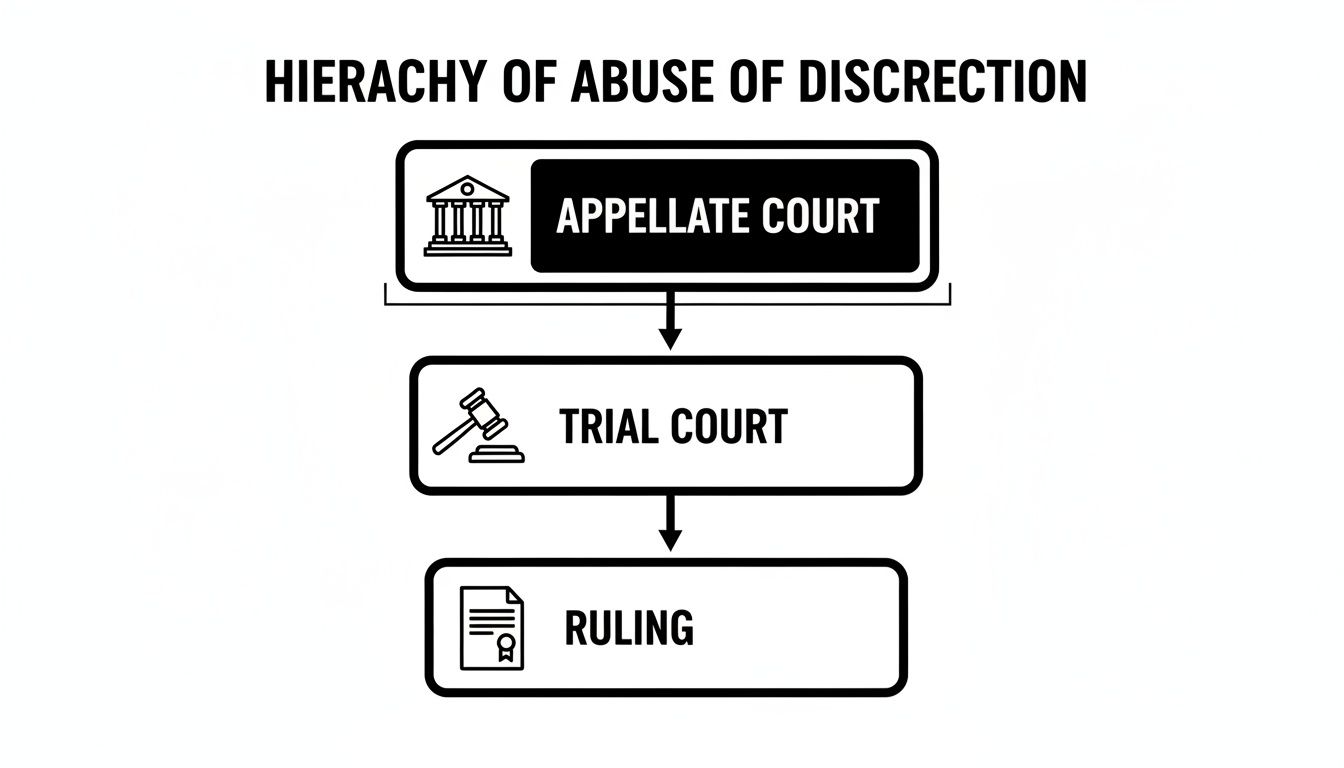
Knowing these distinctions is crucial because winning on appeal is tough. Reversal rates in family law are notoriously low—often under 10% nationally. Texas data shows that trial court decisions are upheld around 92% of the time. You can learn more about these appellate success rates.
These numbers drive home a critical point: successful appeals are rarely about simply re-arguing the facts or disagreeing with the outcome. They are about finding specific, identifiable legal errors and presenting them in a way that aligns with the correct standard of review.
Identifying Reversible Errors in Family Law Cases

It’s one thing to understand the textbook definition of the abuse of discretion standard, but it’s another thing entirely to see what a reversible error looks like in a real-world case. This is where we shift from theory to the hard facts of your trial.
A reversible error isn’t just a ruling you don't like or one that feels unfair. To win on appeal, we must prove the judge’s decision was legally indefensible when stacked against the actual evidence presented in court. It means showing the judge either ignored the law or made a decision so unreasonable that it simply cannot be allowed to stand.
From Disagreement to Demonstrable Error
The real challenge—and the heart of a successful appeal—is pinpointing the exact moments where a judge’s discretion tipped over the edge from a reasonable judgment call into an arbitrary one. While no two cases are the same, certain patterns of error show up again and again in Texas family law appeals.
We're not talking about minor slips of the tongue. We're looking for significant mistakes that poisoned the well and led to a fundamentally unjust outcome. Our job as appellate lawyers is to comb through the trial record with a magnifying glass to find these specific, provable errors.
Common examples of reversible errors in Texas family courts we see include:
- Ignoring Critical Evidence: A judge decides to completely disregard undisputed testimony from a child psychologist about a child's needs or ignores a financial expert's valuation of a family business.
- Misapplying the Law: The court gets the rules for property classification wrong, mistakenly treating a spouse's separate inheritance as community property and dividing it up.
- Making an Illogical Ruling: The judge slaps a geographic restriction on a parent that makes it impossible for them to keep their job or even have a meaningful relationship with their child.
- Failing to Follow Statutory Rules: A judge must correctly apply the Texas Family Code's child support guidelines. Veering from these rules without a legally sound reason is a classic, and often reversible, error.
How a Single Error Can Unravel a Bad Decision
In every one of these situations, the issue isn't that we wished for a different result. The issue is that the judge acted without reference to the guiding legal principles or made a choice that no other reasonable judge would have made in the same spot. That is the very essence of an abuse of discretion argument.
Think about a child custody battle. The law is crystal clear: the judge’s decision must be based on the "best interest of the child." If the record shows the judge’s ruling was tainted by personal bias, ignored clear proof of a parent's stability, or punished a parent for something unrelated to their fitness, that decision is vulnerable. The same logic applies in a complex property division case where the final numbers just don't add up based on the evidence.
A single, well-argued reversible error can be enough to convince an appellate court to overturn an unfair judgment. The goal is to show not just that the judge was wrong, but that their mistake was so significant that it likely caused an improper outcome.
Building the Argument for Reversal
Finding these potential errors is just the first step. From there, we must build a powerful legal argument around them, backed by solid case law and a nuanced understanding of appellate procedure. We have to prove to a panel of appellate judges that the trial court's decision wasn't just a different take on the facts, but a clear departure from the law.
Every potential mistake is a key that could unlock a more just result. Our process is meticulous; we analyze every page of the trial transcript, every exhibit, and every motion to uncover the strongest possible grounds for appeal. It’s this detail-oriented, strategic approach that can transform a feeling of injustice into a compelling case for reversal.
How a Strong Appeal Is Built Before It's Filed
Here’s something most people don't realize: a successful family law appeal rarely starts the day you file a notice with the court. In reality, it's often won or lost based on the strategic groundwork laid during the original trial. Two concepts are absolutely vital to grasp here: preserving error and building the appellate record.
Many clients are shocked to learn that an appellate court can’t fix a mistake the trial judge made unless it was properly pointed out at the moment it happened. This is the core idea behind preserving error. Your trial attorney must make a specific, clear, and timely objection, giving the trial judge a chance to correct a potential misstep in real-time. If they don’t, that issue is generally considered waived and simply can't be raised on appeal.

What Is the Appellate Record?
The second piece of the puzzle is the appellate record. Think of it as the official, closed universe of your case. It contains every single document, motion, order, and word of testimony from your trial. Nothing more, nothing less.
Here’s the crucial part: you cannot introduce new evidence on appeal. The appellate judges can only review what is already contained within the four corners of this record. This is why the work done at trial is so foundational. You could have the most compelling argument in the world, but if the evidence to support it isn't already in the record, it’s like it never happened.
The appellate record is the battlefield. If the evidence and objections aren't in the record, then for the purposes of an appeal, they simply do not exist.
Our job as appellate attorneys is to become masters of your case's record. We meticulously comb through every page of the reporter's record and every document in the clerk's record. We're on a mission, hunting for those specific instances where a judge made an error and the trial attorney properly preserved it. These preserved errors become the essential building blocks for a persuasive appeal.
Finding the Errors Hiding in Plain Sight
This deep-dive review is where a potential appeal truly takes shape. We are looking for those key moments that could demonstrate the judge’s decision met the high bar for an abuse of discretion.
This process involves identifying things like:
- Improperly Admitted Evidence: Did the judge allow testimony or a document that should have been excluded, and did your lawyer object?
- Incorrect Legal Rulings: Did the court misapply a section of the Texas Family Code when making a decision on property division or calculating child support?
- Unsubstantiated Findings: Did the judge make a factual finding that has absolutely no support in the evidence that was actually presented in court?
- Procedural Mistakes: Was a mandatory legal step ignored or done incorrectly, leading to a harmful outcome for you?
The abuse of discretion standard has a long history and sets a high bar for reversing a trial court, particularly when it comes to harsh sanctions. This can be especially tough in family law, where a parent’s failure to provide information in a contested paternity case could risk a default judgment. But sharp appellate work can pinpoint where a Texas judge misapplied the rules, potentially turning a devastating loss in a child support or property fight into a second chance. For those interested in how these standards have evolved, you can read more on the topic from The Florida Bar.
Once we find these preserved errors, they become the core of our legal argument. The next step is weaving them into a compelling narrative in the formal document we submit to the higher court. To learn more about this critical document, you may want to read our guide explaining what is an appellate brief.
This meticulous, behind-the-scenes work is what separates a long-shot complaint from a powerful, strategic appeal capable of correcting an unjust result.
Why an Appellate Specialist Is Critical for Your Case
Taking a family law case to a Texas court of appeals isn't just round two of your trial. It’s a completely different game with a new rulebook, and it demands a completely different kind of lawyer.
A trial lawyer’s world is the live courtroom—presenting evidence, questioning witnesses, and thinking on their feet. But an appellate lawyer’s battle is won or lost in the quiet pages of a legal brief, long before they ever step into a courtroom. Their focus isn't on retelling your story; it's on convincing a panel of seasoned judges that the trial court made a serious legal mistake.
This is especially true when you're up against the tough abuse of discretion standard. To win, you can't just argue that the judge got it wrong. You have to prove their decision was so far outside the bounds of the law that it was legally indefensible. That takes a lawyer who can dig deep into the trial record, unearth the strongest legal arguments, and present them with laser-like precision.
The Different Skill Sets of Trial vs. Appellate Attorneys
You wouldn't ask a heart surgeon to perform brain surgery, and the same logic applies here. Trial and appellate work require distinct talents and a different legal mindset.
- Trial Attorneys Focus On: Building a compelling story from facts, presenting evidence, and reacting in the moment with objections. They thrive in the dynamic, often unpredictable, atmosphere of a trial.
- Appellate Attorneys Focus On: Meticulously combing through a cold, finished trial record for legal errors. Their work involves deep legal research and crafting highly structured, persuasive arguments that follow the strict Texas Rules of Appellate Procedure.
Because appellate courts give so much weight to the trial judge’s decisions in areas like child custody and property division, your appeal has to be perfect. There's simply no margin for error.
An appellate attorney isn’t just another lawyer. They are a specialist trained to take a trial court's decision apart, piece by piece, and build a powerful legal case for why it must be reversed—all within a unique and unforgiving system of rules.
Strategic Advocacy for a Fair Outcome
The vast difference in these skills is why how to choose a family law attorney for your appeal is one of the most important decisions you'll make. You need an advocate who understands their audience isn't a single trial judge anymore, but a panel of legal scholars focused exclusively on the law and the written record.
Our appellate attorneys live and breathe this specialized practice. We know that getting your family a fair outcome on appeal requires a strategic, scholarly, and determined approach. We dive into every detail of your case to make sure your voice is heard and your rights are defended at the highest level.
Answers to Your Top Questions About Texas Appeals
When a family law case doesn't go your way, you're suddenly faced with a new set of worries and a whole lot of questions. The appeals process in Texas is a different world from trial court, and it’s easy to feel lost. Let’s clear up some of the most common points of confusion our clients have, especially when it comes to the abuse of discretion standard.
Our goal here is to give you straightforward answers so you can understand your options and make the best decision for your family.
If I Disagree with the Judge's Ruling, Is That an Abuse of Discretion?
This is the first hurdle for many people. The short answer is no; simply disagreeing with the judge’s decision, even if you feel strongly that it was wrong, isn't enough for a successful appeal.
An abuse of discretion is a very high legal bar. It means the trial judge made a decision that was so “arbitrary and unreasonable” that it completely defies logic and the law. Think of it this way: the judge didn’t just make a judgment call you disagree with; they made a call that no reasonable judge, looking at the same facts and legal rules, would have made.
If the evidence could lead two reasonable judges to two different conclusions, the appellate court will almost always side with the trial judge. Our job on appeal is to prove that the judge's decision wasn't just a different choice, but a choice made without any reference to the guiding legal principles that were supposed to control the outcome.
Can I Introduce New Evidence During My Appeal?
This is a huge, and very common, misconception. You cannot introduce new evidence during an appeal. An appeal is not a second chance to try your case. You don't get to bring in new witnesses, submit new documents, or present arguments you forgot to make the first time.
The appellate court is restricted to reviewing only what happened in the trial court. This is known as the "record."
The appellate record is a closed book. It contains only the documents filed with the court and the official transcript of everything said during the trial. Our entire case must be built from what already exists within its pages.
This is exactly why the work done at the trial level is so critical. As appellate lawyers, we become detectives, poring over that existing record to find the specific, reversible errors that were properly preserved and can be used to build a compelling argument for the higher court.
How Long Do I Have to File a Family Law Appeal in Texas?
The deadlines in Texas appellate law are absolute and unforgiving. If you miss one, you can lose your right to appeal forever. There are no extensions for simply not knowing the rules.
Here are the key timelines you need to know under the Texas Rules of Appellate Procedure:
- Standard Deadline: In most family law cases, a Notice of Appeal must be filed with the trial court clerk within 30 days after the judge signs the final judgment.
- Extended Deadline: This deadline can be pushed to 90 days, but only if you properly file certain post-judgment motions, like a Motion for New Trial, within the initial 30-day window.
Given how rigid these deadlines are, it is crucial to speak with an appellate attorney the moment you receive a final order that you believe is fundamentally wrong.
What Are My Chances of Winning an Appeal?
Let's be direct: winning an appeal is tough. The statistics show that most trial court decisions are upheld. This is largely because appellate courts give a great deal of respect, or "deference," to the trial judge's decisions, especially under the abuse of discretion standard.
However, "tough" doesn't mean impossible. Success on appeal isn’t about luck. It’s about a skilled attorney conducting a deep, methodical analysis of the trial record to pinpoint a clear, preserved, and harmful error. It’s about building a powerful, persuasive legal brief that shows the appellate justices exactly where the trial court went wrong and why it matters. Your chances depend almost entirely on the quality of that legal work.
If you believe the court made a mistake in your family law case, our appellate attorneys can help you seek a fair outcome. Contact The Law Office of Bryan Fagan today for a free consultation. You can reach us at https://familylawcourtappeals.com.