You may feel your case was handled unfairly and worry that errors at trial left your family’s future at risk. If you believe the judge overlooked important facts or misapplied the law, an appeal can offer a second look.
The Notice of Appeal is the official document you file when you ask a Texas appellate court to review a family law trial court’s ruling. It points out the specific mistake you believe occurred and preserves your right to have a higher court weigh in.
Filing on time is crucial. Under the Texas Rules of Appellate Procedure and the Family Code, missing your window can close the door on any further review.
Filing a notice of appeal is like hitting “pause” and asking a different referee to take another look at a play you think was called wrong.
Legal Terms Defined
- Abuse of Discretion: When a judge’s decision falls outside the range of reasonable choices.
- Reversible Error: A significant legal mistake that could change the outcome of your case.
- Briefing: The process of writing legal arguments (appellate briefs) to explain why the appellate court should agree with your position.
Quick Overview Of Notice Of Appeal
Below is a quick snapshot of the main elements you’ll deal with:
Notice of Appeal Quick Overview
| Element | Description |
|---|---|
| Purpose | Preserve and signal your intent to appeal |
| Deadline | File within 30 days of the trial court’s order |
| Record | Starts gathering the appellate record |
Key Appeals Covered
- Child Custody Appeals
- Divorce Appeals
- Property Division Appeals
- Protective Order Appeals
What You Can Appeal in a Texas Divorce Case
Even a final divorce decree can harbor errors worth reviewing. Common issues include:
- Division of community and separate property: misvaluation or unequal distribution (Property Division Appeals).
- Spousal support determinations: incorrect factors or miscalculations.
- Child custody and support orders: failure to follow the best-interest standard (Child Custody Appeals).
- Protective order findings: lack of evidence to support the court’s conclusions (Protective Order Appeals).
Examples of reversible errors in Texas family courts include misapplying legal standards for child custody, using outdated statutes for support calculations, or improperly valuing assets in property division.
Understanding Notice Of Appeal
When a family court decision leaves you doubting the fairness of the process, the notice of appeal is your formal handshake with the appellate system. Under the Texas Rules of Appellate Procedure and the Texas Family Code, filing this document is your way of asking a higher court to step in and take another look.
Imagine raising a bright flag at the courthouse entrance. That’s exactly what the notice does—it announces to judges, opposing counsel, and everyone involved that you intend to challenge the order. It locks in your issues and grants the appeals court the jurisdiction it needs.
- It preserves your right to argue a reversible error or abuse of discretion on appeal
- It triggers key timelines and kickstarts record preparation under Texas law
- It defines which points of the lower court’s ruling you can review
Key Characteristics Of Notice Of Appeal
Don’t confuse this with a trial motion or an appellate brief stuffed full of reasons. The notice of appeal needs only the essentials: who is appealing, the exact order being challenged, and the court you’re heading to. Slip up on party names or case numbers, and the court may refuse to hear your case at all.
Take Federal Rule of Appellate Procedure 3 as an example. Its 2021 revisions lean into simplicity, pressing you to state plainly who files the appeal, which judgment is under fire, and which court will decide. Timing is non-negotiable—you have 30 days in civil matters or 14 days in criminal cases. Miss that window, and you lose your right to appeal. Learn more about Federal Rule 3 at Cornell Law School’s Federal Rule 3.
That snippet shows how minimal the content is and why correctly naming the appellate court is crucial to invoke jurisdiction.
Gatekeeping Role In Texas
In Texas family law, the notice of appeal acts as a procedural gatekeeper under both the Rules of Appellate Procedure and the Family Code. Generally, you’ve got 30 days after the final order is signed. If you file a motion for new trial first, that window can extend to 90 days. Miss those deadlines, and you’ve likely forfeited your chance to challenge the decision. Check out our guide on grounds for appeal in family court for a deeper dive into reversible errors in custody, divorce, and property division (https://familylawcourtappeals.com/grounds-for-appeal-in-family-court/).
- Double-check the exact date on the order you’re contesting
- Attach certified copies of the order when required
- Serve all parties according to Texas service rules
Accuracy in listing parties and citing the exact order can make or break your appeal.
Having an experienced appellate attorney on your side transforms this step from a mere filing exercise into a strategic move. That initial notice sets the pace for your entire appeal—and often determines whether you’ll secure the review you deserve.
Understanding the Standard of Review
Appeals focus on legal and procedural errors, not new evidence. Here’s how they differ from trials:
- New Evidence: None. Appeals rely on the existing trial record.
- Standard of Review:
• Legal issues are reviewed de novo (fresh look).
• Factual findings receive an abuse of discretion review (judge’s decision stands unless unreasonable).
• Mixed questions depend on the issue. - Briefing: You draft an appellate brief explaining each error and the applicable law. See our appellate brief writing guide for details.
- Timeline: Strict deadlines govern every step—from filing the notice to submitting your final brief.
This shift means your strategy changes from presenting evidence to preserving issues and focusing on the court record.
Texas Filing Steps And Timing
If you believe a family law decision didn’t go your way, you’re not alone—and there is a path forward. In Texas, appeals follow strict timing laid out in the Texas Rules of Appellate Procedure and the Family Code.
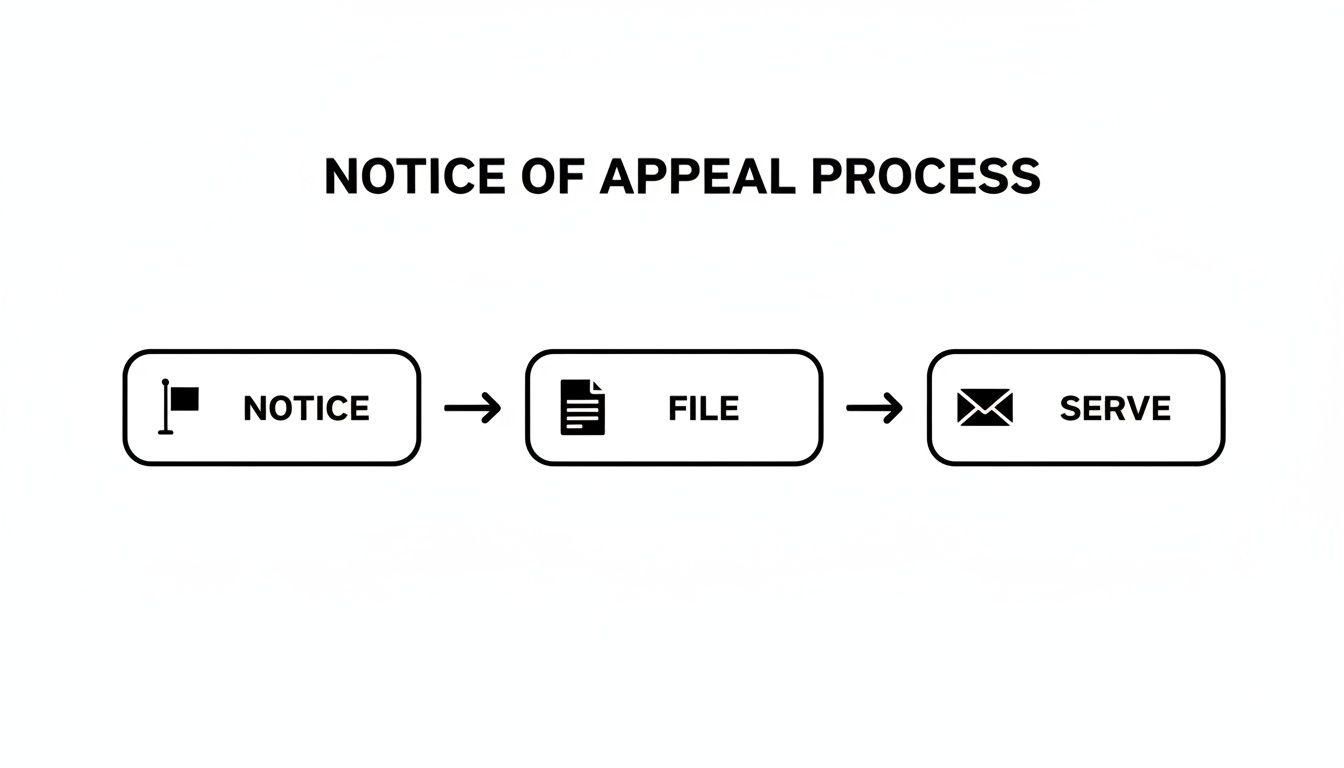
Every day counts once a final order is signed. Below is a simple roadmap to getting your notice of appeal on file:
- Confirm the Final Order Date. Pin down exactly when the judge signed off.
- File Your Notice With the Trial Court Clerk. This kicks off the appeal.
- Serve Opposing Parties. Certified mail or personal delivery will do the trick.
- Preserve the Appellate Record. Start gathering transcripts and exhibits immediately.
Filing Deadline Rules
Most family law appeals in Texas must be filed within 30 days after the final order is signed. If you’ve filed a motion for new trial, that window can stretch to 90 days. Miss these deadlines and you generally lose the right to appeal.
The notice of appeal is your formal declaration to the court and your opponent that you seek review. Its precision matters: Texas courts handle roughly 54,000 appeals each year, and about 8% are tossed out because of technical slip-ups. For a deeper dive into the fundamentals, check out Notice of Appeal Fundamentals.
Appeal Deadlines For Family Law Cases
Below is a quick comparison of deadlines for common Texas family law appeals. Keep in mind that a timely new-trial motion can extend some deadlines.
| Case Type | Appeal Deadline | Notes |
|---|---|---|
| Divorce | 30 days | 90 days with new trial motion |
| Child Custody | 30 days | Same extension as divorce |
| Protective Orders | 20 days | No extension for new trial |
Use this table as a starting point, and always double-check your local court rules before you file.
Service And Record Preservation
Serving every party correctly is non-negotiable. Whether you use certified mail, a process server, or hand delivery, make sure you keep proof. At the same time, assemble your record:
- Request transcripts promptly.
- Catalog exhibits and affidavits.
- Keep both paper and digital backups.
The flowchart below captures the three critical phases of a notice of appeal—notice, filing, service—and how each builds on the next to safeguard your rights.
Avoiding Calendar Errors
One miscounted day can derail your entire appeal. Always start counting from the order’s signing date, not the date you received notice. Courts rarely grant delays for postal hiccups.
Missing a deadline for filing a notice of appeal is one of the most common and fatal mistakes in Texas family law appeals.
For a breakdown of how to track every deadline, see our Record Preservation Guide.
Filing Location And Fees
Your notice must go to the clerk of the trial court that issued the order. Many counties let you e-file, while others require an in-person visit. Filing fees usually mirror trial-court costs, but Texas law allows fee waivers if you qualify.
- Review your county’s fee schedule early.
- Attach payment confirmation to your notice.
- Always include the case number on every page.
For detailed tips on e-filing and fee waivers, refer to our Appellate Briefs And Record Preservation Guide.
Accuracy at each step is your best defense against procedural dismissal. Stay organized—and stay on time.
Checklist For Filing Notice Of Appeal
Filing a notice of appeal in Texas family law can feel like juggling calendars and fine print. This checklist lays out each critical task so you stay on track and avoid missed deadlines.

First, pinpoint the exact date the trial court signed the final order. Under Texas rules, you have 30 days from that signature to file unless you’ve filed a motion for new trial—in which case the deadline extends to 90 days. Getting this date right preserves your right to pursue an appeal.
Key Filing Steps
- Confirm the Appellate Court: Double-check which Court of Appeals district hears your case.
- Draft the Notice of Appeal: List every party, the trial court cause number, and the order date exactly.
- Gather Certified Copies: Request the signed judgment from the clerk and attach it to your notice.
- Serve Opposing Counsel: Send via certified mail or personal delivery, and keep proof of service.
A small mistake in naming a party or court can lead to dismissal.
Additional Tasks To Complete
- File With The Trial Court Clerk: Submit your notice and supporting documents in person or through e-file, following local rules.
- Pay The Filing Fee: Check your county’s fee schedule or apply for a waiver if you qualify.
- Track Deadlines: Enter every key date on a shared calendar or case management system.
- Maintain Copies: Keep both digital backups and paper files to avoid lost paperwork.
Using a shared calendar or case platform helps you avoid miscounts and missed dates.
Tips For Smooth Appellate Filing
• A printed copy of the final order with the signature date highlighted
• Service receipts and certified mail logs with dates clearly marked
• A step-by-step checklist and deadline tracker
• Copies of any extension requests and clerk responses
Maintaining organized records mirrors how an appellate attorney prepares a case. For guidance on building your appellate team, Explore our appellate services
After you file, verify that the trial clerk stamps every page. That official stamp locks in your filing date and triggers the next round of deadlines.
When local quirks pop up—like a new clerk or an unexpected holiday—double-check the rules to avoid surprises.
Keep a folder labeled “Appeal” for all stamped filings, receipts, and digital copies in one place.
Treat this checklist like a GPS guiding you through each step of the appeals process. Every box you check moves you closer to preserving any reversible error.
Common pitfalls include misnaming parties, missing an extension deadline, and forgetting to attach the correct judgment copy.
Review this list with your attorney early to catch any oversights.
Staying one crucial step ahead of procedural rules protects your right to seek justice on appeal.
Common Mistakes In Filing Notice Of Appeal

Filing a notice of appeal requires careful attention to procedural details. Below are the pitfalls that trip up even seasoned practitioners—and how to avoid them.
- Miscalculating key dates can shut the door on your appeal
- Failing to list or properly name all parties invites dismissal
- Skipping service on interested parties renders your notice void
- Relying on outdated or unofficial forms can omit critical details
- Overlooking extension options surrenders precious extra time
Real-World Oversights
In a recent child custody matter, the notice simply omitted the judge’s signature date. The result? Dismissal before the record was ever ordered. This highlights the importance of counting from the trial court’s signed order.
Common Procedural Errors
Typos in the order’s title or date can derail an appeal as swiftly as filing late. One protective order appeal, submitted just five days too late, never saw the inside of an appellate courtroom.
“Precision in your notice of appeal preserves your only ticket to appellate review,” says Managing Attorney Bryan Fagan.
Leaving a party off your service list is another frequent trap. The Texas Rules of Appellate Procedure require serving every affected individual. A misnamed respondent or missing proof of delivery can end your appeal before briefs are even due.
- Verify party names and case numbers against the official docket
- Confirm service with signed acknowledgments or certified mail receipts
- Download and use updated forms from the Texas Rules of Appellate Procedure
- Reference our appellate brief guide for model templates
Preventing Reversible Error
Not every misstep is purely procedural. A reversible error occurs when the court misapplies the law. An abuse of discretion arises when a judge’s ruling lacks a reasonable basis. Your notice of appeal won’t unpack these issues in full—that comes in your brief. But flagging them early ensures you preserve every argument.
| Mistake | Impact |
|---|---|
| Late filing | Appeal dismissed outright |
| Misnaming parties | Service defected |
| Wrong form | Notice considered insufficient |
Staying precise in your notice is your best defense against technical dismissals. If uncertainty creeps in, don’t hesitate to consult an appellate attorney right away.
Next Steps After Filing Notice of Appeal
Once the clerk officially files your notice of appeal, they start gathering the clerk’s record. This package holds every pleading, order and exhibit that played a part in your trial.
At the same time, you’ll need to request the reporter’s record—the transcripts from hearings and courtroom proceedings. Together, these records set the stage for meeting the Texas Rules of Appellate Procedure deadlines.
- Clerk’s Record: All documents submitted at trial
- Reporter’s Record: Verbatim transcripts of hearings and testimony
- Briefing Timeline: Key dates for filing briefs and requesting extensions
Check out our appellate brief writing guide for a step-by-step look at drafting your brief.
Standard Of Review Differences
On appeal, you’re not gathering new evidence. Instead, you’re asking the appellate court to spot legal mistakes or instances where the trial judge may have abused discretion.
The appellate court focuses on whether the judge made a reversible error or exceeded their authority.
That shift means your strategy changes from fact-finding to issue preservation. Next up: planning your brief.
- Draft the appellant’s brief, weaving in each preserved issue
- Serve copies of the brief and record on opposing counsel
- File both the clerk’s and reporter’s records with the appellate court
If you request it, the court may schedule an oral argument once briefs are filed.
Possible Appellate Outcomes
- Affirmation: The trial court’s decision stands
- Reversal: The appellate court changes the outcome
- Remand: The case returns for further proceedings
You’ll usually have about 60 days from filing your notice to submit your briefs. To stay on track:
- Mark every deadline on a shared calendar
- Confirm with the clerk that your record is complete
- Check in with your appellate attorney at each major step
Remember, you can seek extensions under the Texas Rules by filing a timely motion. Once you’ve filed your notice and kick-started record prep, you’ll have a clear roadmap. Keep in close contact with your counsel to avoid any surprises.
Frequently Asked Questions
How Long Do I Have To File A Notice Of Appeal In Texas Family Law Cases?
When the trial court signs its final order, you normally have 30 days to act under the Texas Rules of Appellate Procedure and the Family Code.
If you’ve filed a motion for new trial before the 30-day deadline, that window extends to 90 days. Missing these timelines almost always cuts off your right to appeal.
What Must My Notice Of Appeal Include?
Every notice of appeal must:
- List all parties by name
- Specify the exact date and title of the order you’re challenging
- Identify the appellate court where you’ll file
- Attach a certified copy of the final judgment
Getting these details right preserves your ability to raise reversible error or abuse of discretion later on.
When To Request An Extension
Extensions exist but are hard to secure. You can file a motion in the trial court, showing good cause and a timely basis for your delay.
These requests rest on strict criteria. For more, revisit our Texas Filing Steps and Timing guide.
What Happens If I File But Don’t Prepare The Record In Time?
Filing your notice of appeal kicks off the process, but you still need to:
- Order transcripts from the court reporter
- Gather and organize exhibits
- Submit your complete record before the briefing deadlines
Delay here and you risk dismissal or having key issues dropped on appeal. Our Next Steps After Filing section walks you through practical record‐assembly tips.
“Timely filing preserves your right; record preparation secures your arguments.”
If you believe the court made a mistake in your family law case, our appellate attorneys can help you seek a fair outcome. Contact The Law Office of Bryan Fagan, PLLC at familylawcourtappeals.com for a free consultation.