If a judge's decision in your Texas family law case feels fundamentally unfair, it's natural to feel powerless. You are not out of options. The legal system provides a specific process for these situations: an appeal. It is important to understand, however, that an appeal is not a second trial. It is a formal review process where a higher court examines the trial judge's decisions for serious legal mistakes.
One of the most common grounds for appeal in these cases is the abuse of discretion standard. This is a legal principle used to challenge a ruling that was arbitrary, unreasonable, or made without reference to the guiding rules of Texas law.
What to Do After an Unfair Family Court Ruling

When a family court judge issues an order that ignores critical facts or misapplies the law, the sense of injustice can be overwhelming. You may be facing an unworkable custody schedule, an inequitable property division, or an unfair support award. That frustration is valid. The key is to channel that energy into understanding the legal path available to challenge the outcome.
Many people believe an appeal offers a second chance to argue their case from the beginning. In reality, it is a highly focused review of what already happened in the trial court. The appellate court’s role is to analyze the existing record—the testimony, evidence, and rulings—to determine if the trial judge made a significant legal misstep, known in legal terms as a reversible error.
To clarify, here is a brief comparison of what happens at trial versus on appeal.
Trial vs. Appeal: A Quick Comparison
This table highlights the fundamental differences between a trial court proceeding and an appellate review in Texas family law, governed by the Texas Rules of Appellate Procedure.
| Aspect | Trial Court | Appellate Court |
|---|---|---|
| Purpose | To hear evidence, determine facts, and apply the law to make an initial decision. | To review the trial court's record for legal errors that affected the outcome. |
| Key Player | A single trial judge (or jury) who sees and hears witnesses. | A panel of justices who review a written record (transcript and evidence). |
| Focus | "What happened?" (Fact-Finding) | "Did the judge make a legal mistake?" (Error-Correction) |
| Evidence | New evidence is presented, and witnesses testify live. | No new evidence or testimony is allowed. The review is limited to the trial record. |
| Primary Standard | "Preponderance of the evidence" or "best interest of the child." | "Abuse of discretion," "legal sufficiency," or "factual sufficiency." |
Understanding these distinctions is the first step toward shifting from the raw emotion of the trial to the disciplined, strategic focus required for a successful appeal.
The High Standard for Overturning a Judge’s Decision
Texas family law grants trial judges significant latitude, or discretion, when making decisions about children, property, and finances. The reasoning is that the trial judge was physically present in the courtroom. They observed the witnesses, heard the tone of their voices, and gained a perspective that a written record cannot fully capture.
However, that discretion is not unlimited.
An appeal arguing an abuse of discretion asserts that the judge exceeded the reasonable boundaries of their authority. This occurs in a few specific ways:
- The judge issued a ruling that was arbitrary or unreasonable.
- The judge acted without reference to the guiding legal rules and principles that were supposed to direct their decision.
- The evidence presented in court did not support the judge's final order.
Simply being unhappy with the result is not enough. To succeed on appeal, you must demonstrate the judge's error was so significant that it likely caused an improper outcome. You can explore what qualifies as a valid reason to appeal in our guide on the grounds for appeal in Texas.
Why an Appeal Is a Realistic Path to Justice
Challenging a judge's ruling is difficult, but it is far from impossible. A comprehensive study published in the Houston Law Review analyzed reversals in Texas Courts of Appeals and found a crucial statistic: family law cases have a 21% reversal rate.
This means roughly one in five appealed family law cases is reversed, modified, or sent back for further proceedings. Often, the reason is that the appellate court agreed the trial judge abused their discretion. This statistic confirms that the appellate system serves as a meaningful check on the power of trial courts. If you believe the judge made a mistake, a well-prepared appeal provides a very real path toward restoring fairness.
Understanding the Abuse of Discretion Standard

When appealing a family court ruling, you cannot simply state that you dislike the result. You must prove the trial judge made a specific, serious mistake. For most issues in Texas family law, such as decisions on child custody or property division, the legal standard you must meet is called abuse of discretion.
Think of the trial judge as a referee in a game. The law gives them a wide field of play—their "discretion"—to make judgment calls based on the specific facts and testimony they observe. As long as their decisions are within the established rules and based on the evidence, an appellate court will not second-guess them. It does not matter if another judge might have ruled differently.
But an abuse of discretion occurs when the referee makes a call that is completely outside the rulebook or ignores what happened on the field. It is the legal system's way of ensuring that while a judge’s power is broad, it is not absolute.
The Two Types of Reversible Error
In the context of the abuse of discretion standard in Texas family law, a judge’s critical mistake nearly always falls into one of two categories. Identifying which type of error occurred is the foundation of a strong appeal.
Your appellate attorney will analyze every page of the trial record, searching for evidence that the judge’s ruling fits one of these descriptions:
- Error of Law: The judge failed to understand or correctly apply the Texas Family Code or other relevant laws.
- Error of Fact: The judge made a decision with no reasonable support from the evidence presented in court.
Let's examine what these look like in a real case.
When a Judge Misapplies the Law
The legal definition of this error is when a judge acts "without reference to any guiding rules or principles." In plain English, the judge got the law wrong. They may have been unaware of a specific statute, ignored binding case law, or applied the correct rule in the wrong way.
Here is a common example. During a Texas divorce, the law requires a "just and right" division of community property. While this doesn't have to be a 50/50 split, it must follow the law. Suppose you received a significant inheritance during your marriage. Under the Texas Family Code, that is your separate property. If the judge mistakenly treats your inheritance as community property and divides it with your spouse, that is a clear misapplication of the law—an abuse of discretion.
Key Insight: A legal error isn't about subjective fairness. It's about whether the judge followed the black-letter rules in the Texas Family Code and established court decisions. Appellate courts are very likely to correct this kind of mistake.
When a Judge Ignores the Facts
The second type of abuse of discretion relates to the evidence. This happens when a judge's ruling is so contrary to the facts in the record that it appears arbitrary or unreasonable. The question the appellate court asks is: "Was there enough factual evidence for any reasonable judge to have made this decision?"
Imagine a parent seeking to modify custody due to the other parent's alleged substance abuse.
- Sufficient Evidence: If the concerned parent provides drug test results, testimony from teachers who saw the other parent intoxicated, and photos of drugs in the home, a judge’s decision to limit that parent's access to the child would likely be upheld. There are facts to support the ruling.
- Insufficient Evidence: Now, what if the only evidence is one uncorroborated accusation? If the judge, based on that alone, drastically alters the custody arrangement, the decision is not grounded in fact. The ruling is untethered from the evidence, making it a potential abuse of discretion.
Proving this second type of error can be more challenging because appellate courts give great deference to the trial judge, who was present to observe witnesses and assess credibility. But when a decision is truly baseless, an appeal is the critical mechanism for seeking a just outcome.
How Courts Apply This Standard in Family Law Cases
Understanding the definition of "abuse of discretion" is one thing; seeing how it applies in a Texas family law appeal is another. This standard is the key to many appeals, but its application varies depending on the issue being decided.
Whether the dispute is over where your children will live or how your property is divided, the core question for the appellate court remains the same: Did the trial judge make a ruling that was arbitrary, unreasonable, or untethered from the law and the facts?
Let's explore how this works in common family law disputes.
Child Custody and the Best Interest of the Child
In Texas, every decision about child custody must be based on one guiding principle: the best interest of the child. While judges have broad discretion here, their rulings cannot be based on personal preference. They must be grounded in the evidence presented about what is truly best for that child's physical and emotional well-being.
An abuse of discretion occurs when a judge's order contradicts the evidence or misinterprets what "best interest" means according to the law.
Here are a few real-world examples of when a custody ruling might be successfully appealed:
- Ignoring Major Red Flags: A parent provides documented evidence of the other parent’s ongoing substance abuse or recent family violence. If the judge ignores this evidence and awards that parent unsupervised possession without any safeguards, it is a potential abuse of discretion because the decision is not reasonably tied to evidence of the child's safety.
- Creating an Impossible Schedule: A judge orders a possession schedule forcing a child to travel three hours each way on a school night. This could be an abuse of discretion if it is clearly detrimental to the child's education, health, and stability and lacks a basis in the record.
- Unjustified Geographic Restrictions: The judge limits a parent's residence to a single school district, even though there is no evidence that moving outside that area would harm the child. If the parent needs to move for a better job or more affordable housing, such a tight restriction with no factual basis can be considered arbitrary.
An abuse of discretion in a custody case is not just a decision you disagree with. It is a decision where the appellate court, after reviewing the record, concludes that no reasonable judge, following the law, could have determined this outcome was in the child’s best interest based on the available evidence.
The table below outlines more scenarios where a trial court's decision could be challenged as an abuse of discretion.
Examples of Potential Abuse of Discretion in Family Law Cases
| Case Type | Potential Abuse of Discretion Scenario | Legal Justification for Appeal |
|---|---|---|
| Child Custody | A judge drastically limits a fit parent's possession time without any evidence of risk or harm to the child. | The ruling is not based on the "best interest of the child" standard and lacks evidentiary support. |
| Property Division | The court awards one spouse 90% of the community estate with no factual findings of fault, fraud, or vastly different earning capacities to justify it. | The division is not "just and right" as required by the Texas Family Code and appears arbitrary. |
| Child Support | A judge orders child support significantly below the statutory guidelines without stating on the record the specific facts justifying the deviation. | The order fails to follow statutory requirements, which mandate specific findings for any deviation from the guidelines. |
| Spousal Maintenance | The court denies spousal maintenance to a spouse who clearly meets all statutory eligibility requirements, offering no explanation for the denial. | The decision is made "without reference to any guiding rules or principles" laid out in the spousal maintenance statutes. |
These examples show that a judge's decision becomes an abuse of discretion when it deviates from legal standards without a clear, evidence-based reason documented in the trial record.
Unfair Property Division in a Texas Divorce
When dividing assets in a property division in a Texas divorce, the law requires a "just and right" division. This does not automatically mean 50/50. A judge can order a disproportionate split—for example, 60/40 or 70/30—if the facts justify it. Reasons may include fault in the breakup of the marriage or a significant difference in the spouses' earning capacities.
However, that discretion is not absolute. A judge abuses their discretion when the division is dramatically unbalanced and there is nothing in the record to explain why.
For instance, imagine a judge awards one spouse 80% of the marital estate and the other just 20%. For that ruling to stand on appeal, the trial record must contain compelling evidence to support it, such as proof that one spouse wasted community assets or has a vastly superior ability to provide for themselves post-divorce. Without such strong evidence, the division appears arbitrary and becomes a prime target for an appeal based on the abuse of discretion standard in Texas family law.
Child Support and Spousal Maintenance Deviations
Both child support and spousal maintenance are guided by specific formulas in the Texas Family Code. Judges have the authority to deviate from these guidelines, but they cannot do so silently. They must state on the record the specific reasons why they are ordering more or less than the standard amount.
- Child Support: A judge orders a parent to pay child support far above the statutory cap but fails to make findings that the child has proven special needs (like costly medical treatments) that justify the higher amount. This is a classic abuse of discretion because the judge acted without tying the decision back to the law.
- Spousal Maintenance: A spouse who meets all legal criteria for support—such as being married for over 10 years and lacking the ability to earn sufficient income—is denied spousal maintenance. If the judge gives no reason for the denial, the decision appears arbitrary and could be overturned.
In these financial matters, the law provides a clear roadmap. When a judge takes a detour without explaining why, they have likely abused their discretion.
Proving Your Case: The Importance of the Trial Record
A fundamental rule of the appellate process is that it is not a new trial. The appellate court will not hear from new witnesses, review new documents, or re-weigh the evidence. Its entire decision rests on one thing: the trial record.
The trial record is the official "game tape" of your case. It is what the appellate justices will review to see if the trial judge made a reversible error. If a mistake is not captured on that tape, then from the appellate court’s perspective, it did not happen.
What is the Trial Record?
In Texas, the record is composed of two essential parts. Both are critical for proving a judge abused their discretion.
- The Reporter's Record: This is the word-for-word transcript of everything said during the trial. It includes all witness testimony, attorney arguments, and the judge’s comments and rulings.
- The Clerk's Record: This is the collection of all documents filed in your case, including the initial petition, motions, discovery responses, affidavits, and evidence admitted as exhibits (e.g., bank statements, photos, or reports).
When our firm handles an appeal, our first step is a deep dive into both records. We are looking for two things: the legal error and proof that your trial lawyer properly flagged it for the appellate court.
The Critical Step: Preserving Error for Appeal
This brings us to a crucial concept: preservation of error. You cannot complain to an appellate court about a mistake the judge made unless your attorney properly objected to it at the moment it happened during the trial.
Think of it like a coach challenging a bad call. The coach must throw the challenge flag immediately. They cannot wait until the game is over to ask for a review. The same principle applies in court.
Under the Texas Rules of Appellate Procedure, for an error to be "preserved," your trial lawyer must have:
- Made a timely and specific objection, request, or motion.
- Stated the legal grounds for the objection clearly.
- Obtained a ruling from the judge on that objection.
If these steps were not taken, the appellate court will almost certainly declare the error "waived," meaning you have lost the right to complain about it on appeal. This is one of the most common reasons a potentially valid appeal can fail.
How We Find Reversible Errors in the Record
With the complete record, our appellate attorneys comb through the transcripts and documents to find the exact moments where the judge's decision went wrong. We connect the dots between the evidence presented and the ruling that was made.
For example, if the judge used a flawed valuation for a family business in your property division, we will examine the financial exhibits in the clerk's record and cross-reference them with expert testimony in the reporter's record to pinpoint the error.
If the judge ignored clear testimony about a parent's instability when making a child custody decision, we will find that testimony in the transcript and show how the final order was untethered from that critical evidence. This process of weaving facts from the record into a clear legal argument is the foundation of an effective appeal. You can get a better sense of how this works by reading our guide on how to write a compelling statement of facts.
This detailed analysis allows us to draft an appellate brief that doesn't just claim the judge was wrong—it walks the appellate justices directly to the proof, showing them exactly how and when the trial court’s decision became arbitrary and unreasonable.
Navigating the Texas Appellate Process Step-by-Step
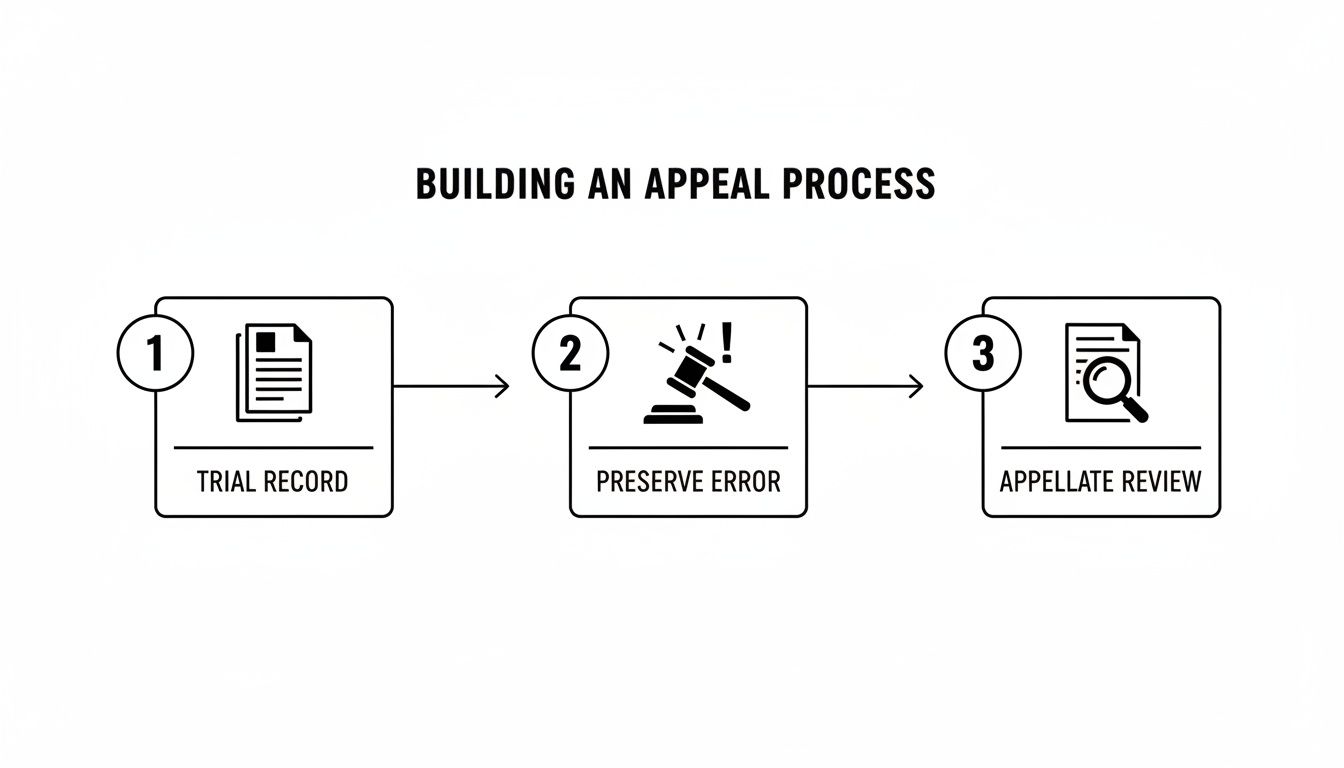
When you believe a judge's ruling was wrong, the next step is to follow the appellate process—a formal path governed by the Texas Rules of Appellate Procedure. While it may seem intimidating, think of it as a structured roadmap to seek a fair outcome. This journey is not a second trial but a technical review focused on correcting legal mistakes. Let’s break down what that journey looks like.
Step 1: Filing the Notice of Appeal
The first action is filing a Notice of Appeal. This document officially informs the court system that you are challenging the judge's decision. This step comes with a strict, non-negotiable deadline.
In most cases, you have only 30 days from the date the final order was signed to file your Notice of Appeal. This window can sometimes extend to 90 days if a valid post-judgment motion (like a motion for new trial) was filed. Missing this deadline is fatal to your case; it permanently closes the door on your right to an appeal, no matter how strong your arguments are. Learn more about these critical timelines in our guide on how to file a Notice of Appeal in Texas.
Step 2: Preparing the Appellate Record
After filing the Notice of Appeal, the next step is assembling the official record. As mentioned, the appellate court can only review what is in this record. It consists of two parts:
- The Clerk's Record: A compilation of all documents filed in your case.
- The Reporter's Record: The word-for-word transcript of everything said during the court proceedings.
Your appellate attorney will work with the court clerk and court reporter to ensure this record is complete, as it forms the foundation for every argument you will make.
Step 3: Appellate Briefing
This is where the core legal battle takes place. Briefing is the process of writing a formal, persuasive legal argument that explains to the appellate justices exactly where, when, and how the trial judge erred. It is not an emotional story but a precise, technical document that connects the facts of your case to the law.
Our attorneys analyze the record, linking specific facts and testimony to Texas statutes and case law. We must show the appellate panel not just that an error occurred, but how that error was an abuse of discretion that violated legal principles and led to an unjust result. The other side will file a response brief, and we then have an opportunity to file a final reply brief.
Step 4: Oral Argument
In some cases, the court will schedule an oral argument. This is a formal, strictly timed session where your lawyer appears before a panel of (usually three) appellate justices to argue the case.
No new evidence is presented. Instead, it is a high-level question-and-answer session. The justices use this time to probe the arguments made in the briefs and ask tough questions. For a skilled appellate attorney, this is a powerful opportunity to emphasize the most critical points and clarify complex issues directly with the decision-makers.
Step 5: The Appellate Decision
After briefing and any oral argument, the case is "submitted," and the waiting begins. The appellate court will deliberate and then issue a formal written opinion, a process that can take several months. The court will issue one of three outcomes:
- Affirm: The appellate court finds no reversible error and agrees with the trial court. The original judgment stands.
- Reverse and Remand: The court finds a significant error. It reverses the incorrect decision and sends the case back ("remands" it) to the trial court for new proceedings, such as a new trial or a specific hearing on an issue.
- Reverse and Render: In some cases, the appellate court not only finds an error but also issues the correct judgment itself. This "renders" a new judgment and avoids the need for more proceedings in the trial court.
Understanding these steps can demystify the process, turning an overwhelming situation into a structured path toward obtaining a fair result.
Frequently Asked Questions About Texas Family Law Appeals
If you are considering an appeal, you likely have many questions. This is a complex area of law, and it is completely understandable to want clarity. Here are plain-English answers to the questions our appellate attorneys hear most often.
Can I Appeal Just Because I Disagree with the Ruling?
No. An appeal is not a second chance to get a different opinion simply because you are unhappy with the outcome.
To have a viable appeal, you must prove the trial judge made a specific, significant legal mistake. In family law, this often means demonstrating an abuse of discretion, where the judge's decision was arbitrary, unreasonable, or contrary to established law. Your entire case must be built on these identifiable errors, not just your disappointment with the order.
How Long Does a Texas Family Law Appeal Take?
A typical Texas family law appeal takes anywhere from 9 to 18 months, from the day the Notice of Appeal is filed to when the appellate court issues its final opinion.
Several factors affect the timeline:
- Preparing the Record: It can take a couple of months for the court reporter and clerk to prepare the official transcripts and case file.
- Writing the Briefs: Both sides are given time to write and file their legal arguments, or "briefs." This back-and-forth process can take several months.
- The Court's Caseload: The time it takes for the appellate justices to review the case, hold oral argument, and write their decision depends on their workload.
What is the Difference Between Reversible Error and Harmless Error?
This distinction is critical. A mistake at trial only matters if it was serious enough to have caused the wrong outcome.
Reversible Error: This is a major legal blunder that harmed your rights and likely led the judge to an improper conclusion. For example, if a judge mischaracterizes a multi-million dollar business as separate property instead of community property in your property division case, that is almost certainly a reversible error.
Harmless Error: This is a minor, technical mistake that did not affect the final result. An appellate court will not overturn a judgment for a small error that did not impact the outcome.
The core of a successful appeal is proving the trial court committed a reversible error. You must persuade the appellate court that if not for that specific mistake, the outcome of your case would have likely been different.
What Are My Chances of Winning an Appeal?
There is no simple answer. Your odds of winning an appeal depend on one critical question: "Did my trial lawyer properly preserve a reversible error in the record for the appellate court to review?"
An appeal's strength can only be determined after a meticulous review of the entire trial record—the reporter's transcript and the clerk's file.
This is why a professional case evaluation is essential. An experienced appellate lawyer can analyze the record, identify errors that matter on appeal, and provide a frank, realistic assessment of whether pursuing an appeal is the right strategy for you.
If you believe the court made a mistake in your family law case, our appellate attorneys can help you seek a fair outcome. Contact The Law Office of Bryan Fagan today for a free consultation.