When a family court judge issues a ruling in your case that feels deeply unfair, it's easy to feel like you've hit a dead end. You may feel your case was handled unfairly, and the outcome simply doesn't reflect the facts or the law. The fight for a just outcome, however, isn’t necessarily over. Texas appellate procedure family law offers a structured path for challenging a court's decision, but it's a very different world from the trial court you just left.
An appeal is not about getting a "do-over" or a second trial. Instead, it is a careful, strategic review of the trial court record to find specific legal mistakes that led to an unjust result. It is a process designed to restore fairness and ensure the law was applied correctly.
Your Path to Justice When a Family Court Ruling Feels Unfair

If you're looking at a final order regarding your children, property, or finances that seems completely disconnected from the evidence, you are not alone. It’s a common and deeply frustrating experience in high-stakes family law matters. That gut feeling that something went fundamentally wrong is often the first step toward seeking a remedy.
The Texas appellate process is that formal remedy. It is a highly technical review of what has already happened in your case, not a new presentation of evidence or witnesses. The entire focus shifts from convincing a judge of your story to convincing a panel of appellate justices that a critical legal error occurred.
What Is a Reversible Error?
This is the absolute heart of any appeal: identifying a “reversible error.” In plain English, this is a significant mistake made by the trial judge that very likely caused an improper judgment. It is not enough to simply disagree with the outcome. To succeed, you must be able to point to a specific moment where the judge misapplied the law, improperly admitted or excluded evidence, or violated a rule of procedure—and show that this mistake harmed your case.
A general understanding of appellate law is helpful, as it provides the framework for all appeals, including those in family law.
An appeal is won by finding a legal error in the trial record, not by re-arguing the facts. The appellate court’s job is to ensure the law was applied correctly and that due process was followed.
The entire process is governed by the Texas Rules of Appellate Procedure and the Texas Family Code, which are notoriously complex. The deadlines are strict and unforgiving. For instance, you generally must file a Notice of Appeal within 30 days of the final judgment. Missing that deadline can permanently extinguish your right to appeal.
How an Appellate Attorney Can Help
Navigating this system requires a completely different mindset and skill set than trial work. An appellate lawyer is not focused on courtroom drama; they are a legal scholar, strategist, and writer. Their job involves:
- Meticulous Record Review: An appellate attorney will comb through every page of the trial transcript and every exhibit, hunting for those critical, reversible errors.
- Legal Research and Writing: They then build a persuasive written argument, called a brief, that methodically explains the errors to the appellate justices, citing relevant case law and statutes.
- Strategic Counsel: A good appellate attorney will give you a frank assessment of your chances of success. They’ll explain the possible outcomes, whether that’s the court affirming the original decision, reversing it entirely, or remanding it back to the trial court for a new hearing.
If you believe the court made a mistake in your family law case, our appellate attorneys can help you seek a fair outcome. Contact The Law Office of Bryan Fagan today for a free consultation.
What You Can Appeal in a Texas Family Law Case
So, you’ve received a ruling from the judge, and you’re certain it’s wrong. The natural impulse is to want to appeal it immediately. But in the world of Texas family law, it’s not always that simple. You generally cannot challenge a judge’s decisions one by one as they happen.
The entire system is built around a bedrock principle called the "final judgment rule." Think of your case in the trial court like a novel. The appellate court’s job is to review the entire finished story, not to read and critique it chapter by chapter. This rule promotes efficiency and prevents cases from getting stuck in an endless cycle of appeals over minor, temporary issues.
Final Judgments vs. Interlocutory Orders
This brings us to a critical distinction in Texas appellate procedure family law: the difference between a final judgment and what’s known as an interlocutory order. A final judgment is exactly what it sounds like—it’s the court’s final order that resolves all issues for all parties involved in the lawsuit. It’s the order that closes the book on the case at the trial level and gives you the green light to appeal.
On the other hand, most of the orders a judge makes during a case are temporary, or “interlocutory.” These are simply mid-game rulings designed to keep things stable until the final trial.
You’ll see interlocutory orders all the time. Common examples include:
- Temporary orders setting child support amounts
- An interim visitation schedule for the kids
- Rulings on temporary spousal support
- An order compelling both parties to go to mediation
While an unfavorable temporary order can be frustrating, you typically must wait until the final judgment is signed by the judge to appeal it. This isn't just a suggestion; it’s a jurisdictional rule that courts take very seriously.
An easy way to remember the difference:
- Final Judgment: The court's last word that ends the case, deciding all claims for everyone. This is appealable.
- Interlocutory Order: A temporary ruling made during the case that does not end the litigation. This is usually not appealable on its own.
The Strict Final Judgment Rule in Texas
Texas appellate courts are notoriously strict about this rule. They view it as fundamental to their jurisdiction—their very power to hear a case. The Texas Supreme Court has said time and again that an appeal can only move forward from a judgment that truly resolves all claims and all parties. This is what keeps the court system from grinding to a halt under the weight of premature appeals. You can explore how appellate jurisdiction works in Texas family law for a deeper dive into the legal reasoning.
Of course, the law must be practical. It recognizes that some temporary orders can cause such significant harm that waiting isn't an option. For these rare situations, the Texas Civil Practice and Remedies Code creates a few narrow exceptions allowing for an immediate interlocutory appeal. A common example in family law is an order that temporarily freezes a major asset, preventing a spouse from selling it during a divorce.
Determining whether your order is final and "ripe" for appeal, or if it might qualify for one of these rare exceptions, is a complex legal analysis. Getting it wrong means your appeal will be dismissed, wasting precious time and money. This is precisely why engaging an appellate specialist early is so important. They can examine the specific order and advise you on exactly when—and how—you can challenge the trial court’s decision.
The Clock Is Ticking: Critical Deadlines and Building Your Appeal
The moment a judge signs the final order in your family law case, a new clock starts. This isn't just any clock—it’s a stopwatch for a series of strict, unforgiving deadlines that govern the entire Texas appellate procedure family law framework. If you believe the court got it wrong, moving quickly isn't just a good idea; it’s the only way to preserve your right to appeal.
Your first and most urgent task is filing a Notice of Appeal. This is the official starting pistol for your appeal. It's the legal document that informs the trial court, the opposing party, and the appellate court that you intend to challenge the final judgment. Under Texas law, you have just 30 days from the day the judgment is signed to get this filed. This is one of the most unforgiving deadlines in our legal system. Miss it, and your chance to appeal is almost certainly lost forever.
It's crucial to understand that an appeal is fundamentally different from a trial. We aren't introducing new witnesses or arguing new facts. The appellate court is more like a referee reviewing a tape of the game that has already been played.
Appeals vs. Trials: A Fundamental Comparison
| Aspect | Trial Court | Appellate Court |
|---|---|---|
| Purpose | To determine the facts of the case and apply the law. | To review the trial court’s actions for legal errors. |
| Evidence | New evidence is presented, witnesses testify live. | No new evidence or testimony; review is limited to the record. |
| Decision-Maker | A single judge or a jury. | A panel of three or more justices. |
| Focus | "What happened?" | "Did the trial judge make a legal mistake?" |
As you can see, the appellate process is entirely focused on what has already happened, which brings us to the next critical step.
Assembling the Foundation of Your Appeal: The Record
After filing the Notice of Appeal, your attorney’s focus shifts to assembling the official appellate record. This record is the entire universe of your appeal. The appellate justices cannot consider anything that is not in it. If an important document was not admitted into evidence or a crucial objection was not made during the trial, it’s as if it never happened for purposes of the appeal.
The appellate record is made up of two key components:
- The Clerk's Record: This is a compiled volume of every document filed with the court clerk—the original petition, motions, discovery responses, and the final order itself.
- The Reporter's Record: This is the word-for-word transcript of everything spoken during the trial and hearings, captured by the court reporter.
Together, these documents are all the appellate court has to work with. An appellate lawyer’s job is to meticulously comb through this record to find the specific legal errors that can lead to a reversal.
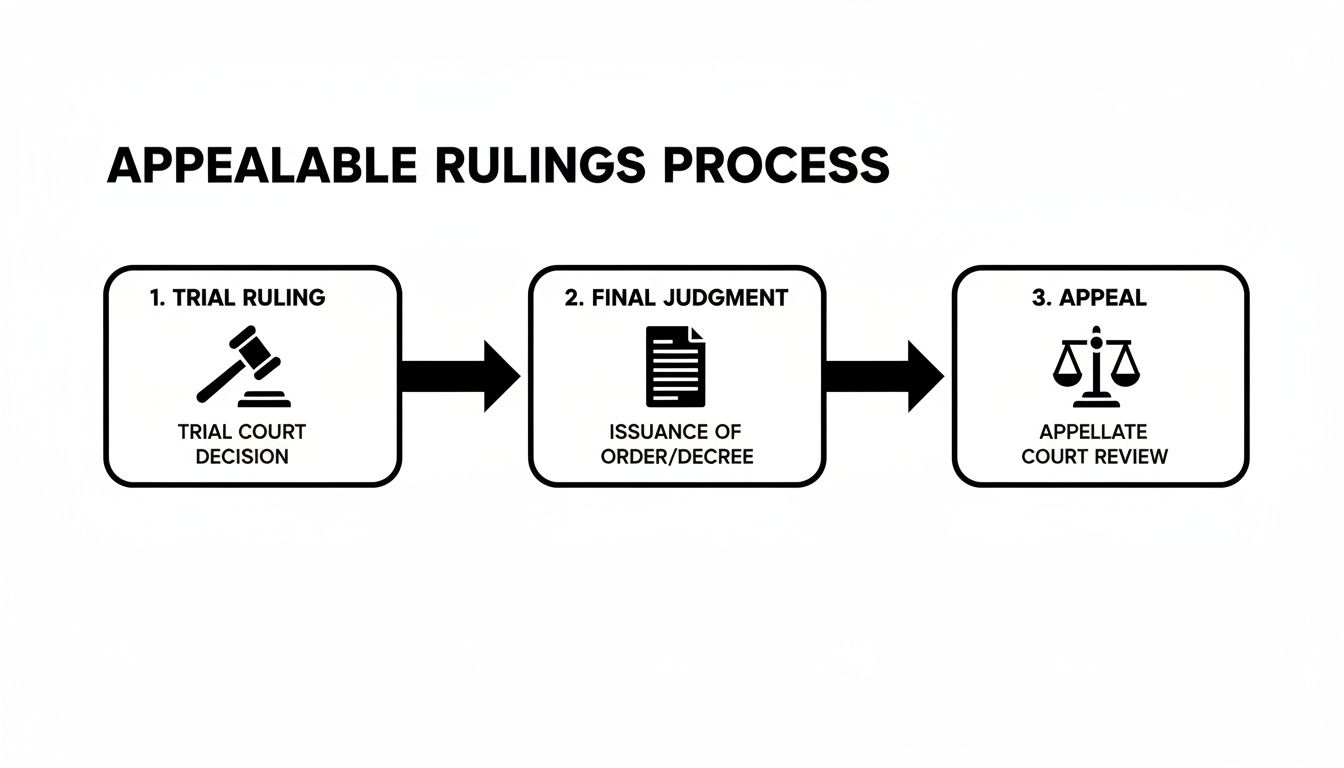
As the chart illustrates, everything flows from the final judgment. Without it, the appellate process cannot begin.
How to Strategically Extend Your Deadline
That initial 30-day deadline can feel overwhelming. You’re often still processing a difficult and disappointing outcome while simultaneously trying to find and hire an appellate specialist. Thankfully, Texas procedure provides a strategic way to buy yourself some much-needed time.
Filing a Motion for New Trial with the trial court is a powerful procedural tool. While these motions are rarely granted, filing one automatically extends your deadline to file a Notice of Appeal from 30 days to a full 90 days from the date the judgment was signed.
This is a standard and highly effective strategy. That extra 60 days of breathing room is invaluable. It gives your appellate team the time needed to properly analyze the trial record, identify potential grounds for appeal, and prepare the necessary documents without being rushed. To understand more about the technical filing requirements, you can review our guide on how to file a Notice of Appeal. Taking this step helps ensure your appeal begins on solid, well-prepared footing.
Understanding the Standard of Review and Finding Reversible Error

Winning a family law appeal isn’t about arguing you deserved a better result. It's about proving the trial court judge made a significant, harmful legal mistake that distorted the outcome of your case. This is the absolute core of every successful appeal.
This is called a reversible error. Simply feeling the judge was unfair or didn't see things your way is not enough grounds to appeal. The entire practice of Texas appellate procedure family law is built on identifying a concrete mistake in the trial record and showing the appellate court precisely how that error violated the law and produced an improper judgment. Without a provable error, there is no appeal.
Understanding the “Abuse of Discretion” Standard
So, how do we find one of these errors? It starts with understanding the standard of review—the specific lens the court of appeals uses to examine the trial judge's actions. In most Texas family law cases, that lens is called “abuse of discretion.”
Think of a trial judge like a referee in a football game. They are on the field, watching the play unfold in real time, and have the discretion to make judgment calls. An appellate court gives the trial judge similar deference, respecting their unique position to hear testimony, observe witnesses, and weigh credibility firsthand.
Abuse of Discretion (Plain-English Definition): An "abuse of discretion" occurs when a trial judge makes a decision so arbitrary, unreasonable, or contrary to guiding legal rules that it falls outside the range of reasonable outcomes.
Proving this is a high hurdle. It means showing the judge didn't just make a call you disagree with; they made a decision that no reasonable judge, given the same evidence and law, could have possibly made. As an appellate court decision shows, a trial judge's decision on supervised visitation will be upheld as long as there is sufficient evidence in the record to support it. To see a detailed analysis of this case, you can read what this 2026 decision teaches parents about custody appeals.
Common Examples of Reversible Error in Texas Family Court
While the standard is tough, it is far from insurmountable. Experienced appellate attorneys know exactly where to look in the trial record for these critical mistakes. Proving them requires a solid foundation of evidence, which is why obtaining official certified copies of key documents is so important.
Here are some common examples of reversible errors in Texas family law appeals:
- Mischaracterizing Property: A judge incorrectly classifies a spouse's separate property (like an inheritance or pre-marriage bank account) as community property and divides it in the divorce, which is a direct violation of the Texas Family Code.
- Mathematical Errors in Support: The court makes a clear calculation error when setting child support or spousal maintenance, leading to an award that is legally incorrect and financially damaging.
- Insufficient Evidence for a Custody Decision: A judge severely restricts a parent’s rights or makes a custody determination without enough evidence on the record to legally justify that decision under the child's best interest standard.
- Improperly Admitting or Excluding Evidence: The judge allows testimony that should have been barred (like from an unqualified expert) or, conversely, refuses to consider crucial evidence that should have been allowed, harming a party's ability to present their case.
Finding one of these errors is the first critical step. From there, the real work begins: drafting a persuasive legal brief that explains the mistake, its impact, and why the law demands a different outcome. You can learn more about the abuse of discretion standard to get a deeper sense of how these arguments are built.
Crafting a Winning Argument: The Briefing and Oral Argument Stage
After the trial record is officially compiled, the fight moves from the courtroom to the page. This is the briefing stage, where a skilled appellate lawyer takes the cold facts from the record and builds a compelling legal argument to persuade a panel of justices that a serious error was made.
Briefing (Plain-English Definition): The process of preparing and submitting written legal arguments (called "briefs") to the appellate court. These documents explain each side's position on whether the trial court's decision was legally correct.
This is not a simple retelling of your side of the story. It is a precise and strategic process. Your lawyer constructs an ironclad case against the trial court's decision, but they can only use two tools: the evidence contained within the official record and the established law found in statutes and prior court decisions (precedent).
The Battle of the Briefs
The briefing stage plays out like a structured, high-stakes debate on paper. It gives both sides a clear opportunity to make their case, and it’s where an attorney’s ability to weave dense legal principles and a complex factual history into a clear, persuasive narrative is absolutely crucial.
This written exchange typically happens in three steps:
- The Appellant's Brief: This is your opening argument. Your attorney files this document to lay out exactly what happened, pinpoint the specific legal errors the trial court made, and explain—using direct citations to the law and the record—why those mistakes require a reversal.
- The Appellee's Brief: The other side (the "appellee") gets to respond. Their brief is a defense of the trial court’s ruling. They will argue that either no error occurred or, if one did, it was harmless and did not change the final outcome.
- The Reply Brief (Optional): As the party who filed the appeal, you get the last word. The reply brief is a focused and powerful tool used to dismantle the appellee's arguments and reinforce the key points from your initial brief.
A well-written brief is the heart of any successful appeal. It must be logical, meticulously researched, and written specifically for an audience of appellate judges. To get a better handle on this critical document, you can read our in-depth guide on what an appellate brief is and how it’s structured.
The Role of Oral Argument
While briefs are the foundation of your appeal, some cases also include oral argument. This is a formal, high-level Q&A session where your lawyer appears before the appellate justices to argue the case face-to-face. It’s a short, intense affair, usually lasting only 15-20 minutes per side.
Not every appeal gets an oral argument; the court decides if one is needed. But when it happens, it is an invaluable opportunity to:
- Emphasize the most powerful points from your brief.
- Clarify any complicated facts or legal issues.
- Answer the justices' questions directly and address their specific concerns.
This direct dialogue can be a game-changer. A sharp oral advocate can breathe life into the written arguments and adapt on the fly, helping to guide the justices’ thinking toward a just result.
The Possible Outcomes of Your Appeal and What Comes Next
After all the intense work of building the record and crafting your legal arguments, the case is finally in the hands of the court. The wait for a decision can be one of the most nerve-wracking parts of the entire process. Understanding what the court might decide can help you prepare for what’s ahead.
When the justices issue their written opinion, it will fundamentally alter the course of your case. Let's break down the three main paths your appeal can take.
Affirming the Trial Court's Judgment
Often, the appellate court will "affirm" the trial judge’s original order. This simply means the justices reviewed the record and found no "reversible error"—no mistake serious enough to justify overturning the decision. While this is not the outcome you hoped for, an affirmance brings a sense of finality.
Reversing and Rendering a New Judgment
This is the home run for anyone appealing a case. When a court "reverses and renders," it doesn't just find that the trial court was wrong; it steps in and issues the correct judgment itself. For example, if a trial judge incorrectly divided your separate property, the appellate court could render a new judgment that definitively declares the property as yours. The case is over, and you win without returning to the trial court.
Reversing and Remanding for a New Proceeding
A more common victory is a "reverse and remand." Here, the appellate court agrees that a significant error occurred but decides the trial court is the best place to fix it. The case gets sent back—remanded—with specific instructions. Essentially, you get a do-over on the part of the case that was mishandled, giving you a critical second chance to seek a fair result on key issues like a flawed child custody arrangement or an improper property division.
Appealing to the Texas Supreme Court
If the court of appeals rules against you, there's one last stop: asking the Texas Supreme Court to review the case. It’s vital to have realistic expectations. The Supreme Court is incredibly selective and only takes on a handful of family law cases each year—usually those that raise novel or significant legal questions affecting the entire state.
However, when they do take a case, the odds of success can be surprisingly high.
In 2025, the Texas Supreme Court issued opinions in just 83 causes. However, the court's reversal rate for these granted petitions held strong at 86%, well above the 75% historical average. This means when the Supreme Court takes a case, there's a strong chance of overturning an unjust outcome. You can explore more about these statistics and their implications for Texas appeals.
This high reversal rate shows why having a rock-solid, compelling legal argument is so critical from the very beginning.
Common Questions About Texas Family Law Appeals
When you've just come through a difficult family law trial, the thought of an appeal can feel overwhelming. It's completely normal to have a lot of questions. You're likely wondering about the time, the cost, and what your chances really are. Let's walk through some of the most common concerns we hear from clients just like you.
How Long Does a Family Law Appeal Take in Texas?
An appeal isn't a quick process. From filing the Notice of Appeal until you have a final decision from the court of appeals, you can generally expect the process to take 9 to 18 months. Every step is methodical and governed by strict court rules, from gathering the record to the briefing schedule and the time the justices need to deliberate and write their opinion. It is a marathon, not a sprint, and patience is essential.
Can I Submit New Evidence During My Appeal?
No, and this is one of the most important aspects of appellate procedure to understand. An appeal is not a second trial or a "do-over" where you can introduce new evidence or have a new witness testify. The appellate court acts as a reviewer of the game that has already been played. It can only look at what happened during the original trial—the testimony, exhibits, and arguments contained in the official “record.” The justices review that record to decide one thing: did the trial judge make a legal mistake based on the information they had?
What Are My Chances of Winning a Family Law Appeal?
Success hinges entirely on proving that a “reversible error” occurred in the trial court. Winning isn't about persuading the higher court that they would have ruled differently or that they like your side better. It's about showing a specific legal mistake so significant that it likely caused an improper outcome. Statistically, most trial court judgments are upheld. However, your odds improve dramatically when an experienced appellate attorney can dig into the record and identify one of these critical legal errors. That's why the first step is always a deep, thorough review of your case to see if a legitimate basis for an appeal exists.
How Much Does a Texas Family Law Appeal Cost?
The cost of an appeal can vary significantly, depending primarily on the complexity of the legal issues and the length of the trial record. A two-day trial creates a much smaller record to review than a two-week trial, which directly impacts the cost. The primary expenses are:
- Attorney's Fees: This is the largest component, covering the many hours needed to meticulously review the record, conduct deep legal research, and write the persuasive legal briefs presented to the court.
- Record Preparation Costs: The court reporter and court clerk charge fees to prepare the official transcripts and case documents. These costs can be significant for a long trial.
- Court Filing Fees: Appellate courts have mandatory fees for filing the notice of appeal and other documents.
We believe in full transparency. In our initial consultation, we will provide a realistic estimate of the potential costs for your specific case so you can make an informed decision that is best for you and your family.
If you believe the court made a mistake in your family law case, our appellate attorneys can help you seek a fair outcome. Contact The Law Office of Bryan Fagan today for a free consultation.