When a court's final decision in your family law case feels fundamentally unfair, you may feel that the system has failed you. In Texas, the path to correcting an unjust outcome isn't about simply disagreeing with the result. The key lies in identifying valid grounds for appeal—specific, significant legal mistakes made by the trial judge.
An appeal is a formal request for a higher court to review the trial court’s proceedings. It is not a new trial or a do-over. Instead, it is a structured review of the original case record to determine if a reversible error occurred that likely led to an improper judgment. This process is your opportunity to seek fairness and restore balance when a legal misstep has compromised your family's future.
A Path Forward When a Court Order Feels Wrong
If you are exploring your appellate options, you likely believe the final order in your divorce, child custody, or other family law matter was unjust. That feeling is understandable, and the Texas appellate process exists for this very reason: to provide a remedy when a case is decided incorrectly due to a legal mistake.
It’s crucial to understand that an appeal is not a new trial. You cannot present new evidence or re-argue your case from scratch. Instead, an appellate attorney conducts a meticulous review of the existing trial record, focusing on one critical question: did the trial judge make a reversible error in applying the law or legal procedure?

Moving Beyond Disagreement to Legal Error
Simply disagreeing with how a judge handled the property division or determined the possession schedule is not enough to file an appeal. The foundation of a successful appeal is built on identifying what the law calls "reversible error."
Reversible Error: A mistake made by the trial court that is so significant it probably caused an improper judgment. It is not a minor slip-up; it is an error that mattered to the final outcome.
This is a high standard. Appellate courts give considerable deference to a trial judge's decisions, especially in family law. To succeed, you must point to specific, reversible errors, such as a clear misapplication of the Texas Family Code, the wrongful exclusion of crucial evidence, or a violation of your due process rights. Statistics on federal judicial caseloads from uscourts.gov show that overturning a lower court is challenging, underscoring the need for a precise and powerful legal argument.
Your First Step Toward Seeking Justice
This guide will provide a clear, calm understanding of how the appellate system works to restore fairness when a legal mistake has occurred. We will explain what qualifies as valid grounds for an appeal, distinguishing between a simple disagreement and the kinds of specific, reversible errors an appellate court has the power to correct.
Let's explore the key concepts you need to understand as you consider your next steps.
Understanding the Foundation of an Appeal: Reversible Error
The world of appeals hinges on one crucial concept: reversible error. This is the key that unlocks the possibility of a different outcome. A common misconception is that you can appeal a case simply because you dislike the judgment. In reality, the process is far more specific.
To win an appeal, you must prove that a specific error was so significant that it very likely caused the wrong result.
Think of it like a football game. A referee might miss a minor holding call that doesn't affect the play—that’s a "harmless error." But if the referee makes a terrible call that negates the game-winning touchdown, that’s a game-changer. That’s a reversible error. It’s a mistake so critical that it fundamentally altered the outcome. The appellate court’s job is to review the game tape—the trial record—to find those game-changing bad calls.

Harmless Error vs. Reversible Error
Distinguishing between a harmless slip-up and a reversible error is at the heart of every appeal. The higher court is not there to nitpick. They will not overturn a judge's decision because of a trivial misstep.
The error must have genuinely harmed your case and directly led to an unjust judgment. Let's break down this critical difference with a comparison.
Harmless Error vs. Reversible Error in Family Law
This table clarifies the critical difference between minor mistakes a trial court might make versus major errors that can justify an appeal.
| Type of Error | Definition | Example in a Divorce Case | Impact on Appeal |
|---|---|---|---|
| Harmless Error | A minor legal or procedural mistake that did not affect the final outcome of the case. | The judge misspoke a filing date during a hearing but immediately corrected it on the record, causing no actual prejudice to either party. | An appellate court would likely note the error but affirm the judgment, as the mistake had no real impact on the case's final orders. |
| Reversible Error | A significant mistake of law or fact that very likely caused an incorrect and unjust judgment. | The judge ignores Texas law and classifies an inheritance you received (your separate property) as community property, then divides it with your spouse. | This is a textbook reversible error. The appellate court would almost certainly reverse the property division and send the case back to the trial court to get it right. |
As you can see, the difference is everything. Identifying which type of error occurred is the first, and most important, step in evaluating whether an appeal is viable.
Defining Abuse of Discretion
In family law, one of the most common grounds for appeal is "abuse of discretion." This term does not mean the judge was rude or unprofessional. In the legal world, it has a very specific meaning.
An abuse of discretion occurs when a judge makes a decision that is arbitrary, unreasonable, or made without reference to guiding legal rules and principles.
Texas family court judges have significant latitude, especially when making decisions about what is in the best interest of a child in a custody case. But that discretion is not unlimited.
A judge abuses their discretion when they act without reference to any guiding rules or principles. For example, if a judge completely ignores credible, undisputed evidence of a parent's ongoing substance abuse when awarding them primary custody, that's not just a questionable call—it's likely an abuse of discretion.
Proving this is challenging. You must show more than just that the appellate judges might have decided differently. You have to convince them that the trial judge's ruling was so far off the mark that it was legally indefensible. Finding these critical errors is what gives you a fighting chance to correct an unjust outcome for your family.
Common Grounds for Appeal in Texas Family Law
When a judge’s final order feels profoundly wrong, it is natural to focus on the unfairness. But in appellate law, disagreeing with the outcome isn't enough. An appeal requires a solid legal foundation—a specific, significant error made during the trial. These mistakes are the grounds for appeal, and they are the only basis for convincing a higher court to reconsider the decision.
An appeal is not a do-over; it is a review of the rulebook. The appellate court is not interested in re-hearing the case or re-weighing evidence. It is looking for one thing: did the trial judge make a critical mistake in applying the law or the rules of procedure?
Let's walk through the most common types of errors in Texas family law cases that can form the basis for a successful appeal.
Abuse of Discretion in Rulings
This is one of the most significant grounds in family law. Abuse of discretion occurs when a judge makes a ruling that is arbitrary, unreasonable, or contrary to established legal principles in the Texas Family Code.
Trial judges have considerable leeway, especially regarding decisions about children or property division. But that power is not absolute. Their decisions must be based on the facts and evidence presented in court. When they stray too far, it is an abuse of discretion.
-
Child Custody Example: Imagine a judge grants primary custody to a parent with a recent, untreated history of substance abuse. If multiple credible witnesses—like teachers or counselors—testified about the child’s safety being at risk, and the judge ignored that evidence without explanation, the ruling could be an abuse of discretion. It directly conflicts with the core mandate to prioritize the "best interest of the child." Our firm often sees this in complex situations, including those involving claims of parental alienation in Texas, where a judge's failure to recognize a destructive pattern is a significant, appealable error.
-
Property Division Example: In a divorce, a judge divides the community estate by giving 90% to one spouse and only 10% to the other. While divisions do not have to be perfectly equal, they must be "just and right." An extremely lopsided division like this, without a clear, factual reason explained in the record, suggests an abuse of discretion.
Clear Errors of Law
Sometimes, the judge simply misapplies the law. An error of law occurs when the court misinterprets a statute, misapplies a legal precedent, or ignores a mandatory rule. Unlike abuse of discretion, which relates to a judgment call, a legal error is more black-and-white.
On appeal, the higher court examines these issues from scratch, without giving any special weight to the trial judge's interpretation.
This is often one of the most powerful grounds for an appeal. The argument isn't about the judge's opinion; it's about a direct failure to follow the law as written.
A classic example is property characterization. Suppose you inherited your grandmother's house before marriage and kept it completely separate from your marital finances. Under Texas law, that is your separate property. If the judge mistakenly classifies it as community property and divides it in the divorce, that is a clear, reversible error of law.
Insufficient Evidence to Support a Ruling
A judge's decision cannot be based on a gut feeling; it must be supported by facts proven at trial. If the evidence is not there, the ruling can be challenged on appeal for being legally or factually insufficient.
-
Legally Insufficient Evidence: This is the more extreme version. It means there is zero evidence to support a crucial finding the judge made. It’s like a building with no foundation—the conclusion has nothing to stand on and must collapse.
-
Factually Insufficient Evidence: This argument is more difficult to win. It acknowledges that there may be some evidence supporting the decision, but argues that this evidence is so weak—or the evidence to the contrary is so overwhelming—that the finding is clearly wrong and unjust.
For instance, a judge sets child support based on an income figure for one parent that has no basis in the tax returns, pay stubs, or other financial documents submitted as evidence. That finding is untethered from the facts and is ripe for appeal.
Procedural and Due Process Errors
The court system operates on rules designed to ensure everyone gets a fair opportunity to be heard. The Texas Rules of Civil Procedure and Appellate Procedure are safeguards, not suggestions. When a judge violates these rules and it harms your ability to present your case, you may have grounds for an appeal.
This could include a judge improperly refusing to admit critical evidence, preventing a key witness from testifying, or failing to give you proper legal notice of a hearing. These are not minor slip-ups—they can be serious violations of your right to due process.
In some complex cases, other issues can arise. For example, some courts have recognized a path to appeal when an appellant can demonstrate that their trial lawyer’s performance was so deficient that it likely changed the outcome of the case. As highlighted in family law trends by Clio, the complexity and high stakes of these cases demand competent representation.
Spotting these procedural errors requires a deep knowledge of the rules and a painstaking review of every document and transcript from your trial. That is exactly what an experienced appellate lawyer is trained to do.
How the Standard of Review Shapes Your Appeal
One of the most important concepts in an appeal is the standard of review. This is not just legal jargon; it is the specific lens the appellate court must use when examining the trial judge's decision. Understanding this concept is critical for having a realistic idea of what it takes to win.
Think of it like an instant replay in football. The official reviewing the play does not re-referee the entire game. For a call like a fumble, the official can only overturn the on-field ruling if there is "indisputable video evidence." In other words, they give great respect—or deference—to the call made in real-time. An appellate court does something similar, giving significant deference to a trial judge on many family law decisions.
This means that how the appellate court reviews an issue depends entirely on the type of issue being appealed. Some decisions are far harder to overturn than others, and it all comes down to the standard of review.
Abuse of Discretion: The Toughest Standard to Meet
In Texas family law, most major issues—child custody, visitation schedules, and property division—are reviewed under the abuse of discretion standard. This is the most deferential standard, which means it gives the most power to the trial judge.
To win an appeal under this standard, you cannot just argue that the appellate court would have ruled differently. You must prove that the trial judge's decision was so arbitrary or unreasonable that it was made without any reference to guiding legal rules. It is a very high bar, rooted in the idea that the trial judge, who saw the witnesses and heard the testimony firsthand, is in the best position to make these judgment calls.
De Novo Review: A Fresh Look at the Law
On the opposite end of the spectrum is de novo review. "De novo" is Latin for "from the new" or "anew." When this standard applies, the appellate court gives zero deference to the trial judge. It looks at the issue with completely fresh eyes, as if for the first time.
This standard is reserved for pure questions of law. For instance:
- Did the judge misinterpret a statute in the Texas Family Code?
- Did the judge apply a legal precedent to the facts of your case incorrectly?
- Was separate property mistakenly characterized as community property?
In these cases, the appellate court simply decides if the trial judge got the law right, without giving any weight to the original decision. This is often where the most powerful grounds for appeal are found.
The following chart shows how different kinds of reversible errors can form the basis of a successful appeal.
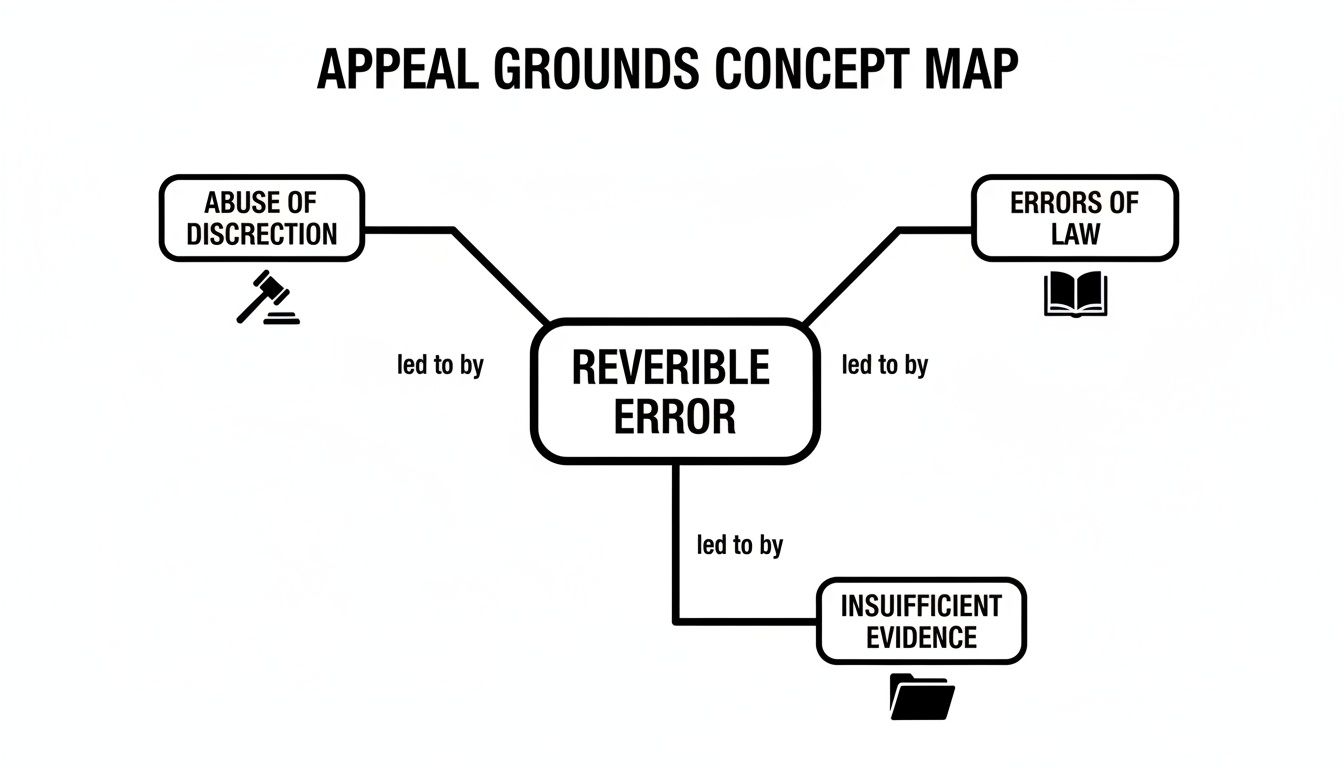
This visual drives home the point: a winning appeal has to target a specific, reversible error, whether it came from an unreasonable judgment call, a legal mistake, or a simple lack of evidence.
Sufficiency of the Evidence: Was the Ruling Actually Supported by Facts?
Another key standard of review relates to the evidence itself. Here, the appellate court combs through the trial record to determine if the factual findings the judge made are actually backed by the evidence presented. There are two primary ways to challenge this:
- Legal Sufficiency: You argue there is no evidence—a complete absence of evidence—to support the judge's finding. You are claiming the conclusion has no factual basis at all.
- Factual Sufficiency: Here, the argument is more nuanced. You are saying that while there may be a tiny shred of evidence supporting the finding, it is so weak—or the evidence to the contrary is so overwhelming—that the decision is clearly wrong and unjust.
Understanding these standards is more than an academic exercise. It is the framework that dictates the entire strategy of your appeal. A seasoned appellate attorney first identifies potential errors, then determines the specific standard of review that applies to each. This strategic analysis turns a complaint into a persuasive legal argument with a real chance of success.
The Critical Step of Preserving Error for an Appeal
An appeal can be won or lost long before it is ever filed. The entire process hinges on a crucial, and often overlooked, procedural step known as preservation of error. Simply put, you cannot complain about a mistake on appeal if your attorney did not properly and promptly object to it during the trial.
Think of it as the legal system’s “speak now or forever hold your peace” rule. The appellate court is not a safety net for arguments that could have been made but were not. Its job is to review the specific decisions the trial judge was asked to make, and you must give that judge the chance to get it right in the first place.

Why Error Preservation Is Not Optional
This is not just a technicality; it is a cornerstone of an efficient and fair judicial process. By requiring objections at trial, the system gives the judge a chance to fix a potential mistake on the spot. This can sometimes avoid the need for a long and expensive appeal altogether.
When an error is not preserved, you have essentially waived your right to complain about it later. This is why it is so critical to have a trial attorney who is not just focused on winning today, but is also thinking ahead to a potential appeal to protect your rights down the road.
How Errors Are Preserved in a Texas Family Court
Preserving error for a future appeal is an active, strategic process. It means your trial lawyer must be vigilant and know the Texas Rules of Appellate Procedure inside and out. Some of the most common methods include:
- Making Timely Objections: When the other side’s lawyer tries to introduce improper evidence or asks a witness an unfair question, your lawyer has to object immediately and state the specific legal reason for the objection.
- Requesting Findings of Fact and Conclusions of Law: After a trial, your attorney can formally ask the judge to spell out the specific facts they relied on and the legal reasoning behind their final decision. This forces the judge to "show their work," making it much easier to pinpoint legal mistakes on appeal.
- Filing a Motion for New Trial: This post-judgment motion is a powerful tool that gives the trial judge one last opportunity to reconsider their rulings and correct any major errors. It is also essential for preserving certain types of complaints for an appeal. You can learn more about this vital step by reading our guide on how a motion for new trial in Texas works.
What is Preservation of Error?
Preservation of error is the legal requirement that you must make a timely and specific objection, motion, or request in the trial court. This action informs the judge of a potential mistake and gives the court a chance to correct it. If you don't take this step, the issue is usually considered waived and cannot be brought up on appeal.
The rules around preserving error are strict, and failing to follow them is a common reason appeals fail. Appellate courts in Texas will often refuse to even consider an argument if the issue was not properly raised with the trial court through objections, specific requests, or timely post-judgment motions.
This demonstrates the high level of technical skill needed in both trial and appellate law. You need an attorney who is not just fighting for a win today, but also carefully protecting your right to a fair review tomorrow.
How to Evaluate Your Case for a Potential Appeal
Understanding the concepts behind an appeal is one thing, but taking decisive action is what truly matters. If you have a final order in your family law case that feels fundamentally wrong, it is time to move from feeling powerless to finding a strategic solution. A successful appeal is not built on a general sense of unfairness; it is built on identifying a specific, preserved, and reversible error.
This means you need a sharp, objective look at your case to see if valid grounds for an appeal exist. That process goes beyond rereading the final order—it requires a deep dive into the entire trial record, from start to finish.
First Steps and the Ticking Clock
The first thing you need to know is the deadline. Time is not on your side. In Texas, the timelines for initiating an appeal are incredibly strict and unforgiving.
As a general rule, you have only 30 days from the day the judge signed the final judgment to file your Notice of Appeal. If you miss this deadline, the door to the appellate court could be closed for good.
That tight window makes it absolutely critical to act fast. Your very first step should be to consult with an attorney who specializes in appellate law. The skillset needed to win an appeal is very different from what is required at trial. It involves meticulous legal research, powerful persuasive writing, and an encyclopedic knowledge of procedural rules.
A consultation with an appellate attorney is a diagnostic process. Their main job is to perform a painstaking review of the trial record—combing through transcripts, exhibits, and motions—to pinpoint potential reversible errors that were properly preserved by your trial lawyer.
What to Expect During an Appellate Consultation
When you meet with our team, we provide a candid, thorough evaluation of your case’s appellate potential. Our attorneys are trained to spot the specific kinds of mistakes that higher courts are willing to correct. We look for things like a clear misapplication of the Texas Family Code, an abuse of judicial discretion, or procedural missteps that deprived you of a fair hearing.
This review involves:
- A Meticulous Record Review: We leave no stone unturned, analyzing every page of your case file to hunt for preserved errors.
- An Honest Assessment: We will give you a straightforward opinion on the strengths and weaknesses of a potential appeal.
- A Strategic Path Forward: If we find viable grounds, we will map out a clear strategy to present the most compelling case possible to the appellate court.
Our job is to give you the clarity you need to make an informed decision. Not every unfair outcome contains the necessary grounds for an appeal, but you will never know for sure without a detailed, expert evaluation. You can learn more about how a dedicated family law appeal attorney can help protect your rights.
If you believe the court made a serious mistake in your family law case, our appellate attorneys can help you seek a just result. Contact The Law Office of Bryan Fagan today for a free consultation to protect your rights before your time runs out.
Frequently Asked Questions About Texas Family Law Appeals
After a difficult family law case, it is normal to feel a mix of confusion, frustration, and uncertainty. If you are questioning the judge’s final decision and wondering if it was truly fair, you are not alone. Let's walk through some of the most common questions our clients have when exploring their options for an appeal.
How Long Do I Have to File a Family Law Appeal in Texas?
This is the most critical question, and the answer is simple: you must act fast. Under the Texas Rules of Appellate Procedure, you generally have a strict 30-day deadline from the date the judge signs the final order to file your Notice of Appeal.
Think of this as a hard-and-fast rule. While certain post-trial motions, like a motion for a new trial, can extend this window to 90 days, you should never count on that extra time. Missing the initial deadline can mean losing your right to appeal permanently, regardless of the strength of your arguments.
Can I Introduce New Evidence During the Appeal?
This is a common misconception. The answer is no; an appeal is not a do-over of your trial. The appellate court’s job is limited to reviewing the trial record—everything that was said and presented to the original judge, including testimony, documents, and legal arguments.
You cannot bring in a new witness or submit a document you forgot about the first time. The focus is entirely on whether the trial court made a legal mistake based on the information it had at that moment.
An appeal is like having a referee review the game tape to see if the original ref made a bad call. They can only watch what happened on the field; they can’t bring in a new player to change the game.
What’s the Difference Between an Appeal and a Motion for New Trial?
It's easy to confuse these two, but they are very different legal tools aimed at different courts.
- A Motion for New Trial is a direct request to the same judge who just ruled on your case. You are asking them to take a second look at their decision and correct a mistake before the case proceeds further.
- An Appeal is when you take your case to a higher court—the Court of Appeals. You are formally arguing that the trial judge misinterpreted the law and that a higher judicial authority needs to step in and correct the error.
What Happens If I Win My Appeal?
Winning an appeal does not automatically mean you get the result you were hoping for. Instead, the Court of Appeals has several options, depending on the type of error that was made.
The most common outcomes are:
- Reverse and Render: This is a complete win. The appellate court reverses the trial court’s decision and "renders" or issues the correct judgment itself.
- Reverse and Remand: This is more common. The court agrees a mistake was made, reverses the decision, and sends the case back ("remands") to the trial court for a new hearing or a full retrial, with specific instructions on how to get it right this time.
- Modify the Judgment: Sometimes the court will adjust a specific part of the original order while leaving the rest of it intact.
Each of these outcomes is designed to ensure the final judgment is fair and follows the letter of Texas law.
If you believe the court made a mistake in your family law case, our appellate attorneys can help you seek a fair outcome. Contact The Law Office of Bryan Fagan, PLLC today for a free consultation about your appellate options.