Skip to content
A lot of people walk out of family court with the same thought. The judge got it wrong.
Maybe you felt rushed. Maybe key evidence never seemed to land. Maybe the final order on custody, support, property division, or enforcement doesn't square with what happened in the courtroom. That reaction is real, and it matters.
But an appeal in Texas family law turns on a narrower question. Not whether the result feels unfair. Whether the trial court made a legal mistake that the appellate court can correct.
That's the bridge between frustration and action. Texas appeals aren't retrials. You usually don't get to present new witnesses, add new documents, or ask a new panel of judges to reach a better result. The appellate court reviews the existing record, the written order, the objections that were made, and the law that governed the trial court's decision. From there, the core issue becomes whether the record shows reversible error.
If you're trying to understand what qualifies as reversible error in Texas family court, the right place to start is with that difference. Feeling wronged may explain why you want help. Proving reversible error is what gives an appeal a path forward.
Your Family Court Ruling Feels Unfair What Now
A parent loses additional possession time and believes the judge relied too heavily on one bad weekend. A spouse leaves a divorce trial convinced the court treated separate property like community property. Someone accused in an enforcement or protective-order case feels the hearing moved so fast that critical testimony never came in.
Those experiences are common. They also create a dangerous assumption. Many people think an appeal is a chance to tell the story again, this time to judges who will listen more carefully.
That isn't how Texas appellate practice works. The appellate court usually asks a disciplined set of questions: What did the trial court do? What part of the record shows it? Was the issue preserved? What legal standard applies? Did the mistake likely affect the judgment?
A strong appeal starts when disappointment gets translated into a specific legal issue tied to the record.
That shift matters in family law because so many rulings involve discretion. Trial judges weigh credibility, sort through competing testimony, and make fact-heavy calls about children, money, and property. Appellate courts don't automatically replace those judgments with their own.
What an appeal can do
An appeal can correct a trial court that:
- Applied the wrong law: The court used an incorrect legal rule in deciding custody, support, property, or procedure.
- Made a harmful evidentiary ruling: Important evidence was wrongly excluded or improper evidence was admitted over a proper objection.
- Entered relief the law doesn't support: The written judgment goes beyond what the pleadings, proof, or governing law allow.
- Committed a procedural error: A party was denied a fair chance to present the case or preserve important rights.
What an appeal usually can't do
An appeal usually isn't effective when the only argument is:
- The judge believed the other side
- The result felt one-sided
- You found better evidence after trial
- You want a new court to reweigh credibility
That's why the first real step isn't venting. It's reviewing the order, transcripts, exhibits, and procedural history with care.
Defining Reversible Error Versus Harmless Error
Texas law draws a firm line between a mistake and a reversible mistake. That line decides whether an appellate court will disturb the judgment.
A trial court can make an error and still be affirmed. That happens when the appellate court concludes the error didn't materially change the outcome or didn't stop the complaining party from properly presenting the appeal.
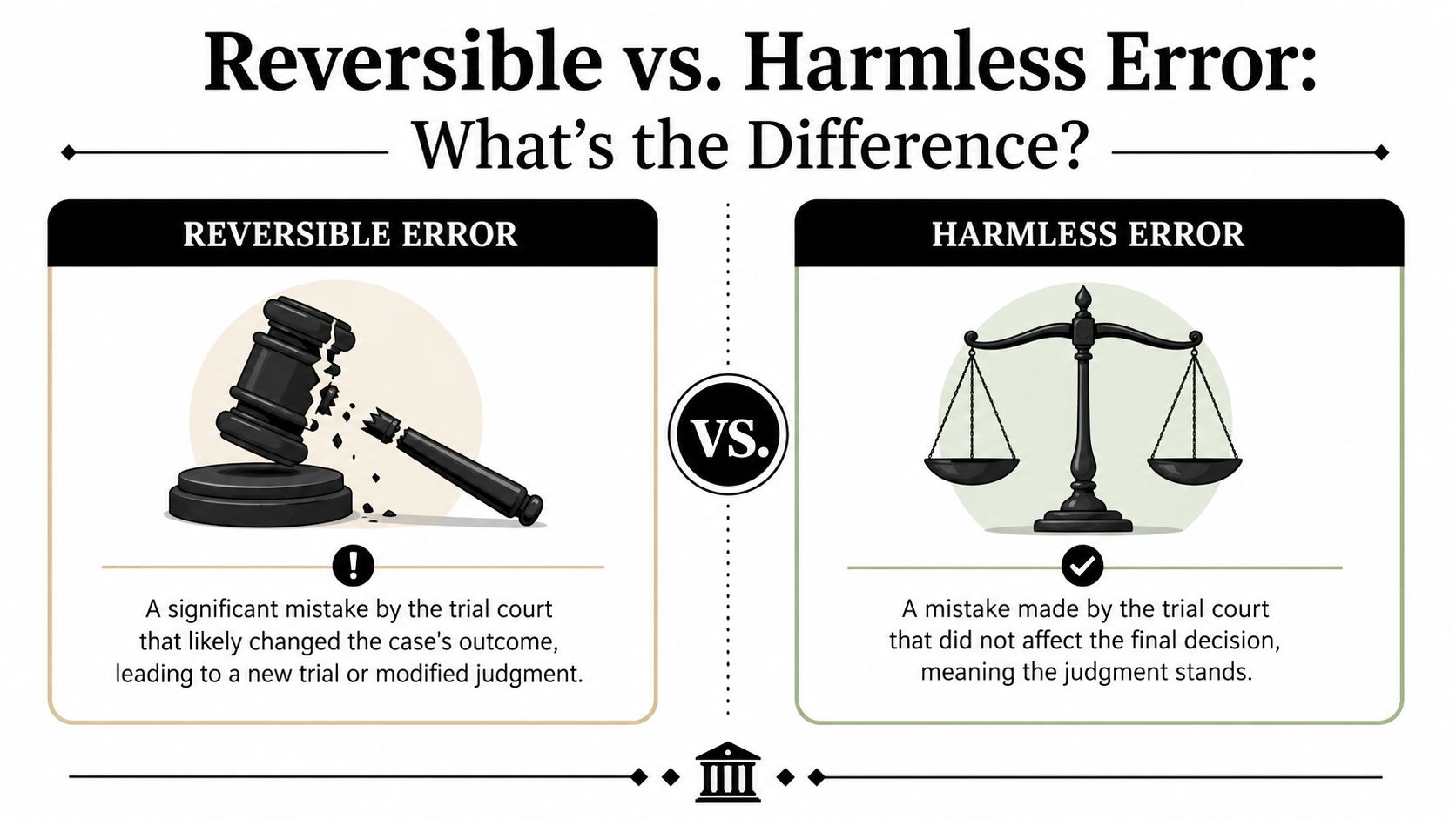
Under Texas appellate practice, a trial-court mistake qualifies as reversible error only if it probably caused the rendition of an improper judgment or probably prevented the appellant from properly presenting the case to the court of appeals. Otherwise, the mistake is treated as harmless and the judgment is usually affirmed, as discussed in this Texas appellate treatment of reversible error.
A plain-English way to think about it
It's similar to a referee's call in a close game.
If the referee makes a minor mistake that doesn't affect who wins, the result stands. That's harmless error.
If the referee's mistaken call directly changes possession at a critical point and likely changes the winner, that's closer to reversible error. In family court, the appellate judges ask a similar question. Did this mistake likely matter enough to affect the judgment?
What counts as harm
“Harm” doesn't mean you're upset by the ruling. It means the record shows a meaningful connection between the trial court's mistake and the result.
That often requires showing one of two things:
| Type of harm | What it means in practice |
|---|---|
| Outcome harm | The mistake likely led to the wrong judgment |
| Presentation harm | The mistake likely kept you from properly presenting the case on appeal |
This is why technical complaints often fail. If the error didn't move the outcome, or didn't interfere with the ability to present the issue on appeal, the court may call it harmless.
Where abuse of discretion fits
In family law, you'll often hear the phrase abuse of discretion. In plain English, that means the trial court had room to decide, but it acted outside the legal bounds of that discretion.
That doesn't mean the appellate court would have made a different call. It means the ruling was unreasonable under the governing law or record. In many family cases, proving reversible error requires showing both parts at once: the court used the wrong approach, and that mistake mattered.
Practical rule: “The judge was wrong” usually isn't enough. The stronger argument is “the judge made this specific legal error, it was preserved in the record, and it likely changed the judgment.”
If you're evaluating a possible appeal, this framework is more useful than asking whether the hearing felt fair. The better question is whether the record shows a preserved, harmful error that an appellate court can remedy. That's the foundation of any serious family law appeal strategy.
Understanding the Appellate Standard of Review
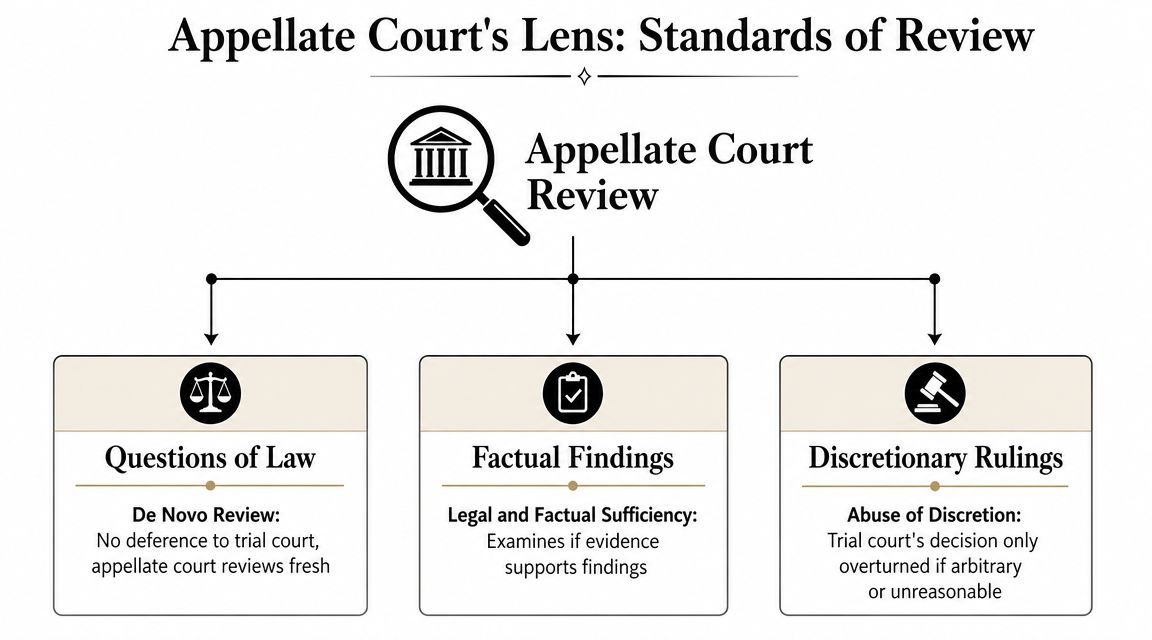
An appeal is shaped by the standard of review. That's the lens the appellate court must use when it looks at the trial court's ruling.
This is one reason appeals feel so different from trials. The appellate judges aren't starting over. They review a fixed record under a specific rule about how much deference the trial judge gets.
Abuse of discretion in family cases
Many family-law rulings are reviewed for abuse of discretion. That includes a wide range of custody, visitation, support, and procedural decisions.
In practical terms, this is a deferential standard. The appellate court doesn't ask, “What would we have done?” It asks whether the trial court acted outside the zone of reasonable choices under the law and evidence. If you want a deeper look at that framework, this discussion of the abuse of discretion standard in Texas family law is a useful starting point.
De novo review and sufficiency review
Some issues are different.
Questions of law may receive de novo review. In plain English, that means the appellate court reviews the legal issue fresh, without deferring to the trial court's legal conclusion.
Evidence-based challenges work differently. A party may argue that the evidence was legally or factually insufficient to support a finding, but those complaints depend heavily on the record and on whether the issue was properly preserved.
Why the standard changes the strategy
A major study of Texas Courts of Appeals found the statewide reversal rate in civil cases was 30%, and the rate was 20% for appeals after bench trials, which are common in family law, according to this Houston Law Review study of Texas reversal rates. That doesn't mean a family appeal can't succeed. It does mean the argument has to fit the review standard with precision.
Appellate judges are not re-trying the family case. They are deciding whether the trial court crossed a legal line that the record clearly shows.
That affects nearly every decision an appellate lawyer makes, including:
- Issue selection: The best appellate issue isn't always the most frustrating one. It's the one that fits the standard of review and shows harm.
- Record focus: If the complaint depends on facts outside the record, it usually won't help on direct appeal.
- Briefing tone: Strong briefing doesn't accuse the trial court of bad faith. It shows exactly where the law, the record, and the ruling stopped aligning.
A simple comparison
| Standard | Plain-English meaning | Common effect |
|---|---|---|
| Abuse of discretion | The trial court had choices, but went outside legal bounds | Harder to reverse without a clear record |
| De novo | The appellate court decides the legal question fresh | Stronger for pure legal issues |
| Sufficiency review | The court tests whether the evidence supports the finding | Depends heavily on preservation and record quality |
If you're wondering what qualifies as reversible error in Texas family court, the answer almost always depends on this lens first. The same complaint can be weak under one standard and powerful under another.
Common Examples of Reversible Error in Family Law
Reversible error becomes easier to spot when you move from theory to actual family-law disputes. The pattern is usually the same. A ruling goes wrong in a specific legal way, the problem is preserved in the record, and the mistake likely affects the judgment.
Child custody and visitation rulings
Custody appeals often fail when a parent argues only that the judge should have weighed the facts differently. They become stronger when the record shows the court used an improper legal basis, ignored a required framework, or restricted a parent's rights without record support tied to the governing standard.
That can happen when a trial court excludes important testimony about the child's circumstances, limits a parent's ability to present evidence on best interest, or signs an order that doesn't match the relief tried in court. In those situations, the issue isn't just disagreement. It's whether the ruling can be tied to a legal defect that likely shaped the outcome.
Property division and characterization disputes
Property cases often produce appealable issues because the final decree has to follow the law on characterization, reimbursement, tracing, and division.
One common problem is treating separate property as community property without a proper legal and evidentiary basis. Another is entering a division that rests on an incorrect legal assumption about ownership. In practical terms, appellate courts look closely at whether the decree rests on a legal error that infected the property division as a whole.
Financial proof also matters. In higher-conflict divorce cases, tracing, account summaries, business records, and source-of-funds analysis can make or break both the trial presentation and the later appeal. For readers dealing with business assets, commingling, or disputed records, this discussion of financial evidence for litigation gives useful context on why precision matters so much before the case ever reaches the appellate court.
In property cases, the strongest appellate arguments usually connect the legal classification mistake to the exact part of the decree it changed.
Evidentiary rulings that affect the result
Evidence issues are another common source of appellate complaints, but not every bad ruling is reversible.
A trial judge may admit evidence that shouldn't have come in, or exclude evidence that should have been admitted. The appellate question is narrower. Did that ruling probably affect the judgment? If the excluded testimony was central to a conservatorship issue, or if improperly admitted material shaped a key finding, the complaint may have real force.
The record holds paramount importance. The appellate court has to see what was offered, what objection was made, how the judge ruled, and why the ruling mattered. That's also why many lawyers focus carefully on improper admission of evidence in a Texas appeal when evaluating family-law judgments.
Procedural errors that deny a fair hearing
Some reversible errors are less about substance and more about process.
Examples include refusing to let a party make a record, entering an order that goes beyond the issues before the court, or cutting off a party's ability to present a claim or defense in a meaningful way. Family cases move quickly, and busy dockets sometimes produce sloppy procedure. But rushed procedure can still be harmful procedure.
What usually doesn't work
Some appellate points sound persuasive in conversation but rarely carry the day unless they are tied to a legal rule and record support:
- “The judge liked the other side more.”
- “My ex lied.”
- “The ruling was unfair.”
- “The judge ignored common sense.”
Those statements may reflect a real experience. But appellate courts need something more concrete:
- a preserved objection,
- a legal standard,
- a ruling shown in the record, and
- a persuasive explanation of harm.
That's the difference between frustration and a viable appellate issue.
How to Preserve Your Right to Appeal an Error
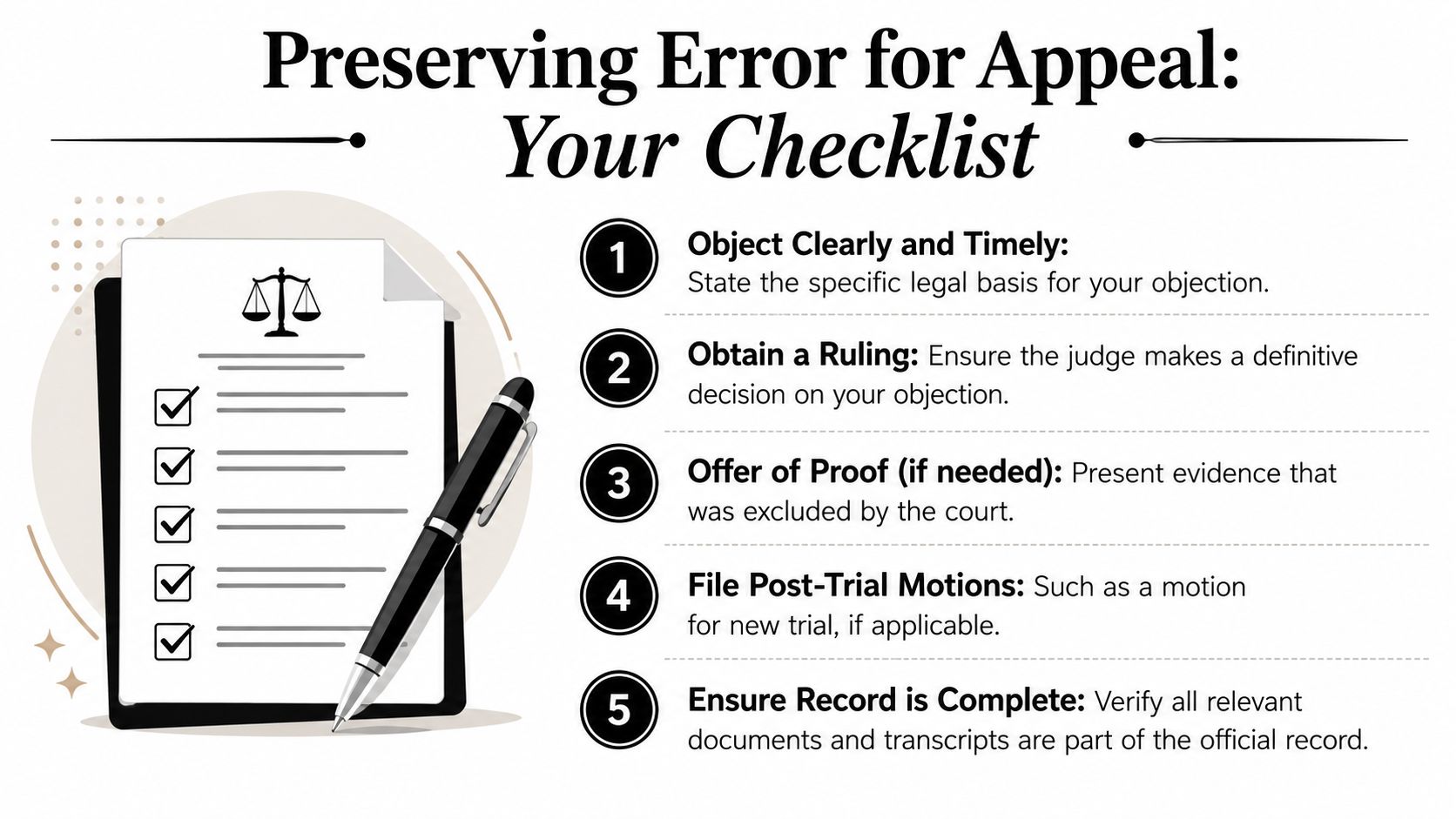
A good appellate issue can disappear if it wasn't preserved in the trial court. Preservation means the complaint was raised in a way that gave the trial judge a chance to address it and created a record the appellate court can review.
Many clients are surprised by this. They assume an obvious mistake can always be fixed on appeal. Often it can't, at least not directly, if no timely objection, request, or motion appears in the record.
The basic rule in practice
You generally can't stay silent in the trial court and then raise the issue for the first time on appeal. Preservation is what connects the trial mistake to appellate review.
That usually means doing several things correctly in real time.
What preservation often requires
- Object clearly and promptly: The objection has to be timely and specific enough to tell the court what the legal problem is.
- Get a ruling: If the judge never rules, there may be nothing for the appellate court to review.
- Make an offer of proof when evidence is excluded: If the judge keeps evidence out, the record should show what the evidence would have been.
- Check the written order carefully: Sometimes the oral ruling and signed order aren't the same.
- Build a complete appellate record: Missing transcripts, exhibits, or filings can cripple a valid complaint.
Post-trial motions matter more than many people realize
Texas appellate rules are strict on preservation. A motion for new trial is the sole means of preserving a factual-sufficiency challenge to a jury finding, and failing to file it waives that complaint. For certain post-judgment remedies, a bill of review may be available only in narrow circumstances, and it generally carries a four-year limitations period, as explained in this discussion of common failures in Texas family-law appeals.
That rule catches people off guard. They assume filing a notice of appeal will keep every issue alive. It won't.
Record-building matters: appellate courts review what was preserved and documented, not what everyone remembers happened.
A practical checklist for trial and post-judgment stages
If there's even a possibility of an appeal, counsel should think ahead on issues like these:
- Was the objection specific enough? “Objection” by itself usually doesn't preserve much.
- Did the court rule? Silence can be a problem.
- Was excluded evidence described on the record? If not, harm is harder to prove.
- Does the final order match the hearing and pleadings? Mismatches can create appellate issues.
- Were necessary post-trial motions filed? Some complaints depend on them.
For a closer look at the mechanics, this guide on preserving error for appeal in Texas family court is worth reviewing.
Preservation isn't about being combative. It's about making sure the legal issue exists in a form the appellate court can evaluate.
How an Appellate Attorney Evaluates Your Case for Appeal
The first job in an appeal isn't writing a brief. It's diagnosis.
An appellate attorney starts by identifying the final order, the dates that control deadlines, and the parts of the case that are reviewable. Then comes the hard part: reading the record with discipline instead of reading it for emotion.
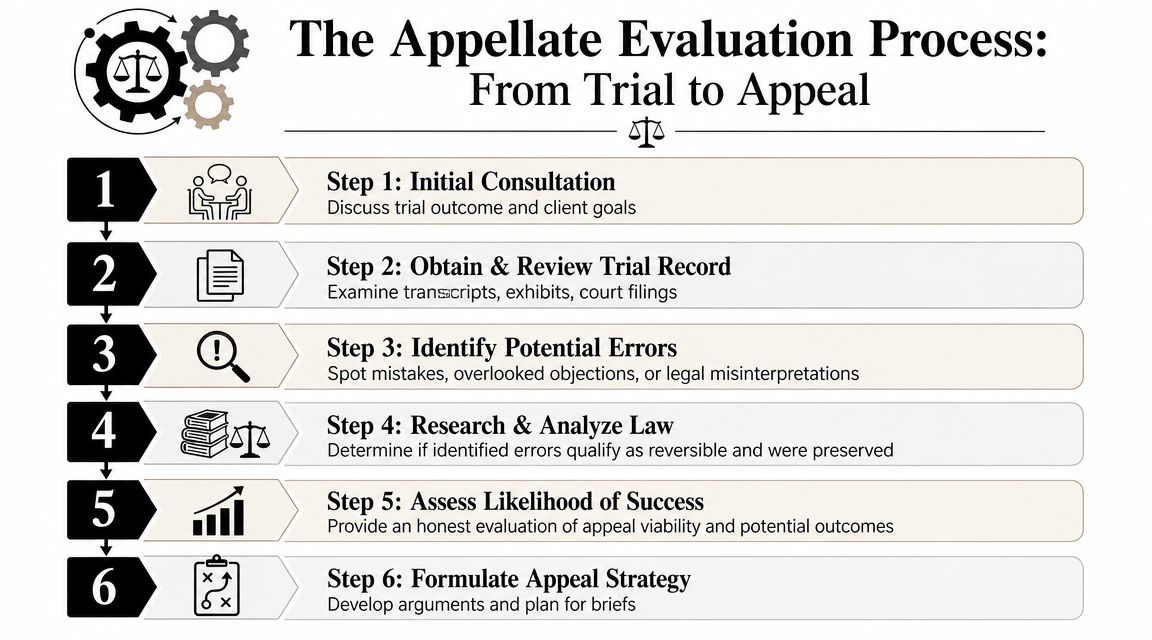
A helpful overview of the process is below.
What gets reviewed first
The attorney usually needs the clerk's record and the reporter's record.
The clerk's record includes pleadings, motions, orders, and filings. The reporter's record contains transcripts from hearings and trial. Together, they show what was requested, what happened, what objections were made, and what the court decided.
The key questions in a real evaluation
A serious appeal review often turns on a short list of questions:
| Question | Why it matters |
|---|---|
| What is the exact ruling being challenged? | Appeals target rulings, not general unfairness |
| Was the issue preserved? | Unpreserved complaints may be waived |
| What standard of review applies? | The standard shapes the strength of the issue |
| Can harm be shown from the record? | Even a real error may be harmless |
| What remedy is realistic? | The result may be a remand, modification, or affirmance |
What a candid appellate assessment sounds like
Sometimes the answer is yes, there is a strong issue worth briefing. Sometimes the answer is more limited. A case may contain error but lack preservation. Or the legal issue may exist, but the record may not show harm strongly enough.
A good appellate evaluation should be clear-eyed. It should identify what works, what doesn't, what deadlines control, and whether the likely benefit justifies the cost and effort of appeal.
The best appellate advice is often precise, not dramatic. It tells you where the legal opening is, and where it isn't.
If you're asking what qualifies as reversible error in Texas family court, that question can't be answered in the abstract for your case. It has to be answered by reviewing the signed order, the objections, the evidence, the transcripts, and the governing law together.
If you believe the court made a mistake in your family law case, the appellate attorneys at The Law Office of Bryan Fagan, PLLC can help you seek a fair outcome. We can evaluate the record, identify whether a preserved and harmful legal error exists, and explain your next steps with clarity. Contact The Law Office of Bryan Fagan today for a free consultation.