You may feel like the court never really heard your side. In many Texas family law cases, that feeling starts when the judge allows testimony, screenshots, emails, or accusations that should never have come in.
That frustration is valid. If the court relied on evidence that broke the rules, you may have more than a complaint. You may have an appellate issue.
An improper admission of evidence appeal texas case is not about re-trying your divorce or custody fight from the beginning. It’s about asking a higher court to review whether the trial judge followed the Texas Rules of Evidence and the Texas Rules of Appellate Procedure. If the judge didn’t, and that mistake likely affected the result, the ruling may be reversible.
Family cases are especially vulnerable to this kind of error. A judge may hear hearsay from a relative, review unauthenticated text messages, consider prior bad acts for the wrong reason, or accept digital exhibits in a virtual hearing without proper foundation. Those mistakes can shape decisions about conservatorship, possession, support, property division, protective orders, and enforcement.
Appeals exist because trial courts can get it wrong. The path is technical, but it is real. The record matters. The objections matter. The wording matters. And timing matters.
Feeling Your Family Court Ruling Was Unfair?
You log off a virtual custody hearing, read the ruling, and realize the judge relied on screenshots no one authenticated, a witness repeated secondhand claims, and your lawyer’s objection disappeared into a broken audio record. In a Texas family case, that kind of unfairness is not just upsetting. It can be the start of a real appellate issue.
Family court rulings hit hard because they shape your children, your property, your support obligations, and your daily life. The frustration gets worse when the problem is not merely that the judge believed the other side. The problem is that the court may have considered evidence the rules should have kept out.
That distinction matters.
An appeal focuses on a legal question tied to the record. Did the trial court admit evidence it should have excluded, and did that mistake probably affect the result? Texas appellate courts do not re-try your divorce, SAPCR, enforcement case, or protective order dispute. They review rulings, objections, exhibits, and transcripts.
Family law cases create recurring evidentiary problems because they often move fast, run hot, and rely heavily on digital proof. Text messages, emails, screenshots, social media posts, school records, and informal statements from relatives show up constantly. Virtual hearings add another layer of risk. Exhibits may be emailed at the last minute, witnesses may refer to documents no one properly offered, and technical glitches can make it harder to tell whether an objection was made, ruled on, or preserved.
That is why a vague reaction like “the hearing was unfair” is not enough. A strong appeal starts with precision.
Ask these questions right away:
- What exact testimony or exhibit should have been excluded?
- What rule made it improper?
- Did your lawyer object clearly and on time?
- Did the judge rule, or refuse to rule?
- Where does that exchange appear in the reporter’s record or clerk’s record?
- Did the improper evidence matter to conservatorship, possession, support, property division, or the protective order itself?
Good appellate strategy is disciplined. Identify the ruling. Tie it to a rule. Confirm the objection. Measure the harm.
That approach gives you something much more useful than anger. It gives you a legal path.
What Is Improperly Admitted Evidence
Improperly admitted evidence is evidence the court allowed even though the Texas Rules of Evidence should have kept it out. That doesn’t mean it was unfavorable. It means it was legally defective.
Think of trial evidence like entry into a secured building. Not everyone gets in just because they show up. The rules require a proper pass. If a witness offers hearsay, if a document isn’t authenticated, or if a party introduces character attacks for an improper purpose, the judge is supposed to stop it at the door.
Evidence you dislike versus evidence the law excludes
This distinction is where many appeals rise or fall.
If your former spouse testified to something you think is false, that alone doesn’t make the testimony inadmissible. Trial courts hear conflicting stories every day. Credibility disputes are part of trial.
But these are different:
- Hearsay. A witness repeats what someone else said to prove the truth of the statement.
- Unauthenticated digital evidence. Texts, emails, screenshots, or social media posts come in without proof they are genuine.
- Improper character evidence. A party uses prior acts to suggest “she’s a bad parent” or “he’s the kind of person who does this,” instead of proving a proper issue.
- Unqualified opinions. A witness gives expert-style conclusions without the training or legal foundation to do so.
The judge’s gatekeeping role
Trial judges are gatekeepers. They decide whether evidence meets the rules before relying on it. When they fail in that role, the mistake can become an appellate issue.
That matters in family court because evidentiary rulings often shape outcomes on:
| Family law issue | How bad evidence can affect it |
|---|---|
| Custody and visitation | Skew a judge’s view of safety, stability, or parenting ability |
| Property division | Distort valuation, tracing, or claims of waste or fraud |
| Protective orders | Influence credibility findings with unreliable accusations |
| Enforcement and contempt | Support sanctions with weak or unsupported proof |
Practical rule: An appeal doesn’t ask whether the trial was unpleasant. It asks whether the court broke the rules governing what evidence could be used.
If you’re thinking about an improper admission of evidence appeal texas case, focus on legality, not just fairness. Fairness matters, but in appellate court, fairness has to be tied to a rule.
You Must Preserve the Error to Appeal It
This is the point many people miss, and it’s the point that ends many appeals before they begin. If the error was not preserved in the trial court, the appellate court usually won’t review it.
A preserved error is one the trial record clearly captures. The objection had to be timely. It had to be specific. The judge had to rule, or refuse to rule in a way the record shows. Without that, the appellate court is often looking at a locked door.
What a timely and specific objection means
The objection must come at the earliest practical moment, and it must tell the judge what rule is being violated. “Objection” by itself usually isn’t enough. The trial court must know the legal basis.
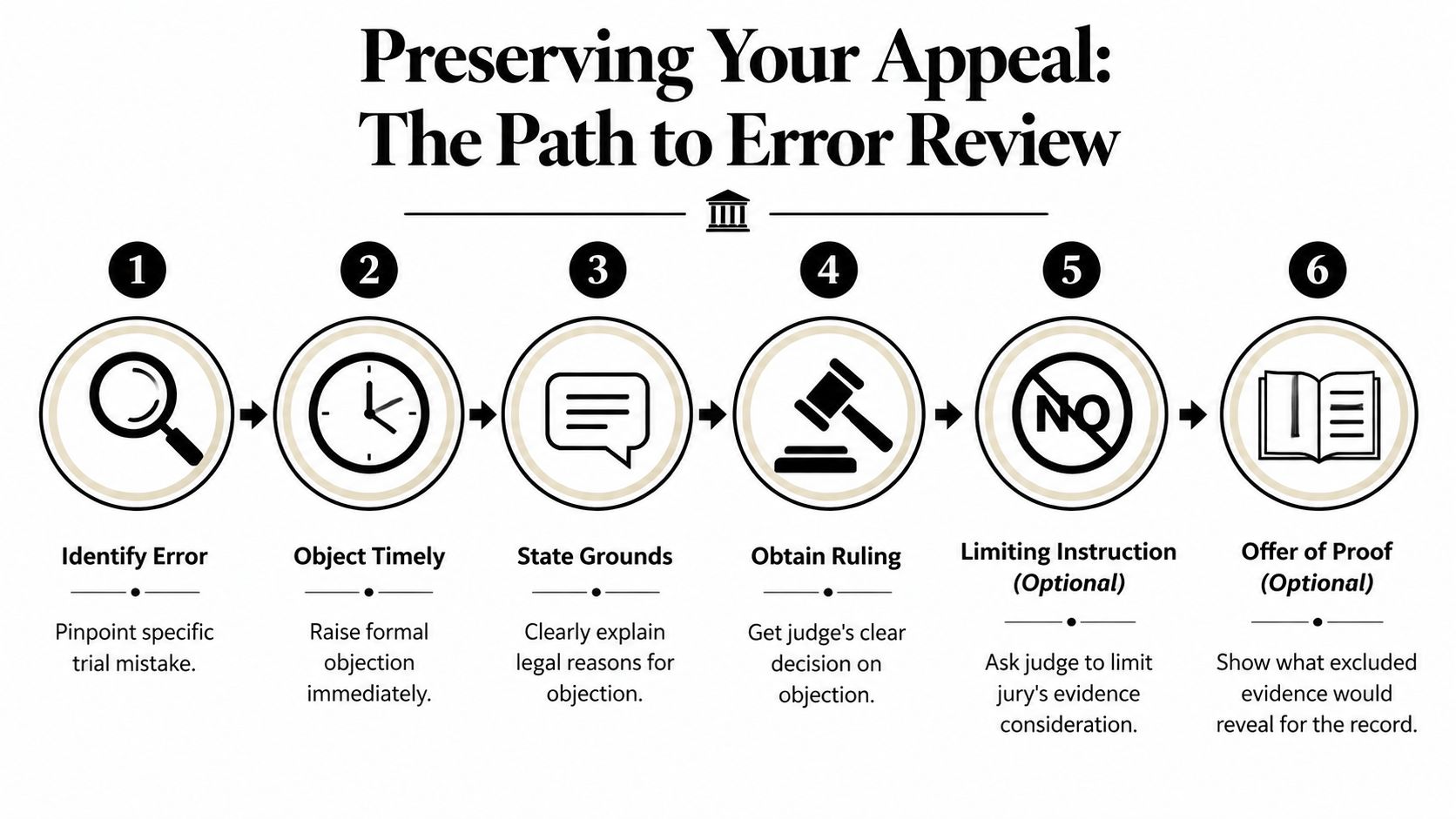
Here’s the practical sequence:
- Object immediately when the question is asked or the exhibit is offered.
- State the legal ground clearly, such as hearsay, lack of authentication, Rule 403 unfair prejudice, or improper character evidence.
- Get a ruling on the record.
- Ask for a limiting instruction if the evidence is admissible for one purpose but not another.
Texas Rule of Evidence 105(a) matters here. If evidence comes in for a limited purpose and no limiting instruction is requested, the complaint is often waived.
Offers of proof are not optional when evidence was excluded
Sometimes the problem is the opposite. The judge kept your evidence out. If you want to challenge that ruling on appeal, the appellate court must know what the excluded evidence would have shown.
That is why offers of proof matter. Texas appellate courts require them for improper exclusion complaints. Without an offer of proof, the reviewing court can’t assess the substance, relevance, or harm from the exclusion, as explained in the SMU Law Review discussion of offers of proof and evidentiary preservation.
Here’s a visual overview of the preservation path:
The same source also notes that sufficiency review considers all admitted evidence, even if it was improper, under Porier v. State. That makes preservation even more important. You need a direct challenge to the ruling itself.
What to look for in the record
If you’re reviewing your case with appellate counsel, these are the first places to examine:
- Reporter’s record for the exact objection, response, and ruling
- Exhibit list showing whether the contested item was admitted
- Bench conferences that may contain preserved objections
- Bills of exception or offers of proof for excluded evidence
A useful starting point is this guide on objections required to preserve appeal in Texas, especially if your concern is that trial counsel objected vaguely or too late.
If the transcript doesn’t show the objection and ruling, the appellate court usually treats the issue as if it never happened.
That sounds harsh, but it’s how appellate procedure works. Appeals run on records, not memories.
How Appellate Courts Review Evidentiary Rulings
Most evidentiary rulings in Texas family appeals are reviewed for abuse of discretion. In plain English, that means the appellate court does not ask, “Would we have ruled differently?” It asks, “Was the trial judge’s ruling outside the range of reasonable choices?”

That standard is deferential, but it is not meaningless. A referee in a sports game gets discretion on close calls. A referee does not get discretion to ignore the rulebook. Trial judges work the same way.
What abuse of discretion really means
A ruling can be an abuse of discretion when the judge:
- applies the wrong legal rule
- admits evidence with no proper foundation
- excludes evidence for the wrong reason
- fails to perform required balancing under rules like Rule 403
- lets limited-purpose evidence be used broadly after a proper request to restrict it
In family law, this often comes up with digital exhibits, child-related allegations, mental health records, prior incidents, and opinion testimony disguised as fact testimony.
If your case included technical medical or injury proof, understanding how specialized testimony should be framed can help you spot foundation problems. A useful example is this discussion of a forensic pathology expert witness, which shows why expertise, method, and fit matter when a witness offers conclusions that can sway a court.
Trial courts can be reversed
Appellate review is not symbolic. In the Texas Supreme Court’s 2024 to 2025 term, the Court reversed 72.3% of the cases it reviewed and affirmed 27.7%, according to this Texas Supreme Court reversal-rate discussion. That doesn’t mean every family appeal will win. It does mean trial court rulings are not untouchable when legal error is properly presented.
A short way to think about standard of review is this:
| Trial issue | What appellate judges ask |
|---|---|
| Fact dispute | Did the judge or factfinder hear competing evidence? |
| Evidentiary ruling | Did the judge stay within the rules and reasonable discretion? |
| Preserved legal complaint | Did the ruling violate a rule in a way the record shows? |
For a deeper explanation tied to family cases, review abuse of discretion in Texas family law appeals.
Appellate courts do not retry your case. They review whether the trial court used lawful reasoning on the record it created.
That distinction matters. It keeps your appeal focused on rulings that can be reversed.
Winning the Appeal The Harmful Error Analysis
Proving the judge made a mistake is only half the job. You must also show the mistake mattered.

Under Texas Rule of Appellate Procedure 44.1(a)(2), improper admission of evidence is reversible only if it probably resulted in an improper judgment. That is the heart of the harm analysis.
The question is cause and effect
The appellate court wants a clean chain of reasoning:
- the court admitted evidence it should have excluded
- that evidence became important in the trial
- the improper evidence likely influenced the outcome
That is harder than many people expect. According to this discussion of harm analysis in Texas evidentiary appeals, 68% of evidentiary reversal claims in family cases fail because the appellant does not show harm well enough.
How appellate lawyers build the harm argument
A persuasive harm analysis does not just repeat “the judge heard bad evidence.” It ties the error to the judgment using the record.
Strong briefs often examine:
- How often the evidence appeared in testimony, argument, or exhibits
- Whether the evidence targeted a core issue like parental fitness, credibility, valuation, or safety
- Whether the other side emphasized it in closing or in key witness examinations
- Whether similar evidence came in elsewhere without objection, which can weaken the complaint
- Whether the final order reflects the same theory the improper evidence supported
For example, if unauthenticated messages were admitted in a custody case and those messages were used to paint a parent as unstable, the brief should connect the messages directly to findings about conservatorship, possession, or restrictions.
Harm is often won in the details
Briefing becomes decisive. Briefing means the written legal argument filed in the appellate court. In many appeals, the brief does most of the work.
A solid harm section usually includes a record-based narrative, not just a string of legal citations. It tells the court where the ruling occurred, where the evidence was used, and why the judgment likely turned on it.
Case focus: The best harm arguments show how one ruling changed the trial’s center of gravity.
If you want to understand how Texas courts treat this issue in family cases, this article on reversible error in Texas family court is a helpful companion.
The practical takeaway is simple. Don’t assume an obvious mistake automatically wins an appeal. It doesn’t. The appellate court must be shown why the mistake changed the result in a meaningful way.
Examples of Improper Evidence in Family Law Appeals
These problems show up in ordinary family courtrooms, not just unusual cases. The facts change, but the pattern is familiar. Someone offers shaky proof, the court lets it in, and the ruling starts leaning on material that should have been excluded or limited.
Hearsay in custody and protective order cases
A grandmother testifies, “My neighbor told me your ex leaves the child alone at night.” That statement may sound alarming, but if it is offered to prove the child was left alone, it raises a hearsay problem.
The same issue appears in protective order hearings. One witness repeats what another person supposedly heard from a third party. By the time the statement reaches the judge, nobody with firsthand knowledge is on the stand.
Screenshots and messages with no real authentication
This is common in divorce and enforcement litigation. One side prints text messages, social media posts, or emails and insists they came from the other party.
Sometimes they did. Sometimes they didn’t. The point is that the court needs a proper foundation before relying on them. If the exhibit is not authenticated, it may be inadmissible.
Prior bad acts used for the wrong reason
A parent may be accused of conduct from years earlier, and the other side may try to use it to suggest bad character rather than a proper issue in the current case. Texas Rule of Evidence 105(a) matters here.
If evidence is admissible for a limited purpose, the court must restrict it and instruct accordingly when asked. If no request is made, the complaint is usually waived. In these limited-purpose situations, reversal occurs in only 22% of such cases, according to the Texas Rules of Evidence discussion cited here. That’s a procedural trap for unprepared lawyers and self-represented parties.
Opinion testimony dressed up as expertise
A witness says a child is being “coached,” a spouse is “hiding money,” or a parent has a mental health condition, but the witness lacks the qualifications to offer that opinion. Family courts hear a lot of strong conclusions. Not all of them are admissible.
A short checklist can help you identify whether something similar happened in your case:
- Did someone repeat another person’s statement to prove it was true?
- Did the judge accept texts, photos, or screenshots without clear proof of origin?
- Did the other side use old allegations to argue you’re a bad person?
- Did a witness offer specialized conclusions without showing proper qualifications?
Some of the most damaging evidence in family court looks persuasive on first hearing and falls apart when tested under the actual rules.
If any of that sounds familiar, the appeal may turn on how the objection was made, how the record reads, and how the evidence influenced the ruling.
Special Challenges in Modern Family Law Trials
Virtual hearings changed how evidence gets offered, objected to, and preserved. They also created new ways to lose an appellate issue.
In a physical courtroom, everyone can usually see when an exhibit is handed up, when counsel stands to object, and when the judge rules. In a virtual setting, that sequence can break down fast. Screen-shared documents appear before anyone lays a foundation. Audio lags over an objection. A party thinks the judge heard the complaint, but the transcript reads like silence.
Digital evidence creates digital mistakes
Texas family hearings increasingly involve screenshots, call logs, PDFs, exported chat threads, and phone images. According to this TexasLawHelp discussion of virtual evidence rules, virtual family hearings surged 300% in Texas from 2024 to 2025, and that shift has amplified authentication failures under Rules 901 and 1004. The same source notes that appellate courts reverse for evidentiary errors affecting substantial rights in fewer than 5% of family appeals, which shows how unforgiving this area can be when error is not cleanly preserved.
That means two things are true at once. First, virtual hearings create more opportunities for bad evidence to slip in. Second, they do not make appellate courts more forgiving.
The earliest opportunity rule still applies
An objection must still be made at the earliest opportunity, even on Zoom or another remote platform. If a lawyer waits because the screen froze, the exhibit flashed by too quickly, or the judge moved on, the issue may be waived.
Consequently, modern family law trials require extra discipline. Counsel has to track:
- When the exhibit was displayed
- Whether a foundation was laid before publication
- Whether the court reporter captured the objection
- Whether the judge ruled clearly enough for appellate review
Practical steps after a virtual hearing
If your case involved remote testimony or electronic exhibits, ask for a targeted record review. Focus on what was preserved, not what everyone remembers happening.
A useful post-hearing review should include:
| Record item | Why it matters |
|---|---|
| Transcript wording | Shows whether the objection was timely and specific |
| Exhibit handling | Reveals if the document was marked, offered, and admitted properly |
| Audio gaps or interruptions | May explain whether the ruling is clear in the record |
| Judicial comments | Can show how the court treated the contested evidence |
One option for that review is an appellate-focused evaluation through The Law Office of Bryan Fagan, PLLC, which examines records in Texas family law appeals involving custody, property division, support, protective orders, and enforcement judgments. The point is not to relive the hearing. The point is to test whether the digital format created a real appellate issue.
In virtual hearings, the rules did not loosen. The margin for procedural error got thinner.
That is why modern evidentiary appeals are so record-driven. A missed objection in a virtual setting is still a missed objection.
Your Path Forward with The Law Office of Bryan Fagan
The hearing ends. The judge rules against you. A document should never have come in, a screenshot was waved through in a remote setting without a proper foundation, or hearsay shaped a custody or property decision. At that point, the right question is simple. Is there a real appellate issue in the record?
That question matters in family law because bad evidentiary rulings often hide inside larger decisions about conservatorship, possession, support, property division, protective orders, and enforcement. In virtual hearings, the problem gets worse. Lawyers and judges may move quickly through electronic exhibits, unclear objections, and off-screen witness handling. If the record is thin, a strong complaint can die on appeal. If the record is solid, a weak trial ruling can be attacked effectively.
An appeal is a record-based challenge to a legal error. The court of appeals will study the clerk's record, the reporter's record, the admitted exhibits, and the briefing. It will not retry your case.
That makes strategy the whole point.
Focus on four questions:
- What specific evidence came in, or was excluded, and where is that shown in the record?
- Did your trial lawyer make a timely, specific objection and get a ruling?
- What review standard will control the issue?
- Can you show that the ruling probably affected the judgment?
Written advocacy is critical because the brief often decides whether the appellate court sees the error as harmful or harmless. In family law appeals, that means tying the bad ruling to the outcome with precision. If an improper exhibit influenced a custody restriction, support finding, or disproportionate property division, the brief needs to show that connection clearly, with record cites.
A useful appellate consultation should also translate the legal terms into practical decisions. Abuse of discretion asks whether the trial court stepped outside the range of reasonable rulings. Reversible error asks whether the mistake justifies changing the judgment. Briefing is the written argument that explains both.
If you believe the court relied on evidence it should not have considered in your divorce, SAPCR, modification, enforcement, contempt, or protective-order case, get the record reviewed quickly. Deadlines are short. Family law appeals are unforgiving, and virtual hearing problems often surface only after someone studies the transcript, exhibits, and rulings line by line.
The Law Office of Bryan Fagan, PLLC handles Texas family law appeals and appellate record review. If you want a clear assessment of whether an evidentiary ruling gives you a real path to relief, contact the firm for a consultation.