If you are reading this article, a Texas family court order has likely left you feeling that the outcome of your case was unfair. You may feel the judge misunderstood the facts, misapplied the law, or simply got it wrong. While the instinct is to ask for a "do-over," the path to a different result is through a formal appeal, and a successful appeal depends almost entirely on the groundwork laid during your original trial.
This crucial groundwork is called preserving error. It is the formal, in-the-moment process of flagging a potential legal mistake for the trial judge, which creates the official record an appellate court will later review. Without it, even the most obvious mistake may not be correctable.
Why Preserving Error Is the Foundation of Your Appeal
An appeal is not a second trial. The appellate court will not hear from witnesses, review new evidence, or reconsider who was more believable. Its only function is to examine the official trial court record for significant legal mistakes—called reversible errors—that changed the final outcome.
If a mistake was not properly documented in that record, for the purposes of an appeal, it legally never happened.

The Trial Record Is Everything
Think of the trial record as the official replay of your case. For the appellate court, if it wasn't recorded, it didn't happen. This record consists of two essential components:
- The Clerk's Record: This includes every document filed with the court, such as the initial petition, motions, and final orders.
- The Reporter's Record: This is the word-for-word transcript of everything said during hearings and the trial, captured by the court reporter.
If your attorney failed to make a timely objection or file a necessary motion, the judge's error will not appear in the record. As a result, the appellate court will have no grounds to review it.
What Is a Reversible Error?
Not every mistake warrants a reversal. An appellate court is looking for a reversible error—a legal mistake so critical that it probably led the judge to issue an improper judgment.
Common examples include the judge misapplying the Texas Family Code during property division or basing a custody decision on inadmissible hearsay. These are the types of substantive errors an appellate court is empowered to correct. You can find more examples of what constitutes solid grounds for a civil appeal in Texas in our detailed guide.
In Texas family law, the most common standard of review is "abuse of discretion." This means you must prove the trial judge acted unreasonably, arbitrarily, or without considering the guiding legal rules. It’s a high standard to meet, and it’s impossible without a perfectly preserved record showing exactly how and when the judge erred.
A successful appeal is not a matter of luck; it is built on a foundation of meticulously documented errors at the trial level.
Winning Your Appeal Begins in the Trial Court
Preparing for a potential appeal starts long before the final judgment is signed. The groundwork for a successful appeal is laid brick-by-brick during your trial. What happens—or, more importantly, what doesn't happen—in the courtroom can determine your chances later.
You cannot simply tell the appellate court that the judge made a mistake. You must prove it using the official record. This requires methodically following the rules to ensure the judge's missteps are documented.
Making Objections: Your First Line of Defense
The most critical tool for preserving error is the objection. This is the "Objection, Your Honor!" moment, but it must be executed correctly. According to the Texas Rules of Appellate Procedure, an objection must be both timely and specific.
Timely means you must speak up immediately—as soon as an improper question is asked or improper evidence is offered, but before a witness can answer. Waiting too long waives the objection.
Specific means you must state the legal reason. Simply yelling "I object!" is not enough. You must inform the judge which rule is being violated.
Consider this common scenario in a Texas child custody case:
- Opposing Counsel: "What did your neighbor say about the other parent's new partner?"
- Your Attorney: "Objection, Your Honor. The question calls for hearsay."
This quick, specific objection flags the legal issue (hearsay) and requires the judge to make a ruling. If the judge says, “Overruled,” and allows the testimony, that potential error is now preserved for the appellate court to review. If your attorney says nothing, the inadmissible testimony becomes part of the record, and you lose the right to complain about it on appeal.
The Offer of Proof: Preserving Excluded Evidence
What happens if the judge makes a mistake and prevents you from presenting crucial evidence? This is where an offer of proof becomes essential. It’s a vital, but often overlooked, procedure for preserving error.
Imagine your expert witness is about to testify about how the other parent's conduct is impacting your child. The judge, for a legally incorrect reason, refuses to allow the testimony. If your attorney simply moves on, the appellate court will have no idea what that expert would have said or why it was important.
To preserve this error, your attorney must make an offer of proof. This is done outside the jury's hearing and places the excluded testimony into the record for the appellate court to see. It can be done in two ways:
- Question-and-Answer Format: Your attorney asks the witness the planned questions, and the answers are recorded by the court reporter.
- Attorney Summary: Your attorney summarizes for the record what the witness's testimony would have been.
An offer of proof creates a record of what should have been heard. It is the only way for an appellate court to understand the substance of the excluded evidence and decide if the judge's error was harmful enough to justify reversing the decision.
Don't Leave Without a Ruling
Making an objection or an offer of proof is only half the battle. The final step is to secure a clear ruling from the judge on the record.
The judge must state "sustained" (agreeing with the objection) or "overruled" (disagreeing). A vague comment like, "Let's move along," is insufficient.
If the judge does not rule, your attorney must politely insist on one. A simple, "Your Honor, for the record, I need a ruling on my objection," is all it takes. This ensures the court reporter captures the complete sequence: the objection, the legal basis, and the judge’s final decision. Without all three elements, there is nothing for an appellate court to review.
Laying the Groundwork with Post-Trial Motions
When the judge signs the final order, you might feel the case is over. However, if you are contemplating an appeal, your work is not done. In Texas family law, the period immediately following a judgment is your last opportunity to secure your right to challenge a flawed decision.
This is where post-trial motions come in. These are not mere procedural formalities; they are strategic tools designed to clarify the court’s reasoning and extend critical deadlines. The deadlines for these motions are strict and unforgiving. Miss one, and the door to the court of appeals could close permanently.
The process of preserving error begins during the trial, as this timeline illustrates. Each objection and offer of proof is a building block for what follows.
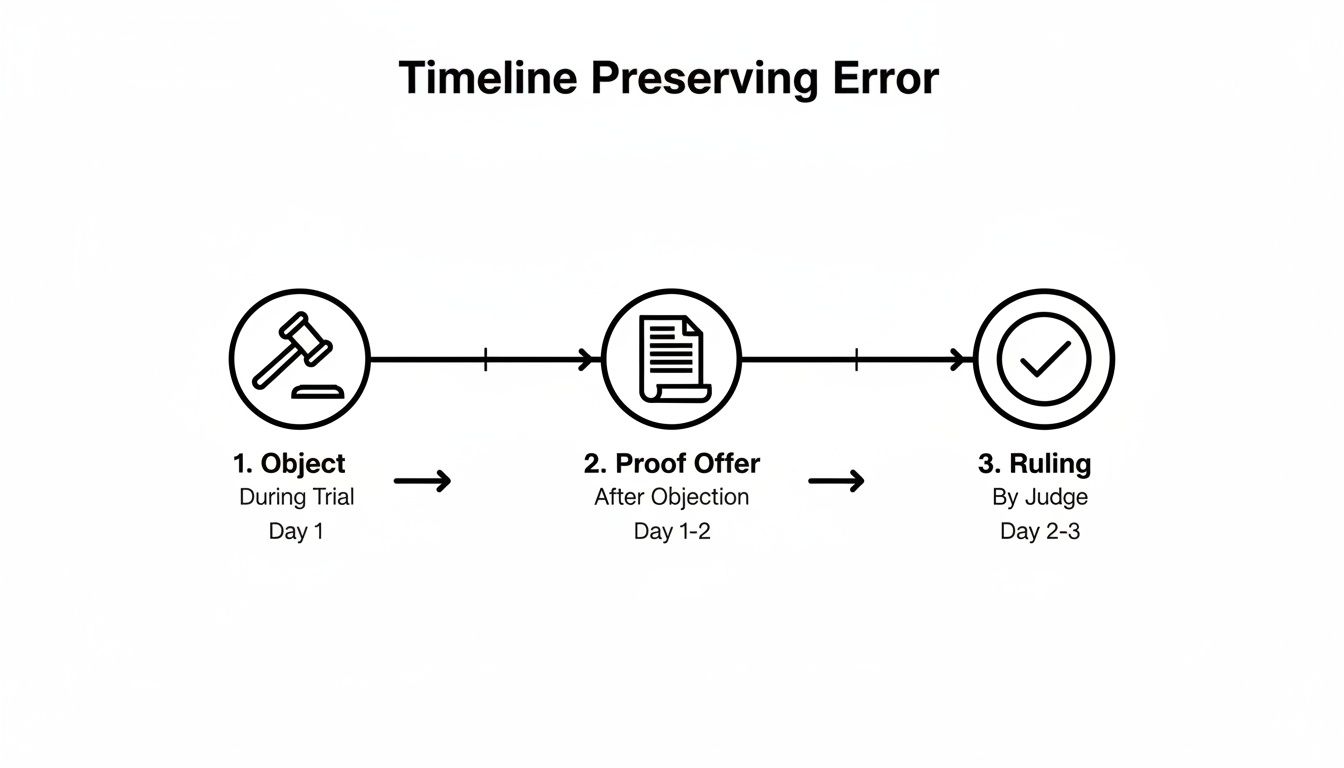
This in-court sequence is what officially logs an error in the record, giving you the foundation needed to launch a powerful post-trial motion.
The Motion for New Trial: More Than a Do-Over
One of the most powerful post-trial tools is the Motion for New Trial. While you are technically asking for a new trial, its true value in the appellate process is often more strategic.
First, it gives the trial judge a formal opportunity to reconsider and correct a major error without involving a higher court. While this is not common, it can save significant time and expense.
Second, and more critically, filing a timely Motion for New Trial extends your deadline to file a Notice of Appeal from 30 days to 90 days from the date the judgment was signed. That additional time is invaluable for an appellate team to analyze the record and build a strong case. We provide a more in-depth look at this strategy in our guide to the motion for new trial in Texas family law.
Findings of Fact: Making the Judge Show Their Work
Perhaps the most critical post-trial filing for a family law appeal is the Request for Findings of Fact and Conclusions of Law. This is a formal demand that the judge put their reasoning in writing. Why did they divide the property that way? What specific facts led them to that custody decision?
Without these findings, appellate courts presume the trial judge had sufficient evidence to support their ruling, which is a difficult presumption to overcome. However, once you have written findings, they become a roadmap that can lead directly to reversible error.
The judge's written findings might reveal they based a custody order on a factor the Texas Family Code prohibits. Or perhaps they misclassified a significant piece of separate property as community property. This is how you expose a clear "abuse of discretion"—transforming a general feeling of unfairness into a concrete legal mistake the appellate court can address.
The deadlines for requesting findings are non-negotiable.
- Step 1: You have 20 days from the date the judgment is signed to file your initial request.
- Step 2: If the judge does not issue the findings, you must then file a "Notice of Past Due Findings" within 30 days of your original request.
Missing either step of this two-part process waives your right to the findings and makes your appeal significantly more challenging.
To help keep it all straight, here is a quick overview of the essential post-trial motions and their unforgiving timelines.
Essential Post-Trial Motions and Deadlines
This table summarizes the critical post-trial motions in Texas family law appeals, their purpose, and the strict deadlines you must meet.
| Motion/Request | Purpose | Initial Deadline (After Judgment Signed) | Impact on Appeal Deadline |
|---|---|---|---|
| Motion for New Trial | Gives the trial court a chance to correct errors and extends the appeal deadline. | 30 days | Extends Notice of Appeal deadline to 90 days. |
| Request for Findings of Fact & Conclusions of Law | Requires the judge to state the factual and legal basis for the decision. | 20 days | Does not extend the appeal deadline on its own. |
| Notice of Past Due Findings | A required follow-up if the judge fails to provide the findings after the initial request. | 30 days after the initial request was filed. | Preserves the right to complain about the lack of findings. |
These are not mere suggestions; they are the bedrock of a well-planned appeal. Mastering these post-trial steps is how you build a clear and compelling case for the higher court.
Spotting Reversible Errors in Texas Family Law Cases
When you receive a final order that feels fundamentally wrong, it is important to understand that simply disagreeing with the outcome is not enough to win on appeal. What you need is a reversible error—a specific, significant mistake that likely caused the judge to issue an improper judgment.
This isn't about finding a minor typo or a ruling you dislike. It involves identifying clear legal missteps that violate the Texas Family Code or established court procedures. The appellate court’s job isn’t to re-try your case; its purpose is to correct serious errors that tainted the final result.
Misapplication of the Law in Property Division
A significant source of appeals in Texas divorces stems from errors in property division. Texas law draws a clear distinction between separate property (what you owned before marriage or received as a gift or inheritance) and community property (everything acquired during the marriage).
A classic reversible error occurs when a judge mischaracterizes a major asset. For example, if you started a business years before you met your spouse and the court treats that business as community property, splitting its value, that is a direct misapplication of the law. To challenge this on appeal, your attorney needed to object at trial and request Findings of Fact to show precisely how the judge arrived at that flawed conclusion. You can explore the rules of Texas property division here.
Errors in Child Custody Decisions
In matters of child custody, every decision must be guided by the "best interest of the child" standard. This is a legal test that includes a specific list of considerations known as the Holley factors.
The most common basis for a family law appeal is an abuse of discretion. This occurs when a judge:
- Makes a decision without sufficient evidence in the record to support it.
- Bases a ruling on a legally forbidden factor, such as a parent's gender or religion.
- Ignores critical evidence, such as a documented history of family violence.
For example, if a judge severely limits your possession of your child based solely on unproven allegations from your ex-spouse, that could be an abuse of discretion. Rulings must be based on facts and evidence, not on unsubstantiated claims.
What Does "Abuse of Discretion" Actually Mean?
This legal term does not imply that the judge acted with ill intent. It is a legal standard meaning the judge’s decision was unreasonable, arbitrary, or made without reference to guiding legal principles.
In plain English, you must convince the appellate court that the trial judge's decision was not just different from what you wanted, but that it fell outside the zone of any reasonable disagreement. It was a choice that no reasonable judge should have made given the facts and law presented.
The statistics for family law appeals can be sobering. More appeals fail than succeed, often because a harmful, reversible error was not properly preserved. If your attorney did not object at the right moment, that mistake could be locked in forever. You can get a sense of how often appeals succeed and why they fail here.
Mistakes in Procedure and Evidence
Sometimes, the most significant error is not in the final order itself, but in how the judge reached it. The legal process matters just as much as the outcome, and procedural errors can be powerful grounds for an appeal.
Common examples include:
- Improperly Admitting or Excluding Evidence: The judge might allow damaging hearsay testimony over your lawyer's objection or refuse to let your expert witness testify despite a proper offer of proof.
- Failing to Follow a Required Step: In Texas, if a child is 12 or older and expresses a desire to speak to the judge, the judge must interview them. Refusing to do so is a clear procedural error.
- Denying a Party Their Day in Court: A judge cannot prevent you from presenting your case without a legally sound reason.
Any one of these issues, if properly documented in the trial record, could convince an appellate court that you did not receive a fair trial. The most common remedy is for the higher court to reverse the judgment and send your case back for a new, fair hearing.
If you believe the court made a mistake in your family law case, our appellate attorneys can help you seek a fair outcome. Contact The Law Office of Bryan Fagan today for a free consultation.
Assembling the Appellate Record and Preparing Your Argument
Once your Notice of Appeal is filed, the focus shifts from the trial courtroom to a new phase centered on legal writing and record preparation. The hard work you did to preserve errors during the trial now becomes the raw material for building your case for the appellate court. This is where the official story of the trial is compiled and your legal argument takes shape.
First, you must assemble the official appellate record. This is the complete, sealed history of your case that the court of appeals will review. Since the appellate judges were not present at your trial, this record is their only window into what happened. It is comprised of two distinct and equally critical parts.

Building Your Case File for the Higher Court
Assembling the record is not an automatic process; you must formally request both components.
The Clerk’s Record: This is the case's paper trail. It is a bound volume containing every document filed with the court clerk, from the initial petition to the final order being appealed. It also includes key post-trial motions, such as a Request for Findings of Fact.
The Reporter’s Record: This is the official, word-for-word transcript of everything said in court. The court reporter prepares this document, which captures witness testimony, attorney objections, and the judge’s rulings.
It is your responsibility to request these records and ensure they are complete. If a key hearing transcript or a critical exhibit is omitted, the appellate court cannot consider it. For the judges, if it isn't in the record, it didn't happen.
Crafting a Winning Argument Through Briefing
With the record assembled, the work of persuasion begins through briefing. Your appellate lawyer will draft a formal, structured legal argument called a brief. This is not an opportunity to re-litigate the case or introduce new evidence. Its purpose is highly focused and strictly governed by the Texas Rules of Appellate Procedure.
The goal of a brief is to connect the dots for the appellate judges. It must pinpoint a specific, preserved error in the record and then use legal precedent and statutes to persuade the court that this error was harmful and led to an improper judgment.
The appeal proceeds as a series of written arguments, giving each side a formal opportunity to state their case.
The Back-and-Forth of Appellate Briefs
The process begins with the Appellant's Brief, which is your opening argument. Here, your attorney lays out the facts, identifies the specific reversible errors made by the trial judge, and provides the legal authority to support your claims. A well-crafted brief tells a compelling story of how the law was misapplied, guiding the judges directly to the moments in the record where the trial went off course. For more on this, you can learn how to structure a compelling statement of facts for your appeal.
Next, the other party (the "Appellee") files the Appellee's Brief in response. Their goal is to convince the court that the trial judge's decision was correct and that any identified errors were either not errors at all or were harmless. They will present their own legal analysis to counter your arguments.
Finally, you typically have one last opportunity to respond with a Reply Brief. This is not a time to introduce new arguments but a strategic tool to correct misstatements in the Appellee's Brief and rebut their arguments directly. A sharp, focused reply can be incredibly effective.
This written exchange is the heart of the appeal. A successful outcome almost always hinges on a powerful, persuasive, and technically sound presentation of the errors you carefully preserved at trial.
Common Questions About Texas Family Law Appeals
After a difficult family court battle, it is normal to have many questions. The appeals process can seem complex, and understanding what to expect is an important first step. Here are some of the most common questions we hear from clients about Texas family law appeals.
What Happens If My Trial Lawyer Failed to Object?
This is a challenging situation. In Texas, the rule is straightforward: if your lawyer did not object at the moment an error occurred in the courtroom, that error is considered waived. You cannot raise it for the first time on appeal.
The purpose of this rule is to give the trial judge an opportunity to correct the mistake immediately. While a very narrow exception for "fundamental error" exists, it is rarely applied in family law cases.
An appellate lawyer must carefully review the entire trial record to determine if any errors were properly preserved or if another path forward exists. This is why it is so important to have a trial attorney who understands how to protect your rights for a potential appeal from the very beginning.
Can I Introduce New Evidence in My Appeal?
No. This is one of the most significant misconceptions about the appellate process. An appeal is not a second trial where you can introduce new emails, text messages, or witnesses.
The court of appeals is limited to reviewing only what is contained in the official trial court record—the documents, exhibits, and the court reporter's transcript.
The court's sole function is to decide if the trial judge made a legal mistake based on the evidence and arguments presented at that time. This is why building a complete record during the trial is essential. Procedures like making an "offer of proof" are critical, as they are the only way to show the appellate court what evidence the trial judge wrongly excluded.
How Long Does a Texas Family Law Appeal Take?
Patience is required. While every case is unique, a typical Texas family law appeal takes anywhere from 9 months to two years to complete, from the filing of the Notice of Appeal to the final decision from the appellate court.
Several factors can influence this timeline, including the complexity of the case and the caseload of the particular court of appeals. The process includes several key stages:
- Record Preparation: It typically takes 1-3 months for the court clerk and court reporter to prepare and file the official record.
- Briefing: The attorneys then have several months (usually 3-5) to research and write their arguments, including the Appellant's Brief, the Appellee's Brief, and a possible Reply Brief.
- Court Review: Once all briefs are filed, a panel of judges reviews the case. It can take several more months for them to discuss the issues and write their formal opinion.
What Is the "Abuse of Discretion" Standard of Review?
This is the standard applied in most family law appeals, and it is a primary reason why winning an appeal is challenging. Under the "abuse of discretion" standard, the appellate court gives significant deference to the trial judge’s decisions. You cannot win simply by arguing that the appellate judges would have ruled differently.
To prove an abuse of discretion, you must show that the trial judge acted unreasonably, arbitrarily, or without reference to any guiding legal rules. This could be a decision with no supporting evidence in the record or one that ignores a mandatory provision of the Texas Family Code. It means the ruling was so far off base that it fell outside the "zone of reasonable disagreement." It is a high bar, but it is not insurmountable with a well-preserved record.
If you believe the court made a mistake in your family law case, our appellate attorneys can help you seek a fair outcome. Contact The Law Office of Bryan Fagan today for a free consultation.