You may feel your case was handled unfairly. A judge made a decision about your children, your home, your support obligations, or your safety, and now you're living with the consequences.
That feeling matters, but an appeal doesn't turn on frustration alone. It turns on whether the trial court made a legal mistake that the appellate court can correct under the Texas Rules of Appellate Procedure and the Texas Family Code. In family law, that usually means identifying a reversible error, building the appellate record, meeting strict deadlines, and writing a brief that shows the court exactly how the law applies to your issue.
Many clients approach an appeal believing the appellate court will read the transcript and decide what seems fair. That's not how it works. Appeals are structured reviews, not new trials. And one concept often controls the whole outcome: the standard of review appellate brief.
Your Trial is Over but the Fight for Fairness Is Not
A client may leave a divorce or custody hearing feeling stunned. The judge may have limited parenting time, signed a property division that feels one-sided, entered a protective order, or ruled on support in a way that changed daily life overnight.
That doesn't automatically mean the result can be appealed. It does mean the case deserves a careful appellate review.
Appeals are different from trials
At trial, the judge hears live testimony, weighs credibility, and decides facts. On appeal, the court doesn't hear witnesses again. It reviews what already happened in the trial court through the appellate record, which usually includes the clerk's record, the reporter's record, filed motions, admitted exhibits, and the final order.
Under the Texas Rules of Appellate Procedure, appeals also move on a strict timeline. The notice of appeal must be filed on time. The record must be requested and prepared. The briefing schedule matters. Missing a deadline can damage or end a valid appeal before the court ever reaches the merits.
An appeal asks a narrower question than trial. Not "Who should win?" but "Did the trial court make a legal error the appellate court can correct?"
Common family law issues that may be appealable
Texas family law appeals often involve issues such as:
- Child custody and visitation rulings: conservatorship, possession schedules, and restrictions on parental rights
- Property division disputes: whether the court divided the community estate in a way the law permits
- Child support and spousal maintenance issues: including legal errors in applying the governing standards
- Protective orders and enforcement rulings: especially where procedure, evidence, or legal authority is disputed
If you're exploring an appeal, it helps to understand the difference between an unfair outcome and an appealable error. A bad result alone isn't enough. The appellate court looks for legal mistakes, procedural mistakes, or rulings that fall outside the trial court's lawful discretion.
Reversible error in plain English
A reversible error is a mistake that likely mattered to the outcome. For example, if a court applied the wrong legal rule, excluded important evidence under an incorrect standard, or based a ruling on legally insufficient proof, that may support appellate relief.
A strong appeal also depends on preservation of error. In plain English, that means the issue usually had to be raised in the trial court first. If no objection, request, or motion preserved the problem, the appellate court may decide it can't review the complaint.
That's why appeals require strategy from the start. The record, the issue preserved below, and the standard of review all work together.
What Is the Standard of Review and Why It Decides Appeals
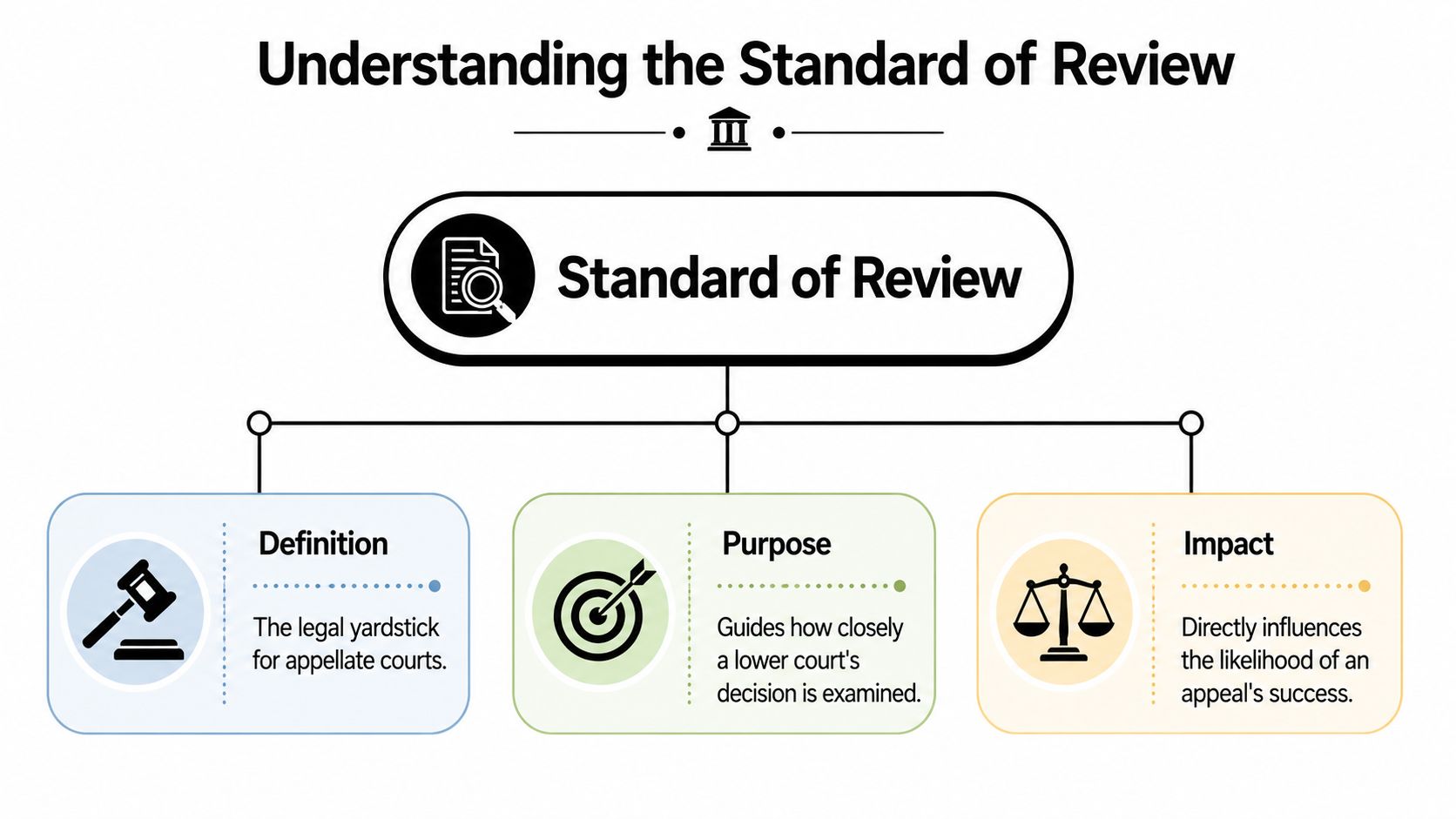
The standard of review is the appellate court's rulebook for judging the trial court's decision. It tells the court how much deference to give the trial judge on each issue.
Consider instant replay in sports. Sometimes replay officials look only for a clear mistake and leave the original call alone unless it was plainly outside the rules. Other times they review the issue fresh, without giving weight to the original call. In appeals, that difference can decide the case.
Deference is the key idea
Deference means the appellate court respects the trial court's role and won't second-guess every decision. In Texas family cases, many rulings receive significant deference because trial judges heard the testimony firsthand.
A lower-deference standard gives the appellant a better chance to argue that the court should review the issue independently. A higher-deference standard means the brief must show more than disagreement. It must show the ruling crossed a legal line.
The article What Is De Novo Review gives a focused look at one of the least deferential standards. For many clients, understanding that contrast is the first time the appellate process starts to make sense.
Why the standard often decides the result
Texas appellate practice isn't just about spotting an error. It's about framing the issue under the correct lens. An empirical analysis of Texas civil appeals found that in roughly 65 percent of successfully reversed civil cases, the reversal was explicitly tied to the appellate court's application of the standard of review, and briefs that clearly articulated the correct standard had a reversal rate nearly three times higher than the overall average (Using the Standard of Review to Craft a Persuasive Brief).
That matters in family law because custody, visitation, property division, support, and protective-order issues often involve more than one kind of question. One part of the issue may be legal. Another may be factual. Another may be discretionary.
Practical rule: If the brief frames the issue under the wrong standard, the court may view a potentially strong complaint through the wrong lens from the beginning.
This is why Standards of Review in Texas Family Appeals matters as a concept. The standard often decides the appeal before the court ever reaches the emotional heart of the dispute.
A short visual explanation may help:
Terms clients often hear
Here are a few plain-English definitions:
- Standard of review: the legal test the appellate court uses to review a particular issue
- Briefing: the written legal argument filed with the appellate court
- Reversible error: a mistake by the trial court that likely affected the result
- Record: the official materials from the trial court that the appellate court may review
When clients say, "The judge ignored the truth," the appellate lawyer has to translate that into a reviewable legal argument. The standard of review is the translator.
The Three Main Standards in Texas Family Law Appeals
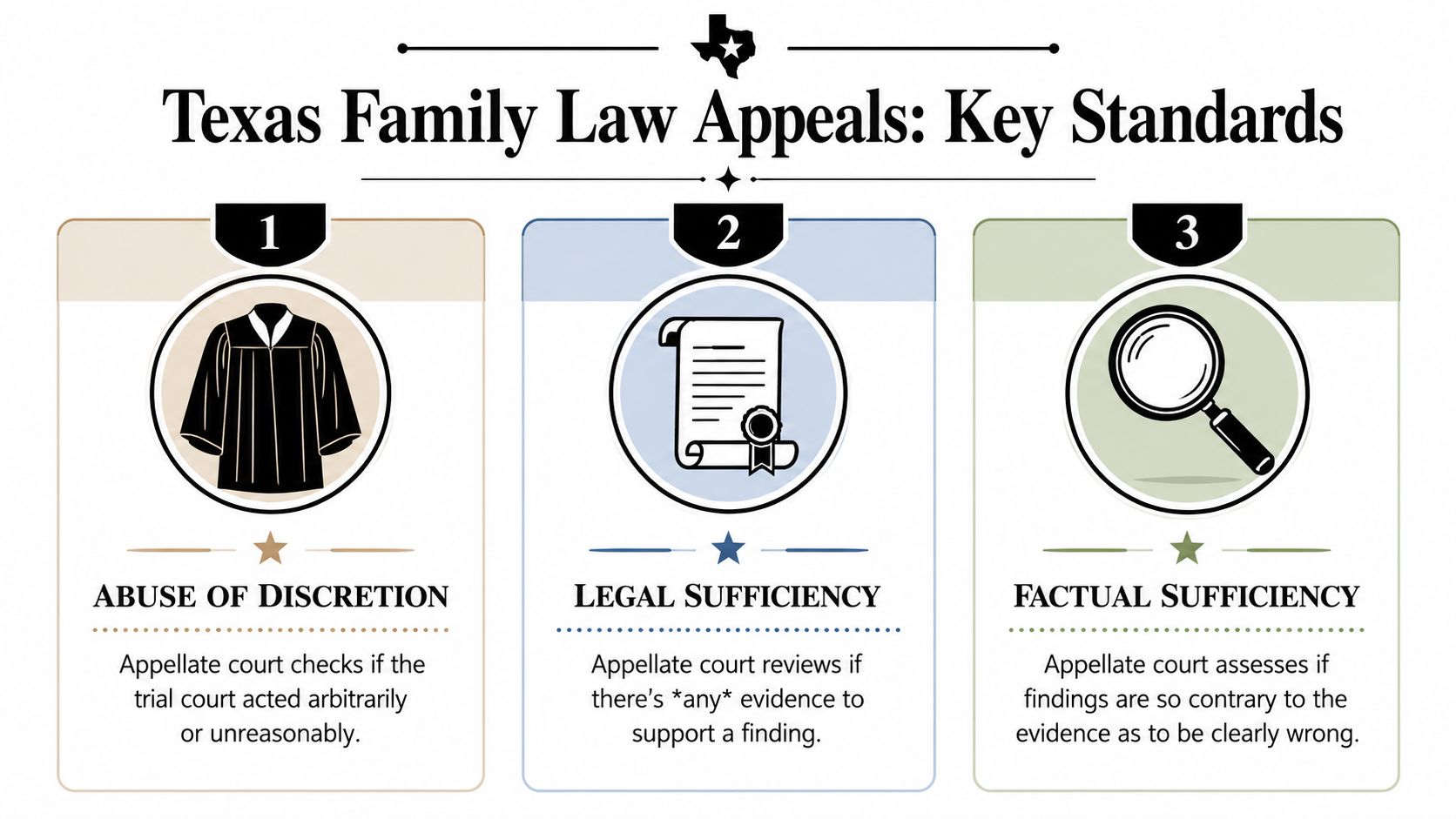
Most Texas family law appeals revolve around three core review frameworks. They don't all ask the same question, and they don't all give the trial court the same level of respect.
A side-by-side view
| Standard of Review | Level of Deference | Applies to… | Texas Family Law Example |
|---|---|---|---|
| Abuse of Discretion | High | Many trial-level family rulings | custody, visitation, property division |
| De Novo | Low | Pure questions of law | interpretation of a statute or legal meaning of an agreement |
| Legal and Factual Sufficiency | Varies by issue | Whether evidence supports a finding | whether the record supports a challenged finding that affects the order |
Abuse of discretion
This is the standard clients see most often in Texas family law. Trial judges usually have broad authority in matters like conservatorship, possession, access, and division of marital property. That doesn't mean they can do anything they want. It means the appellate court won't reverse just because it might have ruled differently.
A ruling is challenged under abuse of discretion when the argument is that the court acted arbitrarily, unreasonably, or without reference to guiding legal principles. In plain English, the complaint isn't "the judge made a close call I don't like." It's "the judge crossed the boundary of reasonable judicial decision-making."
If you're dealing with that concept directly, abuse of discretion in Texas family law is the phrase to understand. It often governs the most important parts of a family appeal.
De novo review
De novo means the appellate court looks at the legal issue fresh. No deference. No assumption that the trial court got the law right because it ruled first.
This standard often applies to pure legal questions. A common example is statutory interpretation. Another is whether the court applied the correct legal rule to a category of issue. If the dispute is about what the law means, not what happened factually, de novo review may apply.
That distinction matters in family cases involving divorce decrees, prenuptial or postmarital agreements, jurisdictional questions, or the legal effect of a written order.
Some family appeals are lost because the brief argues fairness when the real issue is legal classification. If the issue is purely legal, the brief should say so clearly.
Legal sufficiency and factual sufficiency
These standards test the evidence supporting the ruling. They aren't the same.
Legal sufficiency asks whether there is evidence that can support the finding under the governing legal rules.
Factual sufficiency asks whether the finding is so against the great weight of the evidence that it can't stand.
In family cases, these challenges can arise when a finding about income, separate versus community character, best-interest factors, or a basis for a protective order rests on a weak evidentiary foundation.
Why the brief matters so much
The court won't reassemble your case for you. The appellate brief has to identify the issue, match it to the right standard, cite the record, and then argue within that standard. That's one reason The Appellate Brief in a Texas Family Appeal is often described in practical terms as the heart of the appeal.
A useful way to compare them
- Abuse of discretion asks: Did the judge step outside the range of reasonable choices?
- De novo asks: What is the correct legal rule, viewed fresh?
- Sufficiency asks: Does the evidence in this record support the finding?
Courts and practice guidance also emphasize that the standard of review must be tied to each issue in the brief, not dropped into a single generic paragraph. Federal Rule of Appellate Procedure 28(a)(9)(B) requires a concise statement of the standard of review for each issue, and Texas appellate rules similarly require the brief to identify and reflect the correct standard in the argument structure (Federal Rule of Appellate Procedure 28).
Identifying the Right Standard for Your Appealable Issue
The hardest part for many people isn't knowing that standards exist. It's figuring out which one applies to their issue.
That's where appellate work becomes diagnostic. You start with the complaint, but you don't stop there. You sort the complaint into the kind of error the appellate court recognizes.

Start with the kind of mistake
Ask these questions in order:
Was the alleged mistake legal?
Did the judge apply the wrong statute, misread an agreement, or use the wrong legal test?Was the alleged mistake factual?
Is the complaint really that the evidence didn't support a key finding?Was the alleged mistake discretionary?
Did the judge make a choice within a range of options, or a choice outside that range?
This sounds simple, but it often isn't. Many family law issues are mixed. A custody ruling, for example, may involve legal rules, fact findings, and discretionary judgment all at once.
The record controls the analysis
An appeal is confined to the appellate record. That means your lawyer studies transcripts, exhibits, objections, pleadings, and signed orders to see what was argued, what was admitted, and what the judge decided.
The factual statement in the brief also has to be supported by record citations. Appellate rules and practice materials from multiple jurisdictions stress that facts must be tied to the record and that courts won't consider materials outside it (standards of review on appeal practice guidance).
If a point can't be shown in the record, it usually can't be used to win the appeal.
Why lawyers sometimes get this wrong
Even skilled lawyers can mislabel an issue by relying on old templates instead of close doctrinal analysis. As noted in a 2023 survey, even experienced practitioners frequently misstate standards because they rely on popular templates rather than deeper analysis, and practitioners need a practical framework grounded in Texas case law and procedural rules to classify issues as pure law, mixed, or discretionary (what is the standard of review on appeal).
A simple client framework
Use this working approach when you think about your case:
- If your concern is "the judge used the wrong rule," the issue may point toward de novo review.
- If your concern is "there wasn't enough evidence," the issue may involve legal or factual sufficiency.
- If your concern is "the judge had choices but made one no reasonable judge should make," the issue may fit abuse of discretion.
Preservation matters at every stage. If trial counsel didn't object, request findings, offer evidence, or raise the issue in a way the law requires, the appellate court may hold that the complaint wasn't preserved for review.
How to Draft the Standard of Review in an Appellate Brief
A strong standard-of-review section does more than recite a label. It frames how the court should read everything that follows.
What the rules require
Appellate rules commonly require a concise statement of the applicable standard for each issue. That approach appears across jurisdictions, including state systems that require the standard to appear in the issue discussion or under a separate heading for each issue (Florida Rule 28 briefs).
In Texas practice, the same disciplined approach helps the court immediately understand whether a complaint concerns law, facts, or discretion. A standard of review appellate brief should make that clear before the argument starts doing heavy lifting.
For a practical discussion of brief structure in this area, see appellate brief requirements in Texas family law.
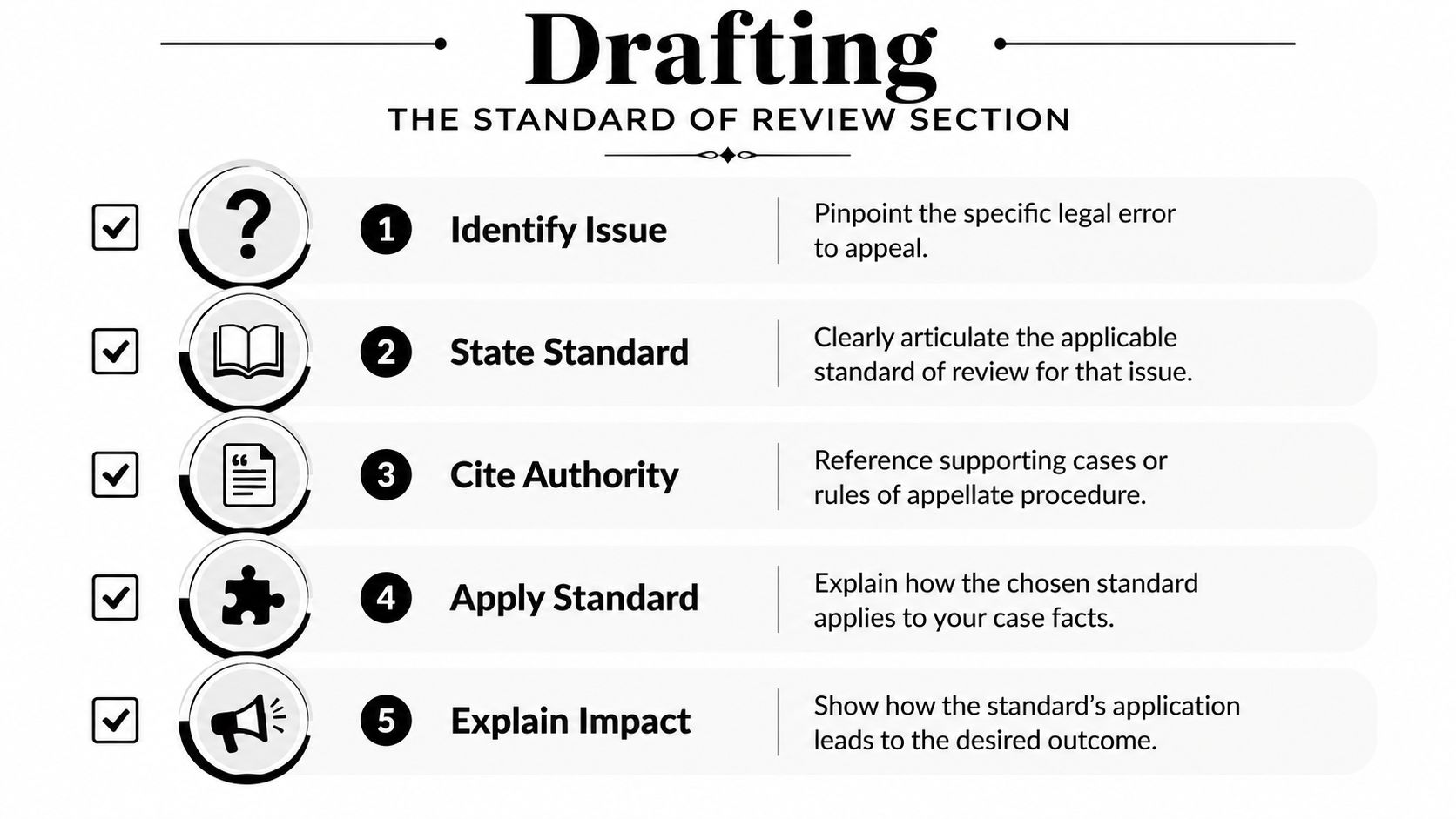
A workable drafting formula
A reliable issue-by-issue formula looks like this:
- Name the ruling being challenged: identify the exact order, finding, or legal conclusion
- State the standard clearly: say whether review is abuse of discretion, de novo, or sufficiency-based
- Cite the authority: include the rule or case support that governs the standard
- Apply the standard immediately: connect the standard to the facts in the record
- Show the consequence: explain why that error requires reversal, remand, or modification
Sample language for an abuse-of-discretion issue
The trial court's conservatorship ruling is reviewed for abuse of discretion. Under that standard, the appellate court does not substitute its judgment for the trial court's on close factual calls, but it may reverse when the ruling is arbitrary, unreasonable, or made without reference to guiding legal principles. Because the record shows the court excluded material evidence relevant to the child's best interest and then based its ruling on an incomplete record, the order cannot stand.
Sample language for a de novo issue
The construction of the challenged provision presents a question of law reviewed de novo. The appellate court therefore gives no deference to the trial court's legal interpretation and determines independently whether the Family Code and the order's text support the ruling below. Because the court applied the wrong legal rule, the resulting judgment should be reversed and remanded.
Common drafting mistakes
A major study of federal appellate briefing found that roughly 28% of appellant briefs failed to include any coherent statement of the standard of review, and that when the standard was framed effectively, the appellant's likelihood of a favorable result increased by roughly 15 percentage points (Storm and the standard of review study).
That helps explain why these mistakes are so costly:
- Omitting the standard entirely: the court has to infer your theory of review
- Using one standard for every issue: family appeals often involve multiple standards in one case
- Stating the right label but arguing under the wrong logic: for example, calling an issue abuse of discretion but writing as if the court should reweigh facts from scratch
- Failing to tie the standard to the remedy: the court needs to know why the identified error matters
Good briefing doesn't just say the standard. It writes the whole argument inside that standard.
A checklist clients can use when reviewing a draft
| Question | Why it matters |
|---|---|
| Is each issue paired with a specific standard? | The court needs the correct lens for each complaint |
| Does the brief cite the record for the facts supporting that issue? | Appellate courts review the record, not memory or argument alone |
| Does the argument match the standard's logic? | A legal issue should read differently from a discretionary one |
| Does the brief explain harm? | Error without meaningful impact may not justify relief |
For parties and lawyers who want focused appellate help, The Law Office of Bryan Fagan, PLLC handles Texas family law appeals involving custody, visitation, property division, support, protective orders, and related post-judgment issues.
Let Our Appellate Attorneys Help You Seek a Fair Outcome
By the time a family law case reaches appeal, the emotional part is already real. Parenting schedules are in place. Money has changed hands. Orders are being enforced. You need more than a sense that the result was wrong. You need a legal path that the appellate court can act on.
That path usually starts with three questions. What exactly did the trial court do? What part of the record proves it? And what standard of review governs that issue under Texas law?
Fairness on appeal comes from precision
A persuasive appeal translates your experience into appellate language. It identifies the reversible error, confirms that the issue was preserved, anchors every factual claim to the record, and frames the argument under the right standard of review.
That is how appeals differ from trials. Trials develop facts. Appeals test whether the law was followed. In Texas family law, that distinction matters in divorce decrees, child custody orders, property division, support rulings, protective orders, and enforcement judgments.
A calm appellate strategy often begins by narrowing the issue, not expanding it.
When a consultation can help
A case review can help answer practical questions such as:
- Is the order final and appealable?
- Was the issue preserved in the trial court?
- What standard of review is most likely to apply?
- Does the appellate record support a viable argument for relief?
If you believe the court made a mistake in your family law case, our appellate attorneys can help you seek a fair outcome. Contact The Law Office of Bryan Fagan today for a free consultation.
If you believe the court made a mistake in your family law case, our appellate attorneys can help you seek a fair outcome. Contact The Law Office of Bryan Fagan, PLLC today for a free consultation.