You may feel that the judge got it wrong. Maybe the custody ruling didn’t reflect what happened in court. Maybe the property division seems one-sided. Maybe an important objection was brushed aside, and the final order now affects your children, your finances, or both.
An appeal can help, but only if it’s handled with precision. Texas appellate courts don’t retry family law cases. They review a written record, study the law, and decide whether the trial court made a mistake that matters. That’s why appellate brief requirements texas family law isn’t just a technical topic. It’s the roadmap for how you ask a higher court to correct an unfair result.
The First Steps After an Unfair Ruling
You leave court with a signed order in your hand, your stomach drops, and your first instinct is to ask, "How do I appeal this?" That reaction makes sense. But the first part of an appeal is less about writing arguments and more about making sure the case is in the right procedural posture at the right time.
In Texas family law, an appeal usually begins only after a final order. That could be a final divorce decree, a final custody order, a final child support judgment, or another ruling that ends the trial court phase of the case. Temporary orders can affect daily life in a serious way, but many of them are not immediately appealable in the ordinary course.

Start with the order itself
The signed order is the starting line.
Clients are often surprised by that because family cases can unfold in stages. A judge may announce a ruling at one hearing, sign one order later, and resolve a remaining issue after that. Until you know which order ends the case, you cannot reliably calculate the appellate deadline.
A useful comparison is a train schedule. If you show up at the wrong station, being early does not help. In the same way, filing before there is an appealable final order can create delay and confusion. Waiting too long can end the appeal before it starts.
That is why a careful lawyer reads the order line by line, compares it to the docket and prior rulings, and asks a basic but decisive question. Did this order dispose of all claims and all parties, or is something still pending?
Practical rule: The appeal timeline usually runs from the signed final order, not from the hearing date and not from the moment the ruling felt unfair.
The Notice of Appeal comes first
Once a final, appealable order exists, the immediate task is filing the Notice of Appeal. Under Texas appellate rules, that deadline is usually short. As noted in Ramos Family Law's discussion of Texas appeal timing, the ordinary deadline is often 30 days after the final order is signed.
That deadline matters for a very specific reason. If the notice is late, the appellate court may lack jurisdiction. In plain English, the judges may have no legal power to hear the case, no matter how unfair the result feels or how strong the legal issue might be.
The Notice of Appeal is a placeholder with a very important job. It does not contain the full legal argument. It tells the system, formally and on time, that review is being sought.
If you want a step-by-step explanation of that filing, review how to file a notice of appeal in Texas family court.
What should happen right away
After the notice is filed, the appeal begins to take shape through the written record. The trial court clerk prepares the clerk's record. The court reporter prepares the reporter's record if hearings were transcribed. Those materials become the universe the appellate court reviews.
That point is easy to miss. Appeals are not a chance to start over with new testimony or better explanations. They are closer to a careful audit of what already happened, using the papers, transcripts, objections, and rulings already in the record.
So the first steps should be deliberate:
- Confirm the final order. In family cases, multiple orders can create real confusion about which ruling starts the appellate clock.
- Calendar the deadline immediately. Even a strong appeal can fail if the notice is not filed on time.
- Protect and review the record. The appellate court will study what was filed, admitted, said, and ruled on below.
- Assess possible issues early. Strong appellate strategy begins with identifying legal error that appears clearly in the record.
Clients often want to begin with the question, "What is our best argument?" That question matters, but timing comes first. A well-founded appeal starts with procedure because procedure is what gets your case through the courthouse door and in front of judges who can correct the error.
The Anatomy of a Winning Appellate Brief
An appellate brief isn’t a letter to the court. It’s a structured legal document written for judges who were not in the courtroom and won’t hear new witnesses. They need a brief that is easy to follow, faithful to the record, and legally grounded.
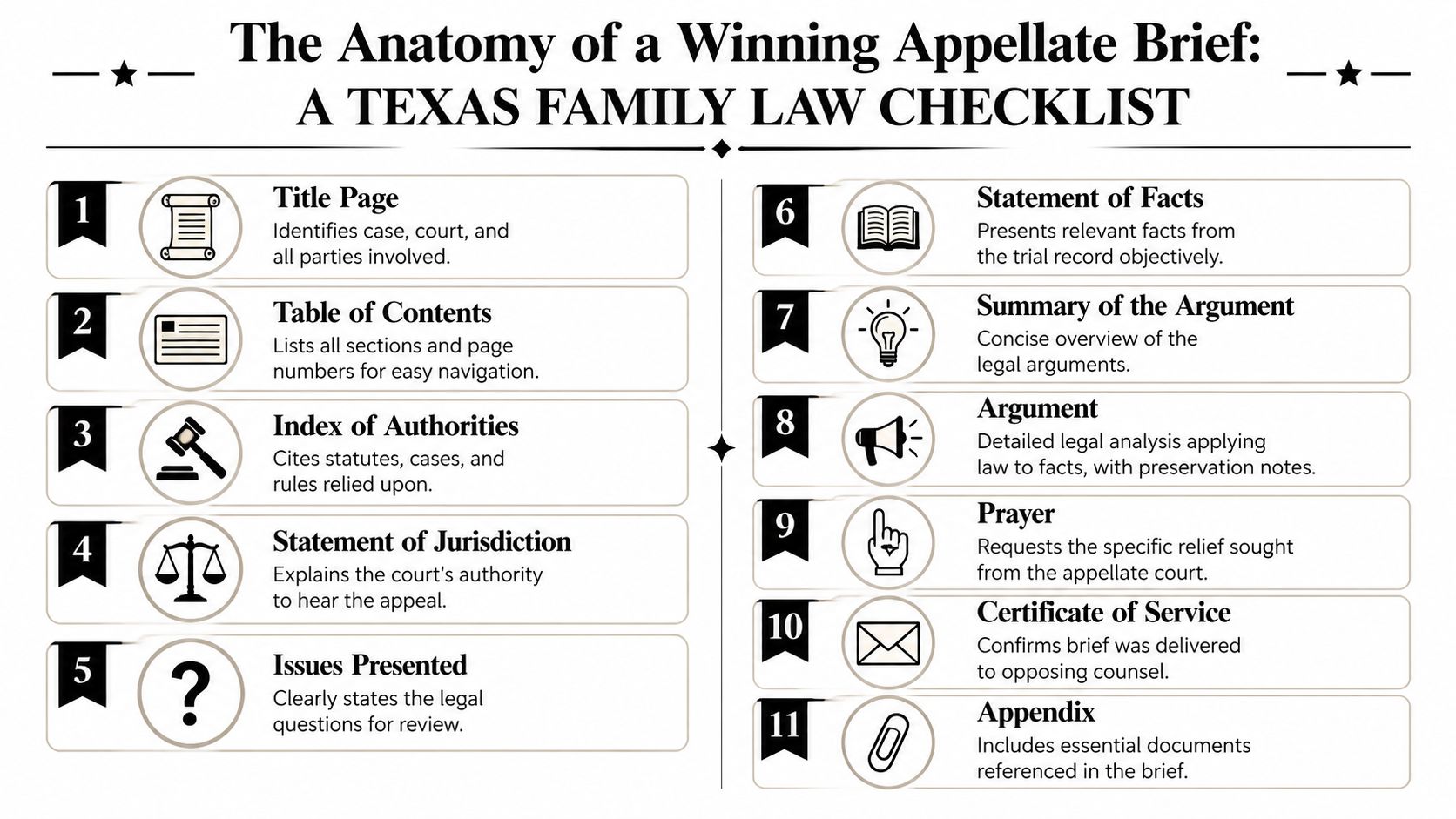
Texas Rule of Appellate Procedure 38.1 sets the framework. In Texas family law appeals, appellants’ briefs must include 12 specific components, including a Table of Contents, Index of Authorities, Statement of the Case, Issues Presented, Statement of Facts, Summary of the Argument, Argument, Prayer, and an Appendix with key materials such as the judgment and selected pleadings (Dallas Divorce Lawyer on TRAP 38.1 brief structure).
Each part has a job
Some sections look administrative, but each one helps the court work through the case.
| Brief component | What it does in plain English |
|---|---|
| Title page | Identifies the case, court, and parties |
| Table of contents | Helps judges move quickly through the document |
| Index of authorities | Lists statutes, rules, and cases relied on |
| Statement of the case | Gives a short procedural history |
| Issues presented | Tells the court the exact legal questions |
| Statement of facts | Summarizes relevant facts from the record |
| Summary of the argument | Offers a concise preview of why reversal is warranted |
| Argument | Applies law to the record and explains the error |
| Prayer | States the relief requested |
| Appendix | Includes important documents the judges may need |
The sections that usually carry the most weight
Clients often assume the “Argument” section is all that matters. It matters a great deal, but several earlier sections shape how judges understand the case before they ever reach the deeper analysis.
The Issues Presented section is where the appeal is framed. A weak issue can make a strong case look unfocused. A carefully written issue can show the court exactly what legal error needs review.
The Statement of Facts must stay anchored to the trial record. This is not the place to retell the case from memory or emotion. If a fact matters, it should tie back to the clerk’s record or reporter’s record.
Judges read a brief with one question in mind. “Show me what the trial court did, where the record supports your account, and why the law says that ruling was wrong.”
The Summary of the Argument also matters more than many people realize. It gives the court a short, coherent map. In a custody appeal, for example, that summary may explain that the court applied the wrong legal standard, excluded material evidence, or exercised discretion in a way the record cannot support.
Why structure matters so much
A brief can contain valid complaints and still fail because it is disorganized. Appellate judges handle many cases. They need a document that respects their workflow. Good structure does that.
A strong Texas family law brief usually does three things at once:
- It narrows the dispute. Instead of arguing everything that felt unfair, it identifies the errors that are significant on appeal.
- It guides the court through the record. Record citations tell the judges where to look rather than asking them to search.
- It asks for specific relief. The court needs to know whether the party seeks reversal, remand, modification, or another remedy allowed by law.
This is why appellate briefing is both technical and strategic. The rules tell you what must be included. Strategy determines how those parts fit together into a persuasive story of legal error.
Mastering the Argument Standard of Review and Preservation of Error
Litigants often come to an appeal wanting to explain what the judge got wrong. That instinct makes sense. But appellate courts ask a more focused question. What kind of error happened, and under what legal standard should it be reviewed?
That’s where many appeals are won or lost.

What standard of review means
The standard of review is the rule the appellate court uses to evaluate the trial court’s decision. It tells the judges how much deference to give the ruling below.
In plain English, it answers this question: How hard is it to overturn this particular decision?
For many family law issues, especially custody and property division disputes, you’ll hear the phrase abuse of discretion. That means the appellate court isn’t deciding what it would have done if it were the trial judge. It is deciding whether the trial judge acted outside the range allowed by law.
A simple way to think about it:
- A trial court has room to choose between reasonable outcomes.
- An appellate court steps in when the ruling goes beyond that legal room.
So if a parent says, “The judge believed the other side, and I think that was unfair,” that usually isn’t enough by itself. But if the record shows the judge applied the wrong rule, ignored controlling law, or made a ruling unsupported by the record under the governing standard, that can become an appellate issue.
Plain-English definitions that matter
Here are three terms clients often hear early in an appeal.
- Briefing means the written legal presentation to the appellate court, in which the party explains the error, cites the law, and cites the record.
- Reversible error means a legal mistake serious enough to justify changing the result.
- Abuse of discretion means the trial court made a decision outside the bounds the law allows.
Those terms matter because an appeal is not a fresh hearing. It is a review of whether the trial court committed a legal error that affected the judgment.
You cannot raise new complaints for the first time on appeal
This is the rule that surprises many people. Texas appellate courts generally review issues that were preserved in the trial court.
Under TRAP 38.1, an appellant’s brief must “contain a clear and concise argument for the contentions made, with appropriate citations to authorities and to the record.” Merely stating conclusions is not enough. TRAP 33.1(a)(1)(A) also requires the party to present issues to the trial court first in a timely request, objection, or motion to preserve them for appeal (Dallas Divorce Lawyer on inadequate briefing and preservation).
That creates a two-part discipline. The issue must usually be raised in the trial court, and then it must be argued correctly in the appellate brief.
Key point: Appellate judges won’t act as a second trial team. They review the legal complaints the record preserved.
What preservation looks like in practice
A few examples make this easier to see.
If a lawyer objected to evidence at trial, stated the legal basis, and the court ruled, that issue may be preserved.
If a party believed the court used the wrong child support analysis but never raised the complaint below, the appellate court may treat that issue as waived.
If the appellate brief says only “the judge was biased” without legal analysis, authority, and record citations, the court may reject the issue even if the client feels strongly about it.
For a practical overview of this topic, review preserving error for appeal in Texas family court.
Common reversible issues in family appeals
Not every disappointing result is reversible. But some categories appear often in Texas family law appeals:
- Custody rulings affected by legal error. For example, a party may argue the court misapplied the governing legal framework.
- Property division mistakes. A court may have characterized property incorrectly or made a division based on an improper legal premise.
- Support findings without required support in the record.
- Procedural errors. These can include rulings that prevented a party from fairly presenting the case.
The job of the brief is to connect the issue, the standard of review, the preserved objection, and the parts of the record that prove the error mattered.
Formatting and Filing Your Brief Rules You Cannot Ignore
You can have a strong appellate issue and still lose the court’s attention if the brief does not meet the filing rules. In family law appeals, formatting is part of persuasion because it determines whether the judges can reach your argument quickly, confidently, and in the form the rules require.
These requirements can feel technical at first. A better way to view them is this: the court uses formatting and filing rules to keep every case organized, readable, and fair to both sides. Your brief is the roadmap. If the roadmap is missing pages, mislabeled, or late, the court may never get to the part where you explain the legal error.
Filing deadlines shape everything that follows
By the time you are preparing the brief, the appeal is already running on a strict court timetable. Earlier deadlines, including the notice of appeal, still matter because a timing mistake at the front end can affect the entire case. As noted earlier, Texas appellate deadlines are enforced closely.
Once the appellate record is filed, the briefing schedule begins. The appellant files first. The other side responds. A reply brief may follow. If you want a practical overview of how those steps fit together, this guide to Texas family law appellate procedure explains the sequence in plain English.
Extensions may be available in some situations, but they are requests to the court, not assumptions a party gets to make on their own.
Format tells the court you are prepared
An appellate brief is more than a written complaint about what happened in trial court. It is a rule-based document with required parts, citation rules, certifications, and limits on length. Judges expect those parts to appear in a predictable order so they can locate the issue presented, the governing law, the record support, and the relief requested without guesswork.
That is why details that seem small often matter a great deal. Word-count certifications matter because the rules limit how much space each side gets. Required sections matter because they help the court test the argument. An appendix matters because judges often want immediate access to the order being challenged and other key materials.
A brief works like a well-organized case file. If the tabs are missing, the reader spends time searching instead of evaluating your position.
Common compliance problems
Several filing problems appear again and again in family law appeals:
- Missing required sections. A brief usually must include items such as issues presented, statement of facts with record citations, argument, prayer, and required certificates.
- Weak or missing record citations. If a factual statement does not point the court to the clerk’s record or reporter’s record, the court may disregard it.
- Word-count and certification errors. Computer-generated briefs often require a certificate showing compliance with the applicable limit.
- Incomplete appendix materials. Leaving out the order under review or other core documents makes the brief harder to use.
- Service mistakes. Filing with the court does not replace the duty to serve the opposing party as the rules require.
Each of these errors creates friction. None helps the court trust the filing.
E-filing requires precision
Texas appellate courts rely on electronic filing, and e-filing has its own discipline. The brief must be uploaded in the proper format, in the correct filing category, with the needed certificates and any supporting motions. A wrong attachment, a missing certificate, or an incorrect filing code can delay acceptance or trigger a notice to correct the filing.
This issue becomes even more sensitive when the record includes documents in another language. If a decree, exhibit, or related family law document needs translation for legal use, accuracy matters because appellate arguments depend on the exact wording in the record. In that situation, outside support such as certified translation for divorce decrees may be useful.
A practical checklist before filing
| Filing issue | Why it matters |
|---|---|
| Deadline calculation | A late filing can prevent the court from reaching the merits |
| Required brief sections | Missing parts can lead to briefing defects or waived points |
| Record citations | Judges need exact support for factual statements |
| Certificate of service | Shows the other side received the filing |
| Appendix contents | Gives the court fast access to key documents |
| E-filing accuracy | Prevents rejection notices and avoidable delay |
Clients sometimes assume formatting is separate from strategy. On appeal, it is part of strategy. A brief that follows the rules closely gives the court a clear path to your argument, and that improves the chance that the underlying legal issue gets a full and fair review.
Common Mistakes That Can Derail a Family Law Appeal
Some appeals fail because the legal issue is weak. Many others fail because the process was mishandled.
That distinction matters. A client may have a real concern about custody, support, property division, or a protective order. But if the appeal is presented incorrectly, the court may never reach the deeper fairness question.
Inadequate briefing
One of the most common problems is inadequate briefing. This happens when a party makes assertions but doesn’t support them with legal authority, record citations, or a developed analysis.
An appellate court won’t comb through a transcript looking for support. It expects the brief to direct the judges to the exact place in the record and explain why that part of the record proves reversible error.
A weak appellate argument often sounds like this:
- “The judge ignored my evidence.”
- “The other side lied.”
- “The ruling was unfair.”
Those feelings may be sincere. But in appellate practice, those statements must be converted into legal arguments tied to the record and the applicable standard of review.
The special difficulty for self-represented parties
Many pro se appeals run into trouble. Pro se litigants are held to the same strict standards as licensed attorneys under TRAP 38.1, with no “free pass.” Courts frequently dismiss pro se appeals for lacking record references, substantive arguments, or compliance with TRAP 38.1(i), because appellate courts cannot search the record or act as an advocate for the appellant (KF Landing on Texas appellate brief requirements for pro se litigants).
That rule can feel harsh, especially in family law cases where emotions run high and legal budgets are tight. But appellate courts apply it in the name of fairness and neutrality. Judges cannot become one side’s researcher or writer.
A self-represented parent may know exactly why the result feels wrong. The court still needs that complaint translated into appellate language.
Mistakes that often become fatal
Some errors are hard to fix once they happen.
Missing a jurisdictional deadline
If the notice isn’t filed on time, the court may never reach the merits.Arguing facts outside the record
Appeals are based on what was filed and said below, not on new documents or later developments.Raising too many issues
More arguments don’t always make a brief stronger. Sometimes they bury the best point.Failing to connect harm to error
Even if the trial court made a mistake, the appellant still has to show why that mistake matters.
A practical comparison
| Common mistake | What the court sees |
|---|---|
| Emotional narrative without citations | Unsupported assertions |
| New evidence attached to the brief | Material outside the appellate record |
| Complaint not raised below | Waiver problem |
| Missing required brief sections | Noncompliant briefing |
Why this happens so often in family cases
Family law appeals are especially vulnerable to these problems because clients are often reacting to highly personal rulings. A parent wants to talk about a child’s routine, a former spouse’s conduct, or financial pressure after divorce. Those facts can matter, but appellate judges need them presented through the record and the law.
That’s why appellate discipline matters so much. The court isn’t dismissing the human side of the case. It is asking for legal precision before it can act.
Why an Experienced Appellate Attorney Is Your Greatest Asset
You receive the trial court’s ruling, read it twice, and still feel the same thing. Something went wrong. At that point, many clients assume the next step is merely to “file an appeal.” In reality, an appeal works more like a technical review than a second hearing. The question is not only whether the result felt unfair. The question is whether the record shows a legal error that gives the appellate court a reason to act.
That is why appellate counsel matters so much in family law cases.
Trial practice and appellate practice involve different skills. Trial lawyers build the factual record, question witnesses, and make quick decisions in a live courtroom. Appellate lawyers work from transcripts, clerk’s records, exhibits, and written rulings. They study what was preserved, identify the issues the court can decide, and translate a complicated family dispute into a clear legal argument for judges who were not in the room.
A useful comparison is this. Trial counsel is handling the surgery. Appellate counsel is reviewing the chart, the procedure, and the outcome to determine whether the rules were followed and whether the error changed the result. Both roles matter, but they are not interchangeable.
What an appellate lawyer adds beyond rule compliance
By this point, you already know the rules for Texas appellate briefs are strict. Experienced appellate counsel adds something more valuable than a checklist. Counsel connects each requirement to strategy.
For example, the statement of facts is not just a summary. It teaches the court how to read the record. The issues presented are not just headings. They define the lane the court will stay in. The standard of review is not technical jargon. It tells the judges how much room they have to correct the trial court. A lawyer who handles appeals regularly understands how those pieces work together.
That changes the quality of the brief in ways clients can feel, even if they do not speak appellate language yet. The brief becomes focused instead of reactive. The argument becomes disciplined instead of emotional. The request for relief becomes realistic and legally grounded.
What an experienced appellate attorney is actually evaluating
A strong appellate review usually starts with a set of hard questions:
- What ruling is being challenged?
- Where in the record was the complaint preserved?
- Which legal standard governs that issue?
- Did the error probably cause an improper judgment?
- What remedy can the appellate court legally grant?
Those questions sound simple. They are not. In family law, one custody ruling may involve temporary orders, final orders, objections, evidentiary disputes, and post-judgment filings spread across a long record. An appellate attorney’s job is to sort that material into a usable theory of the case.
Sometimes that process leads to a confident appeal. Sometimes it leads to a candid conversation that the likely path is narrow. Good appellate advice does both. It identifies real opportunities and rules out arguments that only consume time and money.
Why this is especially important in family law appeals
Family cases often carry a lot of emotional force. That is understandable. You are not arguing about an abstract contract. You are dealing with children, support, possession schedules, property, safety, or a court order that affects daily life.
But the court of appeals cannot reverse a judgment because the story is painful. It can reverse when the law and the record show reversible error. An experienced appellate attorney helps bridge that gap. The lawyer takes the facts that matter significantly to the client and presents them in the form the appellate court can use.
That translation is one of the most valuable parts of the process.
One practical source of appellate help
The Law Office of Bryan Fagan, PLLC handles Texas family law appeals and appellate brief preparation involving custody, support, property division, divorce decrees, protective orders, and related judgments. In a case with a large record or several overlapping issues, focused appellate review can help clarify what the court may review, what arguments are strongest, and how to present them with precision.
The strongest appeal is usually the one that makes the court’s job easier. It identifies the right issue, ties each point to the record, applies the correct standard of review, and asks for a remedy the court has authority to grant.
An appeal cannot promise a different outcome. It can require a disciplined review of whether the trial court followed the law. After an unfair family court ruling, that is often the clearest path toward a just result.