You may feel that the judge got it wrong. In a Texas family law case, that can mean a custody ruling you believe ignored your child's best interest, a property division that doesn't seem lawful, or a support order that left out critical legal requirements.
That frustration is real. So is the need for a clear-eyed strategy.
Those considering how to appeal court order decisions in Texas often expect a second chance to tell the story. An appeal usually isn't that. It's a focused legal review governed by the Texas Rules of Appellate Procedure and the Texas Family Code. The court of appeals asks a narrower question: did the trial court make a legal mistake serious enough to justify changing the result?
A good appeal starts with honesty. Some trial court errors can be corrected on appeal. Many cannot. Deadlines are short, the record matters, and weak arguments fail fast. A strong appellate strategy looks at the order, the preserved objections, the standard of review, and the practical alternatives before spending time and money on a full appeal.
An Appeal Is Not a Do-Over It Is a Review
If you lost in family court, your first instinct may be to gather new documents, line up new witnesses, and explain what the judge missed. That instinct makes sense. It just doesn't match how an appeal works.
An appeal is a review of what already happened in the trial court. The appellate judges look at the written record, the clerk's file, the transcript, and the briefs. They don't hold a new trial. They don't hear fresh testimony. They don't decide which side they personally believe.
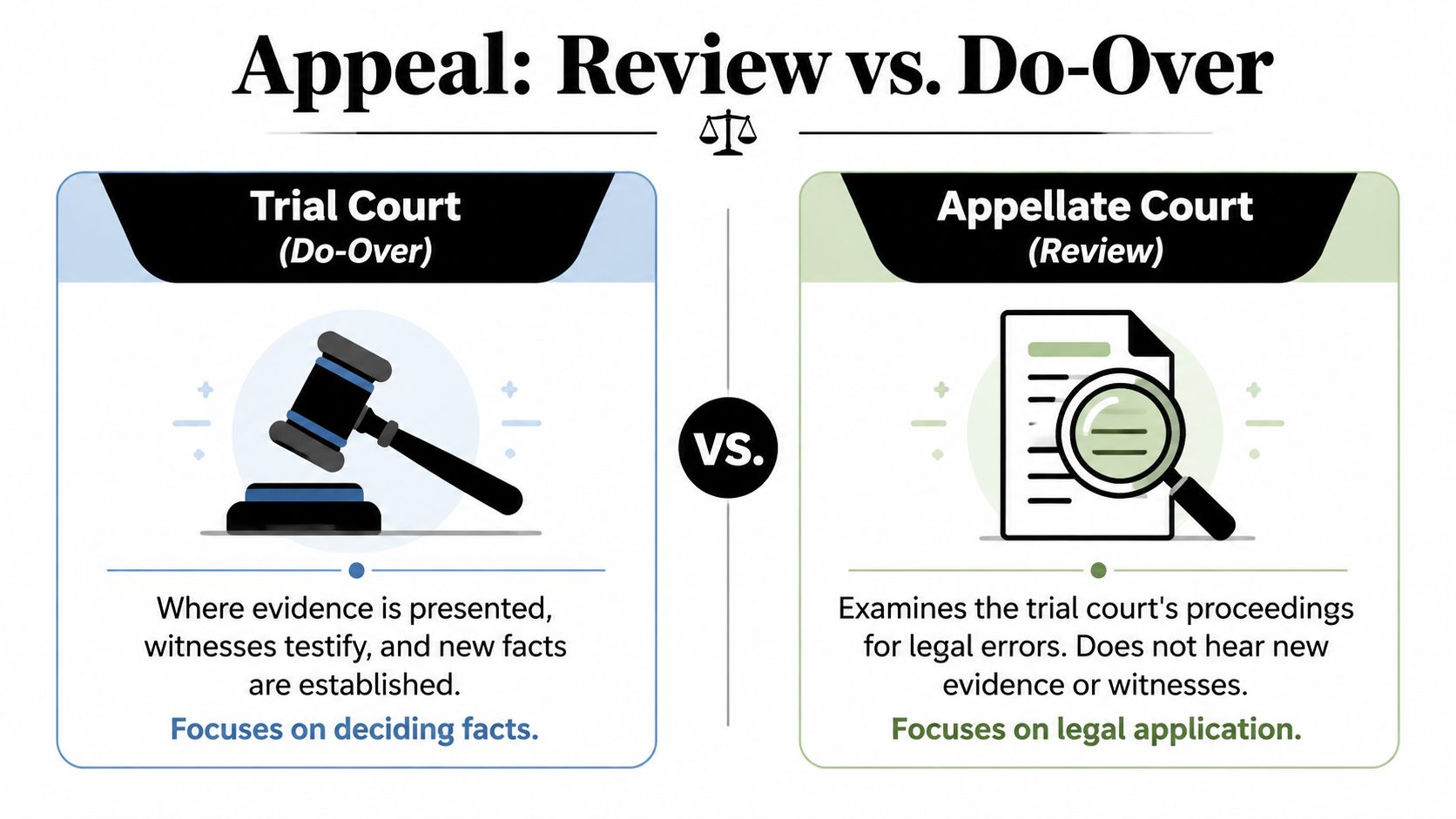
Texas Trial vs. Appeal at a Glance
| Aspect | Trial Court | Appellate Court |
|---|---|---|
| Primary role | Decides facts and applies law | Reviews whether the law was applied correctly |
| Evidence | Witnesses testify and exhibits are admitted | No new evidence or witnesses |
| Focus | What happened | Whether legal error affected the outcome |
| Decision-maker | Judge or jury | Panel of appellate judges |
| Main advocacy tool | Testimony, exhibits, live argument | Written briefing and record citations |
What abuse of discretion means
In Texas family law appeals, the standard of review is often abuse of discretion. In plain English, that means the appellate court won't reverse just because it might have ruled differently. It looks for a decision that was unreasonable, arbitrary, or made without following guiding legal principles, as reflected in Texas Family Code Section 10.003.
That standard changes everything about strategy. Some arguments sound compelling to a disappointed parent or spouse but go nowhere on appeal because they only say, “The judge should have weighed the facts differently.” That usually isn't enough.
Practical rule: An appeal works best when you can point to a specific legal mistake and show why that mistake changed the result.
What reversible error means
A reversible error is a legal error serious enough to justify appellate relief. Not every mistake qualifies. The court asks whether the error materially affected the outcome. That's why appellate briefs need to be precise, restrained, and judge-focused.
This is also why arguments about credibility often fail. Trial judges see the witnesses. Appellate judges read the transcript. If your complaint is mainly that the judge believed the wrong person, the path is steep. If your complaint is that the judge applied the wrong legal standard, excluded critical evidence improperly, or ruled without authority, the case may look very different.
For a closer look at how appellate courts evaluate these arguments, this discussion of standard of review in an appellate brief is a useful starting point.
Determining if You Have Grounds for an Appeal
The judge signs the order. You read it twice, then a third time, and the result still feels wrong. That reaction is common. The harder question is whether the order contains an appealable legal error that gives the court of appeals something it can fix.
Before spending time and money on an appeal, answer two questions first. Is the order appealable, and did the trial court have a fair chance to address the complaint you now want to raise?
Final order or non-final order
In most Texas family cases, a standard appeal starts from a final judgment or final order. That usually means the order resolved the issues before the court and left no substantial judicial work undone. Temporary orders often cause the most immediate harm in custody and support disputes, but they usually do not fit the ordinary appeal route.
That distinction matters because strategy changes at this point. If the order is not final, filing a notice of appeal may waste time you do not have. The better move may be a post-judgment motion, a mandamus analysis, or a focused plan to protect the record until a final order is signed. Clients often ask what the deadline is for filing a notice of appeal in Texas, but the deadline only matters if the order is one the appellate court can review.
Preserving error is not optional
Texas appellate courts review complaints that were presented to the trial court in a timely and specific way. In practice, that usually means an objection, motion, or request, followed by a ruling or a refusal to rule that the record clearly shows.
There is a practical reason for that rule. Trial judges must be given a chance to correct a problem while the case is still in front of them. If no one raised the issue, the appellate court will often treat it as waived, even when the client feels the ruling was plainly unfair.
As the Appellate Division has stated, “the requirement of preservation is not merely a meaningless technical barrier to review.”
I often tell clients to stop asking only, “Was the judge wrong?” and start asking, “Where in the record did we preserve that complaint?” If the transcript shows no objection, no offer of proof, no request for findings, or no ruling, the range of workable appellate arguments gets much smaller.
What usually makes a good appellate issue
The strongest issues usually involve law, procedure, or authority. Weak issues usually ask the appellate court to re-weigh disputed facts or second-guess credibility calls made by the trial judge.
That is why the standard of review matters so much at this stage. Some rulings are reviewed deferentially. Others receive closer scrutiny. If the applicable standard gives the trial court broad discretion, an argument that sounds strong in conversation may be a poor use of briefing space. Good appellate issue selection is partly about identifying error and partly about rejecting arguments that are unlikely to survive the standard of review.
In Texas family cases, issues that may support reversal often include:
- misapplying the Family Code
- admitting or excluding evidence after a proper objection
- deciding a matter outside the court's authority
- failing to make required findings or applying the wrong legal standard
A few examples help make that concrete:
- Custody issue: The court applied the wrong legal framework to a conservatorship or possession ruling, rather than reaching a harsh result.
- Evidence issue: The court admitted testimony or documents over a specific objection, and the record shows the error likely affected the outcome.
- Jurisdiction issue: The court signed an order reaching property or parties beyond its power to adjudicate.
The child's best interest standard under Section 153.002 often appears in custody appeals, and property division disputes can arise under Section 7.001, as reflected in Texas Family Code Section 153.
These issues are then developed in the appellant's brief under the Texas Rules of Appellate Procedure. One resource in this area is Texas Family Law Appeals Lawyer, which concerns appellate representation challenging final family law orders for legal error.
The Strict Timeline for a Texas Family Law Appeal
A parent loses at trial on Friday, spends the weekend focused on the children, and assumes there will be time to sort out an appeal later. By the time that assumption is tested, the deadline may be gone. That is how appeals are lost before the court of appeals reads a single argument.
In Texas family cases, the first date that matters is the date the final judgment or order is signed. Rule 26.1(a) generally requires the Notice of Appeal to be filed within 30 days after that date. The clock does not wait for a party to get organized, save money, or feel ready.
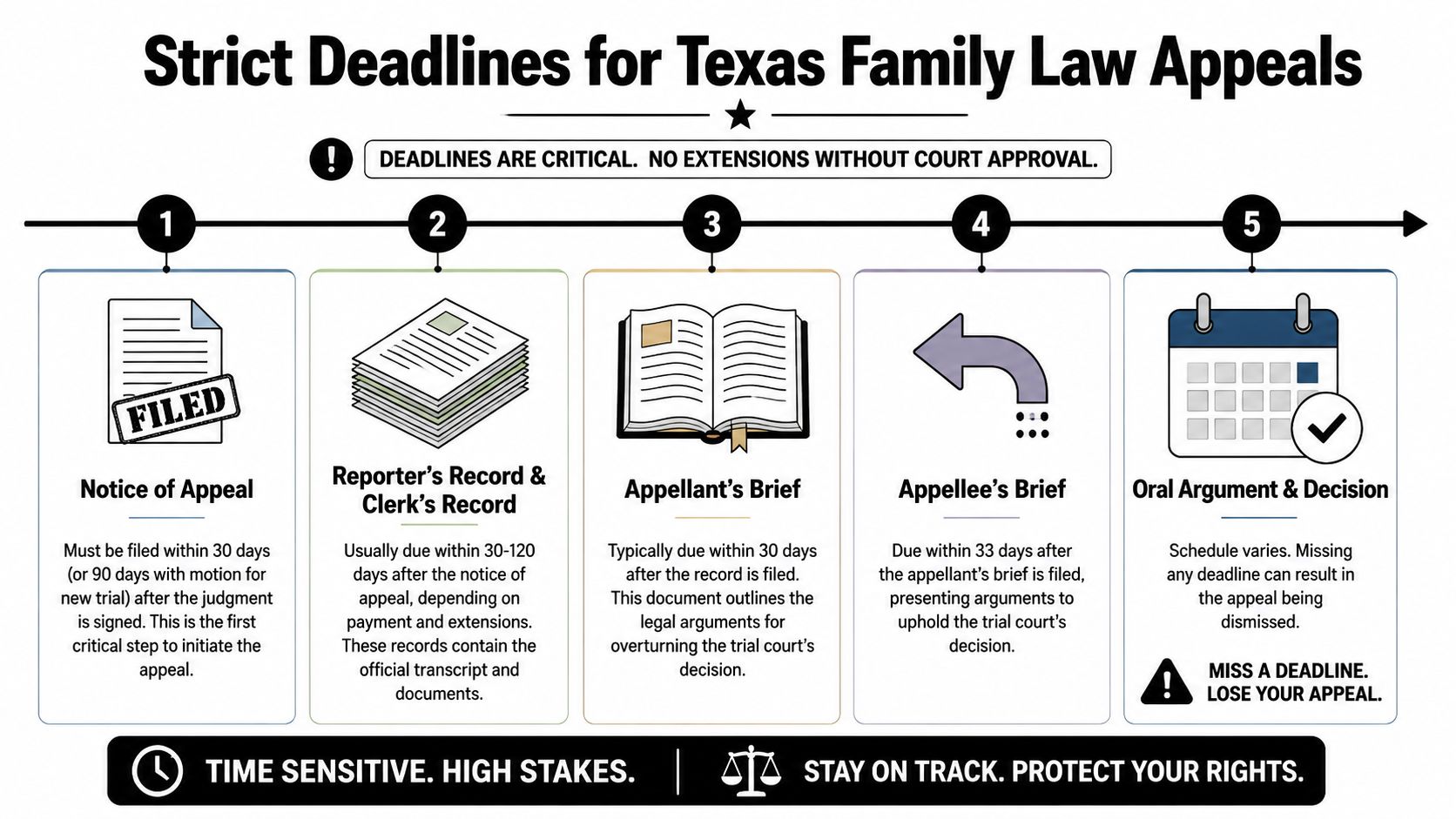
The deadline that controls everything
A missed notice deadline usually ends the appeal. The court of appeals can only act if its jurisdiction is properly invoked, and an untimely notice creates a serious problem at the outset.
That is why I tell clients to treat the notice decision as immediate triage, not as the final shape of the whole appeal. A timely notice preserves options. It gives appellate counsel room to evaluate the record, identify viable issues, and decide whether the case should proceed, be narrowed, or be resolved another way.
Why lawyers also consider post-judgment motions
The next strategic question is whether to file a post-judgment motion, such as a motion for new trial. Sometimes that step extends deadlines under the rules. Sometimes it gives the trial court a chance to correct an error without the cost of a full appeal. Sometimes it helps preserve a complaint that is not yet cleanly presented in the record.
Sometimes it does none of those things.
A weak post-judgment motion can spend time and money without improving the case. In some matters, the better course is to file the notice, protect the deadline, and focus on the issues that are already preserved. The right choice depends on the order, the kind of error involved, and whether another motion will effectively help the client rather than just create activity.
Missing the notice deadline can end the appeal before it starts. Filing the notice on time keeps the case alive while the harder strategic decisions are made.
A practical timeline to watch
The sequence is usually straightforward, even though the exact dates can shift based on what was filed after judgment:
- Final order is signed: The appellate timetable begins.
- Notice of Appeal is filed: This is the first jurisdictional step.
- Post-judgment motions are assessed or filed if warranted: Here, strategy matters. The goal is not to file more paper. The goal is to protect or improve the appeal.
- Record is requested and payment arrangements are made: Delay here creates avoidable problems later.
- The appellate court dockets the case and sets briefing deadlines: At that point, the appeal becomes a disciplined writing and record-based process.
If you need the first step explained in plain terms, this guide on the deadline for filing a notice of appeal in Texas breaks down how the timing rules work.
Building Your Case The Appellate Record and Brief
A lot of appeals are won or lost before the first brief is filed. After the notice of appeal, the essential work becomes disciplined record review, issue selection, and written advocacy tied to what occurred in the trial court.
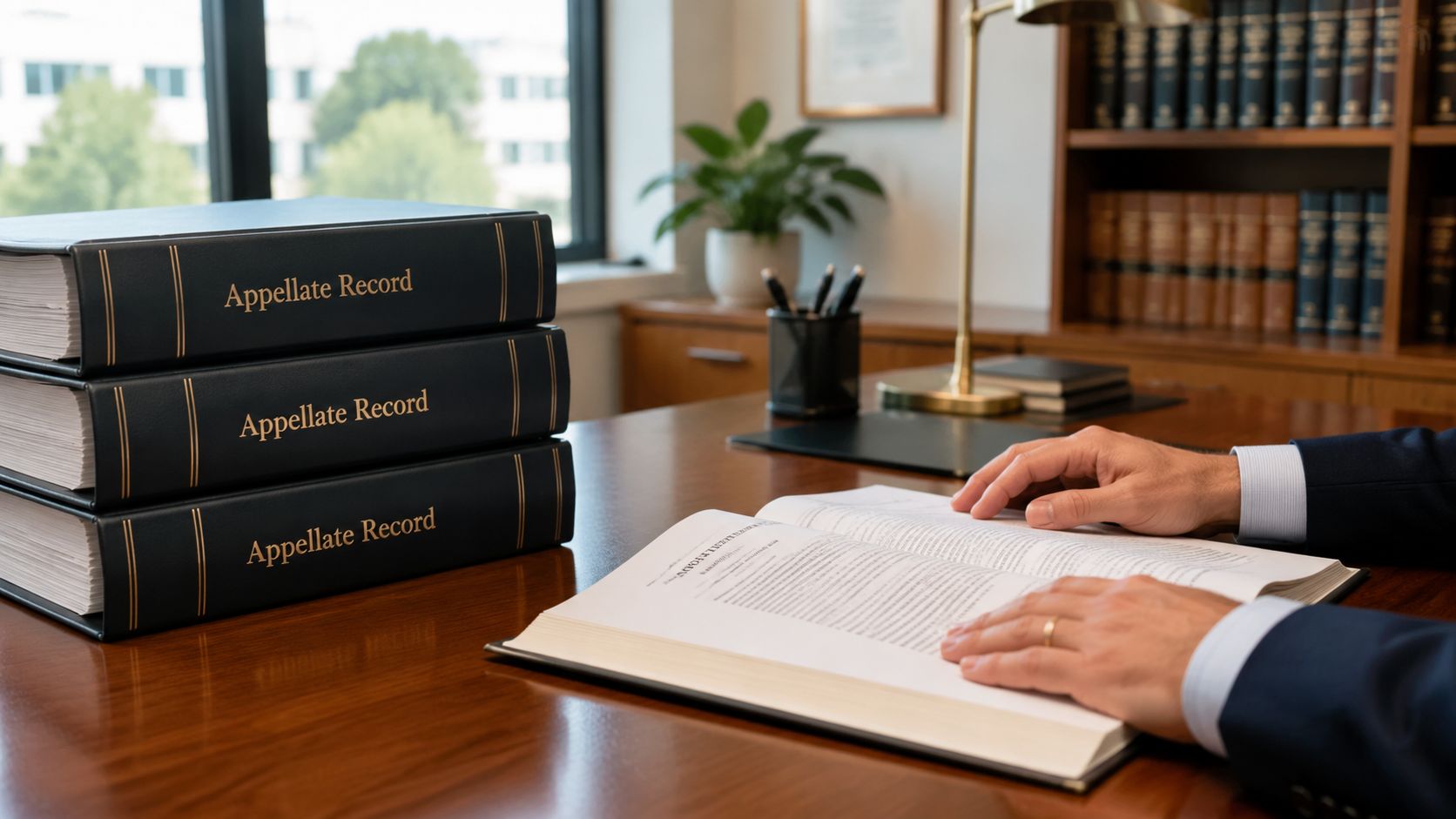
The appellate court works from the record you provide. If a fact, exhibit, objection, or ruling is missing, the court usually treats it as if it is not part of the case.
What the appellate record includes
The record usually has two parts:
- Clerk's record: Pleadings, motions, filed exhibits, orders, and other papers from the court file.
- Reporter's record: The transcript of hearings and trial, including testimony, objections, offers of proof, and the judge's rulings.
That distinction matters because different appellate issues depend on different parts of the record. A complaint about the wording of the final order may live in the clerk's record. A complaint about excluded testimony, a sustained objection, or legally insufficient evidence usually rises or falls on the reporter's record.
Ordering only part of the transcript can save money, but it is a strategy choice, not a default. Under TRAP 34.6, an appellant who requests less than the full reporter's record has to identify the issues to be presented, and an incomplete record can leave the appellate court presuming the missing portions support the trial court's ruling. In family law appeals, that is a serious risk because hearings often build on each other.
Why partial records often backfire
Clients often ask whether every hearing really needs to be transcribed. Sometimes the honest answer is no. If the appeal raises a narrow legal issue decided on written filings alone, a limited record may be enough.
More often, the answer is yes.
Texas family cases rarely turn on one clean event. Temporary orders, evidentiary hearings, trial objections, and clarification hearings can all matter. If the omitted portion contains the only preserved objection, the factual context for the ruling, or the trial court's explanation, the argument weakens fast. The appellate court does not supply missing context in the appellant's favor.
A practical explanation appears in this guide to the Texas appellate record and why it matters.
The brief is where strategy shows up
A strong brief does more than argue that the result felt unfair. It identifies an error the court of appeals can correct under the standard of review, shows where that error was preserved, and explains why it probably affected the outcome.
That is why issue selection matters so much. Five weak issues do not make an appeal stronger. They usually dilute the one argument that had a real chance. In my experience, the better approach is to choose the points that fit the record, fit the preservation history, and fit the standard of review.
Texas appellate briefs must follow the Rules of Appellate Procedure. That includes sections such as a statement of the case, issues presented, statement of facts with record citations, argument with supporting authorities, and a short conclusion stating the relief requested. Good briefing keeps facts and argument organized, then ties both back to the exact place in the record where the error appears.
The appellee may then file a response brief. Under TRAP 38.6(b), that brief is due 20 days after the appellant's brief is filed, unless the court changes the deadline. A party may also request oral argument under TRAP 39.1, but oral argument is not automatic and it rarely fixes a weak record or a poorly framed issue.
Good appellate writing is restrained. It does not replay the entire divorce or custody dispute. It focuses the court on the few rulings that can support reversal, and it leaves out arguments that were never preserved or cannot survive deferential review.
Potential Outcomes Costs and Alternatives to an Appeal
An appeal is a serious investment. It takes time, attorney work, transcript preparation, and emotional stamina. Before moving forward, most clients need the same answer to the same question: what are we trying to accomplish, and what are the actual chances that an appeal gets us there?
The possible outcomes matter because not every win looks the same.
What the appellate court can do
If the appellant succeeds, the court of appeals may:
- Reverse and render: The appellate court changes the result and enters the judgment that should have been entered.
- Reverse and remand: The appellate court sends the case back to the trial court for further proceedings.
- Modify: The appellate court changes part of the judgment.
- Affirm: The original judgment stands.
Nationally, appellate relief is difficult to obtain. In 2014, U.S. appellate courts reversed, remanded, or modified 37% of civil appeals, while 63% of appeals were reviewed solely on the merits without additional evidence or witness testimony. Among those merits-reviewed appeals, 81% resulted in the trial court being upheld or affirmed, according to the Bureau of Justice Statistics report on civil appeals.
That doesn't mean an appeal isn't worth filing. It means the case for appeal has to be stronger than “the judge was unfair.”
The cost side of the decision
Texas appeals involve more than filing a notice. There may be court costs, transcript costs, and legal fees for issue analysis, record review, brief writing, and possible oral argument.
I don't treat cost as a reason to give up. I treat it as a reason to be strategic. A narrow, well-preserved legal issue can justify the expense. A broad challenge built on factual disagreement often won't.
At this stage, appellate counsel should be candid. If the likely result is affirmance, it's better to hear that early than after months of briefing.
When an appeal may not be the best tool
Sometimes the smarter move is not a full appeal.
A few alternatives may include:
- Motion for new trial: This asks the trial court to reconsider its ruling.
- Motion to modify: In family law, later changes in circumstances may support modification of custody, visitation, or support.
- Targeted post-judgment relief: In some cases, a narrower procedural remedy fits better than a full appellate challenge.
Those options serve different purposes. An appeal corrects legal error in the existing judgment. A modification addresses changed circumstances after judgment. Clients often confuse the two. Courts do not.
Why You Need an Appellate Specialist for Your Case
Appellate work is its own discipline. A skilled trial lawyer and a skilled appellate lawyer often solve different problems in different ways.
Trial lawyers build live cases. They manage witnesses, objections, exhibits, and courtroom dynamics. Appellate lawyers work from a fixed record. They identify preserved error, frame issues under the correct standard of review, and write for a panel of judges who expect precision more than drama.

Different skill set, different mindset
A strong appeal usually depends on judgment calls such as:
- Which issues are preserved and which are lost.
- Which arguments fit the standard of review.
- Whether the record supports harmful error, not just technical error.
- Whether a post-judgment motion, appeal, or later modification is the sounder path.
Those choices are where many appeals are won or lost. Filing quickly matters. Filing wisely matters more.
Why precision matters so much
The appellate court reads what happened below through the lens of the record and the rules. That means deadlines, issue preservation, formatting requirements, record citations, and legal framing aren't side issues. They are the work.
One option in this space is The Law Office of Bryan Fagan, PLLC, a Texas-based family law appellate practice that handles appeals involving custody, visitation, property division, support, protective orders, and related family law judgments.
A persuasive appeal is usually narrow, disciplined, and built around preserved legal error. Broad attacks on the whole case rarely work.
If you believe the court made a mistake in your family law case, our appellate attorneys can help you seek a fair outcome. Contact The Law Office of Bryan Fagan today for a free consultation.
If you believe the court made a mistake in your family law case, our appellate attorneys can help you seek a fair outcome. Contact The Law Office of Bryan Fagan, PLLC today for a free consultation.