You may feel your case was handled unfairly. After a long and difficult divorce, seeing a final court order that incorrectly divides your hard-earned 401(k) can feel like a profound injustice. In Texas, community property laws state that only the portion of a 401(k) earned during the marriage is subject to division. When a court gets this wrong, it can jeopardize your financial future.
It’s crucial to understand that an unfair trial court ruling is not the final word. If you believe the judge made a legal mistake in dividing your retirement assets, the Texas appellate process provides a path to seek a fair and just outcome.
What You Can Appeal in a Texas Divorce Case
If you walked out of the courtroom feeling the judge’s decision put your financial security at risk, you have options. Dividing a 401(k) is complex; mistakes in valuation, property characterization, or the application of Texas law can and do happen. These aren’t just minor oversights—they are often reversible errors that can have a massive impact on your retirement.
Perhaps you feel the court ignored clear evidence of your separate property contributions, or that the final division was based on flawed calculations. These are legitimate concerns. The Texas legal system provides a remedy for these situations: the appellate process, which exists to review and correct legal errors made by a trial court.
The Fundamentals of 401(k) Division in Texas
Before delving into the appeals process, it’s helpful to understand the basic rules. For a general overview of these retirement plans, this guide on general 401k pros and cons is a useful resource.
In any Texas divorce involving a 401(k), these key factors are paramount:
- Community vs. Separate Property: This is the most critical distinction. Under the Texas Family Code, any funds contributed to your 401(k) before marriage, plus the growth on those specific funds, remain your separate property—but you must prove this with clear and convincing evidence.
- The Valuation Date: The date chosen to value the 401(k) can significantly alter the division. An incorrect valuation date is a common reversible error that can result in an unfair distribution of assets.
- The Qualified Domestic Relations Order (QDRO): This is a specialized, legally required court order needed to divide a 401(k). It is a separate document from your divorce decree and must be drafted with absolute precision to be accepted by the plan administrator. A flawed QDRO is another common basis for appeal.
Let’s consider an example. Suppose you had $50,000 in your 401(k) on the day you were married. Over a 10-year marriage, the account grew to $300,000. The community property portion subject to division is the $250,000 increase in value. If the court failed to properly trace and protect your initial $50,000 plus its growth, that could be an “abuse of discretion” and grounds for an appeal.
Securing a just outcome from the start is always the goal. Understanding how to choose a family law attorney is a critical first step in protecting what you’ve earned.
When splitting a 401(k) in a Texas divorce, your Final Decree of Divorce is only the first step. A common misconception is that the decree itself is sufficient to transfer the funds. While the decree outlines the agreement—that the 401(k) will be divided and in what shares—it lacks the authority to compel the plan administrator to act.
For that, you need a highly specific court order: the Qualified Domestic Relations Order, or QDRO.
Think of your divorce decree as the overall blueprint for your property division. The QDRO, however, is the specialized key required to unlock the 401(k) account. Plan administrators (like Fidelity or Vanguard) are legally prohibited by federal law from distributing funds to a non-employee spouse without a valid QDRO.
Attempting to bypass this step can lead to significant financial penalties. A distribution made without a QDRO is typically treated as an early withdrawal, triggering income taxes and a steep 10% early withdrawal penalty. The QDRO is the only legal instrument that allows for a tax-free transfer of retirement funds as part of a divorce settlement.
Navigating a divorce is an emotional and complex journey, often starting with a feeling of being completely overwhelmed before moving toward clarity and decisive legal action.
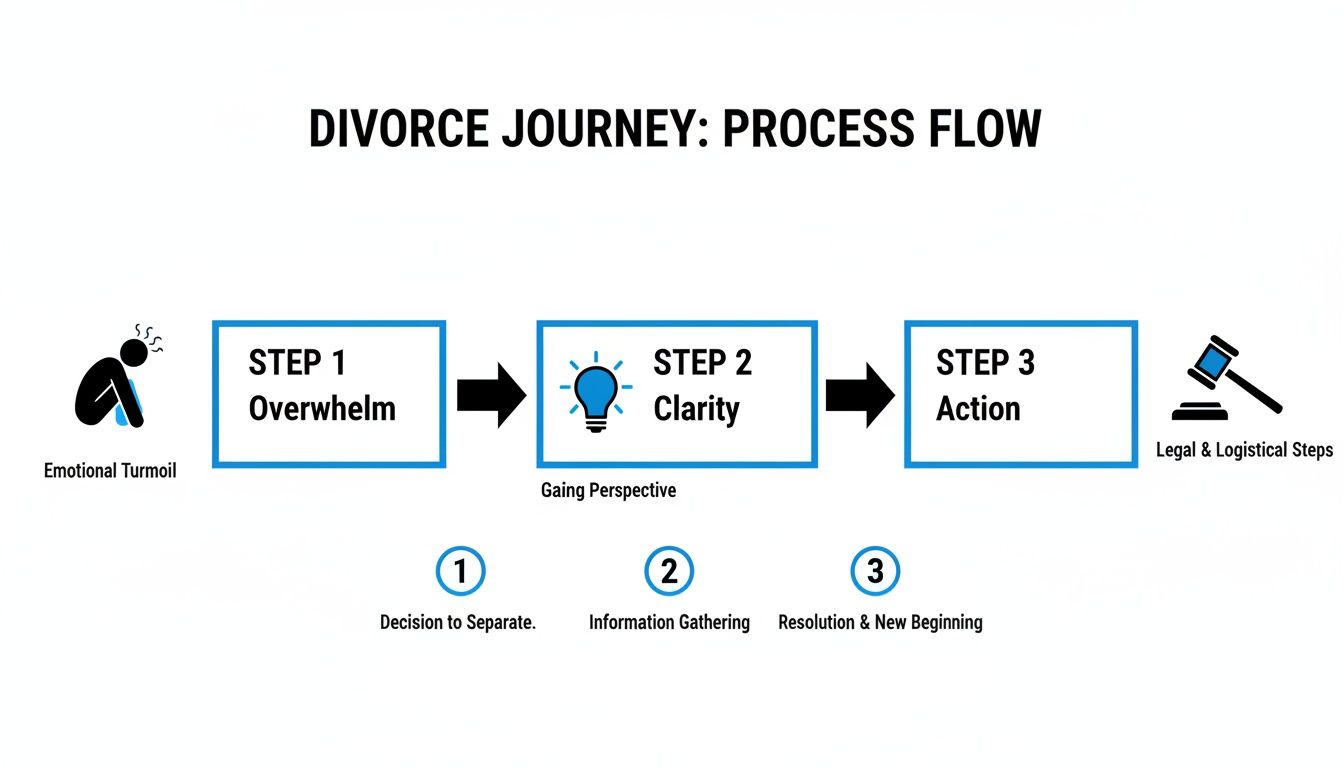
This process highlights why having the right legal instruments, like a properly executed QDRO, is so critical to achieving a fair and final resolution.
Why Your Divorce Decree Is Not Enough
Many are surprised to learn that a final, signed divorce decree has no power over a 401(k) plan administrator. The decree is an order between you and your former spouse, enforceable in a Texas family court. A QDRO is fundamentally different; it is an order directed at a third party—the plan administrator—and must comply with a rigid set of federal laws (specifically, ERISA) and the unique internal rules of that specific retirement plan.
To clarify the distinction, let’s compare the two documents.
QDRO vs. Divorce Decree: Key Differences
| Characteristic | Final Decree of Divorce | Qualified Domestic Relations Order (QDRO) |
|---|---|---|
| Audience | The divorcing spouses and the state court. | The 401(k) plan administrator (a third party). |
| Governing Law | Primarily the Texas Family Code. | Primarily federal law (ERISA) and the plan’s specific rules. |
| Purpose | Outlines the entire divorce settlement (custody, property, etc.). | Solely instructs the plan administrator on how to divide a specific retirement account. |
| Content | General terms, e.g., “Wife is awarded 50% of the community portion of Husband’s 401(k).” | Highly specific details, including the full plan name, participant/payee information, division formula, and distribution instructions. |
| Enforcement | Enforced against the ex-spouse in state court. | Enforced against the plan administrator, who cannot act without it. |
As you can see, the QDRO is a far more technical document. It contains granular details you’d never find in a standard divorce decree.
The QDRO Lifecycle: From Draft to Distribution
Finalizing a QDRO is a meticulous, multi-step process where a single error can cause months of delay or an outright rejection from the plan administrator.
Here’s a typical overview of the process:
- Drafting the Order: An attorney drafts the QDRO with precise language that aligns with both the divorce decree and the plan’s specific requirements.
- Pre-Approval: The draft QDRO is sent to the plan administrator for a preliminary review. This crucial step allows for corrections before it is submitted to the court.
- Judicial Signature: Once the plan administrator approves the draft, it’s submitted to the judge for a signature, making it an official court order.
- Final Submission and Execution: The signed order is sent back to the plan administrator for final processing. They will then segregate the awarded funds into a separate account for the non-employee spouse.
A common and devastating reversible error occurs when a trial judge signs a divorce decree dividing a 401(k) but fails to ensure a separate, valid QDRO is also entered. This leaves the non-employee spouse with an unenforceable order and no way to access their share of the retirement funds without further costly legal action.
Common Reversible Errors and Your Right to Appeal
The complexity of QDROs and property division creates numerous opportunities for trial court errors, which can form the basis of a successful appeal. In Texas, property division appeals are common, and mistakes in dividing retirement accounts are a frequent cause for reversal.
For instance, a judge might sign a QDRO that fails to properly account for market gains or losses between the date of divorce and the date of distribution. Such an error could be considered an abuse of discretion by the trial court. An appellate court reviews the trial record to determine if the judge’s decision was arbitrary or unreasonable. If so, it can reverse the faulty order and remand the case to the trial court with instructions to correct the error. To learn more, you can find insights into how courts handle these retirement divisions.
Tracing Separate vs. Community Property in a 401(k)
If you believe your divorce decree incorrectly divided your 401(k), the issue often comes down to one critical process: financial tracing. Texas law is clear—only assets acquired during the marriage are community property. Any portion of your 401(k) that you owned before marriage is your separate property, provided you can prove it.
This is where many trial court errors occur, and where a well-argued appeal can restore fairness. Tracing is the methodical process of proving an asset’s separate character. For a 401(k), this means establishing the exact account balance on your wedding day and then tracking its growth, separate from any contributions or market gains that occurred during the marriage. An error in this process can lead to your separate property being mischaracterized and wrongly awarded to your ex-spouse.

Building Your Case: The Evidence Needed for an Appeal
To successfully trace your separate property interest in a 401(k) on appeal, you must show that you presented clear and convincing evidence at trial. The burden of proof is on the spouse claiming separate property.
The essential documentary evidence includes:
- The Wedding Day Statement: This document is the cornerstone of a separate property claim, establishing the starting point.
- Complete Statement History: All statements from the date of marriage to the date of divorce are needed to track contributions, employer matches, gains, and losses, which define the community and separate portions.
- Employment Records: Pay stubs and employer records can help verify contribution dates and amounts throughout the marriage.
Just as a business uses effective asset and inventory management strategies to track physical items, a disciplined approach is required to document the financial components of your 401(k).
Plain-English Definitions of Key Legal Terms
Navigating an appeal involves specific legal terminology. Understanding these terms is essential.
- Abuse of Discretion: This is the standard of review used in most family law appeals. It occurs when a trial judge makes a decision that is arbitrary, unreasonable, or without reference to any guiding legal rules or principles.
- Reversible Error: A legal mistake made by a trial judge that was significant enough to have likely caused an improper judgment. Mischaracterizing a large portion of a separate property 401(k) is a classic example of a reversible error.
- Briefing: The process of writing the formal legal argument (the “brief”) that is submitted to the appellate court. The brief identifies the trial court’s errors, cites relevant laws and prior cases, and explains why the decision should be reversed.
We often see cases where a judge committed an “abuse of discretion.” For example, if a judge was presented with clear tracing evidence for a pre-marital 401(k) balance but divided the entire account as community property anyway, that decision is arbitrary and constitutes powerful grounds for an appeal.
A Common—and Costly—Trial Court Error
Let’s examine a scenario of how a court can misapply the law.
Imagine you had $100,000 in your 401(k) on your wedding day. After a 15-year marriage, the account has grown to $700,000. The community property portion is only the value attributable to contributions and growth during the marriage. A crucial point is that your original $100,000 was also growing over those 15 years, and that passive growth remains your separate property.
A classic reversible error is when a trial court fails to account for this passive growth. If your initial $100,000 grew on its own to $250,000, then that entire $250,000 is your separate property. The community estate would be the remaining $450,000. If the court wrongly awarded your spouse half of the total growth ($300,000) instead of half of the community growth ($225,000), you would lose $75,000 of your separate property. This is a significant financial injustice that an appeal is designed to correct.
If your trial judge abused their discretion by ignoring solid tracing evidence, a well-argued appeal can restore the balance and secure a just outcome.
Understanding the Standard of Review: Common 401(k) Division Errors
A final divorce decree may feel conclusive, but when complex assets like a 401(k) are involved, trial judges can make significant legal mistakes. Recognizing these common errors is the first step toward determining if you have grounds for a successful appeal.
An appeal is not a second trial. It is a focused review of the trial record to determine if the judge made a legal or procedural mistake that led to an improper result. We call these reversible errors, and when they concern your 401(k), the financial stakes are substantial.

Abuse of Discretion: The Standard for Property Appeals
In Texas, most family law appeals are reviewed under a standard known as “abuse of discretion.” An appellate court is not asking if it would have made the same decision. Instead, it is looking to see if the trial judge’s decision was arbitrary, unreasonable, or made without reference to guiding legal principles. Many common and costly mistakes in 401(k) division fall into this category.
Using an Incorrect Valuation Date
A 401(k)’s value fluctuates with the market. To ensure a “just and right” division, Texas law requires the court to value assets on a date “on or near” the date of divorce.
A common reversible error occurs when a court uses a stale valuation date, such as from the date of separation months or years earlier. If the market rose significantly between separation and the final divorce, using the older, lower value would result in an unfair windfall for one spouse. This is a clear abuse of discretion that an appellate court can correct.
Miscalculating Gains and Losses on the Community Portion
This is where the math becomes complex and where trial courts often err. The community property portion of a 401(k) includes not only the contributions made during the marriage but also all investment gains and losses on those specific funds.
Consider this scenario:
- During the marriage, $150,000 in community funds were contributed to a 401(k).
- Due to market growth, that $150,000 was worth $250,000 by the date of divorce.
- The community asset to be divided is $250,000, not the original $150,000 contribution.
If the judge only divides the $150,000 and ignores the $100,000 in growth, they have mischaracterized a significant portion of the community estate. This error unfairly disadvantages one spouse and provides a strong basis for an appeal.
“An appellate court will meticulously review the financial records and expert testimony presented at trial. If the record shows the trial court’s math was based on a flawed formula or ignored clear evidence of market growth, a reversal is highly probable.”
Ignoring Outstanding 401(k) Loans
A 401(k) loan is a debt against the account that must be factored into the division. The loan balance reduces the account’s net value. For example, a $300,000 account with a $40,000 loan has a net value of $260,000. If a judge ignores the loan and divides the full $300,000, they have improperly inflated the value of the community estate. This failure to account for marital debt is another clear abuse of discretion.
Drafting an Unenforceable QDRO
A court can perform all calculations correctly and still commit a reversible error by signing a QDRO that is unenforceable. A QDRO is a technical legal instrument governed by strict federal laws and the plan administrator’s rules.
If a judge signs an order with provisions the plan cannot legally implement—such as ordering a payout type the plan does not offer—it is invalid. An appellate court can reverse an improper QDRO and remand the case with instructions for the trial court to enter a compliant one, ensuring your rights under the divorce decree are protected.
If you believe the court made a mistake in your family law case, our appellate attorneys can help you seek a fair outcome. Contact The Law Office of Bryan Fagan today for a free consultation.
What to Do When the Judge Gets It Wrong
Receiving a final court order that incorrectly divides your 401(k) can be disheartening. You may feel defeated, but a trial judge’s ruling is not necessarily the final word. The Texas legal system provides a structured process for correcting such errors. This process is called an appeal, and understanding how it works is the first step toward achieving a just division.
How Appeals Differ from Trials
It is essential to understand that an appeal is not a new trial. You cannot introduce new evidence or re-argue your case. Instead, an appeal is a detailed review of what already happened at trial. A panel of appellate judges examines the official trial court record—including transcripts, pleadings, and evidence—to identify a specific kind of mistake known as a reversible error. The entire process is governed by the strict deadlines and procedures outlined in the Texas Rules of Appellate Procedure.
The central question on appeal is not whether the appellate court would have divided the 401(k) differently. The only question is whether the trial judge’s decision was legally incorrect or an abuse of discretion—meaning the decision was so arbitrary or unreasonable that it disregarded the facts and the law.
Step-by-Step Insights on the Texas Appellate Process
Initiating an appeal is a methodical, time-sensitive process. Missing a deadline can result in the permanent loss of your right to appeal, making swift action essential.
File the Notice of Appeal: The first step is to file a formal Notice of Appeal with the trial court clerk, typically within 30 days of the final judgment being signed. This document notifies all parties that you are challenging the court’s decision.
Prepare the Appellate Record: Your appellate attorney will arrange for the preparation of the official Clerk’s Record (all documents filed in the case) and the Reporter’s Record (the word-for-word transcript of court proceedings). This record is the sole basis for the appellate court’s review.
Briefing: This is the core of the appeal. Your attorney will draft a detailed legal argument, known as an appellate brief. This document identifies the specific errors the trial judge made, cites relevant laws and case precedents to prove the error, and argues why the decision must be reversed.
A Strategic First Step: In many cases, it is advantageous to first file a Motion for New Trial. This motion gives the original trial judge an opportunity to correct their own mistake, potentially resolving the issue more quickly and preserving certain issues for a subsequent appeal.
This process provides a critical check on the justice system. If your court order mishandled the division of your 401(k), exploring an appeal is a logical and necessary next step.
Common Questions We Hear About Splitting a 401(k)
When navigating the division of a 401(k) in a Texas divorce, many questions arise, even after the judge has signed the final decree. Here are some common concerns we address to help clients protect their financial futures.
Can I Give My Spouse Other Assets Instead of Splitting My 401(k)?
Yes, this is known as an “offset” or “buyout” and is a common strategy. You can agree to keep your 401(k) intact in exchange for giving your spouse other community property of equal value, such as equity in the marital home or cash from a savings account.
However, this agreement must be clearly documented in your Final Decree of Divorce to be enforceable. The primary challenge is ensuring a fair valuation. A pre-tax dollar in a 401(k) is not equivalent to a post-tax dollar in a checking account. If a trial court approves an offset without properly accounting for future tax implications, it could be considered an abuse of discretion and grounds for an appeal.
What Happens After the QDRO Is Approved?
Once the 401(k) plan administrator approves the Qualified Domestic Relations Order (QDRO), they will segregate the awarded funds. A separate account is then established for your ex-spouse, who is referred to as the alternate payee.
The alternate payee then has several options, which are typically outlined in the QDRO:
- Roll the funds into their own IRA or another qualified retirement account to maintain tax-deferred growth.
- Cash out the funds. This distribution is exempt from the 10% early withdrawal penalty but is subject to ordinary income tax.
- Leave the funds in the original 401(k) plan in their own separate account, if the plan permits.
Each choice has significant long-term financial consequences and requires careful consideration.
How Long Does the QDRO Process Take After the Divorce?
The timeline for executing a QDRO can be lengthy, often taking several months to over a year after the divorce is final. Your divorce decree establishes the right to divide the account, but the QDRO is the separate legal instrument that accomplishes the division.
The process involves drafting, party approvals, pre-approval by the plan administrator (which can take 30-90 days), obtaining a judge’s signature, and final processing by the plan.
The most common delays are caused by imprecise drafting or language that the plan administrator will not accept. This highlights the importance of working with an attorney experienced in drafting these technical documents to avoid leaving your property division in limbo.
What If My Ex-Spouse Took a Loan from Their 401(k)?
An outstanding 401(k) loan is a community debt that must be addressed in the property division. The loan balance reduces the net value of the account available for division. For instance, a 401(k) valued at $200,000 with a $20,000 loan has a net value of $180,000 for division purposes.
The QDRO must specify how the loan will be handled. Failing to properly account for a 401(k) loan is a significant reversible error. If you believe a loan was ignored or miscalculated in your case, leading to an unfair property division, you should have the decision reviewed by an experienced appellate attorney. It could provide a strong basis for an appeal.
If you believe the court made a mistake in your family law case, our appellate attorneys can help you seek a fair outcome. Contact The Law Office of Bryan Fagan today for a free consultation about your legal options.