
If you have received an unfair result in your Texas family law case, you may feel that the justice system has failed you. After investing your time, emotional energy, and financial resources into a trial, a judge's ruling that ignores the facts or misapplies the law can feel deeply unjust. It is critical to understand that the trial judge’s decision is not necessarily the final word.
An appellate brief is your formal, written argument to a higher court, explaining precisely why the trial court’s decision was legally incorrect. An appeal is not a second trial. You cannot introduce new evidence or call new witnesses. Instead, this powerful document uses only the existing trial record—every transcript, exhibit, and motion—to prove that a significant legal mistake, known as a reversible error, occurred and unfairly tipped the scales of justice against you.
Challenging an Unfair Family Court Decision

It is an all-too-common feeling to walk out of a Texas family courtroom believing the judge ignored critical facts, misunderstood the law, or handed down a decision that seems fundamentally wrong. These moments can make you question the fairness of the entire legal process.
Fortunately, the Texas legal system provides a remedy for these situations: the appeal. This process is your opportunity to have a panel of experienced appellate judges conduct an objective review of what happened in your trial. They are not there to rehear the case but to meticulously examine the trial court’s actions for significant legal errors.
Your Path to a Fair Review
The single most important tool in this process is the appellate brief. Think of it as a legal roadmap, carefully drawn to guide the appellate judges through the complex trial record. Its purpose is to connect the dots and show them exactly where, when, and how the trial judge made a mistake that violated the law and led to an improper outcome.
An appeal is a completely different world from a trial. The focus shifts from presenting evidence and witness testimony to building a powerful written argument based on legal precedent and the existing record. The strength of your appellate brief is everything.
Understanding what an appellate brief is—and what it is not—is the first step toward seeking a fair result. This guide will pull back the curtain on the process, explaining how this critical document can be your key to challenging an unjust ruling in cases involving:
- Child Custody: When a possession order is clearly not in your child's best interest.
- Property Division: If the court made a significant error in classifying or dividing your community property.
- Protective Orders: When an order was granted or denied based on a flawed application of the Texas Family Code.
- Divorce Decrees: For challenging any part of a final decree that stems from a reversible legal mistake.
Our goal is to show you that a strategic path exists to correct legal wrongs and fight for the fair result your family deserves. That journey begins here, by understanding your most powerful tool for appellate advocacy.
What Is an Appellate Brief in Plain English?
In simple terms, an appellate brief is the single most important document in your appeal. It is your entire case—your whole story—presented in a formal written argument to a panel of judges. This is not a do-over of your trial. You cannot call new witnesses or introduce new evidence. Instead, the brief is a meticulously crafted argument built only from the official trial record: the court reporter's transcripts, the admitted exhibits, and the judge's orders.
Its sole purpose is to persuade the appellate court that a serious legal mistake—what attorneys call a reversible error—occurred in your case. Your attorney must demonstrate that this was not just a minor slip-up but an error so significant that it likely changed the final outcome. For most appeals, this brief is the only chance you get to make your case, making its clarity and persuasive power absolutely critical.
It’s Not a Document; It's Your Argument
At its core, an appellate brief is a formal, written argument. It weaves together the key facts from your trial with the laws and past court decisions (precedents) that support your position. The document has a massive job to do, especially when you consider that appellate courts uphold trial court decisions the vast majority of the time. The quality of the brief can absolutely be the deciding factor.
Because you do not get to re-argue your case in person, the brief must do all the talking. It becomes your voice, telling the story of what happened at trial through a sharp legal lens. It pinpoints exactly where things went off track and explains why the law demands a different result.
The Anatomy of a Persuasive Brief
Crafting an appellate brief is a highly disciplined art form, strictly governed by the Texas Rules of Appellate Procedure. It is part factual storytelling and part rigorous legal analysis. This is far more than a simple summary; it is a strategic narrative designed to guide the judges to one unavoidable conclusion: the trial court made a reversible error, and it must be corrected.
Building a powerful brief is a step-by-step process that requires immense attention to detail.
- Deep Dive into the Record: First, your appellate lawyer will pour over the entire trial record—every word spoken in court, every document filed, every piece of evidence. This is a massive undertaking.
- Pinpointing the Errors: From that deep dive, they identify the specific legal mistakes. Did the judge misinterpret a statute? Improperly exclude evidence? These are the potential grounds for your appeal.
- Digging for Legal Support: Next comes intensive legal research to find statutes and previous case law that prove an error was made and that it was harmful to your case.
- Weaving the Narrative: Finally, all of these pieces are woven together into a compelling story that is clear, concise, and powerfully persuasive.
An appellate brief demands the ability to boil down huge volumes of information from trial transcripts and dense legal texts into a sharp, focused argument. This is why mastering summarization in reading is such a foundational skill in this area of law. Every single claim made in the brief must be anchored to a specific page in the trial record and backed up by solid legal authority. It is this disciplined approach that gives your appeal its best shot at success.
The Key Components of a Persuasive Appellate Brief
An appellate brief is a carefully structured argument, not just a document. Following the Texas Rules of Appellate Procedure, it has a very specific structure, and each section is designed to build on the one before it. Once you understand these components, you can see exactly how an appellate attorney transforms the raw, often messy, details of your trial into a clear, compelling case for the higher court.
Think of it like building a house. You cannot just throw up walls wherever you want. You need a solid foundation (the case history) before you can frame the structure (the legal arguments) that will support the entire appeal.
Let's walk through the essential pieces that work together to tell your story to the appellate judges.
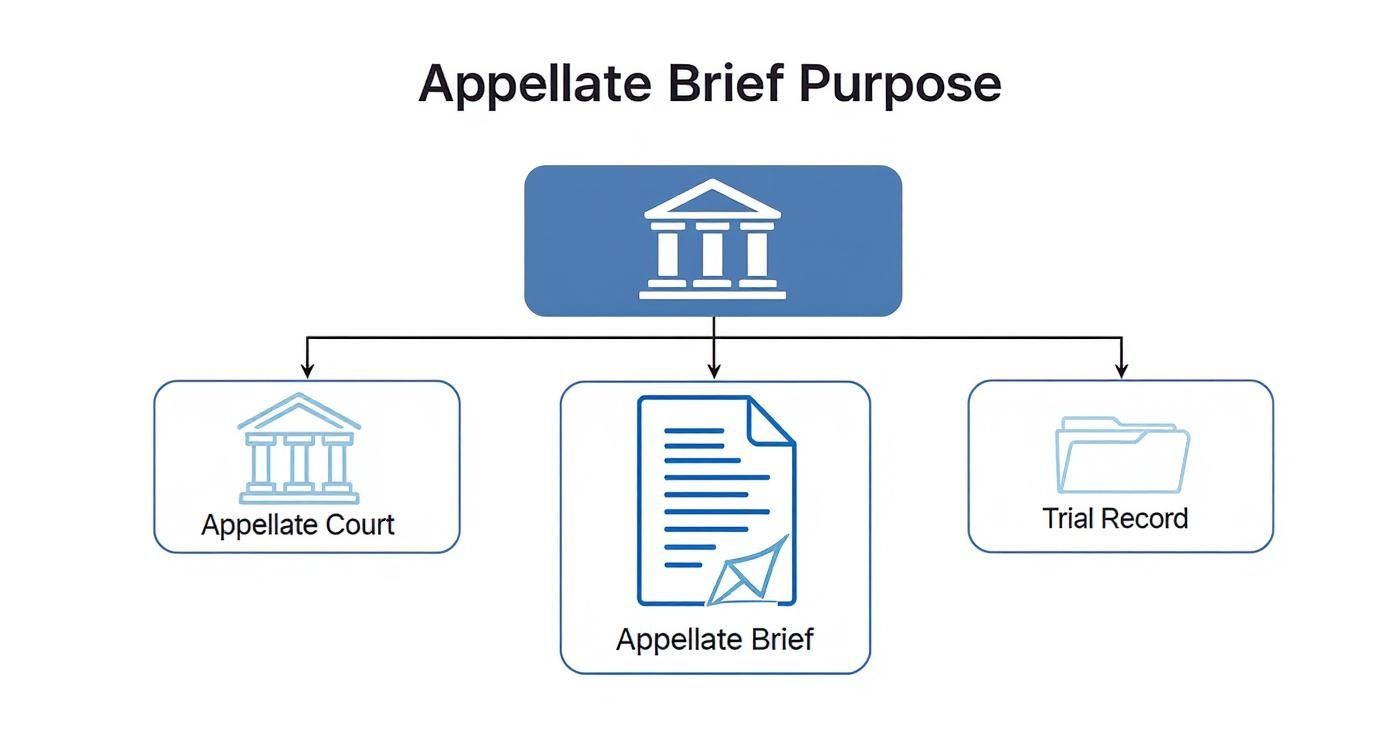
As you can see, the brief is the bridge. It is the only tool the appellate court has to understand what happened at trial, connecting them to the official record through a structured, persuasive narrative.
Statement of the Case: Setting the Stage
The first major section, the Statement of the Case, gives the appellate court a bird's-eye view of the journey so far. It is a concise, neutral summary of what happened in the trial court—the key events, the major rulings, and the procedural path that brought the case to the court of appeals.
This part is purely factual. Every statement must point directly back to a specific page in the trial record. While it is not the place for flashy arguments, its importance cannot be overstated. A clear, well-organized Statement of the Case builds trust with the judges and makes it much easier for them to follow the legal arguments to come.
Issues Presented: Pinpointing the Errors
Next up is one of the most critical sections: the Issues Presented. Think of these as sharply focused questions that get right to the heart of the matter. They pinpoint the exact legal mistakes you are asking the appellate court to fix.
Each question is carefully worded to guide the court toward the answer you believe is correct. For example, an issue might be phrased like this:
"Did the trial court commit a reversible error by labeling the husband's pre-marriage inheritance as community property, directly violating the Texas Family Code?"
This section defines the entire battlefield for the appeal. The appellate court will generally only consider the specific errors raised in these questions, so getting them right is absolutely crucial.
The Argument: The Heart of the Matter
The Argument is the engine of the brief. It's the longest and most detailed section, and it’s where your attorney connects the dots. Here, we take the facts from the trial record and pair them with established law—from statutes to previous court decisions (precedent)—to prove that a reversible error occurred.
This is where the real persuasion happens. The goal isn't just to show the trial judge made a mistake, but to demonstrate that the mistake was so significant it probably caused an unfair result. Drafting a powerful argument requires incredible organization and research, which is why many modern practices rely on cloud-based law firm software solutions to manage the complex process.
Statement of Facts: Telling Your Story
Finally, the Statement of Facts weaves the factual story of your case. It presents the narrative in a way that is most favorable to your position while staying completely faithful to the trial record. It provides the human context for the legal arguments.
Interestingly, while the facts are the foundation of any case, this section is only one part of the brief. The real work is done in the legal argument, where those facts are applied to the law to prove an error occurred.
The brief then wraps up with a Prayer, which is a formal, one-sentence request telling the court exactly what you want it to do. This could be a request to reverse the trial court's judgment entirely, send the case back for a new trial (remand), or issue a new decision.
Anatomy of a Texas Appellate Brief
The table below outlines the essential sections of a Texas appellate brief, explaining what each part does in plain English.
| Brief Section | Purpose | What It Includes |
|---|---|---|
| Identity of Parties | To clearly identify who is who in the appeal (Appellant vs. Appellee). | Names and roles of all parties and their attorneys. |
| Table of Contents | A roadmap that helps the judges navigate the document quickly. | A list of every section and argument heading with corresponding page numbers. |
| Index of Authorities | A reference list of all the legal sources (cases, statutes) cited in the brief. | An alphabetized list of every case, statute, and rule mentioned, with page numbers where they appear. |
| Statement of the Case | To provide a neutral, factual background of the case's history. | A short summary of the trial court proceedings and the final judgment being appealed. |
| Issues Presented | To frame the specific legal errors the appellate court needs to decide on. | A numbered list of carefully worded questions that define the scope of the appeal. |
| Statement of Facts | To tell the story of the case from your perspective, supported by the record. | A detailed narrative of the relevant facts, with citations to the Clerk's Record and Reporter's Record. |
| Argument | The core of the brief; to persuade the court that a reversible error occurred. | A detailed legal analysis for each "Issue Presented," applying the law to the facts with supporting citations. |
| Prayer | To formally ask the court for a specific outcome. | A single, concluding sentence requesting a specific action (e.g., "reverse the trial court's judgment"). |
| Certificate of Service | To prove that a copy of the brief was sent to the opposing party. | A signed statement confirming the date and method of delivery to the other side's attorney. |
Understanding this structure demystifies the appellate process and shows the incredible level of detail and strategy required to build a winning appeal.
Understanding How an Appeal Differs from a Trial
One of the most important things to understand is that an appeal is not a do-over. It is not a second trial where you get another chance to present your case or introduce evidence you wish you had used the first time. The entire process is fundamentally different, governed by a new set of rules with a completely different goal.
Think of it this way: a Texas family law trial is about building something from scratch. Attorneys are like construction workers, presenting evidence (materials) and calling witnesses (the crew) to build a factual record for the judge.
An appeal, on the other hand, is more like being a building inspector. You start with the finished structure—the official trial record—and your job is to search for critical flaws in how it was built, specifically, legal mistakes made by the judge. There are no witnesses, no new exhibits, and no jury. The entire fight takes place on paper, in the appellate brief.
No New Evidence Allowed
This is often the toughest concept for clients to accept. The appellate court is strictly confined to reviewing what is already in the trial court record. This record is made up of two key parts:
- The Clerk’s Record: This is the collection of every document filed in your case—petitions, motions, discovery responses, and the final judgment itself.
- The Reporter’s Record: This is the word-for-word transcript of everything said in court during hearings and the trial, captured by the court reporter.
The appellate judges cannot consider anything outside of these documents. This is precisely why the quality of your appellate brief is so critical; it must masterfully use only this existing information to prove that a legal error happened. You can learn more about this process in our guide on how to appeal a family court decision.
Understanding the Standard of Review
Appellate judges do not simply ask if they would have ruled differently. Instead, they must use a specific legal measuring stick called the standard of review, which sets a very high bar for overturning a trial court’s decision.
In most Texas family law cases, the standard is abuse of discretion. This is a legal term meaning the judge acted unreasonably, arbitrarily, or without following established legal rules. It does not mean the judge was a bad person or acted with ill intent. To win on appeal, your brief must show that the judge's decision was not just a simple disagreement, but a clear departure from the law.
A trial asks, "What are the facts?" An appeal asks, "Did the judge make a legal error in applying the law to those facts?" This shift in focus is what makes appellate law a highly specialized field.
A Battle of Written Words, Not Live Testimony
Since everything in an appeal hinges on the written record, your primary weapon is the appellate brief. This is where a specialized appellate attorney proves their worth. They craft a powerful, meticulously researched legal argument that walks the appellate judges through the trial record, pointing out the errors and explaining exactly why those errors matter under the law.
The vast majority of appeals are decided based on the written briefs alone, often without the attorneys ever stepping into the courtroom for oral argument. The heavy reliance on the written word is what makes appellate work a distinct skill—it’s all about legal writing, deep analysis, and procedural precision.
Common Reversible Errors in Texas Family Law

To truly understand why an appellate brief is so crucial, you must understand what a reversible error actually is. It is not about simply being unhappy with the judge's final decision. It is about identifying a specific, significant legal mistake that likely led to an improper outcome. A successful appeal hinges on our ability to comb through the trial record and prove that mistake happened.
These errors often fall into a few common categories. Think of them as instances where the trial court strayed from the legal rulebook that governs every Texas family law case. By recognizing these patterns, you can begin to see if your case may have grounds for a second look from a higher court.
Property Division Errors
One of the most common sources of reversible error is in the division of marital property. The Texas Family Code provides very specific guidelines for distinguishing between separate and community property. When a trial court gets it wrong, the financial consequences can be devastating.
A classic example is the mischaracterization of property. For instance, if the court treated an inheritance you received during the marriage—which is your separate property by law—as community property and divided it with your ex-spouse, that is a clear legal error. An appellate brief would guide the higher court through the trial evidence, showing exactly why that asset was separate and how the judge's mistake created a financially unjust result.
Child Custody and Support Miscalculations
Every decision regarding a child must be based on the "best interest of the child." If a court makes a custody or possession ruling that is not supported by evidence in the record, that can be what’s known as an abuse of discretion.
Common reversible errors in this area include:
- Improper Application of Custody Factors: The judge may have ignored important evidence about the other parent's instability or failed to consider all the legally required factors when deciding what was in the child's best interest.
- Child Support Miscalculations: A judge might miscalculate a parent's net resources, overlook sources of income, or deviate from the state's child support guidelines without providing a legally valid reason in their written findings.
- Denial of a Parent's Rights: A court may impose an unfair geographic restriction or a possession schedule that is not supported by any evidence, essentially punishing a fit parent without just cause.
Evidentiary and Procedural Mistakes
Sometimes, the error is not in the final ruling but in the flawed process that led to it. The Texas Rules of Evidence and Civil Procedure are designed to ensure every trial is fair. When a judge violates one of these rules and it harms your case, you may have grounds for an appeal.
A reversible error isn't just any mistake. It's a mistake that mattered—one that probably caused the trial court to reach the wrong conclusion. The appellate brief's job is to prove not only that an error occurred, but that it was harmful to your case.
For example, perhaps the judge wrongly refused to admit a key piece of evidence that would have proven your point. Or, conversely, they may have allowed unreliable testimony that prejudiced the case against you. These kinds of procedural errors can undermine the fairness of the entire trial. If you suspect a mistake like this occurred, it is critical to review the specific grounds for appeal in a family court case to determine if you have a path forward. Pinpointing these errors is the foundation for building a compelling appellate brief and fighting for the just outcome you were denied.
Why an Appellate Specialist Is Critical for Your Appeal
Winning a trial and winning an appeal are two completely different undertakings, requiring fundamentally different skill sets. Think of your trial attorney as a master of the stage—they excel in the live theater of the courtroom, persuading juries, cross-examining witnesses, and thinking on their feet. Their entire focus is on building a compelling factual record in real-time.
Appellate work, on the other hand, is a different craft altogether. It's a scholarly, behind-the-scenes battle fought almost entirely on paper. It demands an obsession with meticulous legal research, the art of persuasive writing, and an encyclopedic knowledge of the complex Texas Rules of Appellate Procedure.
A Fresh and Objective Perspective
One of the most powerful things an appellate specialist brings to the table is a fresh set of eyes. After a grueling and emotionally charged trial, it can be difficult for the original attorney and the client to look at the case objectively.
An appellate lawyer, however, comes in cold. They have no emotional baggage tied to the case. Their one and only job is to meticulously scour the trial record—every single page of transcript, every exhibit—to hunt for the specific legal mistakes that amount to reversible error. They are trained to see the forest for the trees and spot issues that were easily missed in the chaos of trial.
Speaking the Language of the Appellate Court
Appellate judges operate on a different wavelength than trial judges or juries. They are not there to re-hear testimony or decide which party is more believable. Their sole purpose is to determine if the law was applied correctly, and they do this by following a strict standard of review for each type of potential error.
An appellate specialist knows this audience inside and out. They understand how to structure an appellate brief that speaks directly to these judges, focusing squarely on legal precedent and procedural rules, not on the emotional appeals that might sway a jury. Their arguments are painstakingly built to persuade a panel of legal scholars that a serious legal error infected the trial's outcome.
An appeal isn't won by re-telling the story that lost at trial. It's won by presenting a new story—a story about legal error—that convinces a higher court to intervene and restore fairness to the process.
This specialized focus is absolutely essential. Your trial lawyer did their part by creating the record. Now, you need an expert to dissect that record for legal flaws. The strategic advantage of working with a dedicated Texas family law appeal attorney who lives and breathes this unique area of law cannot be overstated. They bring the precise expertise needed to give your case its best possible shot at a just result.
Taking the First Step After a Disappointing Court Ruling
When a judge’s decision in your divorce or child custody case feels fundamentally unfair, it is easy to feel that you have reached a dead end. But a trial court's ruling does not have to be the final word. The Texas appeals process exists for this very reason—to provide a structured path to challenge a decision you believe was based on a legal mistake.
Understanding what an appellate brief is and its central role in this process is the crucial first step. It is the key to having your case re-examined for the kinds of errors that can derail a family’s future. You have the right to seek justice, but the clock is already ticking.
The deadlines for filing an appeal are incredibly strict and begin the moment the judge signs the final order. Acting quickly is a necessity. Our appellate attorneys are dedicated to this complex field of law. We focus on pinpointing the specific, reversible errors that appellate courts look for and then build a compelling, judge-focused brief that presents your case in the strongest possible light.
A single legal misstep at trial can impact your finances, your property, and your relationship with your children for years to come. You do not have to simply live with an outcome that feels wrong. Let our team provide a straightforward, honest evaluation of your situation and guide you in the fight for the fair resolution you and your family deserve.
If you believe the court made a mistake in your family law case, our appellate attorneys can help you seek a fair outcome. Contact The Law Office of Bryan Fagan today for a free consultation. Contact us today for a free case evaluation.