You may feel like the judge made a decision that turned your life upside down in a matter of minutes. A parenting schedule changed. A property award feels lopsided. Support obligations start immediately, even though you believe the court got the facts or the law wrong. That sense of unfairness is real, and it often comes with a second fear: what happens before an appellate court has time to review the case?
Texas appellate law gives you a path forward, but it's a technical path. Appeals aren't second trials. They are rule-driven reviews of whether the trial court committed legal error, abused its discretion, or entered a judgment that can't stand under the record and the law. That distinction matters, because the steps you take right after judgment can protect your rights, your assets, and sometimes your ability to keep the case from becoming harder to fix later.
One of the most confusing parts of this process is the phrase appeal bond Texas family law. Many people search for it because they assume a bond is required to start an appeal. In most Texas family law appeals from district court, that isn't true. Instead, the strategic question is usually whether you need a supersedeas bond to pause enforcement of a money judgment while the appeal moves forward.
A spouse who has been ordered to make a property equalization payment faces one set of risks. A parent appealing a conservatorship ruling faces another. Knowing the difference can keep you from wasting time on the wrong problem.
Introduction An Unfair Ruling Is Not the Final Word
A family law judgment can leave you feeling cornered. One day you're trying to explain your side in court. The next, you're reading an order that controls your finances, your parenting time, or both.
That shock often leads people to ask the wrong first question. They ask, “How do I get an appeal bond?” when the better questions are: “What can I appeal?” “What deadline applies?” and “What part of this order can be paused?”
Appeals are about legal error, not starting over
Texas appeals work under the Texas Rules of Appellate Procedure and the Texas Family Code. The appellate court reviews what happened in the trial court. It studies the clerk's record, the reporter's record if one exists, the written briefs, and the legal standards that govern the issues raised.
A few plain-English terms help:
- Abuse of discretion means the trial court acted outside the zone of reasonable choices allowed by law.
- Reversible error means a legal mistake that probably caused an improper judgment or prevented a fair presentation of the case.
- Briefing means the written legal arguments filed in the appellate court, with citations to the record and controlling law.
A strong appeal doesn't argue that the outcome felt unfair. It shows where the ruling broke the rules.
How an appeal differs from a trial
Trials focus on live witnesses, exhibits, credibility, and fact finding. Appeals focus on the existing record and the standard of review. That standard can be decisive. Some issues are reviewed with deference to the trial judge. Others turn on pure legal questions.
Common reversible issues in Texas family court can include:
- Wrong legal standard applied when the court used the wrong rule to decide conservatorship, property, or support.
- Excluding key evidence that should have been admitted and mattered to the outcome.
- Procedural error such as denying notice, rushing a hearing, or limiting a party's ability to present the case.
- Insufficient findings or unsupported rulings when the judgment doesn't match the evidence or the required legal framework.
The first days after judgment are often the most important. Preserving deadlines, ordering the record, and identifying what can be challenged creates structure when everything else feels unstable.
What Is an Appeal Bond in Texas Family Law
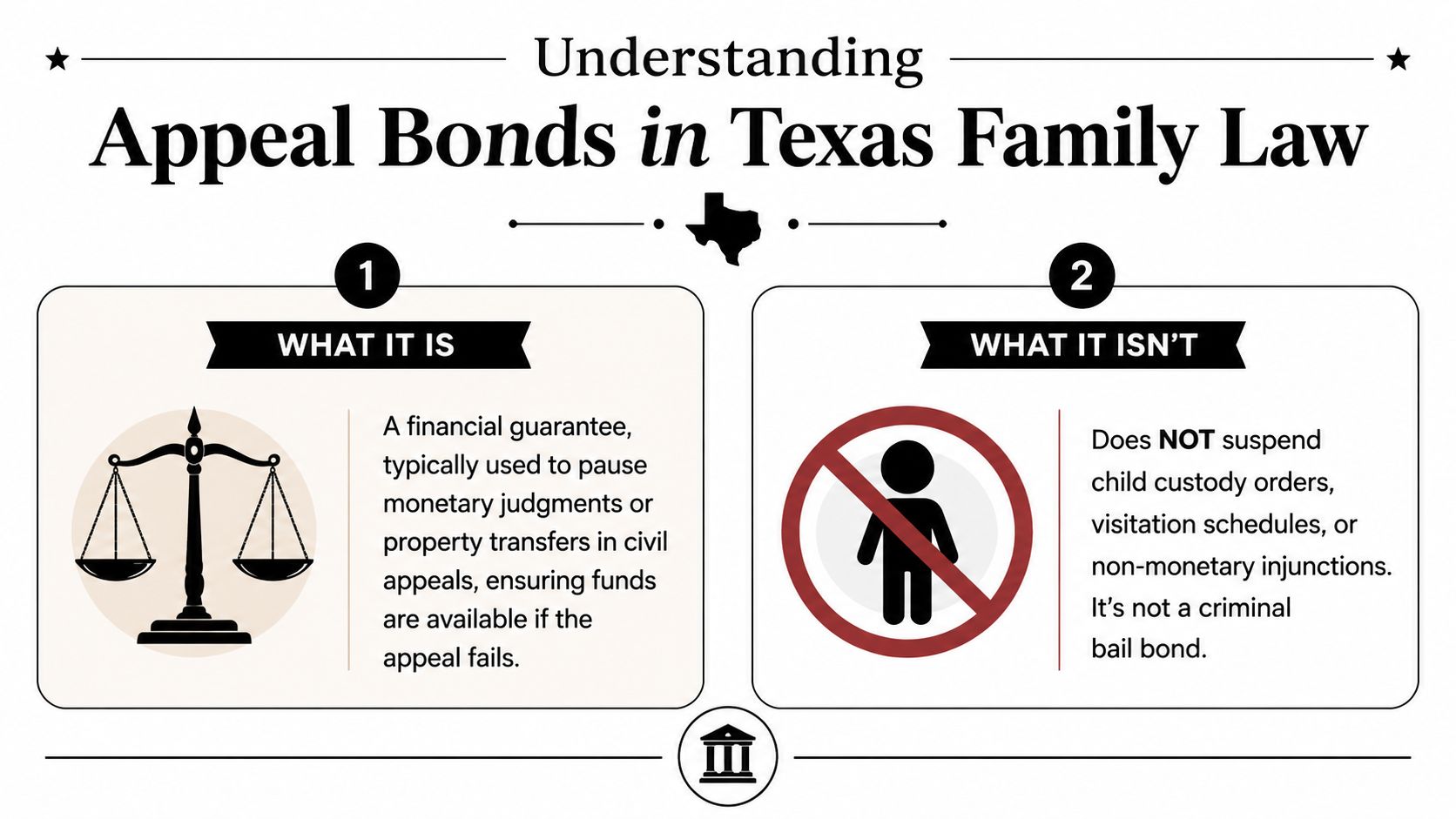
The phrase appeal bond causes more confusion than almost any other term in family appeals. In district court family cases like divorce, custody, property division, and support, you generally don't need a bond just to file the appeal. Texas civil family law appeals are perfected by filing a Notice of Appeal. The prior statutory requirement for an appeal bond to initiate the appeal has been repealed, and a supersedeas bond is a separate tool used to suspend enforcement of a money judgment during the appeal, as noted by Hennan Culp's discussion of Texas appeals.
Here is the core distinction.
The notice starts the appeal
If your case was decided in district court, the appeal starts by filing a Notice of Appeal within the applicable appellate deadline. That filing gets the case into the appellate system. It does not, by itself, freeze enforcement.
Many people lose time searching for bond forms, calling surety companies, and assuming the appeal cannot begin without security. In most family appeals, that effort misses the first procedural step.
The supersedeas bond pauses enforcement of money judgments
A supersedeas bond is different. Think of it as a pause button for the financial parts of a judgment. If the trial court awarded money or entered a judgment that can be enforced financially, a supersedeas bond can suspend collection efforts while the appeal is pending.
That distinction is explained in more depth in this guide to a Texas family law supersedeas bond.
Later in the case, the appellate court won't retry the evidence. It will review whether the trial court committed reversible error. If you're trying to identify those issues, Grounds for Appealing a Texas Family Law Ruling addresses the kinds of error that can support an appeal.
A short visual overview can help:
Where actual appeal bonds still matter
The bond rules people often find online usually apply to justice court or municipal court appeals, not district court family appeals. Existing guidance often misses that distinction, even though Texas family cases are typically filed in district court. The small claims appeal materials collected by the Texas State Law Library guide on appealing a case show why that confusion happens.
In plain terms, if you're appealing a divorce decree or final custody order from district court, the key issue usually isn't “Do I need a bond to appeal?” It's “Do I need supersedeas relief to stop financial enforcement while the appeal proceeds?”
When a Supersedeas Bond Is Required in a Family Law Appeal
A supersedeas bond matters when the judgment includes a money component and you need to stop the other side from enforcing it while the appeal is pending. Without acceptable security, the judgment creditor may enforce the final judgment after 30 days, even during appeal, under the rules summarized by the State Bar guidance referenced in the verified data. That timing can quickly alter the practical advantage in a case.
Monetary parts of a decree versus non-monetary parts
Family law decrees often contain several kinds of rulings at once. Some can be protected with supersedeas. Some cannot.
| Part of the order | Can a supersedeas bond help pause enforcement |
|---|---|
| Property division payment | Yes, if it operates as a money judgment |
| Spousal maintenance arrearage or money award | Often yes, if it is a money judgment |
| Turnover of certain financial assets | Often part of the monetary enforcement question |
| Child custody schedule | No |
| Visitation terms | No |
| Injunctive or conduct-based provisions | Not through a standard money supersedeas analysis |
If the decree orders one spouse to pay a sum related to the division of the marital estate, the winning party may try to collect if no supersedeas is in place. That can affect cash accounts, business interests, or real property before the court of appeals decides whether the judgment stands.
Practical rule: If the order can be enforced like a money judgment, ask about supersedeas immediately.
The bond amount and the cap
Texas Rule of Appellate Procedure 24.2 ties the amount of supersedeas security to compensatory damages, interest for the estimated duration of the appeal, and costs. The amount is capped at the lesser of 50% of the judgment debtor's current net worth or $25 million, as reflected in the verified Rule 24.2 data.
That cap matters most in high-value divorce litigation. It prevents a supersedeas requirement from becoming financially destructive while still protecting the other side if the appeal fails.
Here is what works in practice:
- Documenting net worth carefully because the cap depends on current net worth, not guesswork.
- Separating monetary relief from parenting provisions because only some parts of the decree fit the supersedeas framework.
- Acting before enforcement begins because delay gives the prevailing party time to pursue collection remedies.
What doesn't work is assuming the appellate filing itself prevents enforcement. It doesn't. If the decree has a serious financial component, supersedeas strategy should be part of the appeal plan from the beginning.
The Process for Suspending a Judgment
Suspending enforcement is a formal process. It takes planning, documentation, and a clear understanding of which court orders can be paused. In most money-judgment situations, the work starts almost immediately after the final order is signed.
Step one begins with the appeal and the record
The appeal itself requires a timely notice, then preparation of the appellate record. That usually includes the clerk's record and, if testimony matters, the reporter's record. This is one major difference from trial practice. On appeal, if something isn't in the record, the appellate court generally can't consider it.
The briefing stage also matters. Your appellate brief identifies the legal issues, states the standard of review, cites the record, and explains why the error warrants reversal, remand, or modification. A good brief is precise. It does not relitigate every grievance from trial.
Suspending enforcement requires a separate security analysis
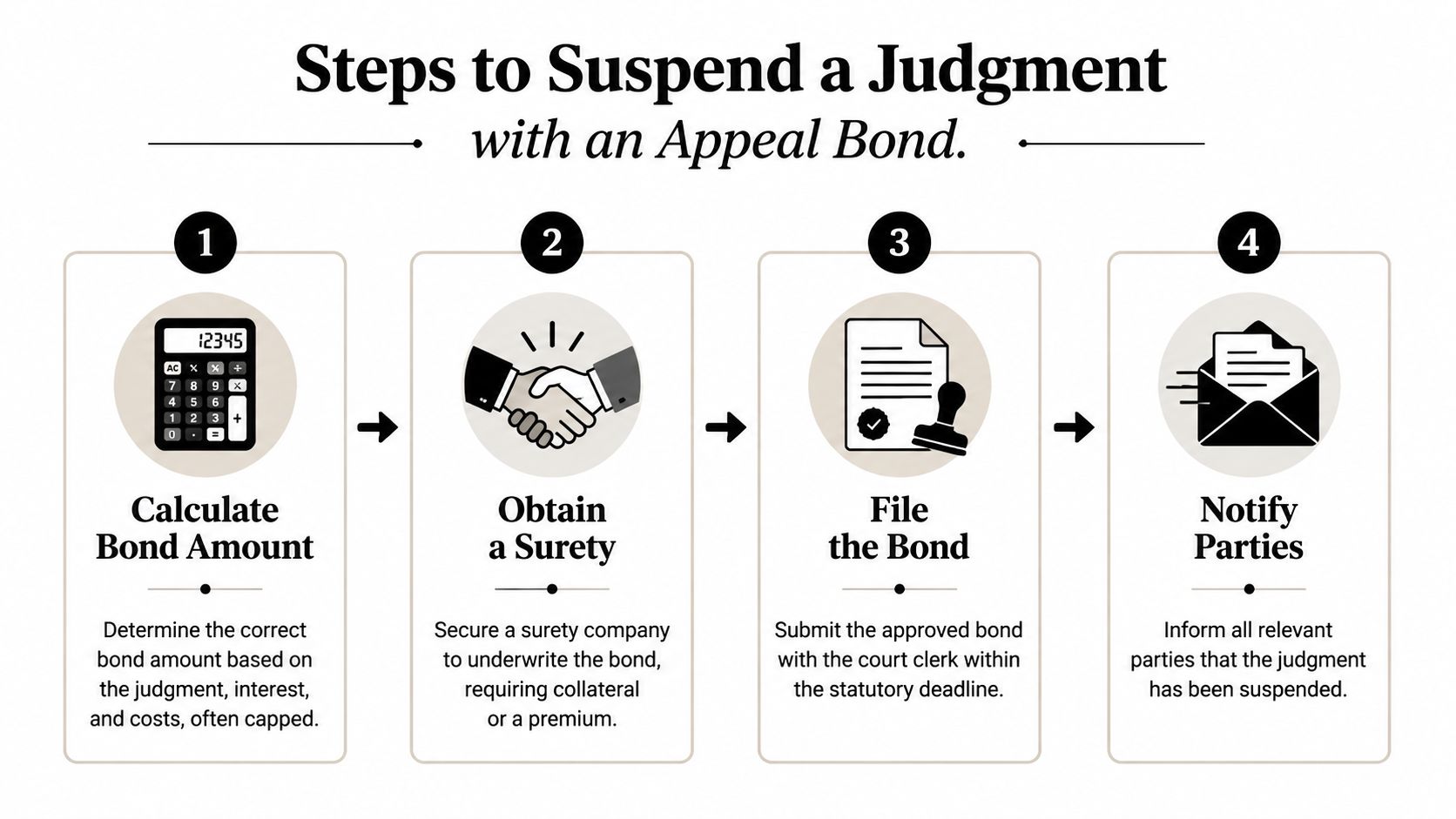
Under Texas Rule of Appellate Procedure 24.2, the court must determine the amount and type of security required to supersede a money judgment. The verified data confirms that this usually involves filing a motion to determine the amount of security, presenting evidence of net worth, and obtaining a written order approving the security.
That process often includes:
- Calculating the amount based on compensatory damages, estimated interest during the appeal, and costs.
- Presenting net worth evidence if the cap is relevant.
- Obtaining security through a surety bond or another approved form.
- Securing a written order so there is no doubt about what has been approved.
A practical reference on this point is the discussion of a stay of enforcement pending appeal in Texas.
A bond alone may not stop a family law order
Family cases differ from many ordinary civil judgments in that filing a supersedeas bond under Texas Family Code Chapter 109 does not automatically suspend a final order in family law. Suspension occurs only if the appellate or trial court specifically orders it, according to Texas Family Code Chapter 109 materials.
That means lawyers have to ask a second question: even if money-security issues are addressed, is there a separate suspension request that needs to be made?
Filing security is one task. Getting an enforceable suspension order is another.
Traditional bond versus cash deposit
Some litigants use a surety bond. Others consider a cash deposit with the clerk if permitted and strategically sensible. The right choice depends on liquidity, collateral, underwriting realities, and the size of the judgment.
A surety company may require substantial financial disclosure. In a divorce involving business ownership, retirement assets, or real estate, that can become a detailed exercise. A cash deposit may avoid underwriting issues, but it ties up funds.
The procedural roadmap is manageable, but it has to be done carefully. Deadlines, evidence, and the wording of the court's order all matter.
Navigating Custody and Non-Monetary Orders During an Appeal
The most dangerous mistake in this area is believing a bond will freeze the parenting provisions of the judgment. It won't. If the trial court changed conservatorship, possession, or access, those rulings generally remain in effect unless a court specifically suspends them.

Why custody orders are treated differently
Texas family courts place a premium on stability for children. For that reason, an appeal from a final family law order does not automatically suspend the order, even if a bond is filed, unless the appellate court specifically orders suspension. The verified Texas Family Code Chapter 109(C) data also notes that parents may be bound by temporary custody orders during appeals that can last 12+ months.
That reality is hard for parents to hear, especially when they believe the trial court plainly got it wrong. But accurate advice matters more than comforting myths.
What that means in daily life
If the final order sets a new exchange schedule, decision-making structure, or restriction on contact, you usually must follow it while the appeal proceeds. Violating the order because you believe the appeal will fix it can create new problems, including enforcement claims.
This applies beyond custody. Many non-monetary rulings don't fit neatly within a standard supersedeas framework. Protective restrictions and conduct-based injunctions often require separate analysis and separate relief.
If your appeal involves those issues, a related question may be whether you can challenge protective or restraining relief directly. This article on appealing a restraining order addresses that category.
Parents often focus first on winning the appeal. The immediate legal task is usually compliance with the current order while preserving the appellate challenge.
The standard to suspend is demanding
Courts do not casually suspend child-related orders. The party seeking suspension has to do more than say the ruling was unfair. The request must be grounded in law, record support, and the specific standards that govern emergency or interim relief.
That's why expectations have to be realistic. The appellate process can correct serious error, but it usually doesn't create an immediate reset of day-to-day parenting terms.
Common Pitfalls and Strategic Considerations
Some appeal problems come from bad rulings. Others come from avoidable post-judgment mistakes. In family law appeals, both matter.
The traps that cause the most damage
A few errors appear again and again:
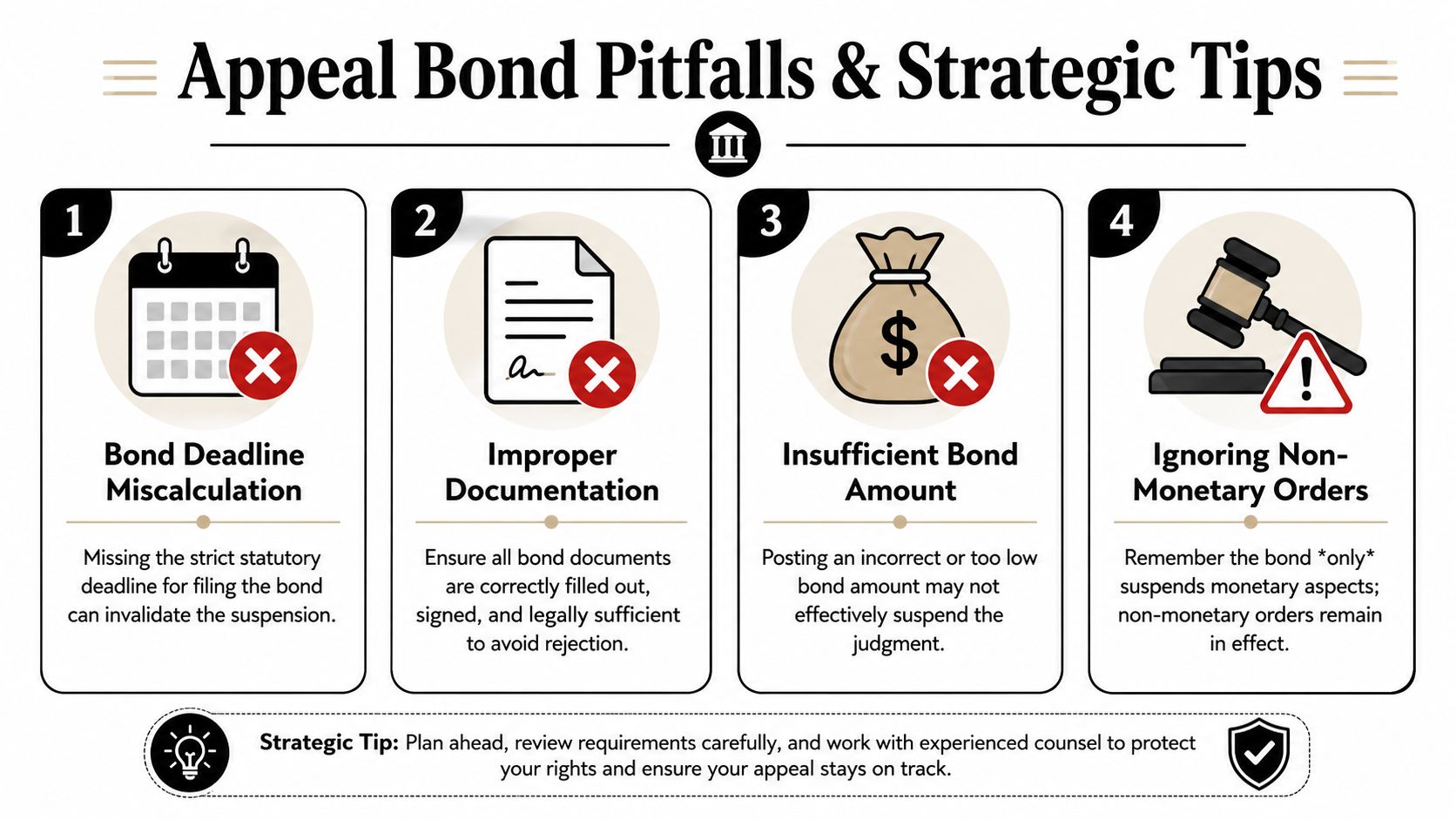
- Confusing court levels because justice court bond rules are mistaken for district court family appeal rules.
- Missing appellate timing issues by waiting too long to evaluate the judgment, post-judgment motions, and notice deadlines.
- Using weak net worth proof when asking the court to apply the supersedeas cap.
- Assuming the bond covers custody or injunction terms when it addresses only the financial side of enforcement.
In justice and municipal court appeals, bond rules are very specific. Under Texas Government Code section 30.00147, the bond must be filed no later than the 10th day after the overruling of a motion for new trial, plaintiffs file a $500 bond, and defendants post twice the judgment amount. Those rules are real, but they usually are not the rules controlling a district court divorce or custody appeal.
Strategy means weighing cost against purpose
Not every appeal needs supersedeas. If the decree contains no immediately enforceable money judgment, the bond issue may be minor or irrelevant. If the financial exposure is serious, the analysis changes.
Useful questions include:
- Is the judgment likely to be enforced quickly?
- Would enforcement disrupt retirement funds, real estate, or business operations?
- Is the cost of obtaining security justified by what the bond protects?
- Does the appeal present a focused, legally sound reversible issue?
Sometimes the right move is to invest heavily in supersedeas because the asset risk is immediate. Sometimes the better move is to direct resources toward record work and briefing because a bond won't materially change the client's position.
For parties who need appellate representation or a second opinion on viability, Texas Family Law Appeals Lawyer is one available resource describing appellate representation focused on final family law orders and legal error.
Your Path to a Fair Outcome Next Steps in Your Appeal
An unfair ruling can make the future feel fixed. It isn't. Texas appellate procedure gives you a structured way to challenge legal error, but success depends on using the right tools for the right problem.
If there is one point to hold onto, it's this: in most district court family appeals, an appeal bond is not what starts the appeal. A timely notice does that. The supersedeas bond serves a different purpose. It can protect against enforcement of money judgments while the appellate court reviews the case.
That difference shapes strategy from the start. Appeals require close attention to deadlines, the appellate record, standards of review, and the parts of the judgment that can or cannot be suspended. They also require honest advice. Some rulings can be paused financially. Custody and other non-monetary orders usually require separate and much harder relief.
A calm, careful review of the order often changes the conversation. Instead of reacting to the entire judgment at once, you can identify what must be appealed, what must be obeyed for now, and what must be protected before enforcement begins.
If you believe the court made a mistake in your family law case, our appellate attorneys can help you seek a fair outcome. Contact The Law Office of Bryan Fagan today for a free consultation.
If you're weighing an appeal after an unfair divorce, custody, property division, or protective order ruling, The Law Office of Bryan Fagan, PLLC can evaluate whether legal error occurred, what deadlines control, and whether supersedeas or other post-judgment relief should be part of the strategy. Schedule a free consultation to review your case and discuss the next practical step.