You may be reading this right after a hearing that felt rushed, one-sided, or plainly wrong. That reaction is common in protective-order cases because the consequences start immediately, while the legal options can feel hidden behind technical rules.
The short answer is yes, in many situations you can appeal a restraining order. But the better question is often this: Is an appeal the right tool, or is another post-judgment remedy more effective? In Texas, that distinction matters. A direct appeal, a motion for new trial, a request to modify the order, and in limited situations a mandamus proceeding all serve different purposes.
A good strategy starts with the order you have, the errors that occurred in the trial court, and the deadline that's already running.
Understanding Your Right to Appeal a Texas Protective Order
If a Texas court signed a final protective order, you may have the right to appeal it. That matters because a final order can affect daily life in ways that are hard to undo later. It can restrict contact, affect where you go and who you see, influence future family-court disputes, and create serious reputational consequences.
A lot of confusion starts with the word “restraining order.” People use it loosely to describe several different orders. In Texas family law, the label matters because not every order is immediately appealable.

Temporary orders and final orders are not the same
A temporary ex parte protective order is usually entered at the beginning of a case without the full final hearing. Its purpose is short-term protection until the court can hear both sides more fully. In practice, these temporary orders are usually not treated the same way as a final judgment for appeal purposes.
A final protective order is different. It follows a hearing and operates as the court's final ruling on that request for relief. That finality is what typically opens the door to appellate review.
If you're trying to sort out what kind of order was entered, a Texas-specific overview of protective orders in Texas can help you identify the posture of your case before you choose a remedy.
Why clients challenge these orders
People don't appeal merely because they're angry. They appeal because the order may carry consequences into other parts of life, including later disputes over parenting, possession, and credibility. In family law, one court's findings can echo into the next hearing.
Practical rule: Before asking whether the judge was unfair, ask whether the order is final. That single issue often determines whether you should file an appeal, seek modification, or pursue another remedy.
Texas appellate practice also fits a broader pattern seen in other states. In many jurisdictions, appeal rights exist, but procedure changes sharply from state to state. California explains that an appeal is usually governed by 60 or 180 days depending on the triggering event and that the appellate court reviews the existing record rather than retrying the case, while Maryland permits certain protective-order appeals to proceed de novo at an initial appellate level in some circumstances, meaning a new trial there (California and Maryland appellate guidance). The lesson is simple. The right to appeal may exist, but the path depends on the kind of order and the rules of the forum.
The first strategic question
When someone asks, “Can you appeal a restraining order?” my first concern isn't rhetoric. It's classification.
Use this short lens:
- If the order is temporary, a standard appeal may not be the right vehicle.
- If the order is final, appellate deadlines may already be running.
- If the problem is the wording or scope of the order, modification may be more practical than a full appeal.
- If the court acted outside normal procedure before final judgment, a different extraordinary remedy may be worth analyzing.
That early decision shapes everything that follows.
Common Grounds for a Successful Protective Order Appeal
An appeal is not a replay of the hearing. The court of appeals does not decide which witness it personally likes better. It asks whether the trial judge made a reversible error, meaning a legal mistake serious enough to justify changing the result.
That's why many disappointed litigants never become successful appellants. Disagreement alone isn't enough. The question is whether the record shows a legal problem the appellate court can correct.
Abuse of discretion in plain English
In Texas family appeals, a common standard is abuse of discretion. In plain English, that means the trial court made a decision that fell outside the range of reasonable choices allowed by law. The judge doesn't abuse discretion just because one side disagrees. The problem is bigger than that. The ruling must rest on a mistaken legal rule, a clearly unsupported conclusion, or a procedure the law didn't permit.
If you want a deeper explanation of why appellate outcomes often turn on this issue, Standards of Review in Texas Family Appeals addresses the basic framework.
What reversible error often looks like
A few examples come up repeatedly in protective-order appeals:
- Applying the wrong legal definition. If the court treated conduct as family violence when the governing law required more, the problem may be legal, not factual.
- Relying on evidence that should not have been considered. If the judge admitted improper hearsay over a valid objection and that evidence drove the ruling, that may support appellate review.
- Cutting off a party's right to present a defense. Protective-order hearings can move fast, but speed doesn't erase due process. If a party was denied a meaningful chance to testify, cross-examine, or offer admissible evidence, that can become a serious issue on appeal.
A broader discussion of what qualifies as reversible error in Texas family court can help you test whether the problem in your case is legal enough for appellate review.
Insufficient evidence is different from simple disagreement
Another common argument is legal or factual insufficiency. This means the evidence presented at the hearing wasn't enough to support the order under the governing standard. This is harder than many people expect. Appellate courts usually give trial judges room to resolve credibility disputes.
The strongest appeals usually point to a specific ruling, a specific objection, and a specific place in the record where the court went off course.
That's why a careful appellate review focuses less on “the judge didn't believe me” and more on questions like these:
| Issue in the hearing | Why it matters on appeal |
|---|---|
| Wrong rule applied | The order may rest on legal error |
| Proper objection overruled | The record may preserve an evidentiary complaint |
| Key testimony excluded | The party may have been denied a fair hearing |
| Findings unsupported by admitted evidence | The ruling may lack a sufficient basis |
A strong appeal is precise. It doesn't argue everything. It identifies the error that likely changed the outcome.
The Critical First Steps and Deadlines for Your Appeal
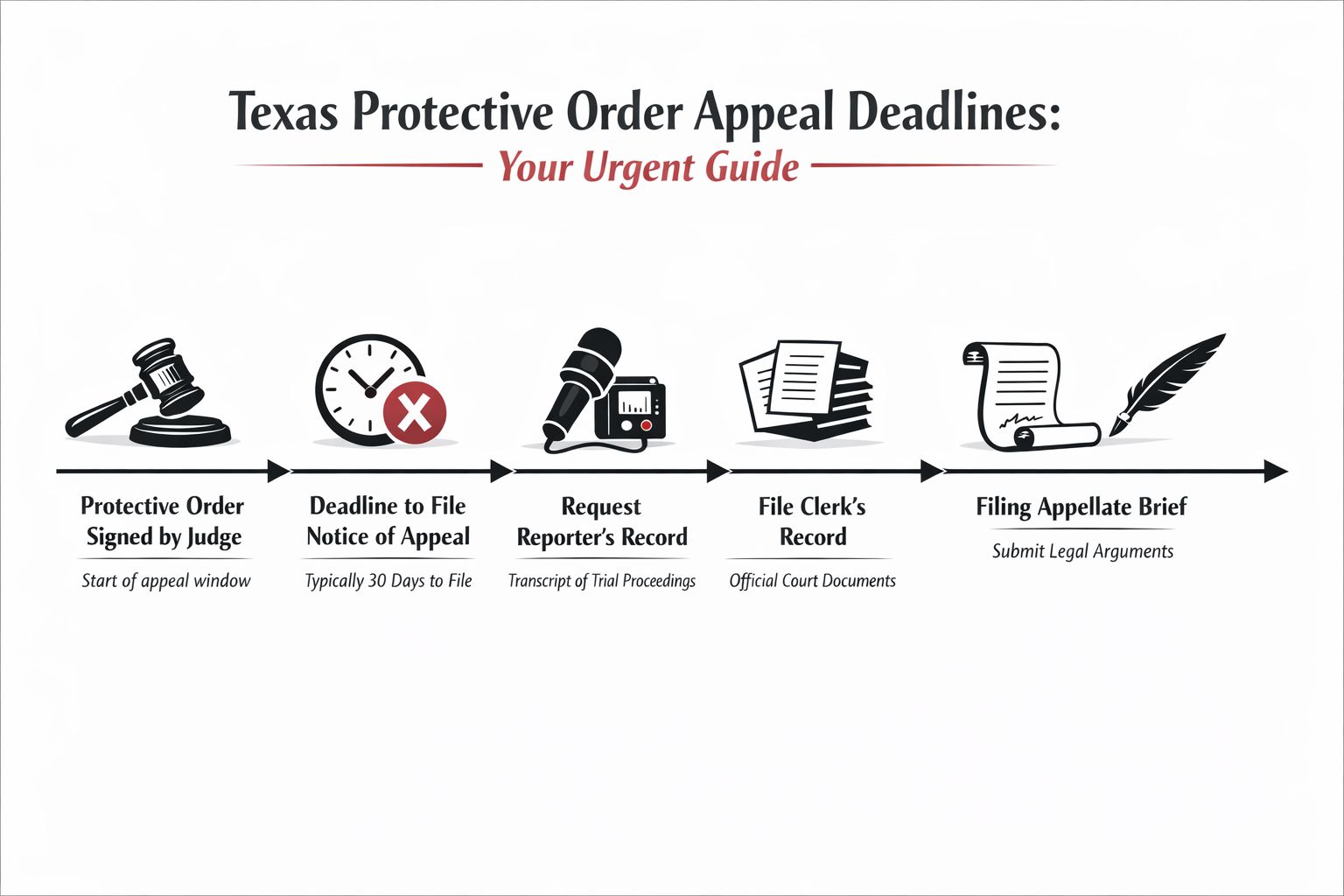
This is the part clients most often underestimate. Once a final protective order is signed, the legal clock starts. Waiting to “see what happens” can effectively eliminate options that might have existed the day before.
In Texas appellate practice, timing is not a side issue. It is part of the merits because a missed deadline can end the case before any appellate court reviews the order at all.
The deadline problem is real
Texas appellate deadlines are strict under the Texas Rules of Appellate Procedure, and protective-order cases don't reward delay. The broader pattern across the country shows the same urgency. State guidance reflects short appeal windows in many places. Ohio requires a notice of appeal within 30 days, New Jersey gives 45 calendar days, and West Virginia allows only 10 days to appeal a denied final protection order, with a hearing on that appeal within 10 days of filing (short protection-order appeal windows in several states).
That national pattern matters for one reason. Courts treat these disputes as time-sensitive because they affect contact, safety, residence, and parenting issues right away.
Immediate moves that protect your position
In Texas, the practical first step is usually to identify the signing date and calculate the deadline for the notice of appeal. A related guide on the deadline for filing a notice of appeal in Texas can help you frame that analysis quickly.
After that, the work becomes tactical.
Get the signed order immediately
Don't rely on memory from the courtroom. Read the actual order. Appellate rights turn on what the judge signed, not what everyone thought the judge meant.Preserve the record while it's fresh
If the hearing was recorded by a court reporter, request the reporter's record. If key objections, rulings, or excluded testimony matter, you need that transcript.Consider post-judgment filings
In some Texas cases, a motion for new trial or a request for findings of fact and conclusions of law may affect strategy, preserve issues, or alter appellate timing. These aren't boilerplate filings. They should be chosen for a reason.
Here's a quick visual of how the process unfolds:
A working checklist for the first days
Use this as a practical sequence, not as a substitute for legal advice:
- Confirm finality. Ask whether the order is final and appealable.
- Calendar every deadline. Include the notice of appeal and any post-judgment filings under the Texas Rules of Appellate Procedure.
- Secure transcripts and exhibits. Appeals rise or fall on the record.
- Write down what happened at the hearing. Your memory is useful now, especially about objections, excluded evidence, and procedural problems.
- Get appellate counsel involved early. Early review helps identify whether the case belongs in a direct appeal, a post-judgment motion, or another route.
Urgency point: The first mistake after a bad ruling is often silence. The second is filing the wrong remedy after the right deadline has passed.
Protective-order appeals reward speed, but not panic. The goal is fast, accurate triage.
Navigating the Appellate Process From Record to Ruling
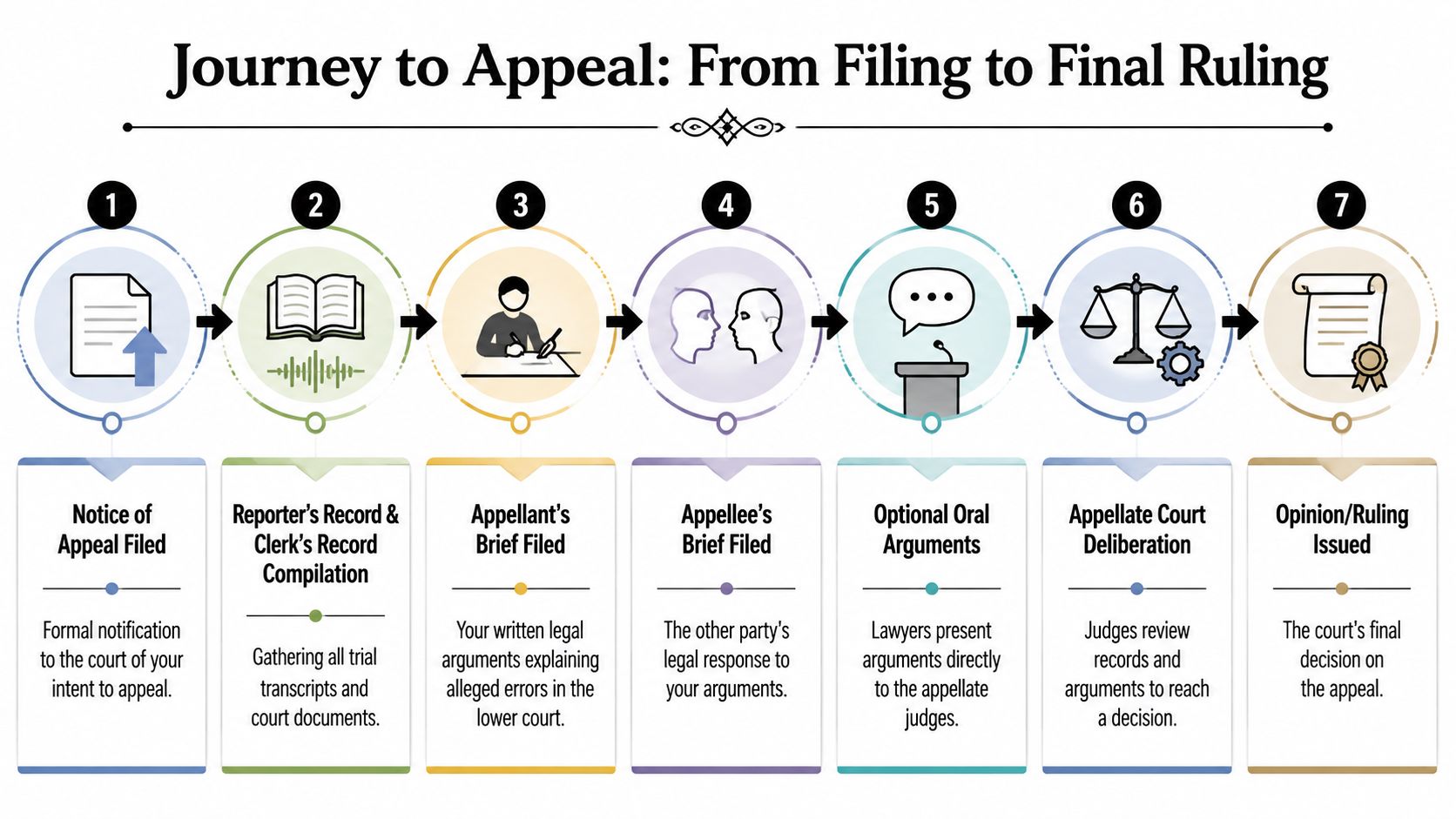
Once the notice of appeal is filed, the case changes character. Trial courts decide facts in real time, often with live testimony and immediate rulings. Appellate courts work differently. They study a closed record, read briefs, apply standards of review, and decide whether the trial court committed legal error.
That shift is where many clients feel lost. They expect another hearing with witnesses. Usually, that isn't what happens.
What the appellate record includes
The appellate record usually has two main parts.
- The clerk's record includes filed papers, the signed order, motions, pleadings, and other documents in the court file.
- The reporter's record is the transcript of what was said in the hearing, along with admitted exhibits if they were part of the proceedings.
That matters because appellate review is generally record-based. In many jurisdictions, including those discussed in court guidance outside Texas, an appeal is not a new hearing. The appellate court reviews the papers, admitted exhibits, and transcript from below rather than taking new testimony (record-based appellate review of protective-order cases).
Why new evidence usually doesn't help on appeal
Clients often say, “I have new texts now,” or “I found another witness.” That may be important for some other remedy, but it usually doesn't fit a direct appeal. Appellate courts review what the trial court had before it. They ask whether the judge erred on that record.
This is why appeals and trial strategy are connected. If a key exhibit never got admitted, or an objection was never made, the appellate court may have limited room to act.
A strong appellate case is built from what the trial court actually saw, heard, and ruled on. Not from what a party wishes had been offered later.
What briefing means
Briefing is the heart of the appeal. A brief is the written legal argument submitted to the appellate court. It identifies the issues, cites the governing law, points to the exact pages in the record, and explains why the error requires relief.
Good briefing does several things at once:
| Stage | What happens |
|---|---|
| Appellant's brief | The party appealing explains the trial court's error |
| Appellee's brief | The other side answers those arguments |
| Possible oral argument | Lawyers may answer judges' questions directly |
| Opinion | The court issues its ruling |
The brief is not a summary of frustration. It is a disciplined legal document. It has to translate a messy hearing into a clean legal question the appellate court can resolve.
In that sense, appellate work is often less about drama and more about structure. The best briefs show judges exactly where the error occurred, why it mattered, and what remedy fits the record.
Appeal vs Modification Exploring All Your Options
A direct appeal isn't always the best answer, even when a client was treated unfairly. Sometimes the stronger move is to return to the trial court and ask for a different kind of relief.
That's especially true when the underlying problem is not just what happened at the hearing, but what has changed since the order was signed.
Direct appeal and modification solve different problems
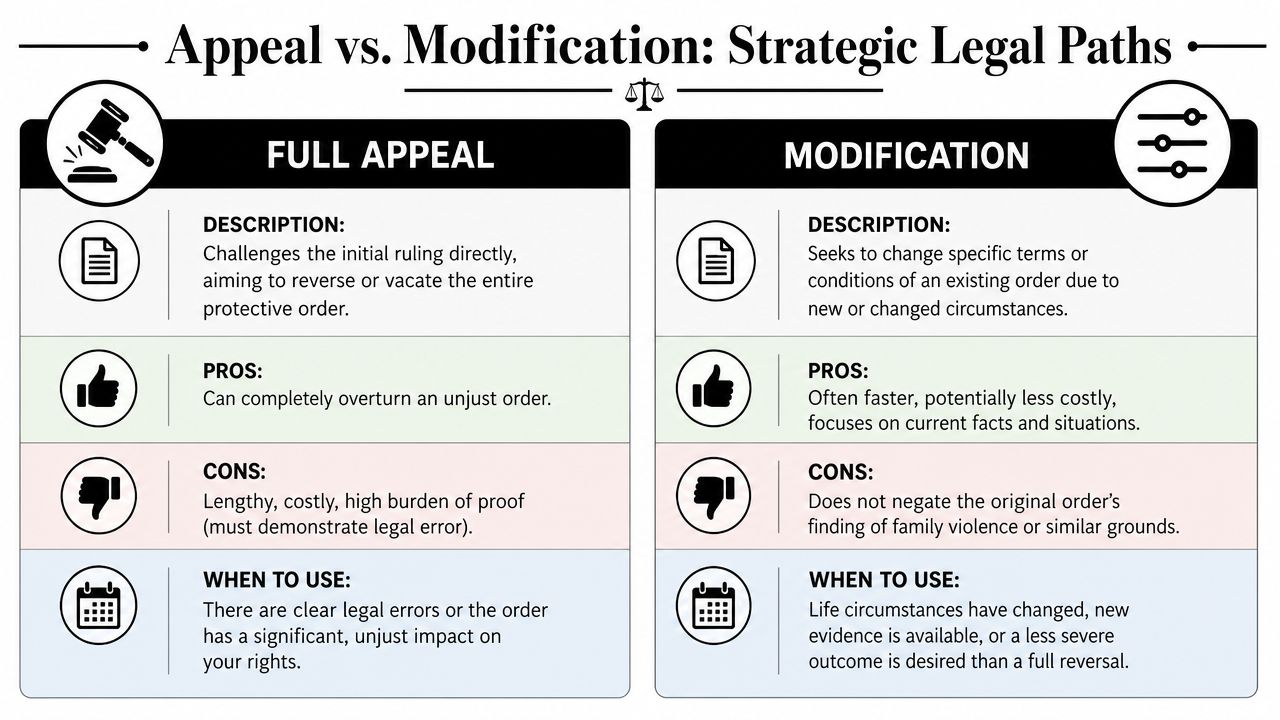
A direct appeal usually asks an appellate court to review the existing record for legal error. A motion to modify or dissolve asks the trial court to address the current reality of the order itself. Those are different jobs.
That distinction appears in court guidance from other jurisdictions as well. An appeal is usually limited to legal error on the existing record, while modification or dissolution can address changed circumstances or overly broad terms directly with the trial court (difference between appeal and modification or dissolution).
A practical side-by-side comparison
| Remedy | Best fit | Main limitation |
|---|---|---|
| Direct appeal | The judge made a legal or procedural error in the original hearing | Usually no new evidence |
| Motion for new trial | A narrow post-judgment challenge in the trial court may correct the problem quickly | Timing and preservation matter |
| Modification or dissolution | Circumstances changed, or the order's terms are too broad for current facts | Doesn't necessarily erase the original ruling |
| Mandamus | The court acted in a way that may require immediate extraordinary review | Available only in limited situations |
How the choice plays out in real life
If the judge applied the wrong legal standard at the hearing, that points toward appeal.
If the order contains terms that no longer match current circumstances, modification may be more efficient.
If a serious procedural problem happened before a final appealable judgment, mandamus might deserve analysis.
And if the trial court can still correct its own error through a timely post-judgment motion, that route may save time and narrow the issues for any later appeal.
A strategic review should ask:
- What exactly went wrong. Was it legal error, bad wording, or changed facts?
- What remedy can fix that specific problem. Not every unfair result needs a full appeal.
- How quickly is relief needed. Some remedies move faster than others.
- What does the existing record prove. Appeals depend on the record. Modification often depends on present circumstances.
The strongest strategy is the one that fits the problem, not the one that sounds most forceful.
When to Contact a Texas Appellate Attorney
Appellate work is a different discipline from trial work. A trial lawyer builds testimony, manages objections in real time, and persuades one judge in a live setting. An appellate lawyer studies the paper record, isolates error, and writes for a panel that was not in the courtroom.
That difference matters in protective-order cases because these appeals often turn on details that are easy to miss if someone reviews the file too late. A preserved objection. A missing finding. A ruling that looked routine at the hearing but reads very differently on a transcript.
What an appellate lawyer actually does
A Texas appellate attorney typically focuses on work like this:
- Record analysis. Reading the clerk's record and reporter's record closely to identify preserved issues.
- Procedural triage. Determining whether the case belongs in a direct appeal, a motion for new trial, a modification request, or another procedural vehicle.
- Brief writing. Preparing the legal argument in the format required by the Texas Rules of Appellate Procedure.
- Standard-of-review analysis. Matching each issue to the level of deference the appellate court will apply.
That's why many trial lawyers bring in appellate counsel even when they handled the hearing themselves. The skill set is different.
When the call should happen
The right time is usually immediately after the order is signed, or even sooner if post-judgment strategy is already in play. Early involvement helps preserve deadlines, secure the record, and avoid filing a remedy that doesn't match the problem.
For clients looking at next steps, The Law Office of Bryan Fagan, PLLC handles Texas family law appeals involving protective orders, custody, divorce, support, and related post-judgment issues.
You don't need to know yet whether your case belongs in an appeal, a modification proceeding, or another form of review. You do need to get the file in front of someone who can tell the difference.
If your hearing felt unfair, that doesn't automatically mean the result can be reversed. But it also doesn't mean the order is untouchable. The question is whether the trial court made an error the law recognizes, whether the record shows it, and whether the right remedy is still available.
If you believe the court made a mistake in your family law case, our appellate attorneys can help you seek a fair outcome. Contact The Law Office of Bryan Fagan, PLLC today for a free consultation.