You may feel your case was handled unfairly, or you may be on the other side of that problem. You won an important ruling in a Texas family court, and now the other party has filed an appeal. That can be unsettling. Many people assume an appeal means the whole case starts over.
It doesn't.
In a Texas family law appeal, the court isn't holding a new trial. The appellate court reviews what already happened in the trial court and decides whether the judge made a legal mistake that justifies changing the result. If you are the person defending the trial court's ruling, you are the appellee.
That word sounds technical, but the role is easier to understand than it seems. If you're trying to understand what is an appellee, the short answer is this: the appellee is the party responding to the appeal and asking the appellate court to leave the trial court's decision in place.
Defining the Key Players Appellant vs Appellee
Under Texas appellate rules, Texas Rule of Appellate Procedure 1(e) defines an appellee as “a party adverse to an appellant.” The same rules explain that the appellee's main job is to file an appellee's brief under Texas Rule of Appellate Procedure 38.2, which sets out the legal arguments for keeping the trial court's judgment in place.
In plain English, the appellant is the challenger. The appellee is the defender.
A simple way to think about it is a scoreboard. The trial court entered a ruling. One side wants the appellate court to change the score. That side becomes the appellant. The other side wants the score to stay where it is. That side becomes the appellee.
For many readers, the confusion often starts here. People often think the appellee is always the “respondent” in the same way they were in the trial court. Sometimes everyday language blurs those labels. In a Texas appeal, though, the key question is much simpler: Who filed the appeal, and who is opposing it? If you didn't file the appeal and you are defending the ruling, you are the appellee.
If you want a fuller explanation of the party filing the appeal, this guide on what an appellant is in an appeal is a useful companion.
Appellant vs Appellee at a Glance
| Characteristic | Appellant | Appellee |
|---|---|---|
| Basic role | Challenges the trial court ruling | Defends the trial court ruling |
| Position in the appeal | Starts the appeal | Responds to the appeal |
| Primary goal | Seek reversal or modification | Seek affirmance |
| Main written filing | Appellant's brief | Appellee's brief |
| Focus of argument | Claims the trial court made harmful legal error | Shows the ruling should stand under the law and record |
| Relationship to trial result | Usually dissatisfied with it | Usually wants it preserved |
Practical rule: If the other side is asking the court of appeals to undo all or part of your family court order, you are likely the appellee.
That can happen in a divorce, child custody case, property division dispute, child support matter, or protective order appeal. The label changes with the stage of the case, but the basic role stays the same. The appellee stands between the trial court's ruling and the appellant's effort to overturn it.
The Appellee's Role and Procedural Duties
Once an appeal begins, the process becomes rule-driven. In Texas family law, an appellee is typically served with a Notice of Appeal within 30 days after the final judgment, and that deadline is discussed in this overview of the Texas family law appeal process. The same discussion explains two points that matter immediately to appellees: the appeal works from the existing trial record, and no new evidence is permitted.
That means an appeal is not a surprise retrial. It is a structured review with deadlines, records, and briefing requirements.
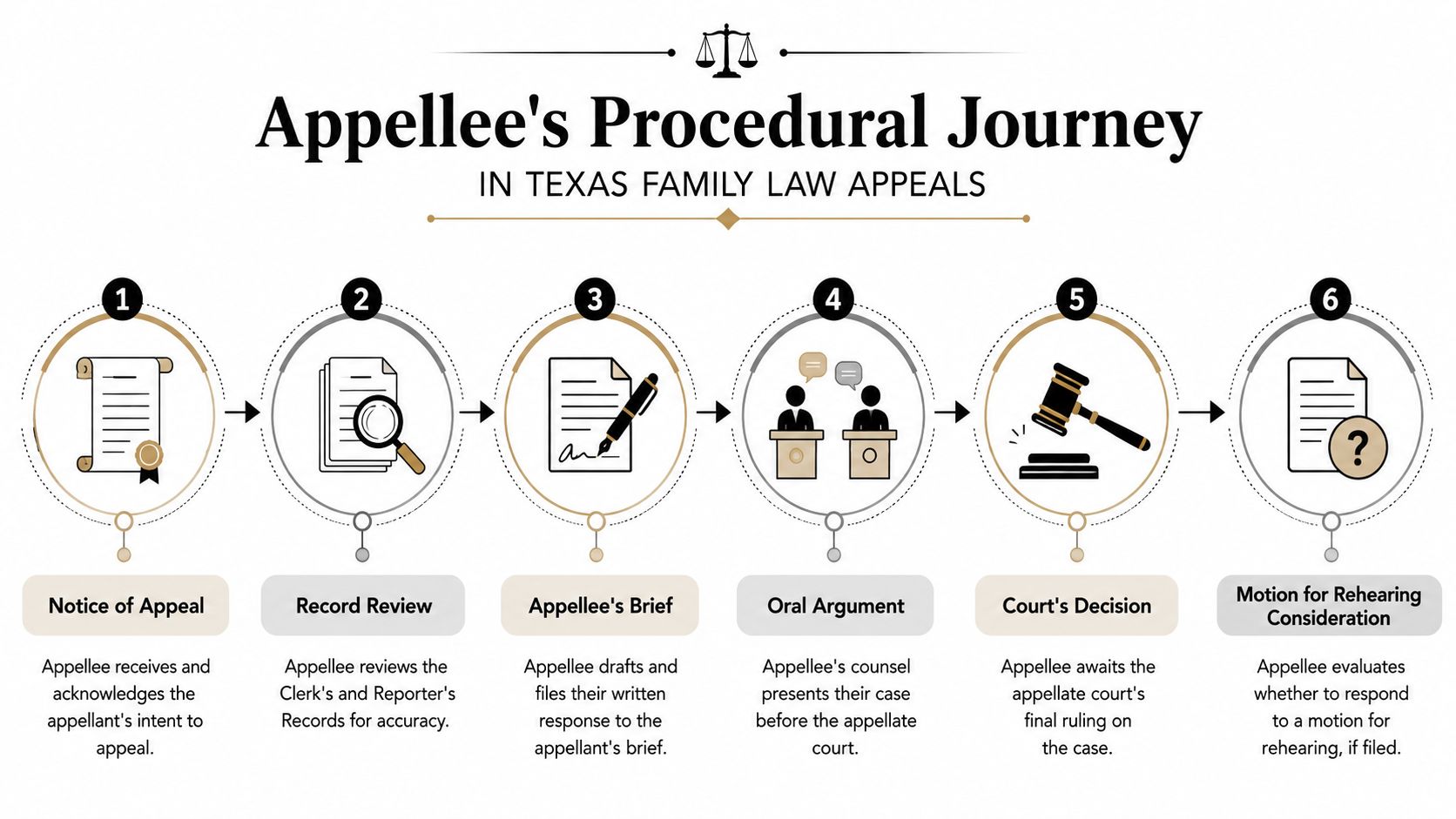
A visual summary helps:
What the appellee actually does
After notice of the appeal, the appellee and counsel usually turn to the record. That includes the clerk's record and, when available, the reporter's record. The question is not “What else should the judge have heard?” The question is “Does the existing record support the ruling under the governing law?”
The appellee's central task is preparing the brief. That document answers the appellant's arguments and explains why the trial court did not misapply the law, abuse its discretion, or commit a procedural error. The Appellate Brief in a Texas Family Appeal discusses why the brief is the heart of the appeal, and that is especially true for an appellee.
A practical timeline from the appellee's side
- Notice arrives: You learn that the other side is asking the court of appeals to review the judgment.
- Record gets reviewed: Your legal team studies pleadings, exhibits, orders, and transcripts.
- Arguments are framed: The appellee's response is built around the actual issues raised on appeal.
- The brief is filed: This is the formal written defense of the trial court's decision.
- Oral argument may occur: In some cases, lawyers appear before the appellate court to answer questions.
- Post-decision choices follow: If the appellant files further requests, the appellee may need to respond.
Here is a short video that helps make the appellate process feel less abstract:
The appellee is not trying to retry the facts. The appellee is showing why the trial judge's ruling fits the law and the record already made.
Why details matter so much
An appeal can be lost through weak briefing, missed procedural points, or a careless response to the issues raised. That is one reason appellate work feels different from trial work. Trial lawyers build a live evidentiary story. Appellate lawyers work with a fixed file and must explain, with precision, why the judgment should remain intact.
For a parent defending a custody order, or a spouse defending a property division, that discipline matters. Your favorable ruling may already exist on paper. The appellee's job is to protect it.
Understanding the Standard of Review in Texas
Many clients ask the same question after reading the notice of appeal: “Will the appellate court look at everything again from scratch?” Sometimes the answer is yes for a legal issue, but often the answer is no. The appellate court applies a standard of review, which is the legal lens it uses to examine the trial court's decision.
That lens often decides the shape of the whole case.
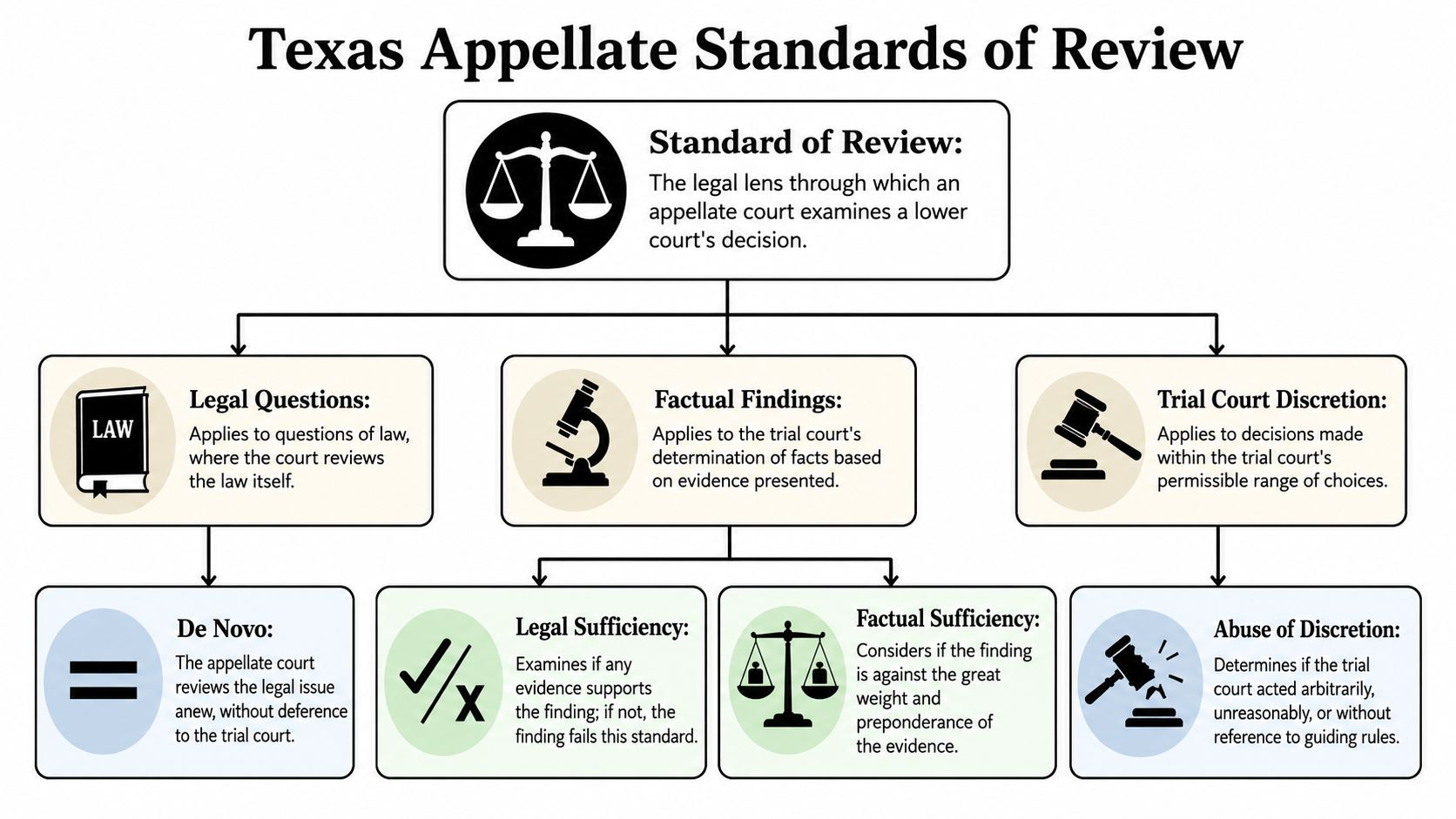
Why an appeal is not a second trial
A trial court hears witnesses, weighs credibility, and receives evidence. An appellate court reads the record and applies review standards. Those are very different jobs.
A helpful analogy is a referee in a game. The appellate court is not replaying the whole match. It is asking whether the referee made a call outside the rules that was significant. If the call fell within the range of reasonable judgment, the ruling often stands.
Under this primer on appellant and appellee roles, to prove abuse of discretion in a Texas family law appeal, the appellant must show the judge's decision was unreasonable or arbitrary. That same discussion explains that appellate courts give significant deference to trial courts, and if there was adequate evidence to support the ruling, it will not be reversed.
Plain-English definitions that matter
- Abuse of discretion means the trial judge acted outside the range of reasonable choices.
- Reversible error means a legal mistake serious enough to justify changing the outcome.
- Briefing means the written legal arguments filed with the appellate court.
If you're trying to make sense of how these standards work in practice, this article on the standard of review in an appellate brief can help. So can Standards of Review in Texas Family Appeals, which explains why the standard of review often decides the appeal.
How this helps the appellee
The appellee benefits when the standard of review is deferential. In family law, many rulings involve judgment calls by the trial court. That matters because the appellee does not need to prove the trial judge made the only possible decision. The appellee often needs to show the judge made a legally permissible one.
Key point: A strong appellee brief doesn't argue that the case was perfect. It argues that the trial court stayed within the law and that any claimed error does not justify reversal.
Common examples of possible reversible error in Texas family courts include applying the wrong legal rule, entering an order without required procedural protections, or making a ruling that the record cannot support. The appellee's answer is to anchor the appellate court in the actual record, the controlling law, and the proper standard of review.
How Appellees Defend Common Family Law Rulings
The word appellee becomes much easier to understand when you put it next to real family court issues. In Texas appeals, the legal labels stay the same, but the arguments look very different depending on whether the order involves children, money, or safety.
Child custody and visitation orders
Suppose one parent won a custody ruling after a contested hearing. The other parent appeals and argues the judge got the facts wrong. The appellee does not get to add new school records, new witnesses, or new events that happened after trial.
Instead, the appellee points to the existing record and shows why the trial judge had a reasonable basis for the ruling. In a custody case, that often means highlighting testimony, exhibits, and findings tied to the child's best interest.
A strong appellee response in a custody appeal often does three things:
- Centers the trial record: It points the appellate court to testimony and exhibits the judge was allowed to credit.
- Respects the trial judge's role: It reminds the court that the trial judge personally observed the witnesses.
- Answers legal complaints directly: If the appellant claims a procedural flaw, the appellee shows why the complaint lacks merit or did not affect the result.
Property division in divorce
Property division appeals often arise when one spouse believes the court's division was unfair. Texas law speaks in terms of a just and right division, which leaves room for trial court judgment. The appellee's task is to show that the division had support in the evidence and fit within the court's lawful discretion.
That may involve defending the judge's treatment of debt, separate property claims, reimbursement issues, or the overall balance of the estate. The appellee is not promising that every line item made both sides happy. The argument is narrower and stronger: the ruling was legally defensible based on the record the court had.
Child support and support-related orders
Child support appeals can involve guideline disputes, findings about income, reimbursement claims, or enforcement issues. Here the appellee often focuses on whether the trial court followed the proper process and whether the record supports the order entered.
In family appeals, the appellee wins by being concrete. General statements rarely help. The court wants citations to the record, the rules, and the law that govern the issue being challenged.
You may also see appeals involving protective orders, enforcement judgments, or contempt-related rulings. The same principle applies. The appellee defends the specific ruling the appellant is attacking, using the record already made and the legal standard that governs that issue.
Strategic Choices for the Appellee The Cross Appeal
Being the appellee does not mean being passive. Sometimes the best defense includes a carefully chosen offensive move.
One of the most important strategic questions is whether the appellee should file a cross-appeal. That may be appropriate when the appellee agrees with the overall result of the case but believes the trial court made a separate error that should also be reviewed. For example, a spouse may want to defend the divorce decree overall but challenge one part of the property ruling. A parent may want to preserve the main custody outcome but seek review of a narrower possession provision.

When a cross-appeal enters the conversation
A cross-appeal is not automatic. It is a strategic choice. The question is whether there is a part of the judgment the appellee also wants changed, and whether appellate review is the proper path for that issue.
That requires disciplined thinking:
- What part of the order are you defending? Some rulings should be protected as entered.
- What part are you challenging? A cross-appeal asks the appellate court to review a separate complaint.
- What risk comes with asking for more? Appellate strategy often involves deciding what not to disturb.
This is also where confusion about remedies can matter. In some situations, parties wonder whether they should pursue an appeal or a different post-judgment tool. This overview of appeal vs bill of review in Texas family court can help clarify that distinction.
Why the appellee often starts from a position of strength
Appeals are difficult for appellants. According to Women's Law's explanation of appeals and appellate outcomes, roughly 70% of appeals are affirmed, which means the appellee successfully defends the trial court's ruling. That same source ties the high affirmance rate to deferential standards of review and the heavy burden placed on the appellant.
That doesn't guarantee success in any individual case. It does explain why appeals are not another round of fact-finding. The system gives meaningful weight to what the trial court already decided.
An appellee's role is stronger than most people realize. You are not asking the court to build a new result from nothing. You are defending a judgment that already exists.
In practical terms, this means an appellee should think strategically from the first day of the appeal. Preserve the favorable parts of the order. Evaluate whether a cross-appeal makes sense. Answer the issues with precision. Don't treat the appeal as background noise. Treat it as a focused legal challenge that deserves an equally focused response.
How to Protect Your Favorable Ruling
If you've been pulled into an appeal after winning an important family court ruling, your position is real, but so is the need for careful legal work. An appellee is the party defending the judgment. That defense depends on rules, deadlines, record review, and strong briefing under the Texas Rules of Appellate Procedure and the Texas Family Code.
The most useful mindset is this: the appellate court is not deciding who tells the most emotional story now. It is deciding whether the trial court made a legal mistake that justifies changing the result. That is why protecting a custody order, property division, child support ruling, or protective order requires a different skill set than trying the original case.
If you are evaluating next steps, it can help to compare likely issues, timing, and costs early. Readers often find it useful to review related information about Texas family law appeals, including child custody disputes, divorce property issues, and appellate process questions. In some situations, a focused consultation with an appellate attorney is the fastest way to determine whether the judgment is stable, vulnerable, or in need of a cross-appeal.
The Law Office of Bryan Fagan, PLLC offers Texas Family Law Appeals Lawyer services for parties challenging final family law orders for legal error. That same appellate focus can also be relevant when a client needs to defend a favorable ruling on appeal.
If you believe the court made a mistake in your family law case, or if you need to defend a favorable ruling against an appeal, The Law Office of Bryan Fagan, PLLC can help you seek a fair outcome. Contact the firm today for a free consultation.