You may feel like the court never really heard you. You showed up. You brought records. You tried to explain old payments, missing credits, or why the arrears amount looked wrong. Then the judge signed an order that felt disconnected from the facts you lived with for years.
That reaction is common in arrears cases. These rulings often involve old records, payment histories spread across multiple systems, and legal rules that are not easy to understand in the moment. A child support arrears order can affect income, property, and long-term financial stability. It can also be enforced in ways many parents do not expect.
An appeal is not a second trial. It is a focused review of whether the trial court made a legal or procedural mistake. In the right case, that review is the path to a fair result.
The stakes are real. Texas legislative analysis reported that, as of January 30, 2023, the Texas Child Support Division had 18,118 incarcerated obligors in open cases who collectively owed over $450 million in child support arrears (Texas legislative analysis on child support arrears involving incarcerated obligors). That figure shows how large, complex, and long-running these disputes can become.
Seeking Fairness After an Unjust Ruling
A child support arrears case often does not feel complicated until the ruling arrives.
Maybe the order says you owe far more than expected. Maybe the court refused to hear evidence of payments you made years ago. Maybe the judge accepted the other side’s spreadsheet without requiring backup records. By the time you leave the courtroom, you are left with a signed order and a short deadline.
That is where strategy matters.
An appeal of child support arrears ruling texas cases is about identifying a reviewable mistake and showing the appellate court exactly where it appears in the record. The appellate judges do not retry the dispute. They examine whether the trial judge followed the law, used the correct procedure, and based the ruling on admissible evidence in the record.
Some parents come to this process feeling defeated. Others feel angry. Both reactions make sense. But appellate work is most effective when it is calm and precise. The question is not whether the result felt unfair. The question is whether the record shows a reversible error.
Key point: A strong appeal does not depend on how strongly you feel the order was wrong. It depends on whether the trial court made a legal mistake that the appellate court can correct.
Arrears rulings can be especially hard because they often involve old payment histories, old orders, and strict deadlines. In some cases, the issue is not just math. It is due process. Did the court give you a fair chance to present evidence? Did it apply the right statute? Did it sign a final order that can be reviewed?
Those are the questions that turn frustration into a legal strategy.
When Can You Appeal a Child Support Arrears Ruling
Not every ruling can be appealed right away. That confuses many people because a judge may make an important decision in court, but the appellate court still may not have authority to review it yet.

Final orders matter
In most Texas family law appeals, you need a final order.
A final order is the order that resolves the dispute the trial court was asked to decide. Consider it the end of a book. A chapter may contain an important event, but the story is not over until the book ends. In the same way, a hearing may include key rulings, but the appeal usually starts only after the court signs a final judgment or final enforcement order.
In arrears cases, a final order often does one or more of these things:
- Confirms arrears: It states the amount the court says is owed.
- Renders judgment: It turns that arrears amount into an enforceable judgment.
- Orders collection tools: It may authorize withholding, liens, foreclosure steps, or related enforcement.
A temporary scheduling ruling or an evidentiary ruling made during the case is usually not appealable by itself. Those issues may still matter, but they are generally reviewed only after the final order is signed.
What if the judge made a harmful ruling before the final order
Some trial court actions are serious enough to require a different appellate tool. In limited situations, a party may seek mandamus relief.
A writ of mandamus is not a regular appeal. It is an extraordinary request asking a higher court to correct a clear abuse of power when waiting for a normal appeal would not provide an adequate remedy. That is a narrow path, but it can matter in urgent family law disputes.
Most arrears cases, though, proceed through the standard appeal process after a final order is signed.
How to tell whether your order is appealable
Start with the document itself. Read the title, the decretal language, and the last pages carefully.
Look for language showing the court intended to dispose of the arrears dispute. If the order identifies the amount owed, grants judgment, and leaves nothing substantial unresolved on that issue, you may be looking at a final appealable order.
You also need to know the difference between what was said in court and what was signed. Oral statements can matter for context, but the signed order usually controls the appellate timetable.
Practical tip: Do not rely on memory or courtroom notes alone. Get a copy of every signed order, every docket entry, and the clerk’s file as early as possible.
Why this first step matters
If you file too early, the appellate court may dismiss for lack of jurisdiction. If you file too late, you may lose the right to appeal. Both mistakes are avoidable, but only if you identify the correct order at the start.
That is why experienced appellate review begins with a simple but decisive question. What exactly did the trial court sign, and when did it sign it?
Once that answer is clear, the rest of the appeal can be built on solid ground.
The Foundation of Your Appeal Preserving Error at Trial
The most important truth about appeals is also the hardest for many parents to hear. You do not get to start over.
Texas appellate courts review the record made in the trial court. They do not hear new witnesses. They do not accept newly found bank records just because those records are important. They do not consider explanations that never became part of the official file.
A Texas family law appeals resource explains that the reviewing court is limited to the trial record, that a Notice of Appeal must typically be filed within 30 days of the judgment, and that evidence not properly presented and admitted at trial generally cannot be introduced for the first time on appeal (Texas child support appeal steps and record limits).
That rule is often called the closed-record principle.
What preserving error means
Preserving error means giving the trial court a fair chance to correct a mistake while the case is still in front of that judge.
If your lawyer believes the court admitted improper evidence, excluded proper evidence, applied the wrong standard, or calculated arrears incorrectly, that concern usually must be raised in a specific way at the right time. If it is not, the appellate court may decide the complaint was waived.
That can feel harsh. But appellate courts are not there to referee issues that no one clearly raised below.
What a proper record usually includes
A useful appellate record is not accidental. It is built piece by piece during the hearing.
Some of the most important steps include:
- Specific objections: Saying “objection” is rarely enough. The trial court should be told the legal reason.
- Offers of proof: If the judge excludes your evidence, your lawyer may need to explain what the evidence would have shown so the appellate court can evaluate the harm.
- Admitted exhibits: Documents must usually be offered and admitted, not just mentioned.
- Clear rulings: The record should show whether the judge sustained or overruled the objection.
- Findings and conclusions: In some cases, requesting findings of fact and conclusions of law can help clarify the basis for the decision.
For a closer look at this issue, this discussion of objections required to preserve appeal in Texas is useful background.
The game tape analogy
Think of the appellate record like game film.
The appellate court can review the tape. It cannot add scenes that were never recorded. If a payment ledger stayed in your briefcase and never became an exhibit, the appellate court cannot treat it as evidence. If your lawyer did not respond when the court cut off testimony, the appellate judges may have no preserved complaint to review.
That is why so many otherwise valid grievances do not turn into successful appeals.
Key takeaway: A strong fact that is missing from the record may be legally useless on appeal.
Records, transcripts, and why format matters
Parents sometimes keep years of proof in boxes, screenshots, email chains, and handwritten notes. That may help your attorney understand the history, but appellate judges work from the official clerk’s record and reporter’s record.
When a transcript is central to the appeal, accuracy matters. Tools such as legal transcription services can help lawyers organize spoken testimony, hearing audio, and working notes while preparing arguments about what the record shows. The final appellate record still comes through the court process, but careful transcript handling can make issue spotting much more efficient.
A short video can also help explain how appellate review differs from trial practice.
Why appellate thinking should begin before the hearing ends
The best appellate issue often begins as a trial objection.
If the judge refuses to credit a proven payment, bars you from offering records, or relies on a figure unsupported by admitted evidence, the moment must be captured properly. Waiting until after the ruling is often too late.
This is one reason some trial lawyers consult appellate counsel early, even before judgment. A lawyer who is thinking about the record while the hearing unfolds is protecting options that may matter later.
For parents facing an appeal of child support arrears ruling texas courts have entered, this is often the turning point. The question is no longer “Do I have more proof?” It becomes “What proof made it into the record, and what objections were preserved?”
Understanding the Standard of Review in Arrears Cases
Many clients believe the appellate court will read the file and decide what it thinks is fair. That is not how appeals work.
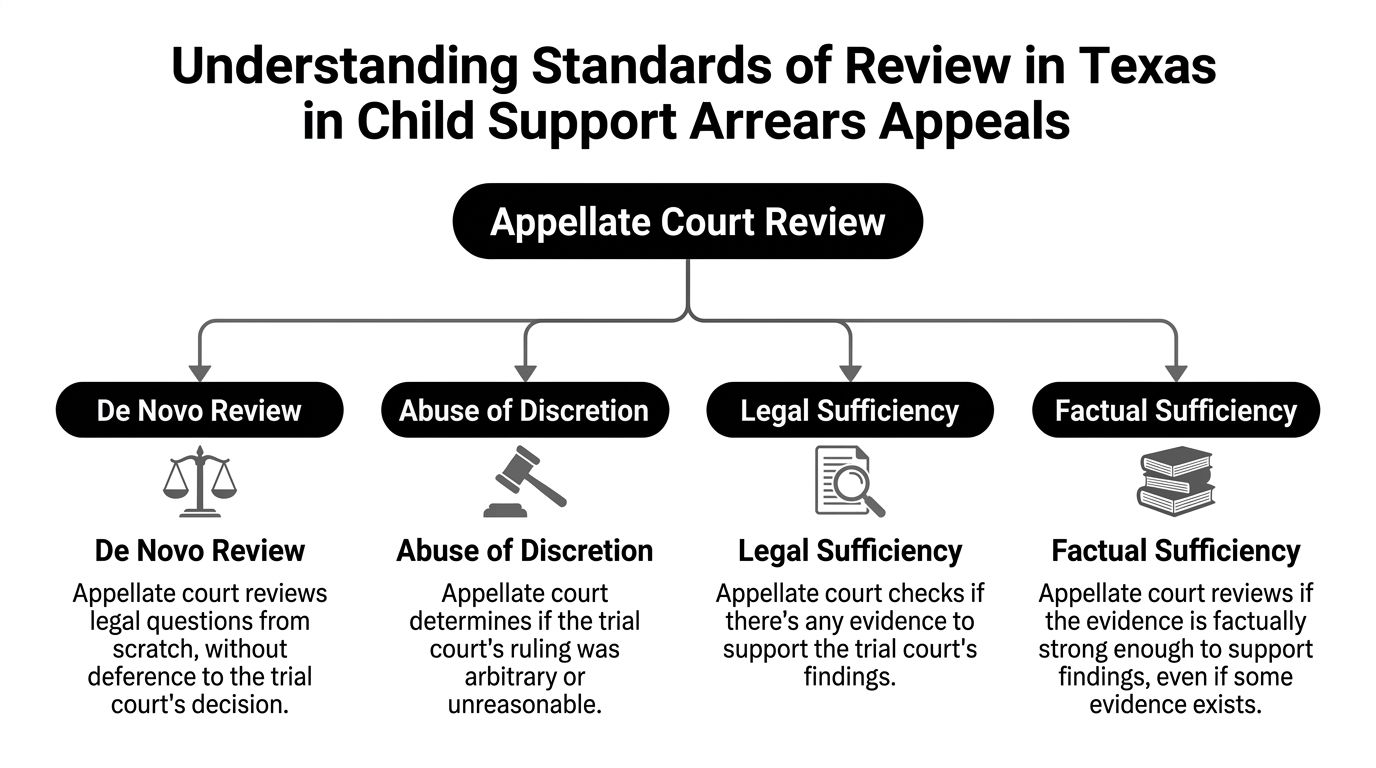
Appellate courts use standards of review. These are the rules that determine how much deference the trial judge receives. In plain English, the standard of review tells you how hard it is to overturn the ruling.
Abuse of discretion
In many family law appeals, the main standard is abuse of discretion.
That does not mean the appellate court asks whether it would have made a different decision. It asks whether the trial court acted without reference to guiding rules or principles. If reasonable judges could disagree, the order often stands.
A Texas appellate authority discussing arrears enforcement explains that this standard requires the appellant to show the trial court acted without reference to guiding rules or principles. It also notes that writs of income withholding and child support liens are not subject to the same time limits as ordinary enforcement tools, which gives arrears rulings long-lasting consequences (Texas case discussing abuse of discretion and no time limits for certain arrears enforcement tools).
That is why the standard matters so much. If an arrears ruling survives appeal, collection effects may continue for a very long time.
For a fuller explanation, this article on the abuse of discretion standard in Texas family law is a helpful companion.
De novo review
Some issues are reviewed under de novo review.
That phrase means the appellate court takes a fresh look at a legal question. The trial judge gets no deference on pure questions of law. If the issue is what a statute means, whether the court had authority under a statute, or whether the wrong legal rule was applied, de novo review may apply.
This distinction matters in arrears cases because one part of the case may be factual and another legal.
For example:
| Issue | Likely focus on appeal |
|---|---|
| Whether a payment was proven by admitted evidence | Often tied to the trial court’s fact findings |
| Whether the judge applied the correct Family Code provision | Often a legal question |
| Whether the trial court had authority to use a particular enforcement mechanism | Often a legal question |
Legal sufficiency and factual sufficiency
You may also hear legal sufficiency and factual sufficiency.
These standards ask whether the evidence in the record could support the trial court’s findings, and whether the record as a whole is strong enough to support them. They often operate alongside abuse of discretion in family law cases.
A simple way to think about it is this:
- Legal sufficiency: Is there at least some evidence supporting the finding?
- Factual sufficiency: Is the evidence strong enough overall to support the finding?
- Abuse of discretion: Did the judge make a decision outside the bounds of reasonable judgment?
A referee analogy
Think of the appellate court like a replay official.
If the issue is a judgment call made within the rules, the replay official usually defers to the referee on the field. If the issue is whether the referee applied the wrong rulebook entirely, the replay official steps in much more readily.
That is why framing matters. A weak appeal argues only that the judge was unfair. A stronger appeal identifies whether the problem was legal error, lack of evidence, or misuse of discretion, then matches that problem to the proper standard of review.
Practical tip: The same set of facts can produce more than one appellate issue. Good appellate briefing separates factual complaints from legal ones and argues each under the correct standard.
In arrears cases, that discipline is not academic. It often determines whether the court sees your complaint as a real legal problem or just disagreement with the outcome.
Common Reversible Errors in Texas Child Support Arrears Cases
Parents often ask the same question after an adverse order. “What kind of mistake matters on appeal?”
Not every trial court error leads to reversal. The mistake must be significant enough to affect the outcome or undermine the fairness of the proceeding. In arrears litigation, several problems appear again and again.

A notable Texas case affirmed collection of $263,215.52 in child support arrears from a 1970 divorce decree, and the court held that liens and writs of income withholding had no statute of limitations under the Family Code (Texas case summary on decades-old child support arrears enforcement). That kind of case shows why accuracy matters. If a trial court gets the number wrong in a long-running arrears case, the consequences can last for years.
Miscalculating the arrears amount
This is one of the most common issues.
The mistake may involve missed credits, duplicate entries, unsupported balances, or a judgment amount that does not match the admitted records. Sometimes the error is simple arithmetic. Other times it comes from accepting a summary that was never properly supported.
Why it may be reversible: If the record shows the court used the wrong amount or had no evidentiary basis for the figure it adopted, the resulting judgment may not stand.
Refusing to credit proven payments
Some parents have receipts, wage withholding records, or payment portal histories showing that support was paid. Problems arise when the court ignores that evidence or refuses to consider it despite proper presentation.
Why it may be reversible: A court cannot arbitrarily deny credit for payments that were properly proven and relevant to the arrears calculation.
Excluding evidence unfairly
This issue often appears in old cases where payment records span many years.
A party may try to offer bank records, money order receipts, military records, or agency account statements. If the judge excludes the evidence on an incorrect legal basis, or cuts off the party without a fair chance to present it, an appellate issue may exist.
Why it may be reversible: Due process requires a meaningful opportunity to be heard. When the court blocks relevant evidence in a way that affects the judgment, reversal may be possible.
Warning sign: If the hearing felt rushed and the court would not let you finish proving your payment history, that concern should be reviewed closely by appellate counsel.
Applying the wrong law
Some arrears disputes turn on legal interpretation, not just numbers.
The trial court may apply the wrong enforcement provision, misunderstand how a statute works, or treat a time limit as broader or narrower than the law allows. In old cases, these legal distinctions matter a great deal.
Why it may be reversible: Legal questions are often reviewed more closely than factual disputes. If the judge used the wrong legal rule, that can reshape the entire result.
Findings unsupported by the record
A court may make factual findings that sound definite but lack support in the admitted evidence.
Examples include assumptions about earning capacity, assumptions about payment history, or acceptance of a balance with no clear backup in the record. If the transcript and exhibits do not support the court’s conclusion, the order may be vulnerable.
Why it may be reversible: Trial judges have discretion, but they still need evidence.
Denying basic procedural fairness
This category includes problems such as refusing cross-examination, ruling without an adequate hearing, or deciding critical issues without allowing one side to respond meaningfully.
These errors can be especially important because they affect the integrity of the process itself.
Why it may be reversible: Appellate courts care much about whether each side received a fair hearing under the rules.
The practical lesson is simple. A successful appeal usually comes from a specific, documented problem. Not a general sense that the ruling was harsh, but a concrete error tied to the record and the law.
Navigating the Appellate Timeline and Key Filings
A good appeal runs on deadlines. Miss one, and even a strong issue may never be heard.
For that reason, the timeline matters almost as much as the merits.
The first deadline is often the most dangerous
After the trial court signs the final order, the clock usually starts quickly.
Under Texas appellate procedure, a Notice of Appeal must typically be filed within 30 days after the judgment is signed. In some situations, a timely post-judgment motion can extend the appellate timetable. Families often hear about a Motion for New Trial in this context because it can preserve complaints and affect deadlines.
But arrears cases also carry another trap. A Texas family law discussion of decades-old arrears disputes highlights the 10-day deadline under Texas Family Code §158.102 to challenge a notice of arrears. Missing that deadline can lead to exclusion of payment evidence and create a serious due process problem later on appeal (discussion of the 10-day arrears challenge deadline in Texas).
That short deadline catches people off guard, especially when they need old records fast.
Key Appellate Deadlines in Texas Family Law
| Filing | Standard Deadline | Purpose |
|---|---|---|
| Notice of Appeal | Typically within 30 days after the final judgment is signed | Starts the appeal in the appellate court |
| Motion for New Trial | Post-judgment deadline set by Texas procedure | Gives the trial court a chance to correct error and may affect the appellate timetable |
| Challenge to notice of arrears under Family Code §158.102 | 10 days | Seeks to contest arrears notice before enforcement consequences harden |
| Request and preparation of clerk’s and reporter’s records | Early in the appeal after notice and designation steps | Creates the official record the appellate court will review |
| Appellate brief | Deadline set by appellate rules and court notices | Presents the legal arguments for reversal or affirmance |
The notice of appeal
The Notice of Appeal is the document that tells the appellate court you are invoking its jurisdiction.
It is short, but it is not casual. It must be filed correctly, in the right court, within the proper deadline. If you want a practical overview, this guide on how to file a notice of appeal is a useful starting point.
A common misunderstanding is that filing the notice explains the whole case. It does not. It preserves your place in the appellate process.
Building the record
Once the appeal starts, the record must be assembled.
That usually includes:
- The clerk’s record: Pleadings, orders, motions, exhibits filed with the clerk, and related documents.
- The reporter’s record: The hearing transcripts and admitted exhibits from the court reporter.
- Any necessary post-judgment filings: These can matter for both preservation and timing.
If something important is missing, appellate counsel may need to address that promptly. Waiting too long can narrow your options.
The appellate brief
The brief is the core of the appeal.
A briefing is the written legal argument submitted to the appellate court. It explains what happened, identifies the legal issues, cites the record, and argues why the trial court’s ruling should be affirmed or reversed. It is not a personal letter to the judges. It is a structured, rule-driven legal document.
Lawyers often refine briefs through multiple rounds of editing, record citation checks, and issue framing. For readers curious about what makes a written argument persuasive, these proven legal brief writing tips offer a useful look at clarity, structure, and precision in legal writing.
Can enforcement continue during the appeal
Often, yes.
Filing an appeal does not automatically stop enforcement of the arrears order. In some cases, a party may seek a stay or use a supersedeas bond or related procedure to pause collection while the appeal is pending. Whether that is available, practical, or strategically wise depends on the order and the facts.
Immediate advice matters here. A parent can be fully committed to appealing and still face withholding or other collection efforts unless the right additional steps are taken.
Practical tip: Do not assume that “I appealed” means “collection stops.” Those are different questions.
How to approach the process strategically
Parents are often deciding under pressure. They may be gathering decades of records while trying to understand deadlines and preserve rights at the same time.
A practical response often includes:
- Get every signed order immediately.
- Confirm the exact signing date.
- Secure transcripts and exhibits early.
- Identify whether payment-proof issues were preserved.
- Evaluate whether post-judgment motions are necessary.
- Assess whether a stay or supersedeas request should be considered.
The Law Office of Bryan Fagan, PLLC handles family law appellate review and evaluates whether the record shows reversible error in child support, custody, divorce, property division, protective-order, and enforcement matters through consultation and record analysis.
In an appeal of child support arrears ruling texas parents are often not defeated by the merits. They are defeated by time. The appellate process rewards speed, accuracy, and disciplined issue selection.
Potential Outcomes and What Happens Next
A successful appeal does not always mean the appellate court erases the arrears ruling and ends the case. The result depends on the kind of error the court finds.
Affirm
If the appellate court finds no reversible error, it will affirm the trial court’s order.
That means the ruling stays in place. The arrears judgment remains enforceable, and collection can continue under the existing order.
Reverse and render
This is often the cleanest appellate win.
To reverse and render means the appellate court overturns the trial court’s ruling and substitutes the judgment that should have been entered. This may happen when the law clearly requires a different outcome and no further fact-finding is necessary.
Reverse and remand
This is a common result in family law appeals.
To reverse and remand means the appellate court found error, set aside the ruling, and sent the case back to the trial court for further proceedings. That could mean a new hearing, additional findings, or reconsideration under the correct legal standard.
Important perspective: A remand is still a meaningful win. It can reopen a case that seemed closed and require the trial court to address the dispute under proper rules.
Some appeals also produce partial results. One part of the order may be affirmed while another is sent back. That is why expectation management matters. The goal is not only to “win” in a general sense. The goal is to secure the kind of relief the law allows.
Take the First Step Toward a Fair Review
A wrongful arrears ruling does not always have to be the final word. But appeals are technical, deadline-driven, and shaped by the record made in the trial court.
If you believe the court made a mistake in your child support arrears case, careful review can identify whether that mistake is reversible, whether deadlines are still open, and what path makes sense next. Calm analysis is the first step toward a fair review.
If you believe the court made a mistake in your family law case, our appellate attorneys can help you seek a fair outcome. Contact The Law Office of Bryan Fagan, PLLC today for a free consultation.