You may feel like the court heard your case, looked at your pay records, and still got the number wrong.
That reaction is common in child support appeals. Parents often leave court thinking the result was not just disappointing, but mathematically off, legally unsupported, or disconnected from the evidence they fought to present.
In Texas, that feeling alone is not enough to win an appeal. Appealing child support calculation texas cases require discipline. The appellate court is not there to retry the family conflict. It reviews the existing record to decide whether the trial court made a legal mistake that matters. That is the difference between frustration and a viable appeal.
When a Fair Calculation Feels Unfair
A parent may walk out of court with a child support order that strains every part of life. Mortgage or rent becomes harder to cover. Ordinary expenses start colliding with a payment amount that seems based on the wrong income figure. The order may feel unfair because the court used the wrong documents, misunderstood pay structure, or skipped over proof that should have changed the result.
That experience matters. But an appeal does not begin with, “The judge should have believed me.” It begins with a narrower question. Did the court commit a reversible error?

What an appeal is, and what it is not
An appeal is not a second trial. No one starts over. No one calls fresh witnesses to tell the same story again. The court of appeals reviews what already happened in the trial court and asks whether the law was applied correctly.
That distinction changes strategy.
At trial, lawyers persuade through testimony, exhibits, and credibility. On appeal, the work is more technical. The issue is whether the signed order can stand under the Texas Family Code, the Texas Rules of Appellate Procedure, and the record the trial court created.
Turning frustration into a legal argument
A parent may believe the support amount is plainly too high or too low. The appellate court needs something more precise than that. It needs an argument tied to the record, such as:
- The wrong income measure was used
- The guideline formula was misapplied
- The court deviated without legally sufficient support
- The court made a procedural ruling that affected the outcome
A strong appeal does not ask the appellate court to feel what happened. It shows exactly where the trial court departed from the governing rules.
That is why appellate review can help in the right case. It gives parents a structured path to challenge a support order when the problem is not just dissatisfaction, but a legal error embedded in the judgment.
Identifying Reversible Error in Child Support Orders
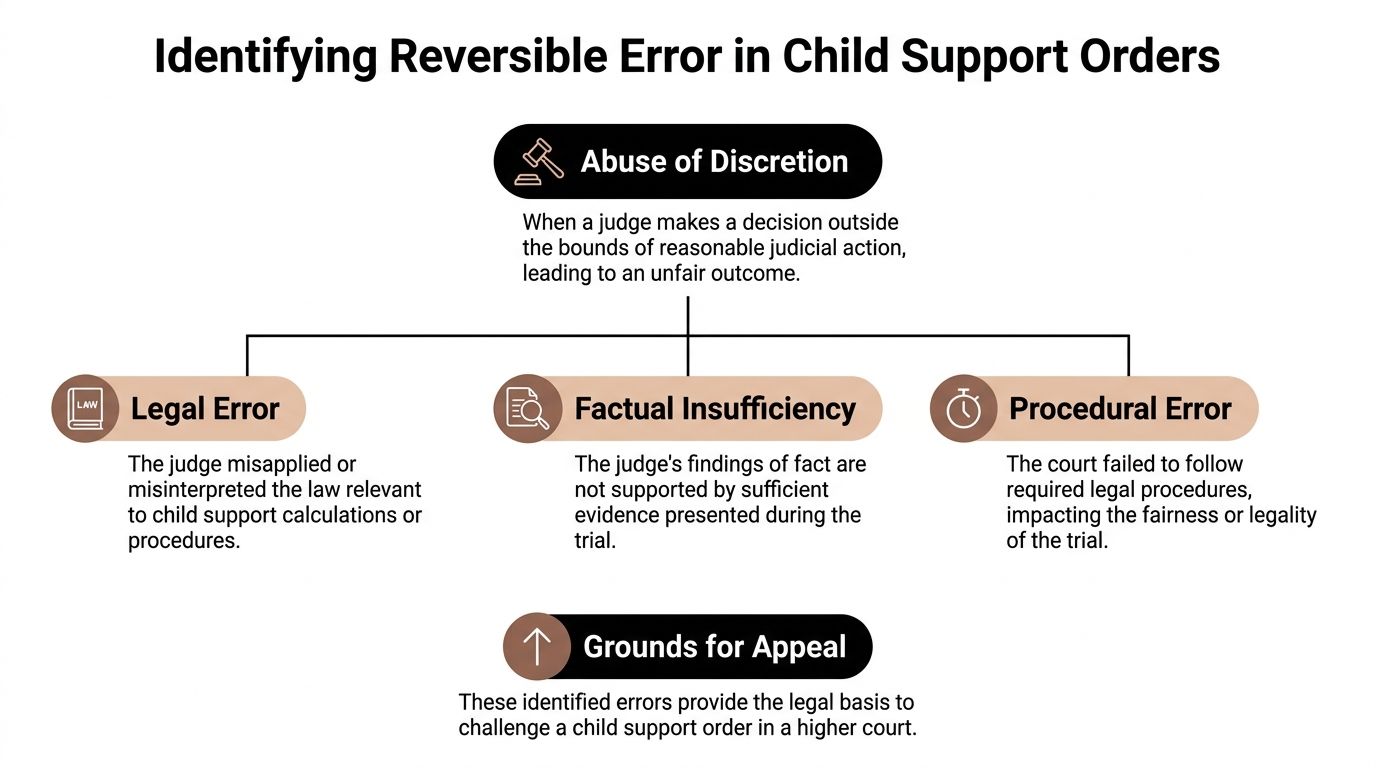
The central phrase in most Texas child support appeals is abuse of discretion. In plain English, that means the trial court acted arbitrarily, unreasonably, or without following the controlling legal principles. In child support calculation cases, that standard matters because appellate courts do not reweigh evidence just because another judge might have reached a different result.
Texas child support calculations follow percentage guidelines under Texas Family Code §154.125, with 20% of net monthly resources for one child, 25% for two, 30% for three, 35% for four, and 40% for five or more, applied up to the cap that rose from $9,200 to $11,700 effective September 1, 2025. The same source explains that appellate courts review these rulings for abuse of discretion and that a recent appellate court reversed a support order where the trial court confused gross wages with net resources in the calculation process (Texas child support deviation factors and appellate review).
Abuse of discretion in real terms
This standard does not mean the judge acted in bad faith. It usually means something more ordinary and more fixable. The court may have used the wrong legal framework, relied on the wrong income figure, or entered a number the record does not support.
That is why parents should be careful about language. Saying “the ruling was unfair” is emotionally understandable. Saying “the court used gross wages instead of net resources” is the kind of issue an appellate court can evaluate.
Common errors that can support an appeal
In appealing child support calculation texas cases, several patterns appear again and again.
Net resources were calculated incorrectly
Texas law focuses on net monthly resources, not just gross pay. Only certain deductions count in reaching that figure, including items such as Social Security taxes, federal income tax, union dues, and child health insurance premiums, as stated in the verified data tied to the earlier Bryan Fagan reference.The guideline percentage was applied to the wrong base
Even when the court states the correct percentage, the result can still be wrong if it applies that percentage to the wrong resource number.The court mishandled the statutory cap
For new or modified orders after the September 1, 2025 update, the cap changed. That matters most in higher income cases, where a support amount may turn on whether the court applied the proper capped amount before considering any departure.A deviation lacked evidentiary support
Texas courts may depart from the guideline result when application of the guidelines would be unjust or inappropriate. But that kind of departure is not automatic. It must be supported by evidence tied to the statutory factors.
Why small math errors become major legal problems
Child support orders often look straightforward on paper. A court takes an income figure, applies a percentage, and enters a monthly obligation. In practice, each step matters.
A single misstep near the beginning can distort everything that follows. If the court starts with the wrong “net resources” figure, even a correctly stated percentage produces the wrong support amount. That is one reason these appeals often succeed or fail on financial detail rather than courtroom drama.
The difference between disagreement and reversible error
Not every disappointing ruling is appealable.
If both sides presented competing evidence and the judge picked one version, an appeal may be difficult unless the ruling departed from the legal framework. Appellate courts defer to trial courts on many judgment calls. They do not step in just because one parent thinks the judge should have weighed the facts differently.
A stronger appeal usually looks more like this:
| Issue in the trial court | Why it may matter on appeal |
|---|---|
| Gross income treated as net resources | The formula may have been applied to the wrong legal number |
| Guideline percentage used incorrectly | The order may conflict with the Family Code |
| Cap ignored or applied to the wrong order period | The baseline support amount may be legally flawed |
| Deviation entered without proof tied to statutory factors | The order may lack support for departing from the guideline result |
Related family law issues often overlap
Child support appeals rarely exist in isolation. The same final order may also include custody terms or divorce rulings that affect the practical stakes. Readers dealing with connected disputes may also want to review this firm’s pages on child custody appeals and divorce appeals.
The best appellate issue is usually narrow, documented, and tied to a specific ruling the trial court made. Broad complaints are less effective than precise errors.
Preserving Your Right to Appeal Starts at Trial
Many parents assume the appeal begins after the final order is signed. In reality, much of the appellate battle is won or lost in the trial court.
Texas appellate courts usually review complaints that were properly preserved. That means the trial lawyer gave the trial court a fair chance to correct the problem when it happened. If no one objected, requested a ruling, or made the record clear, the appellate court may treat the issue as waived.
What preserving error means
Preserving error means creating a clear record that shows three things:
- A legal problem occurred.
- The court was alerted to it.
- The court ruled, or refused to rule, in a way the record captures.
That can happen in different ways. A lawyer may object when the other side offers financial proof that does not meet the governing standard. A lawyer may ask the court to clarify the basis for a deviation. A lawyer may challenge a worksheet or calculation before the order is signed.
What this looks like in practice
Suppose the other side offers a summary of income that mixes gross wages, reimbursements, and unsupported estimates. If no one objects, the appellate court may later say the trial judge was entitled to consider the evidence that came in.
Or suppose the judge excludes your pay records, business records, or insurance evidence. If your lawyer does not make an offer of proof, the appellate court may have no way to evaluate whether the exclusion mattered.
A useful discussion of this issue appears in objections required to preserve appeal in Texas.
Trial lawyers and appellate thinking
Good trial work and good appellate preparation are closely related. A lawyer focused only on the immediate hearing may miss opportunities to protect the record. A lawyer who understands appeals thinks one step ahead.
That does not mean objecting to everything. Excessive objections can irritate the court and distract from stronger points. It means objecting with purpose, obtaining rulings, and making sure the key financial and procedural issues are visible in the transcript and filings.
A silent record is hard to fix on appeal. If the mistake is not preserved, the appellate court may never reach the merits.
Why inaction creates real risk
The hardest consultation in appellate practice often comes after a parent says, “The judge clearly got it wrong,” but the record does not show a preserved complaint.
That does not mean every unpreserved issue is fatal. Some errors can still be addressed through other procedural tools, depending on the posture of the case. But as a rule, waiting until after judgment to think about appellate rights limits your options.
Preservation is not a technical side issue. It is part of the core strategy in any family law case where child support calculations are disputed.
The Appellate Clock Starts Now Key Deadlines
The day a ruling comes down, the appellate timeline starts moving. It does not wait for emotions to settle, for co-parenting tensions to ease, or for finances to stabilize.
That is one reason parents should seek appellate advice quickly after a child support ruling. Delay can eliminate options.

Why deadlines matter so much
Texas appellate procedure is deadline-driven. Some post-ruling steps must happen almost immediately. Verified data for Texas child support appeals notes that in some matters involving associate judge rulings, a party may have only three business days to seek a de novo hearing, and missing a key deadline can bar later review rights (Texas child support appeal deadline discussion).
That short deadline does not apply to every final order, but it shows how strict this system can be.
The first deadlines counsel reviews
When a parent calls after an unfavorable support ruling, appellate counsel usually starts with timing questions:
- Was the ruling made by an associate judge or by the trial court?
- Has a final order been signed?
- Were any post-judgment motions filed?
- Has anyone requested findings or other post-judgment relief?
The answer to those questions shapes the next move. A missed procedural step can change the case before the merits are ever discussed.
Motion for New Trial and Notice of Appeal
A Motion for New Trial is not just a request for a do-over. In the right case, it can help sharpen complaints, preserve issues, and affect appellate deadlines. A Notice of Appeal is the filing that formally invokes appellate review.
These are not interchangeable tools. They serve different purposes, and they must be timed correctly under the Texas Rules of Appellate Procedure.
For many families, the biggest mistake is waiting too long to ask whether either filing is necessary. This page on the deadline to appeal a Texas family court order is a useful starting point for understanding how fast these windows can close.
A practical sequence after judgment
The early post-judgment period is often less about argument and more about control. Counsel is trying to secure the case’s procedural footing before briefing even begins.
| Early task | Why it matters |
|---|---|
| Identify the exact ruling date | Appellate deadlines run from signed orders and other triggering events |
| Confirm the court that issued the ruling | Associate judge procedures can create different immediate obligations |
| Evaluate post-judgment motions | Some issues are better raised promptly in the trial court |
| Prepare for the appellate record | Delay can complicate transcript and filing coordination |
A short explanation can also help clarify how the process fits together:
What works and what does not
What works is fast, orderly review of the signed order, docket activity, and hearing history. What does not work is assuming there will be time later to “fix it.”
Parents sometimes spend the first stretch after judgment trying to negotiate informally or waiting to see whether the other side will be reasonable. That may make sense for some practical issues. It is risky when appellate rights are expiring in the background.
If you are considering appealing child support calculation texas issues, calendar review should happen immediately. The legal merits do not matter if the deadline has already passed.
Building Your Case The Appellate Record and Brief
Appeals are won on paper before they are argued in court. The appellate judges do not know your family personally. They know your case through the official record and the written briefs.
That is why a parent’s instinct to “explain what really happened” must be redirected into the materials the court can lawfully consider.

The appellate record
The appellate record is the universe the court of appeals reviews. If something is not in that record, the appellate court generally cannot rely on it.
The record usually has two main parts:
Clerk’s Record
This contains the filed documents. Pleadings, motions, orders, exhibits that were properly filed, and other papers from the court file usually appear here.Reporter’s Record
This is the transcript of what was said in hearings or trial. It captures testimony, objections, rulings, and the exact words that often determine whether error was preserved.
A practical overview appears at appellate record in a Texas family law case.
Why the record controls the appeal
Parents often discover after trial that they now have better proof. A missing pay statement turns up. An employer clarifies compensation. A spreadsheet is corrected. Those developments may matter in a modification case or other later proceeding, but they usually do not become appellate evidence.
That is one of the hardest truths about family law appeals. The appellate court asks whether the trial court erred based on what the trial court had before it.
What briefing really means
An appellate brief is the formal written argument filed with the court of appeals. It is not a letter. It is not a narrative statement of hardship. It is a structured legal document that connects the record, the governing law, and the requested relief.
A strong brief in a child support calculation appeal usually does several things at once:
- It identifies the exact ruling being challenged.
- It cites the controlling legal standard.
- It points to the pages of the record that matter.
- It explains why the error was harmful enough to require relief.
Standard of review shapes the writing
The standard of review is the rule the appellate court uses to evaluate the trial court’s decision. In Texas child support calculation disputes, the key standard is abuse of discretion, as discussed earlier.
That changes how the brief is written. The argument cannot just say the evidence favored a different number. It has to show that the trial court’s approach fell outside the governing legal framework.
For example, a brief may focus on:
A formula problem
The court used the wrong base figure.A category problem
The court treated gross income as net resources.A deviation problem
The order departed from the guideline result without record support tied to the statutory factors.
What appellate judges respond to
Appellate judges look for clarity, precision, and support in the record. Emotional intensity rarely improves a brief. Careful citation usually does.
The most persuasive briefs are disciplined. They avoid overstating the case. They concede what the record does show, then explain why the legal error still requires reversal.
Choosing the right scope for the appeal
Some parents want to challenge every issue from trial. That impulse is understandable. It is not always strategic.
A focused appeal can be stronger than a sprawling one. If the clearest problem is the child support calculation, counsel may decide to center the brief there rather than dilute the argument with weaker complaints.
This is also where clients may benefit from appellate-specific help. Firms such as The Law Office of Bryan Fagan, PLLC handle review of the trial record, identify possible reversible error, and prepare judge-focused briefing in Texas family law appeals.
The appellate brief is where frustration becomes advocacy. It translates the trial record into a legal reason the judgment should be changed.
Potential Outcomes and What Happens Next
An appeal does not automatically erase the existing order. It opens a review process that can lead to different results depending on the type of error and the state of the record.
Managing expectations is important. A good appeal is not just about whether you were right. It is about what remedy the appellate court can lawfully grant.
Affirmed
If the court of appeals affirms the order, the trial court’s ruling stays in place.
That outcome does not always mean the appellate court thought the order was ideal. It means the appellant did not show reversible error under the governing standard. In child support disputes, that often reflects the deference appellate courts give trial judges when the record supports more than one reasonable view.
Reverse and render
If the court reverses and renders, it changes the result and enters the judgment that should have been entered.
This remedy is more likely when the error is clean and the record already contains what the appellate court needs to fix it. A straightforward calculation problem can sometimes fit that pattern if the proper legal inputs are established in the record.
Reverse and remand
If the court reverses and remands, it sends the case back to the trial court for further proceedings.
That is common when the appellate court finds error but more trial court work is still required. For example, the court of appeals may determine the child support calculation was legally flawed but conclude the record does not allow it to enter the corrected amount itself.
Practical consequences during the appeal
One of the first questions clients ask is whether they still have to follow the order while the appeal is pending. In many cases, existing orders remain enforceable unless the court grants appropriate relief that changes the order’s effect during the appellate process.
That is why appellate planning is practical as well as legal. Counsel may need to evaluate enforcement risk, payment strategy, and whether additional trial-court action is needed while the appeal moves forward.
Appeals often intersect with other family law orders
Child support rulings may sit inside larger final orders involving conservatorship, divorce decrees, or protective provisions. The practical next step may depend on how those other rulings interact with support.
Readers dealing with broader appellate concerns may also want to review related pages on property division appeals and protective order appeals.
A successful appeal does not always end the case. Sometimes it corrects the legal path and sends the matter back for a more accurate result.
Seeking a Just Outcome Through Appellate Advocacy
A child support order can affect nearly every part of a parent’s life. When the calculation appears legally wrong, the pressure is immediate. But the response must be measured.
Appeals reward precision. They depend on the record, the rules, the briefing, and a disciplined understanding of what the trial court did wrong. That is why appealing child support calculation texas cases are not about reliving the hearing. They are about proving reversible error in a way an appellate court can act on.
A careful appellate review can restore balance when a trial court misapplied the law, used the wrong financial framework, or entered an order the record does not support. It can also bring clarity to a difficult question many parents ask after court. Was this merely a hard result, or was it a legal mistake?
If you believe the court made a mistake in your family law case, our appellate attorneys can help you seek a fair outcome. Contact The Law Office of Bryan Fagan today for a free consultation to evaluate your case and understand your options.
If you believe the court made a mistake in your family law case, a focused appellate review may help you understand whether that mistake can be corrected. The Law Office of Bryan Fagan, PLLC handles Texas family law appeals involving child support, custody, divorce decrees, property division, protective orders, and related post-judgment issues. Contact the firm for a free consultation to evaluate your case and discuss your appellate options.