Skip to content
When a family law case concludes with an outcome that feels deeply unfair, you may feel that your case was handled unfairly and that justice was not served. It's natural to seek a second chance through the appeals process. However, an appeal isn't a simple do-over of your trial. It is a highly specific legal review focused on mistakes the trial court judge may have made. To have a chance at correcting these mistakes, your attorney must "preserve the error" during the trial itself.
This crucial, in-the-moment process usually requires making a specific and timely objection and getting the judge to rule on it. If these steps are missed, even a game-changing error might be impossible to fix on appeal.
Why Objections Are the Foundation of Your Texas Appeal
An appeal is not a retrial. It’s a focused review of the trial record to see if the judge made a mistake that led to an unjust outcome. To succeed, you can’t just argue that the final result was wrong. You must prove the judge committed a reversible error—a legal blunder so significant that it very likely caused the wrong judgment.
Reversible Error: A legal mistake made by the trial judge that was so serious it likely tipped the scales and led to an unfair outcome. To win an appeal, you must prove not only that a mistake happened and was preserved, but that it was truly harmful to your case.
The groundwork for correcting that mistake is laid in the trial courtroom. Under the Texas Rules of Appellate Procedure, if your attorney doesn't flag an error the moment it happens, you generally lose your right to complain about it later. This is the core concept of "preserving error." It requires your attorney to give the trial judge an immediate opportunity to catch and correct their own mistakes in real-time, ensuring fairness and due process.
The Three-Step Rule: Timeliness, Specificity, and a Ruling
Preserving an error for appeal boils down to three critical actions your attorney must take in the courtroom:
- A Timely Objection: The objection must be made right when the error is happening.
- Specific Grounds: Your attorney must state the precise legal reason for the objection (e.g., "Objection, Your Honor, that's hearsay.").
- A Ruling: The judge must make a decision on the objection ("Sustained" or "Overruled") that is recorded by the court reporter.
This flowchart illustrates the essential three-part sequence for preserving an error.
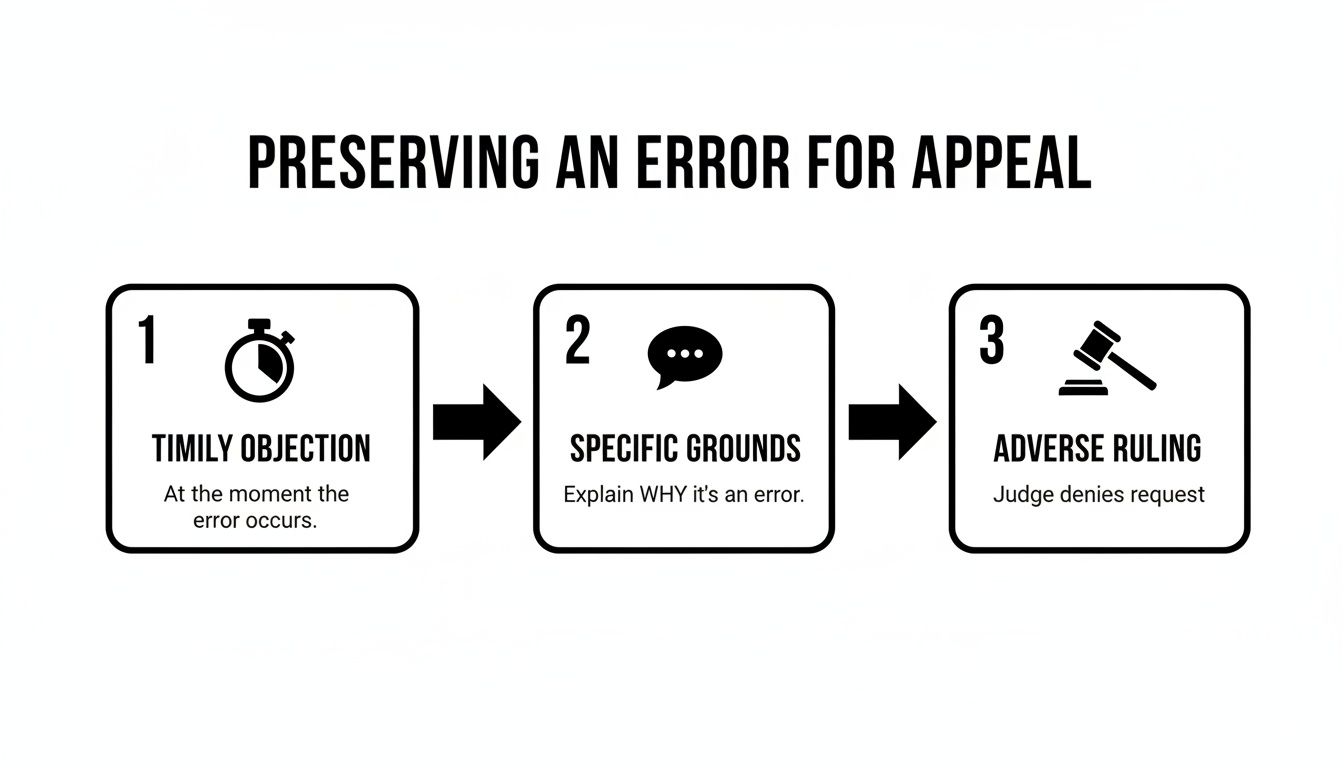
Each step builds on the last, creating a clear history of the alleged mistake and the judge's response. This record is the only thing the court of appeals will review.
The Three Essential Steps to Preserve an Error for Appeal
To successfully preserve a trial judge's mistake for review, your attorney must complete these three critical actions. Skipping even one step can prevent an appellate court from considering the error.
| Action | Why It Is Essential | Example in a Divorce Case |
|---|---|---|
| 1. Make a Timely Objection | The trial judge must be given a chance to fix the mistake as it happens. Waiting too long waives the complaint. | Your spouse's attorney asks a witness what a neighbor thought about your parenting. Your attorney must object immediately, before the witness answers. |
| 2. State Specific Grounds | The objection must tell the judge the exact legal rule being violated (e.g., hearsay, relevance). A generic objection is not enough. | Instead of just "Objection!", your attorney says, "Objection, hearsay. The witness is about to testify to an out-of-court statement offered to prove the truth of the matter asserted." |
| 3. Obtain an Adverse Ruling | You need the judge’s decision on the record. If the judge overrules your objection, you have preserved the error for appeal. | The judge says, "Overruled," allowing the witness to answer. This "adverse ruling" is now officially part of the trial record and can be challenged on appeal. |
Everything properly preserved becomes part of the official trial court history. For a deeper dive, you can read our guide on what goes into the appellate record in a Texas family law case. From a legal standpoint, if an error isn't in that record, it might as well have never happened.
The Legal Rationale Behind Preserving Error

The requirement to object during trial is not a procedural trap; it is rooted in fairness and judicial efficiency. The law expects attorneys to give the trial judge an opportunity to correct their own mistakes in real-time. This principle, found in the Texas Rules of Appellate Procedure, ensures that the trial is the main event, not just a rehearsal for an appeal.
Giving the Trial Court a Fair Chance to Get It Right
Making an objection is about giving the judge and the opposing party fair notice that you believe a legal error is happening. It allows the judge to reconsider a ruling or prevent improper evidence from being introduced. This prevents a party from sitting silently while an error unfolds, only to spring it as a trap on appeal.
Every objection becomes part of the official trial record. This transcript is the only thing the appellate court can review. An objection acts as a clear marker in that record, identifying the precise spot where you believe a mistake occurred and giving the appellate judges a clear path to follow.
Understanding the Standard of Review: Abuse of Discretion
In most Texas family law appeals, especially those involving complex issues like child custody or the division of property, the appellate court applies a standard called "abuse of discretion."
Abuse of Discretion: This legal term means the trial judge made a decision that was arbitrary, unreasonable, or without reference to any guiding legal rules or principles. It does not mean the judge was hostile. To win on appeal, you have to prove the judge's decision wasn't just wrong, but legally indefensible.
Meeting this high standard is challenging and nearly impossible without a record of proper objections. Your objections show the appellate court that the trial judge was presented with the correct legal argument but chose to misapply it, leading to a harmful outcome.
Significant errors do happen. During the 2024–2025 term, for example, the Texas Supreme Court reversed a high percentage of the state court cases it reviewed, showing that higher courts will correct errors when they are properly preserved. You can explore data on Texas Supreme Court decisions for more insight. A solid record of objections provides your appellate lawyer with the evidence needed to argue that the judge's decision was a true abuse of discretion that must be overturned.
Common Reversible Errors in Texas Family Law Trials
During the emotional and fast-paced environment of a family law trial, your attorney must be a vigilant guardian, constantly watching for legal missteps. Spotting these mistakes is one thing, but objecting to them at the moment is what preserves your right to seek justice on appeal. While every case is unique, certain critical errors appear frequently in Texas family courts.
Errors in Child Custody Cases
Decisions about child custody must be based on the best interest of the child. A common reversible error is the misapplication of the Holley factors—the list of considerations Texas courts use to determine a child’s best interest. For example, a judge might fixate on one parent's income while ignoring compelling evidence of the other parent's stronger nurturing bond with the child.
Another common error involves expert testimony. If the other side presents a "parenting expert" who lacks proper credentials or offers an opinion based on a flawed analysis, your attorney must object. Failure to do so allows that unqualified testimony to unfairly influence the judge. If your attorney stays silent, you lose your chance to argue on appeal that the judge got it wrong.
Errors in Property Division Cases
Texas is a community property state, but the rules for classifying and dividing assets in a divorce are complex. This complexity often leads to significant and costly errors.
A prime example is the mischaracterization of property. If a judge incorrectly treats your separate property (like an inheritance received during the marriage) as community property and divides it, that is a clear legal error. Similarly, if the court accepts a flawed or outdated business valuation while ignoring more accurate evidence, it can result in a profoundly unfair property division. If your attorney does not object immediately, the appellate court must assume you agreed with the error, and the unfair division becomes permanent.
Errors in Support and Financial Cases
Calculating child support or spousal maintenance may seem straightforward, but mistakes are common and can have lasting financial consequences. For instance, a judge might ignore clear evidence that a spouse is "intentionally unemployed or underemployed" to reduce their support obligation. A court's refusal to consider this is a serious error.
Simple math mistakes—like using the wrong income figure or applying an incorrect percentage—are also frequent reversible errors. If your attorney does not object to a calculation error or the court's failure to address underemployment, the incorrect amount becomes locked into your final order. You will be stuck paying or receiving the wrong amount for years, unable to change it without proving a "new and substantial change in circumstances."
Advanced Ways to Preserve Your Right to Appeal

While timely objections are fundamental, a skilled trial lawyer uses more advanced tools to protect the record when a judge makes a serious error. Two of the most critical are the Offer of Proof and the Motion for New Trial. Preserving error is a strategic process aimed at building a complete record that gives the appellate court the information it needs to restore a fair outcome.
Using an Offer of Proof to Preserve Excluded Evidence
Imagine your attorney tries to call a crucial witness, but the judge sustains the other side’s objection and refuses to let them testify. If your attorney simply moves on, the appellate court will never know what that witness would have said, and the error is lost. This is where an Offer of Proof is essential.
An Offer of Proof (also known as a "bill of exceptions") creates a record of the evidence the judge excluded. Your attorney can do this outside the jury’s presence in two ways:
- Question and Answer: Your lawyer questions the witness on the record, so the court reporter captures the full testimony.
- Attorney Summary: Your lawyer provides a detailed summary of the witness's expected testimony.
An Offer of Proof shows the appellate court exactly what crucial evidence was kept from the fact-finder. Without it, the court has no way to gauge whether the excluded evidence was important enough to have changed the outcome of your case.
This is the only way to demonstrate the harm caused by the judge’s ruling. It is a fundamental step in building the narrative when you later write a compelling Statement of Facts for your appeal.
The Motion for New Trial: Your Last Chance in the Trial Court
After the trial ends and the judge signs the final order, you have one last opportunity to convince the trial judge to correct a major error. This is done through a Motion for New Trial. This post-trial motion formally asks the trial court to set aside its judgment and grant a do-over due to a significant mistake that undermined the fairness of the trial.
Crucially, a Motion for New Trial is required to preserve certain types of errors. These are among the objections required to preserve appeal in Texas that cannot be skipped. For example, if you believe the evidence was legally or factually insufficient to support the verdict—such as a baseless property valuation—you must raise that complaint in a Motion for New Trial. Failure to do so waives your right to argue it on appeal.
The Texas court system is focused on efficiency. In fiscal year 2023, new family law filings decreased by 6%, and courts maintained a 100% clearance rate, according to Texas judiciary annual statistical reports. While this speed is generally positive, it means an unjust result can become final very quickly if these procedural rules are not followed perfectly.
How an Appellate Lawyer Analyzes Your Case for Appeal

When you receive a family court ruling that feels wrong, an appeal offers a path to challenge it. An appeal is a detailed investigation into the trial itself, and the first step is obtaining the official trial record. The record is the entire documented history of your case, and to the appellate court, if something isn't in it, it didn't happen. The record consists of two parts:
- The Reporter's Record: The court reporter's word-for-word transcript of everything said during the trial.
- The Clerk's Record: A collection of every document filed in your case, from petitions and motions to evidence and the final order.
Our job begins by meticulously reading every page of this record, searching for legal errors that your trial attorney properly preserved for appellate review.
Identifying Preserved Errors in the Record
We are trained to spot the critical three-part action: a timely objection, a clear statement of the legal grounds, and a ruling from the judge. When we find that combination, we have found a potential issue for your appeal. We cross-reference what was said in the courtroom with the documents filed. If the judge excluded key evidence, we look for an Offer of Proof. If the judge made a ruling that contradicts established Texas law, we find that exact moment in the transcript.
This process is like piecing together a complex puzzle. We are not just looking for mistakes; we are looking for preserved mistakes—the only kind that an appellate court has the authority to review.
The quality of your trial record determines the strength of your appeal. A transcript filled with clear, specific, and timely objections gives us the raw material to build a compelling argument that the trial court’s judgment was flawed.
Applying the Correct Standard of Review
Once we identify a preserved error, we analyze it through the correct legal lens, known as the standard of review. This standard dictates how much deference the appellate court gives the trial judge's decision. Different errors are measured against different standards:
- Abuse of Discretion: The most common standard in family law, it applies to decisions on child custody or property division. We must show the ruling was arbitrary or unreasonable.
- De Novo Review: For pure questions of law, such as interpreting a statute, the appellate court gives no deference. "De novo" means "from the new," and the court reviews the issue with fresh eyes.
- Evidentiary Sufficiency: We challenge whether there was legally or factually sufficient evidence to support the outcome.
Matching the error with the correct standard is critical. A mistake is more likely to be considered a reversible error when it was perfectly preserved and can be proven to fail the applicable standard. This strategic analysis is what determines if you have a viable case. To learn more about the initial process, read about perfecting an appeal in a Texas family court.
Frequently Asked Questions About Texas Appeals
After a difficult trial, it's natural to have questions. When a family law judgment feels unjust, figuring out your next steps can be overwhelming. Here are plain-English answers to some of the most common questions our appellate attorneys receive.
What if My Trial Lawyer Never Objected at All?
This is a common fear. While a failure to object makes an appeal much harder, it doesn't always close the door. The law allows for a few specific exceptions for "fundamental errors." One of the clearest examples is an issue of subject matter jurisdiction—whether the court had the legal power to rule on your case at all. This type of error can be raised for the first time on appeal.
More commonly, certain arguments can be preserved by raising them in a Motion for New Trial after the trial is over. For instance, an argument that there was legally insufficient evidence to support the judge's decision must be made in a post-trial motion to be preserved for appeal. An appellate specialist can review your trial record to identify if one of these rare exceptions applies.
How Long Do I Have to File an Appeal in a Texas Family Law Case?
The deadlines in Texas appellate law are absolute and unforgiving. If you miss a deadline, your right to appeal is gone forever.
- Standard Deadline: You generally have 30 days from the date the final judgment is signed to file your Notice of Appeal.
- Extended Deadline: This deadline can be extended to 90 days if a proper post-judgment motion (like a Motion for New Trial) is filed.
Because these timelines are rigid, you should contact an appellate attorney immediately after receiving an unfavorable ruling. The clock starts ticking the moment the judge signs the final order.
If the Judge Made a Mistake, Does That Mean I Automatically Win?
No. This is one of the biggest misconceptions about appeals. Simply pointing out a mistake is not enough. Appellate courts classify errors as either harmless or reversible.
A harmless error is a real mistake, but one that did not affect the final outcome. The court might agree an error occurred but conclude the result would have been the same anyway.
A reversible error, however, is a game-changer. This is a mistake so significant that it likely caused the judge to make the wrong decision. To win your appeal, your attorney must prove that a preserved error occurred and convince the appellate court that the error was so harmful it requires a different outcome or a new trial for your divorce or child custody case.
Your Fight for a Just Outcome Starts in the Trial Court
Winning an appeal begins in the trial court. As this guide explains, if the right objections required to preserve an appeal in Texas are not made, the door to justice can close. These rules exist to ensure the legal process is fair for everyone.
An experienced appellate attorney’s first job is to meticulously review the trial record—every transcript page and filed document—to find moments where a mistake was made and a proper objection was logged. This is the raw material needed to challenge an unjust outcome. If the final orders in your divorce or child custody case were built on a serious legal error, you deserve a chance to have it corrected.
What an Appeal Really Is
An appeal is not a do-over. You cannot present new evidence or re-argue your case. It is a focused review to see if the judge followed the rules and applied the law correctly. Your trial lawyer’s skill in preserving errors is what gives you a ticket to that review.
An appeal is your chance to hold the system accountable. When you feel the trial court got it wrong, an appeal offers a path to restore balance and ensure the final judgment rests on solid legal ground.
Do not lose hope if you are facing a final order that feels fundamentally unfair. The first step is to get a professional evaluation of your case to see what errors were preserved and what legal arguments can be made on your behalf.
If you believe the court made a mistake in your family law case, our appellate attorneys can help you seek a fair outcome. Contact The Law Office of Bryan Fagan today for a free consultation at https://familylawcourtappeals.com.