Skip to content
If you have just received a child support order that feels fundamentally unfair, you are not alone. You may be looking at the final numbers, convinced the judge made a mistake that will create a significant financial burden for years to come. This experience can be incredibly disheartening.
The good news is that you do not have to accept a decision based on a legal error. Appealing a child support order in Texas is a specific legal process designed to correct these kinds of mistakes and seek a just outcome. An appeal is not a re-trial, but rather a formal review by a higher court focused on ensuring the law was applied correctly.
From our experience handling family law appeals, we understand that errors can happen in a busy court system. Perhaps the judge miscalculated a parent's net resources, misinterpreted evidence, or failed to apply the Texas child support guidelines correctly. These are not just minor disagreements—they are potential grounds for an appeal. This guide will explain the process, from identifying a valid reason to appeal to understanding what a successful challenge involves.
Understanding Reversible Error in Child Support Appeals
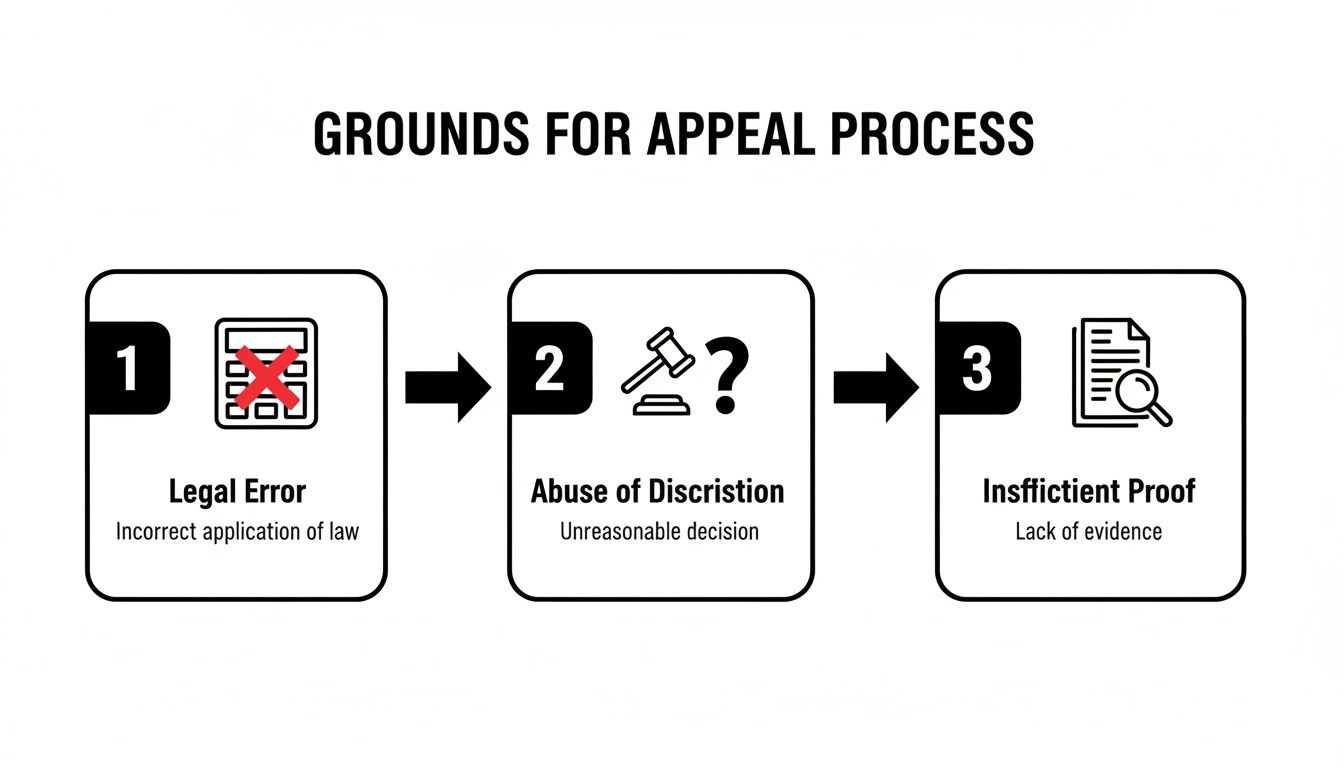
A successful child support appeal in Texas is not about expressing dissatisfaction with the judge's decision. It hinges on proving the trial court made a specific and significant legal mistake, known as a reversible error. The appellate court's role is not to re-hear the case but to review the trial court record for serious legal flaws that unfairly affected the outcome.
So, what does a reversible error look like in a child support case? Here are a few common examples:
- Miscalculation of Income: The court incorrectly calculated a parent's "net resources" by including non-taxable income or refusing to deduct legitimate business expenses for a self-employed parent.
- Ignoring Evidence: The judge disregarded clear, undisputed evidence of a parent's true earning potential or hidden income, leading to an inaccurate support amount.
- Incorrect Application of Law: The court applied an outdated child support cap or failed to make legally required findings to justify deviating from the standard Texas child support guidelines.
Another critical ground for appeal is an "abuse of discretion." This is a key legal term in family law appeals. We cover this in depth in our guide to the abuse of discretion standard.
Abuse of Discretion: In plain English, this occurs when a judge makes a decision that is so arbitrary or unreasonable that it goes against the facts and the law.
For example, if a judge orders a support amount far above or below the Texas guidelines without providing a clear, legally sound reason in the court record, that may be an abuse of discretion. These are identifiable legal errors that an appellate court has the power to correct.
Critical Deadlines and Procedures in a Texas Appeal
When appealing a family law order, time is of the essence. Texas courts are exceptionally strict about deadlines, and missing one can permanently forfeit your right to appeal.
The most important deadline is for filing your Notice of Appeal. In most cases, you have just 30 days from the date the judge signs the final child support order to file this document.
Extending the Filing Deadline
In some circumstances, this deadline can be extended. Filing a post-judgment motion, such as a Motion for New Trial, can extend the deadline for your Notice of Appeal to 90 days from the date the order was signed. However, this is a strategic legal decision that can have other consequences for your case and should only be made after consulting with an experienced appellate attorney.
You can find a more detailed overview of the requirements in our guide on how to file a Notice of Appeal.
The Appellate Record and Your Brief
Once the notice is filed, the process of preparing the appellate record begins. This is the official case file the court of appeals will review, and it consists of two parts:
- The Clerk’s Record: All documents filed in your case, such as motions, pleadings, and the final order.
- The Reporter’s Record: The word-for-word transcript of what was said during court hearings and the trial.
The appellate court cannot consider new evidence; its review is strictly limited to this record. Your appellate attorney will meticulously analyze this record to identify the specific legal errors that will form the basis of your appeal.
These findings become the foundation of your appellant's brief. A brief is a formal written argument that explains to the appellate court precisely what legal mistakes the trial court made and why its order should be reversed.
How an Appeal Differs from a Trial
It is crucial to understand that an appeal is not a second trial. The purpose, rules, and procedures are fundamentally different.
| Aspect | Trial Court | Appellate Court |
|---|---|---|
| Purpose | To determine facts and apply the law to those facts. | To review the trial record for legal errors. |
| Evidence | New evidence and testimony are presented. | No new evidence is allowed; the review is limited to the existing record. |
| Decision-Maker | A single judge or a jury. | A panel of three or more justices. |
| Key Document | The Final Judgment or Order. | The legal briefs filed by both parties. |
Understanding these differences helps set realistic expectations. An appeal focuses narrowly on mistakes of law, not on re-arguing the facts of your case.
How the New Child Support Cap Can Impact Your Appeal
For high-income child support cases, a recent legislative update may be central to your appeal. The Texas Family Code recently increased the presumptive maximum for monthly net resources, which for a long time was set at $9,200.
This change is not retroactive; it applies to orders in cases filed after the law took effect. The timing is critical.
A Potential Reversible Error
A clear reversible error may exist if the trial judge in your recent case mistakenly applied the old, lower cap to calculate support. For example, if you presented clear evidence that the other parent's monthly net resources were well above the new, higher cap, but the judge based the final calculation on the outdated $9,200 figure, that is a legal mistake. It is a strong ground for an appeal because the final order is not based on current law.
For a deeper dive into how this calculation works, read our comprehensive guide on the maximum child support in Texas.
Common Procedural Mistakes That Can Jeopardize an Appeal
Many valid child support appeals fail due to avoidable procedural mistakes, not a lack of merit. Understanding these pitfalls is the first step toward protecting your rights.

Missing the Filing Deadline
The single most critical error is missing the deadline to file the Notice of Appeal. This deadline is jurisdictional, meaning if you miss it, the appellate court loses its legal authority to hear your case. The result is almost always an immediate dismissal, with no second chances.
Failure to "Preserve Error"
Another common pitfall is failing to preserve error. This legal requirement means that to complain about an issue on appeal, your attorney must have made a specific and timely objection during the original trial court proceeding. If the objection was not made at trial, you generally lose the right to raise that issue on appeal.
Preserving Error: In simple terms, you must give the trial judge a chance to fix their own mistake before you can ask a higher court to do it.
Ignoring the Existing Order
Filing an appeal does not automatically pause the child support order you are challenging. You must continue to pay the ordered amount on time and in full throughout the appeal process. Failure to do so can lead to enforcement actions, including wage garnishment, license suspension, and the accrual of interest on the unpaid balance.
Why You Need an Appellate Attorney
A common misconception is that a trial lawyer is the best person to handle an appeal. In reality, trial and appellate law require distinct skills. A trial lawyer's job is to build a case with evidence and argue facts in a courtroom. An appellate lawyer's work is to scrutinize the trial record for legal errors and construct a persuasive written argument based on complex procedural rules and case law.
Appellate advocacy is a scholarly and strategic discipline. It demands mastery of the Texas Rules of Appellate Procedure, deep legal research, and powerful writing. Appellate attorneys know the expert strategies for crafting arguments that win cases—a skill essential for convincing a panel of justices that a trial judge made a reversible error.
With thousands of family law cases filed in Texas courts each year, even the most diligent judges can make mistakes. An appellate specialist has the focused expertise to identify those errors and advocate for a fair and just outcome.
Common Questions About Appealing a Child Support Order
If you are considering an appeal, you likely have many questions. Here are answers to some of the most common concerns we hear from clients.
Can I Stop Paying Child Support While My Appeal Is Pending?
No. The trial court’s order remains legally binding and fully in effect during the appeal. You must continue to make all payments as ordered. If you stop paying, the other parent can initiate enforcement actions against you, and any unpaid support will accrue interest.
What Are My Chances of Winning a Child Support Appeal?
Success depends entirely on whether a reversible error occurred at trial, not on whether the outcome felt "fair." An appeal is a legal challenge to the judge's ruling, not a second chance to argue the facts. To win, your attorney must prove that the judge made a legal mistake that likely caused an improper judgment. An experienced appellate lawyer can review the trial record to provide a candid assessment of whether such an error exists and if an appeal is a viable path forward.
How Long Does a Child Support Appeal Take in Texas?
An appeal is a marathon, not a sprint. A realistic timeline, from filing the Notice of Appeal to receiving a final decision, is typically 6 to 18 months. The duration depends on the complexity of the legal issues, the time it takes to prepare the official trial record, and the caseload of the specific appellate court handling your appeal.
If you believe the court made a mistake in your family law case, our appellate attorneys can help you seek a fair outcome. Contact The Law Office of Bryan Fagan today for a free consultation to evaluate your case.