Skip to content
When the judge hands down the final property division in your Texas divorce, it’s supposed to be the end of a long, difficult chapter. But what happens when that decision feels fundamentally unfair? You may feel your case was handled incorrectly, and the result is deeply disconnected from the facts presented at trial. If so, you might have a path forward by appealing the property division.
This isn't about being unhappy with the outcome. An appeal is a formal legal process designed to correct a specific, significant mistake made by the trial court. It is a powerful tool to restore fairness and seek justice when the system has fallen short.
What You Can Appeal in a Texas Divorce Case

Watching a judge divide your life’s assets can be an incredibly stressful experience. When that final order misinterprets your contributions, mislabels major assets, or seems arbitrary, it can leave you questioning the fairness of the entire process. You are not alone in feeling this way.
The good news is that the Texas Rules of Appellate Procedure provide a way to seek a just result. It's important to understand, though, that an appeal isn't a do-over. You don't get to present new evidence or re-litigate your case from scratch. Instead, an appeal is a strategic review of the existing trial record—every transcript, exhibit, and motion—to determine if a significant legal error occurred that unfairly impacted the outcome.
The Foundation of a Property Appeal: Separate vs. Community Property
Everything in a Texas property division boils down to a fundamental distinction between two types of property. A mistake in this area is one of the most common grounds for a successful appeal.
- Separate Property: This includes anything you owned before the marriage, plus any assets you received during the marriage as a gift or inheritance. This property is yours alone and is not subject to division by the court.
- Community Property: This is everything else acquired by either spouse during the marriage. This "community estate" is what the judge is tasked with dividing in a "just and right" manner.
One of the most powerful reasons for appealing a property division in a Texas divorce is when a court mischaracterizes property. For example, if a judge incorrectly classifies your inherited family ranch as community property and awards half of it to your ex-spouse, that’s a clear legal mistake. This type of error is often a reversible error, meaning the appellate court can correct it. To learn more about these critical definitions, you can review our guide on community property law in Texas.
Understanding the "Just and Right" Standard of Review
Texas law instructs judges to divide the community estate in a manner that is "just and right." This standard gives them a great deal of flexibility, or discretion. It does not mean a 50/50 split is required.
A judge can order an unequal division based on factors like fault in the divorce, significant differences in earning capacity, or the health and needs of each spouse.
A judge's broad discretion is often the central battleground in property appeals. While they have significant power to make a judgment call, that power is not limitless. The decision cannot be arbitrary or unfair.
A successful appeal demonstrates that the judge abused that discretion, leading to a division that is so lopsided it becomes manifestly unjust. It's important to distinguish between a ruling you simply disagree with and one that constitutes a legal error.
Grounds for Appeal vs. Trial Disagreements
| Appealable Issue (Potential Reversible Error) | Non-Appealable Issue (Trial Court Discretion) |
|---|---|
| Mischaracterizing separate property as community property. | Awarding a 60/40 split after considering all relevant factors. |
| Failing to assign a value to a major asset, like a business. | Believing one spouse's testimony over the other's. |
| Applying the wrong legal standard or statute. | Deciding one spouse has greater financial needs post-divorce. |
| Awarding 90% of assets to one party without clear justification. | Ordering the house to be sold instead of awarded to one spouse. |
A successful appeal hinges on proving that the trial judge's decision was not just one you disliked, but one that was legally indefensible based on the evidence. An experienced appellate attorney can review your case to determine if such an error exists and help you navigate the path toward a more equitable outcome.
The "Just and Right" Standard: Why 50/50 Is a Myth in Texas
When you first look at your final divorce decree, the property division might come as a shock. Many people assume Texas is a strict 50/50 state, but that is a common misconception.
The reality is that Texas family law judges utilize a principle called the “just and right” standard. Found in the Texas Family Code, this principle doesn't require a mathematically equal split. Instead, it directs the judge to divide the community estate in a way they deem fair based on the specific circumstances of your marriage. This flexibility is the very reason why so many appeals of property division in a Texas divorce occur.
Factors That Influence the Division
A judge cannot simply choose a 65/35 split without reason. Their decision must be grounded in a set of well-established legal factors, often called the Murff factors. These are the guideposts they use to determine what "just and right" means for your case.
Common factors a judge will weigh include:
- Differences in Earning Power: Does one spouse have a much greater ability to earn income in the future?
- Fault in the Divorce: Was there adultery, cruelty, or another fault-based reason for the divorce? The court may award a larger share to the non-fault spouse.
- Health of Each Spouse: A spouse with chronic health problems or a disability might receive more to account for future needs.
- Future Benefits: Did the divorce prevent one spouse from realizing the future benefits of the other’s growing retirement or business interests?
- Size of Separate Estates: If one spouse has a large separate estate (like an inheritance), the judge might give the other a larger piece of the community property to create a more equitable outcome.
This framework, laid out in Texas Family Code Section 7.001, is about fairness, not formulas. For a real-world example, look at the recent Texas Court of Appeals case Paez v. Rodriguez. After a 47-year marriage, the court affirmed an unequal property division because the trial judge properly weighed these types of factors. You can see more analysis of how judges apply this standard in Dallas divorce property division cases.
What Does "Abuse of Discretion" Actually Mean?
This brings us to the core of many property division appeals: arguing that the trial judge committed an “abuse of discretion.” This is the standard of review the appellate court uses, and it is a high bar to clear.
Abuse of Discretion: A legal term meaning the trial court’s decision was so arbitrary, unreasonable, or lacking in legal basis that it resulted in a patently unfair outcome.
Winning an appeal isn't about telling a higher court you just don't like the 60/40 split you received. You must prove the judge’s entire decision-making process was flawed. This means showing they either ignored clear evidence, misapplied the law, or made a ruling so far outside the bounds of reason that no reasonable judge would have come to the same conclusion.
Mischaracterization: A Clear-Cut Reversible Error
While arguing about the fairness of a split can be subjective, there’s another path to a successful appeal that is more definitive: mischaracterization of property. This isn't about a judge's discretion; it's about a straightforward legal error.
When a mistake is significant enough to have likely caused the wrong outcome, it’s considered a “reversible error,” giving the appellate court grounds to send the case back for correction.
Here’s a classic example: You inherited your grandmother's house during the marriage. Under Texas law, that is your separate property. If the trial court mistakenly labels it as community property and gives half its value to your ex-spouse, that’s a clear reversible error. Proving this kind of mistake is often more direct than proving a judge's entire thought process was flawed. An experienced appellate lawyer knows how to identify these critical missteps in the trial record.
Navigating the Critical Deadlines for Your Appeal
When it comes to appealing a family law decision, the calendar is unforgiving. The entire process for appealing a property division in a Texas divorce is governed by a series of strict deadlines. Missing one can close the door to your appeal permanently, no matter how unfair the judge's ruling was.
The Texas Rules of Appellate Procedure are rigid and demand immediate, precise action. Understanding this timeline is the first and most critical step in protecting your right to seek a fair outcome.
The Most Important 30 Days of Your Case
The clock starts ticking the moment the judge signs your Final Decree of Divorce. From that day, you typically have just 30 days to file a document called a Notice of Appeal.
This document officially informs the court and the other party that you intend to challenge the judgment. It initiates the entire appellate process. While it may seem simple, its timing is everything. There is a limited exception: if you file a proper Motion for New Trial, this deadline can be extended to 90 days from the date the decree was signed.
A Notice of Appeal isn’t the appeal itself; it’s the key that unlocks the door. Its purpose is to preserve your right to challenge the decision. Many people with strong cases lose their chance to appeal simply because they waited too long to file this one document.
This is why you must speak with an appellate attorney the moment you receive an unfavorable result at trial. Even a week's delay can jeopardize your case. We have resources that explain how to file a Notice of Appeal to help you understand this crucial first step.
A judge's property division hinges on getting the fundamentals right—namely, what's separate property and what's community property. This is the foundation of a "just and right" division.
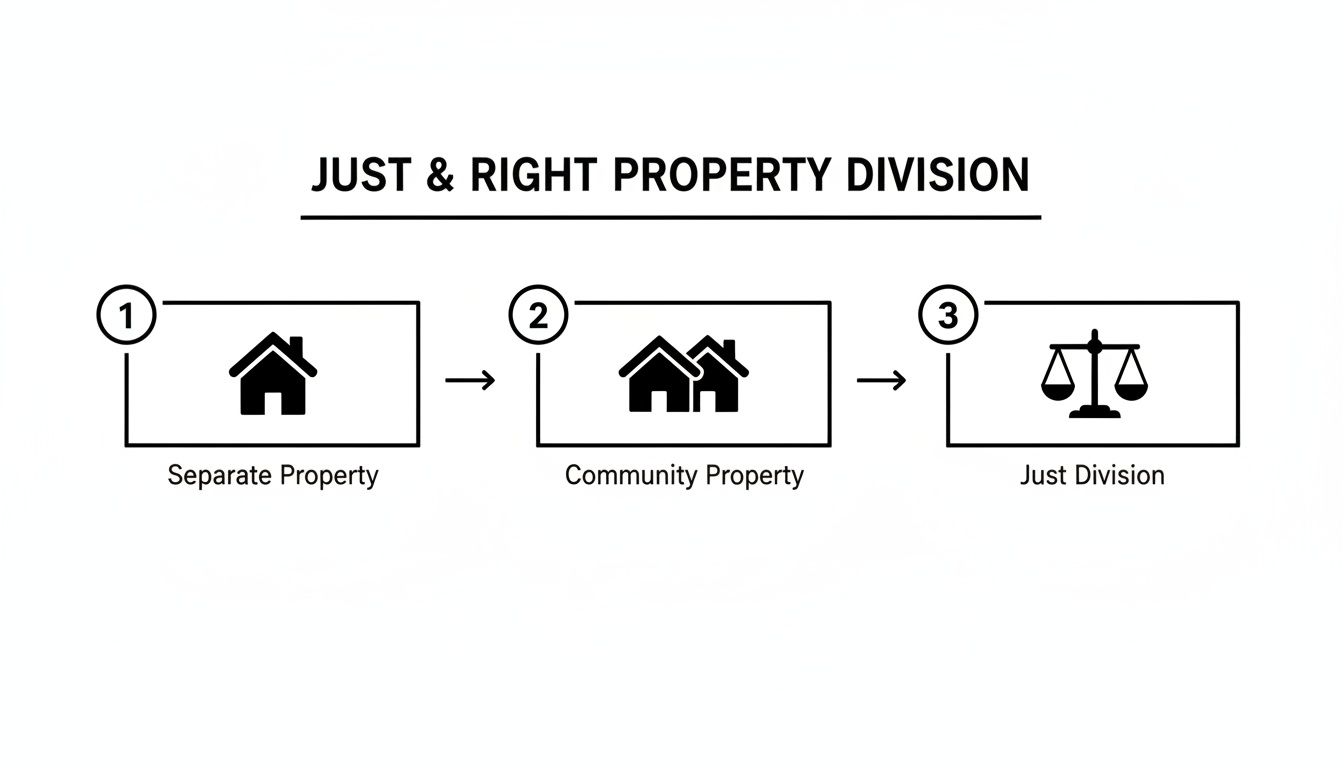
As you can see, if the court makes a mistake at the start—like mischaracterizing a separate property inheritance as community property—it throws off the entire calculation. That kind of error can create an unjust outcome that only an appeal can fix.
Assembling the Foundation of Your Appeal: The Record
Once your Notice of Appeal is filed, the next step is to prepare the appellate record. This is the complete case file that the court of appeals will review. The appellate judges are not allowed to consider anything outside of this record. If it isn't in the record, it doesn't exist for the purposes of your appeal.
The appellate record is composed of two key parts:
- The Clerk’s Record: This is a collection of all documents filed in your case—from the original petition and inventories to motions and the final decree.
- The Reporter’s Record: This is the word-for-word transcript of everything said during the trial. It includes all testimony, attorney arguments, and the judge's statements.
Your appellate lawyer will order these records and then comb through every page, hunting for the specific reversible error that will be the heart of your appeal. Without a complete and accurate record, proving the trial judge made a mistake is nearly impossible.
Crafting Your Argument Through Briefing
With the record complete, the main event of the appeal begins: briefing. This is where the legal battle is fought and won.
An appellate brief is a formal, written legal argument presented to the court of appeals. In the brief, your attorney meticulously lays out the facts from the record, identifies the specific errors made by the trial court, and uses case law and statutes to build a powerful argument for why the original decision must be overturned. This is a sophisticated, persuasive document that requires a deep understanding of appellate procedure and the complex financial issues at play.
Crafting a Winning Argument for the Appellate Court
The first thing to understand is a critical rule of appellate law: an appeal is not a do-over. This is not a chance to tell your story again, introduce new evidence, or call new witnesses.
Your appeal will be won or lost based entirely on the existing trial court record. The entire fight happens on paper, meticulously built by identifying a specific, provable legal mistake—a reversible error—that led to an unjust outcome. A successful appeal is secured through a compelling written argument, the appellate brief, long before any oral argument takes place.
The Search for Reversible Error
Our appellate team approaches a trial record like forensic accountants, combing through every page of the reporter's record (the transcript) and every exhibit. We are hunting for those critical moments where the trial judge either misapplied the law or made a decision so unreasonable that it amounts to an "abuse of discretion."
Common reversible errors we find in property division appeals include:
- Mischaracterization of Property: The classic example is when a judge mistakenly labels separate property, like an inheritance, as community property and divides it.
- Major Valuation Errors: This occurs when the court fails to assign a value to a significant asset—like a family business or stock options—or accepts a valuation with no credible evidence to support it.
- A Skewed and Unjust Division: The judge orders a wildly disproportionate split of the community estate, like 75/25, without a solid, legally sound reason based on the established Murff factors.
A reversible error isn't just a minor mistake. It must be a substantial error that probably caused the court to reach an improper judgment. We must convince the appellate justices that if the error hadn't happened, the property division would have likely been very different.
"Preserving Error": The Make-or-Break Step at Trial
Many potential appeals fail because of the "preservation of error" rule. Simply put, you cannot complain about a mistake on appeal unless your trial attorney made a specific and timely objection to it during the trial. The court of appeals is not the place to raise new issues for the first time.
For example, if the opposing expert presents a flawed business valuation, your lawyer must object right then and there. If they don't, you have almost certainly lost your right to challenge that valuation on appeal. This underscores why having a skilled trial lawyer is essential.
However, a good appellate attorney can often find appealable issues that were properly preserved, even if they weren't the focus at trial. A seemingly minor objection can sometimes become the key to a successful appeal, especially when a judge's ruling is so fundamentally unfair it rises to the high standard of an abuse of discretion standard in Texas family law appeals.
From Trial Record to Persuasive Brief
Once we identify a reversible error that was properly preserved at trial, the work of briefing begins. The brief is the formal, written legal argument where we lay out our entire case for the court of appeals.
A great brief tells a compelling story grounded entirely in the facts from the record and the rule of law. It methodically walks the justices through the case, showing them exactly what went wrong and why it matters. We structure the brief to:
- Present the facts of the case based only on what's in the official appellate record.
- Pinpoint the exact error the trial judge made.
- Cite statutes and previous court decisions (case law) that prove the judge's ruling was legally incorrect.
- Argue persuasively that this error resulted in an unjust property division that must be reversed.
Writing a powerful brief is an art form that demands deep legal knowledge, strategic thinking, and clear, forceful writing for a sophisticated audience of appellate judges. This document is the absolute foundation of your fight for a fair outcome.
Potential Outcomes and What to Expect After an Appeal

After all the briefs have been filed, the waiting begins. Months later, the appellate court will issue its written decision. So, what does a "win" look like when you are appealing a property division in a Texas divorce?
The appellate court has a few different ways it can correct a trial court's mistake, and understanding these possibilities is key to managing your expectations.
Reverse and Remand: The Most Common Outcome
By far, the most frequent result of a successful appeal is a "reverse and remand." This is a significant victory, even though it doesn't end the fight immediately.
Here's what it means: the court of appeals agrees that the trial judge made a significant error. The appellate court then reverses, or voids, the trial court's property division. However, the appeals court will not create a new division for you. Instead, it "remands" the case, sending it back to the trial court for a new proceeding with specific instructions. For example, the judge may be ordered to treat certain assets as separate property or re-evaluate the entire estate in a way that is truly "just and right."
A reverse and remand resets the board. It forces the trial court to correct its mistake, giving you a renewed opportunity to argue for a fair division under the proper legal framework.
Reverse and Render: The Rarer, More Decisive Win
In some cases, you may achieve an even better result: a "reverse and render." This is a cleaner, faster, and more final outcome.
This happens when the mistake is so obvious and the correct answer is so clear from the trial evidence that there’s no need for another hearing. The court of appeals essentially says, "The trial court got this wrong, and here is the right answer."
For instance, if the trial court awarded your ex-spouse $50,000 from a bank account that the evidence indisputably proved was your separate property, the appellate court could "render" a new judgment that removes that award, fixing the problem on the spot. This provides immediate finality and avoids another trip to the trial court.
The Reality of the Timeline
It is critical to understand that appeals are not fast. From filing the Notice of Appeal to receiving a decision, the process can easily take a year or more. The court needs the full trial record, both sides file extensive written arguments (briefs), and sometimes, oral arguments are held.
Even after a decision, the losing side could try to appeal again to the Texas Supreme Court, though this is less common in family law. Patience is a necessity in an appeal.
If you believe the division of your property was fundamentally unfair or legally incorrect, you have the right to challenge it. Our appellate attorneys can analyze your case and help you pursue a just outcome. Contact The Law Office of Bryan Fagan today for a free consultation to evaluate your options.
Frequently Asked Questions About Appealing a Texas Property Division
After a judge divides your property, the final decree can feel set in stone. But what if you’re certain the judge made a major mistake? It’s a frustrating and confusing position. Here are answers to the most common questions from clients considering an appeal.
Is an "Unfair" Property Division Enough to Win an Appeal?
This is the first question on everyone's mind, and the answer is usually no. Simply feeling that the split was unfair isn't enough to win an appeal. The appellate court is not there to re-weigh the evidence. To be successful, you must prove the trial judge made a specific, significant legal mistake—a "reversible error."
For example, arguing you should have received 5% more of the estate probably won't succeed. But if the judge gave your spouse a larger share because they incorrectly classified your separate property inheritance as community property, that's a clear error of law and a strong foundation for appealing a Texas property division.
What Does It Cost to Appeal a Divorce Decree?
An appeal is a significant financial undertaking. The costs vary depending on the complexity of your case and the length of the original trial. You should budget for a few key expenses:
- Attorney's Fees: This is the largest cost, covering the extensive time your appellate lawyer needs to review the record, research the law, and write a compelling legal brief.
- The Appellate Record: You must pay to have the official records prepared. This includes the Clerk's Record (all filed documents) and the Reporter's Record (the trial transcript). For a multi-day trial, this can cost thousands of dollars.
- Court Filing Fees: These are administrative costs for filing your appeal with the court.
An appeal is a serious investment. But when a major financial error has occurred—like the mischaracterization of a business or real estate—the cost of an appeal is often the only way to protect yourself from a much more devastating financial loss.
We provide a realistic breakdown of these potential costs during our initial consultation so you can make an informed decision.
How Long Do I Have to File a Divorce Appeal in Texas?
This is where the Texas Rules of Appellate Procedure are incredibly strict. You have a non-negotiable deadline of 30 days from the date the judge signed the final divorce decree to file your "Notice of Appeal."
This deadline can be extended to 90 days, but only if you first file a proper Motion for New Trial. If you miss that initial deadline, your right to appeal is almost certainly gone forever. It is absolutely critical to speak with an appellate attorney the moment a judgment is signed.
What Happens to Our Property While the Appeal Is Ongoing?
This is a crucial point. The original property division order is still legally enforceable during the appeal. This means your ex-spouse could sell the house, empty a disputed bank account, or liquidate stocks.
To protect the assets, your attorney will likely need to post a "Supersedeas Bond" with the court. This bond acts as a security deposit that "pauses" the enforcement of the property judgment. It freezes the assets in place, ensuring they are still there if you win the appeal and the case is sent back for a fair division.
If you believe the court made a mistake in your family law case, our appellate attorneys can help you seek a fair outcome. Contact The Law Office of Bryan Fagan today for a free consultation at https://familylawcourtappeals.com.