Skip to content
When a judge signs a custody modification order that you believe is fundamentally unfair, it can feel like the ground has shifted beneath your feet. You may feel your case was handled unfairly, that the court ignored critical facts, or that the final decision does not protect your child’s best interest. This is a frustrating and often isolating experience, but the judge's signature does not have to be the final word.
Texas law provides a specific pathway for correcting legal errors: the appeal. An appeal is not a second chance to re-try your case but a structured, strategic process to ensure the law was applied correctly. If you are concerned that a significant mistake led to an unjust outcome for your family, the appellate process offers a way to seek fairness and restore balance.
Understanding the Difference Between a Trial and an Appeal

It is essential to understand that an appeal is fundamentally different from the trial you just experienced. Recognizing this difference is the first step in building a successful appellate strategy. An appeal is a review, not a retrial.
- The Focus is on Legal Mistakes. An appeal is not an opportunity to present new evidence or have a new judge re-evaluate witness credibility. Instead, the court of appeals reviews the existing trial record—the official transcripts and evidence—to determine if the trial judge committed a significant legal error.
- No Witnesses, No Jury. The appellate process is conducted almost entirely through writing. Your appellate attorney will prepare and file a detailed legal argument, known as a brief, which identifies the trial court’s errors and explains why those errors were harmful enough to produce an improper outcome.
- The Goal is to Correct Injustice. A successful appeal ensures that the laws designed to protect your family, as outlined in the Texas Family Code, were followed correctly. It is an opportunity to seek a more just result for you and your child by holding the trial court accountable to the rule of law.
The deadlines for family law appeals are notoriously strict and complex. The Texas Rules of Appellate Procedure govern the timeline, and missing a deadline can permanently bar your right to seek review. This is why it is critical to act quickly. If you believe the recent custody modification order was unjust, the clock has already started ticking. Your first step is to determine if you have a valid legal basis for a child custody appeal in Texas.
What Constitutes a Reversible Error in a Texas Custody Case?
Feeling that a judge’s ruling was wrong is a valid emotional response, but it is not, by itself, enough to win an appeal. To succeed, you must demonstrate that the trial court made a specific legal mistake known as a reversible error.
A reversible error is a significant legal or procedural mistake that was so substantial it likely caused the trial court to reach the wrong conclusion. The court of appeals is not there to second-guess the trial judge's judgment on which parent was more believable. Its role is to ensure the trial was conducted fairly and according to the law.
Understanding the "Abuse of Discretion" Standard of Review
In most Texas family law appeals, including custody modifications, the appellate court reviews the trial judge's decision under the "abuse of discretion" standard. This is a high bar to clear.
Abuse of Discretion (in plain English): This legal term means the trial judge made a decision that was arbitrary, unreasonable, or without reference to any guiding legal rules or principles. It is not about whether the appellate judges would have made a different decision; it is about whether the trial judge’s decision was so legally unsupported that it cannot be defended.
For example, a judge who ignores a mandatory provision of the Texas Family Code or bases a ruling on personal opinion rather than the evidence has likely committed an abuse of discretion. The goal is to show the appellate court not just that the judge got it wrong, but that the decision was fundamentally flawed because the judge misapplied or ignored the law. You can learn more about what qualifies as a reversible error in Texas family court and see if the facts of your case align.
Common Examples of Reversible Error in Custody Modification Cases
While every case is unique, reversible errors in custody modification appeals often fall into several common categories:
- Misapplying the "Best Interest of the Child" Standard: A judge must consider a specific set of factors (the Holley factors) when determining a child's best interest. If credible evidence of family violence exists, for instance, the law creates a presumption that it is not in the child’s best interest for the abusive parent to be a joint managing conservator. A judge who disregards this presumption without a compelling, stated reason may have abused their discretion.
- Improperly Admitting or Excluding Evidence: The Texas Rules of Evidence are designed to ensure that court decisions are based on reliable and relevant information. If a judge allowed prejudicial hearsay or unverified documents to influence their decision, or conversely, refused to consider critical, admissible evidence you offered, it could constitute a reversible error.
- Ignoring Mandatory Legal Procedures: The Texas Family Code provides a clear procedural roadmap. A judge who skips required steps—such as failing to make specific findings of fact about family violence when requested or refusing to interview an older child who has properly asked to speak with the court—commits a procedural error that can undermine the fairness of the entire proceeding.
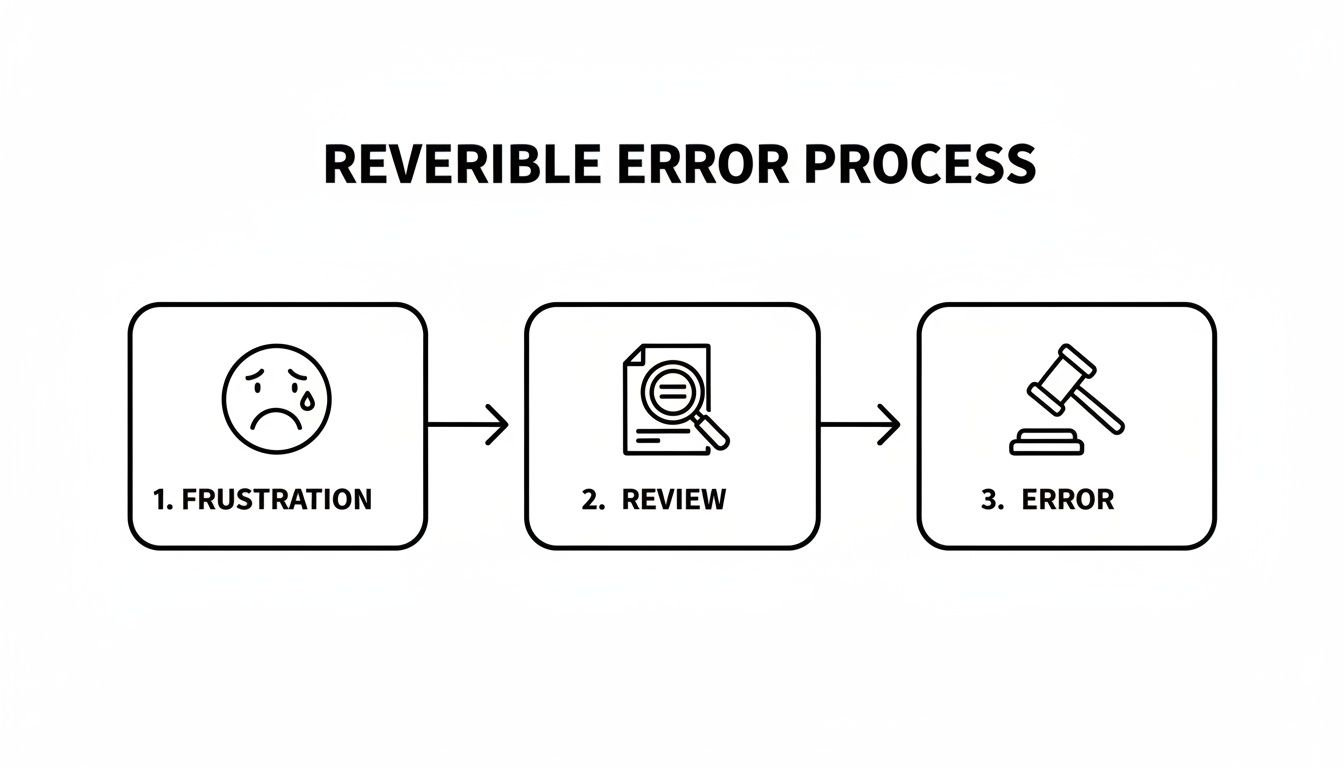
Distinguishing between trial court frustration and reversible error is the core of appellate advocacy.
Trial Court Frustration vs. Reversible Error
This table illustrates the critical difference between the common disappointments of a trial and the specific legal errors that can form the basis of a successful appeal.
| Common Trial Frustration | Potential Reversible Error |
|---|---|
| "The judge didn't seem to believe my testimony." | The judge refused to hear testimony from a qualified expert witness on a critical issue, violating the rules of evidence. |
| "I don't think the new possession schedule is fair to me." | The judge ordered a possession schedule that conflicts with a mandatory presumption in the Texas Family Code, such as the one related to family violence. |
| "The judge seemed biased against me from the start." | The judge made statements on the record showing a clear prejudice or failed to apply the law equally to both parties, depriving you of a fair trial. |
| "I presented emails showing the other parent is uncooperative, but they were ignored." | The judge excluded properly authenticated emails that were crucial to proving a material and substantial change in circumstances, misapplying the rules of evidence. |
An appeal is not a do-over; it is a meticulous review of the legal process. Identifying a reversible error is the key that unlocks the door to the court of appeals and a chance for a just outcome.
The First Steps in a Texas Custody Appeal
When you receive a final custody modification order you believe is wrong, the actions you take in the following days are critical. Appellate deadlines are unforgiving. Missing one can permanently forfeit your right to challenge the ruling.
The clock starts running the moment the judge signs the order. Your first, most urgent step is to file a Notice of Appeal. This formal document informs the trial court, the appellate court, and the other party that you intend to challenge the judge's decision.
Under the Texas Rules of Appellate Procedure, you generally have only 30 days from the date the order was signed to file this notice. This deadline is strictly enforced. Filing on day 31 will almost certainly result in your appeal being dismissed. Filing the notice on time is the single most important step to preserve your right to seek justice.
Assembling the Appellate Record: The Foundation of Your Case
Once the notice is filed, the next task is to compile the official evidence for the court of appeals. The appellate court will not hear new testimony or review new documents. Its review is confined to what happened in the trial court, as captured in the appellate record.
The record consists of two parts:
- The Clerk’s Record: A collection of all documents filed in your case, including petitions, motions, and the final order itself.
- The Reporter’s Record: The official, word-for-word transcript of everything said during hearings and the trial, including witness testimony and the judge’s rulings.
You must formally request that the court clerk and court reporter prepare these records. If a piece of evidence or a crucial statement is not in the record, then for the purposes of the appeal, it never happened. This is why understanding the procedural steps for how to file a notice of appeal and requesting the record is essential.
Can I Pause the New Custody Order During the Appeal?
One of the most pressing questions for parents is whether they must follow the new, unfair order while the appeal is pending. The answer is generally yes. A trial court’s order takes full effect the moment it is signed.
However, you may have an option. Your appellate attorney can file a motion asking the trial court to temporarily suspend enforcement of its order while the appeal proceeds. In legal terms, this is often called seeking supersedeas. If the judge grants this motion, it could prevent a disruptive change in your possession schedule or halt a relocation, providing critical stability for your child during the lengthy appellate process. Obtaining a suspension is challenging, but it can provide vital breathing room for your family.
Building Your Case and Understanding the Standard of Review
The success of your appeal hinges on persuading the appellate court that the trial judge made a significant legal error. This persuasion happens within a framework known as the standard of review. This standard dictates how much deference the appellate justices must give to the trial court's decision. For most custody modification appeals, the standard is abuse of discretion, which is a difficult but not insurmountable challenge.
What Does "Abuse of Discretion" Mean in Practice?
To prove abuse of discretion, we must show the trial judge’s decision was more than just a judgment call we disagree with. We must demonstrate that the ruling was arbitrary, unreasonable, or made without any reference to guiding legal rules.
The appellate court asks: “Based on the evidence in the record, was there a legitimate, lawful basis for the trial judge's decision?” If the answer is yes, the order will likely be upheld. Our job is to prove that the answer is a firm "no."
An abuse of discretion can occur when a judge:
- Makes a ruling with little to no supporting evidence.
- Clearly misinterprets or misapplies a key provision of the Texas Family Code.
- Issues an order that is fundamentally inconsistent with the facts presented in court.
Your sense that the result was unfair is the starting point, but we must connect that feeling to a specific legal error in the process to build a successful appeal.
Different Standards for Different Types of Errors
While abuse of discretion is common, it’s not the only standard. If your appeal involves a pure question of law—for example, the judge misinterpreted the meaning of a statute—the appellate court applies a de novo review.
De Novo Review (in plain English): This term means "from the new." The appellate court gives no deference to the trial judge's legal conclusion and looks at the legal issue with fresh eyes to decide it for themselves.
In other situations, we may challenge the judge's factual findings by arguing there was "no evidence" or "insufficient evidence" to support them. Each standard requires a distinct strategy and a different type of legal argument.
Crafting the Appellate Brief: The Heart of Your Appeal
The most important part of your appeal is the appellate brief. This is not a simple letter but a formal, persuasive legal document written by your attorney to tell the story of the trial court’s error.
The briefing process is meticulous and involves:
- A Deep Dive into the Record: Your attorney will thoroughly review every page of the trial transcript and all filed documents.
- Targeted Legal Research: They will find case law and statutes that demonstrate the judge's action was a reversible error.
- Weaving a Compelling Narrative: The brief connects the specific facts from your case to established law, building a powerful argument that explains precisely what the judge did wrong and why it led to an unjust result.
For example, Texas courts are inundated with modification cases, often fighting over what constitutes a "material and substantial change." The high volume—protective order filings alone jumped 11% in fiscal year 2026—can lead to errors. One recent appeal, the 2026 A.L.K. case from El Paso, involved a complex dispute over education and possession schedules that highlighted these exact issues. You can explore the implications of this case and custody modifications at dallasdivorcelawyer.com.
A strong brief persuades the appellate justices that the trial judge's mistake was not minor but a harmful error that produced an unjust outcome, compelling them to intervene.
What Happens After the Appeal Is Filed
Once the Notice of Appeal is filed and the record is prepared, the appellate process is officially underway. What follows is a period of intense legal work behind the scenes, followed by a period of waiting.
The appellate process is not quick. After both sides have submitted their written briefs, it can easily take a year or more for the court to issue a decision. It is also important to remember that the trial court's custody order remains in effect during this time, unless your attorney successfully secured a motion to suspend the order.
Will There Be an Oral Argument?
In some cases, the court of appeals will schedule an oral argument to hear directly from the attorneys. This is not a new trial; you will not testify, and no new evidence is presented.
Instead, your attorney will appear before a panel of three justices to highlight the most important parts of the written brief and answer the justices' questions. Many cases are decided solely on the written briefs, but when oral argument is granted, it provides a valuable opportunity to clarify complex issues and focus the court's attention on the key points of your case.
Possible Outcomes from the Court of Appeals
If your appeal is successful, what does that mean for your case? The appellate court's role is to identify and correct legal errors, which typically leads to one of two outcomes.
- Reverse and Remand: This is the most common result in a successful family law appeal. The appellate court agrees a significant error occurred, reverses (vacates) the original order, and remands (sends) the case back to the trial court for a new proceeding. The justices are effectively telling the trial judge, "You made a mistake. Please conduct a new hearing and, this time, follow our instructions on the law." This may mean a full new trial or a more limited hearing.
- Reverse and Render: This is a less common but more decisive outcome. When a court reverses and renders judgment, it not only finds the trial court was wrong but also issues the correct order itself. This typically happens only when the legally correct outcome is clear from the record and no further factual determinations are needed.
Winning an appeal often means returning to the trial court, but you return with a significant advantage: a binding opinion from a higher court that instructs the trial judge on how the law must be applied to your case.
Common Questions About Appealing a Custody Order
Embarking on an appeal is a significant decision, and it is natural to have questions about the process, the cost, and the potential outcomes. Here are answers to some of the most common concerns we hear from parents in your position.
Can I Introduce New Evidence During My Custody Appeal?
No. This is one of the most critical and often misunderstood aspects of appellate law. An appeal is not a new trial. The court of appeals is limited to reviewing what already happened in the trial court based on the official record. You cannot introduce new text messages, emails, or witness statements that were not part of the original trial. The appellate court's sole function is to review the existing record for legal mistakes.
What Are My Chances of Winning a Custody Modification Appeal?
Appeals are challenging. Success depends entirely on whether a reversible error occurred in your trial. This is not about whether you disagree with the outcome but whether a significant legal mistake was made that likely led to that outcome. A case where the judge clearly ignored a mandatory provision of the Texas Family Code has a much stronger chance of success than one where you simply disagree with how the judge weighed conflicting testimony. The first step is to have an experienced appellate attorney review your case to determine if a viable, arguable error exists.
An appeal is not about luck; it's about law. Success hinges on demonstrating that a harmful legal mistake tainted the trial court's decision, making the outcome fundamentally unfair.
For example, to modify a custody order, a parent must prove a "material and substantial change in circumstances." This is a high bar. A Texas appeals court recently reversed a trial judge for abuse of discretion because a parent failed to provide sufficient evidence of this change—even though the other parent defaulted and did not appear in court. This demonstrates how seriously appellate courts scrutinize the evidence. You can read more about how Texas courts demand solid evidence for custody modifications.
Do I Have to Follow the Unfair Custody Order During the Appeal?
Yes, in most cases, you must comply with the order. A trial court’s order is legally binding as soon as it is signed, even if you are appealing it. Ignoring the order can lead to enforcement actions against you, which will only complicate your legal situation. The only exception is if your attorney files and wins a "motion to suspend enforcement," which temporarily pauses the order. Unless and until a court grants that motion, you must follow the current order.
How Long Does an Appeal Take and How Much Does It Cost?
The appellate process is lengthy. From the time the final briefs are filed, it can easily take 12 to 24 months or even longer for the court of appeals to issue a decision. The cost is also a significant consideration. The total expense will vary based on the complexity of your case but typically includes court filing fees, the cost of preparing the appellate record (transcripts and documents), and attorney's fees for the many hours required to research the law and write a persuasive appellate brief.
If you believe the court made a mistake in your family law case, our appellate attorneys can help you seek a fair outcome. Contact The Law Office of Bryan Fagan today for a free consultation.