Skip to content
You may feel your case was handled unfairly after a jury delivers a verdict in your family law case that seems wrong. The emotional impact can be overwhelming. You have likely spent months, if not years, fighting for your family's future, only to have a jury seemingly ignore the facts. But it is important to know that a jury verdict is not always the final word. Texas law provides a clear path for challenging an unjust outcome, offering you a chance to restore balance through an appeal.
Your First Steps After an Unfair Jury Verdict

The moments immediately following a verdict are emotional, but they are also legally critical. The actions you take—or fail to take—in the first few days will determine whether you can pursue an appeal after a jury verdict in a Texas family court. It is time to shift from the trial's result to a strategic, focused mindset for the appellate process ahead.
This is not the moment to give up; it is the moment for swift, deliberate action. Your right to appeal is governed by strict timelines and procedures found in the Texas Rules of Appellate Procedure. An appeal is not a second trial or a "do-over." Instead, it is a focused review of the trial record to find legal errors that caused an unfair verdict.
Shifting from a Trial Mindset to an Appellate Strategy
Winning at trial is about persuading a jury with facts, witness testimony, and a compelling narrative. An appeal is entirely different. The goal is to persuade a panel of experienced appellate judges with sharp, precise legal arguments based on statutes and case law. This requires a new strategy and, often, a new legal team with specialized skills.
An appellate lawyer does not simply re-tell your story. Their job is to meticulously analyze the trial record—every transcript, every exhibit, and every objection—to find "reversible error."
- Reversible Error: A significant legal mistake made by the trial judge that likely led to an improper judgment. For an appeal to succeed, we must prove that such an error occurred and that it harmed your case.
The core of an appeal isn't about proving the jury believed the wrong person. It's about proving the court applied the wrong law or procedure, which unfairly tilted the scales and led the jury to an incorrect conclusion.
Why You Must Act Immediately
The clock on your right to appeal starts ticking the moment the judge signs the final judgment based on the jury's verdict. The initial deadlines are short and unforgiving. If you wait too long, you could permanently lose your chance to challenge the outcome.
Here’s what needs to be your immediate focus:
- Preserving Error: The foundation of any appeal is ensuring that all legal objections were properly made and recorded during the trial. If your trial lawyer failed to do this, it can be very difficult—or impossible—to raise the issue on appeal.
- Hiring Appellate Counsel: Trial lawyers and appellate lawyers have different skill sets. You need a specialist who focuses on complex legal research, persuasive legal writing, and the unique procedures of appellate courts.
- Mapping Out the Path Forward: An experienced appellate attorney can quickly assess your case, identify potential grounds for an appeal, and lay out a clear, realistic strategy for seeking a fair outcome.
Your divorce or custody battle deserved to be decided fairly and according to the law. If you believe a legal error prevented that, the appellate process is your opportunity to seek justice.
Your First Moves: Post-Verdict Motions and Deadlines

The moment the judge signs the final judgment based on a jury's verdict, a clock starts ticking. These are a series of hard, unforgiving deadlines that govern your right to appeal. Missing one of these deadlines can close the door on your appeal, regardless of how wrong the verdict was or how strong your legal arguments are. The Texas Rules of Appellate Procedure are strict, so your next steps must be immediate and precise.
The 30-Day Sprint: Filing Your Notice of Appeal
Your first, most urgent deadline is filing a Notice of Appeal. This is the formal document that officially begins the appellate process, informing the trial court and the other party that you intend to challenge the judgment.
For most cases, the timeline is very tight.
You have just 30 days from the day the judge signs the final judgment to file your Notice of Appeal. This is a non-negotiable rule with very few exceptions.
This short window leaves no time for hesitation. You must quickly decide if an appeal is the right path and engage an appellate lawyer who can file the necessary documents before time runs out.
The Strategic Extension: Using Post-Trial Motions to Secure 90 Days
While 30 days is the standard, a crucial strategic maneuver can extend your time. By filing a post-trial motion, you not only ask the trial judge to correct an error but also automatically extend your appellate deadlines.
The most common of these is a Motion for New Trial. You must still file this motion within the initial 30-day window, but doing so gives the trial judge one last chance to reconsider and order a new trial. More importantly, it pushes your deadline for the Notice of Appeal from 30 days to 90 days from the date the judgment was signed.
Key Texas Appellate Deadlines After a Jury Verdict
This table outlines the standard and extended deadlines for initiating a family law appeal in Texas, helping you understand the critical timeframes.
| Action | Standard Deadline | Extended Deadline (if post-trial motion is filed) | Governing Rule |
|---|---|---|---|
| File Notice of Appeal | 30 days after judgment signed | 90 days after judgment signed | Tex. R. App. P. 26.1 |
| File Motion for New Trial | 30 days after judgment signed | N/A | Tex. R. Civ. P. 329b(a) |
| File Motion to Modify Judgment | 30 days after judgment signed | N/A | Tex. R. Civ. P. 329b(g) |
| Request Findings of Fact | 20 days after judgment signed | N/A (but can help extend deadline) | Tex. R. Civ. P. 296 |
As you can see, the timely filing of a motion for new trial, a motion to modify the judgment, or a request for findings of fact and conclusions of law can trigger that 90-day extension.
That extra 60 days is more than a cushion; it is a strategic necessity. It provides the time needed to:
- Secure the full trial record: Ordering and reviewing every page of the reporter's record and all exhibits is an essential process.
- Conduct in-depth legal research: Your attorney needs this time to find the case law that will form the backbone of your appeal.
- Build a winning appellate strategy: A powerful appeal requires careful thought and persuasive writing.
Another post-trial tool is a Motion for Judgment Notwithstanding the Verdict (JNOV). As detailed in our guide on the Motion for Judgment Notwithstanding the Verdict, this motion argues that the jury's verdict has no legal or factual support and asks the judge to enter a different judgment instead. Filing these motions is about properly preserving all your arguments for an appeal after a jury verdict in Texas family court.
How an Appeal Differs From Your Original Trial
Many people understandably believe an appeal is a chance for a "do-over"—a second opportunity to tell their story to more experienced judges. This is one of the biggest misconceptions about the appellate process. An appeal is not a new trial. You cannot introduce new evidence or call new witnesses. The appellate court does not re-weigh the facts or decide who was more believable. Its job is to focus on one thing: whether the law was applied correctly.
The Game Tape Analogy
Think of your trial as the game itself. The trial judge acted as the referee, making calls in real-time as the trial unfolded—ruling on objections, admitting evidence, and instructing the jury.
An appeal is the slow-motion instant replay in the review booth. The appellate justices do not re-run the plays. Instead, they scrutinize the "game tape"—what lawyers call “the Record”—to see if the referee made a critical error that unfairly changed the outcome. Their focus is on whether the rules of the game were applied correctly.
An appellate court isn’t asking if the jury reached the right verdict. It’s asking if the jury reached its verdict through a fair process where the law was applied correctly.
The Core Concepts That Define an Appeal
To understand how appeals work, you need to know the language of appeals. These are the fundamental pillars of the process.
- The Record: This is the official transcript of your trial. It is a closed universe containing only the court reporter’s word-for-word transcript, all documents and photos admitted as evidence (exhibits), and all motions and rulings filed with the court clerk. The appeal lives and dies by what is in this record.
- Standard of Review: This is the specific lens the appellate court must use to view the trial judge's decisions. It dictates how much deference they must give to those rulings. Some decisions are easier to overturn than others.
- Briefing: This is the process of writing and filing the detailed legal arguments that form the core of your appeal. It is a formal, written debate between your attorney and the opposing counsel, conducted through documents filed with the court.
Understanding the "Abuse of Discretion" Standard
In Texas family law appeals, the most common and challenging standard of review we face is “abuse of discretion.” This standard applies to most of a trial judge's decisions, from setting a possession schedule to dividing a complex estate.
- Abuse of Discretion: A judge abuses their discretion when they act without reference to guiding legal rules or principles, or when their decision is so arbitrary and unreasonable that it defies logic.
Proving this is a high bar. It is not enough to show that the appellate judges would have decided differently. You must demonstrate that the trial judge’s decision was so far outside the accepted legal framework that it cannot be allowed to stand. This is where a skilled appellate lawyer's expertise is critical. They know how to frame the facts from the record into legal arguments that meet these strict standards. Your fight moves from the emotional trial to the logic of the law. Our appellate team is built for that fight.
Common Reversible Errors in Family Law Jury Trials
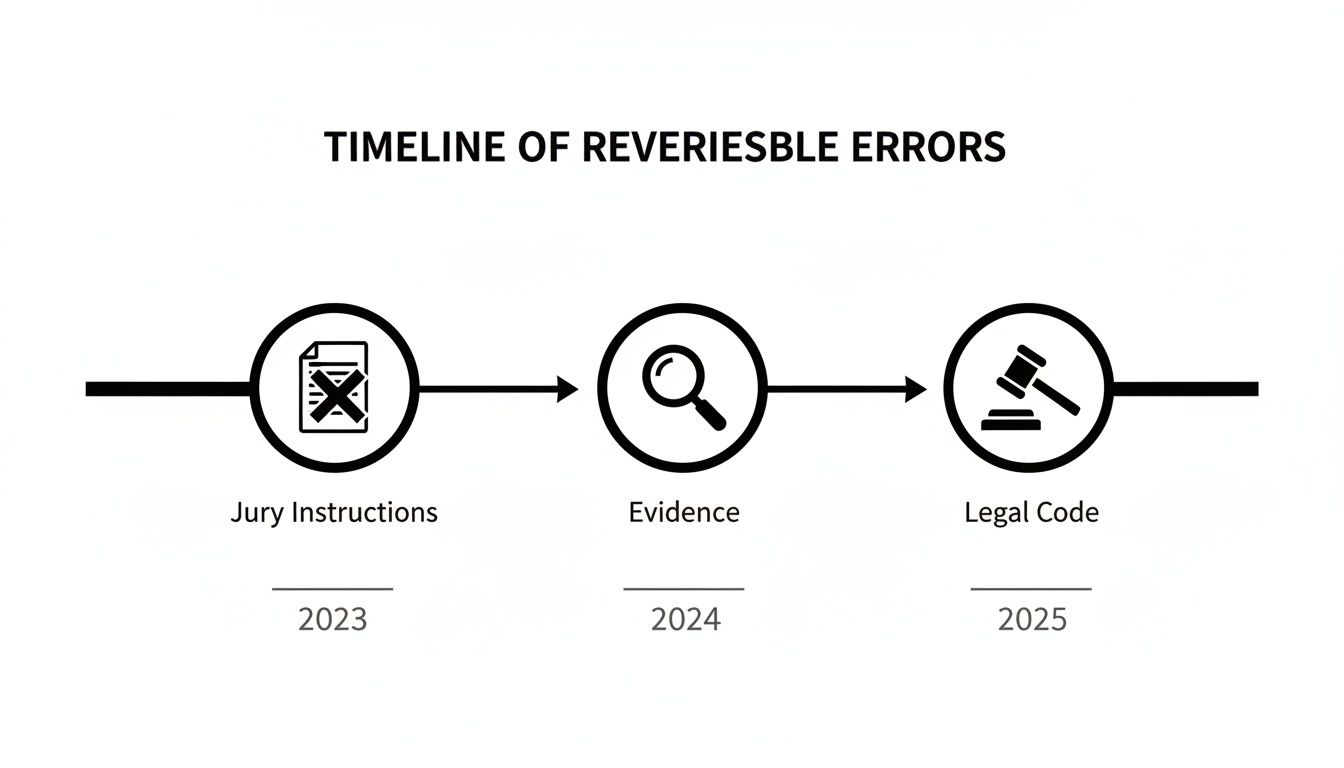
Not every mistake a judge makes will lead to a different outcome. To win an appeal, your attorney must identify a "reversible error"—a mistake so significant that it almost certainly led the jury to the wrong conclusion. If you left the courtroom feeling the result was fundamentally unfair, that feeling often points to one of these types of errors. When we appeal a jury verdict, we show the higher court exactly how a specific error by the trial judge compromised the fairness of the trial.
Improper Jury Instructions
Before the jury deliberates, the judge reads them a document called the "jury charge," which explains the relevant parts of the Texas Family Code and lists the questions they must answer. This is a critical moment. A reversible error occurs if that charge is wrong. For example, in a child custody case, the judge might give the jury a legally flawed definition of "best interest of the child." This gives the jury the wrong rules for their decision, making a correct legal outcome nearly impossible. Your trial lawyer must object to a faulty jury charge before it is read to the jury to preserve the issue for appeal. You can learn more about this in our article on objections required to preserve an appeal in Texas.
Evidentiary Errors
The evidence presented at trial is the foundation for the jury's decision. The Texas Rules of Evidence act as a strict filter, controlling what jurors can and cannot consider. When a judge misapplies these rules, it can be a powerful basis for an appeal. These errors typically come in two forms:
- Wrongful Admission: The judge allowed the jury to see or hear prejudicial evidence they should not have, such as unreliable hearsay. This can easily poison a jury's perception.
- Wrongful Exclusion: The judge blocked crucial evidence the jury should have seen. For example, if you had a bank statement proving hidden assets, but the judge wrongly ruled it inadmissible, the jury would make its decision based on incomplete facts.
For an evidentiary mistake to be "reversible," it must be substantial enough that it probably caused an improper judgment. A minor technicality is not enough.
Legal Misinterpretation
Family law is complex, and sometimes judges misinterpret the law. This often happens in cases with high-value estates, complicated property division issues, or unique custody situations involving protective orders. An appellate court gives little deference to a trial judge's interpretation of the law, which can make this a strong angle for an appeal. A classic example is when a judge misclassifies separate property (like an inheritance) as community property and allows the jury to divide it. This is a clear legal error that can be reversed on appeal. Issues like common legal translation errors can also create reversible errors if they lead to a misunderstanding of critical testimony.
If you believe a reversible error led to an unjust outcome in your case, our appellate attorneys can help you seek a fair outcome. Contact The Law Office of Bryan Fagan today for a free consultation.
Your Appellate Journey: A Timeline of What to Expect
Once you and your appellate attorney decide to move forward, your journey through the Texas appellate system begins. It’s a path governed by strict rules and timelines, far different from the trial you just experienced. Knowing the roadmap ahead can help demystify the process and set realistic expectations for the path to a fair outcome.
The first major milestone after filing your Notice of Appeal is compiling the official trial record. This isn't something that happens overnight. Your attorney will need to formally request both the Clerk's Record (which includes all the documents filed in your case) and the Reporter's Record (the word-for-word transcript of everything said during the trial).
Think of these two records as the entire universe of information the appellate court will use to decide your case—they can't consider anything else. We dive deeper into this crucial topic in our article on the importance of the appellate record in Texas family law cases.
The Briefing Stage: Where the Battle Is Fought
After the complete record is filed with the appellate court, the "briefing" schedule kicks into gear. This is the heart of the appeal, where the real legal battle takes place on paper. Briefing is simply the legal term for writing and filing long-form, persuasive legal arguments.
Your attorney will start by drafting the "Appellant's Brief." This is an incredibly detailed document that accomplishes a few key things:
- It lays out the facts of your case, but only using evidence found within the official record.
- It pinpoints the specific, reversible errors the trial judge or jury made.
- It uses Texas law and previous court decisions (known as precedent) to argue why those mistakes were so significant that the verdict must be overturned.
Once your brief is filed, the other side gets their turn to file an "Appellee's Brief" to counter your arguments. Your attorney may then file a final "Reply Brief" to get the last word in. This back-and-forth written exchange is truly where most appeals are won or lost.
Oral Argument and the Final Decision
In some cases, the court might schedule an Oral Argument after all the briefs are in. This is a formal hearing where the lawyers stand before a panel of three appellate justices to verbally argue their case and, more importantly, answer the justices' pointed questions. It’s a chance to clarify complex legal points and really drive home the most critical parts of the written arguments.
After the briefing (and any oral argument), your case is considered "submitted" to the justices for a decision. Honestly, this waiting period can be the longest and most difficult part of the whole process. The justices will review the massive record, meticulously analyze the briefs, and eventually issue a written opinion that either affirms the trial court's judgment or reverses it.
It's crucial to understand that appeals are a marathon, not a sprint. It’s not at all uncommon for this entire process to take a year or more from start to finish.
Why You Need a Dedicated Appellate Attorney
After going through an exhausting and emotional jury trial, it's completely understandable to feel a strong sense of loyalty to the attorney who fought for you in the trenches. They were your advocate, and they likely did an excellent job. But here's a hard truth: winning an appeal after a jury verdict in a Texas family court requires a totally different playbook and a different kind of lawyer.
The world of appellate law is its own highly specialized field. Your trial lawyer was a master of storytelling, connecting with a jury, and presenting evidence in a compelling way. An appellate lawyer’s audience couldn't be more different—it's a panel of judges who live and breathe the law. Their focus isn't on the emotional narrative but on a single, critical question: was there a legal error? This means the strategy shifts from persuasive storytelling to a laser-focused legal and analytical argument.
The Difference Between Trial and Appellate Advocacy
Imagine your trial attorney as a brilliant courtroom performer. Their job was to build a narrative, to make the jury feel the human side of your case through powerful witness testimony and carefully selected evidence. They are masters of persuasion in a live, dynamic setting.
An appellate attorney, on the other hand, is a legal scholar and a master strategist whose work only begins once the trial is over. They don't get new evidence or call new witnesses. Their battlefield is the trial record itself and the vast expanse of the law library. Their role is entirely different and involves:
- Pinpointing Reversible Error: They must meticulously comb through every page of the trial transcript and every exhibit, looking for specific legal mistakes that are significant enough to have changed the outcome. This is a search for a needle in a haystack, and you have to know exactly what the needle looks like.
- Deep-Dive Legal Research: Their job is to find the precise statutes in the Texas Family Code and the case law (precedent) that proves a legal error occurred. It's about building an irrefutable legal argument, brick by brick.
- Crafting a Flawless Brief: All this work culminates in a formal "brief"—a highly technical, structured document written for judges. This isn't a story; it's a legal proof that explains exactly why the trial court's judgment was legally wrong and must be corrected.
An appellate lawyer isn’t coming in to re-argue the facts or tell your story again. They are there to deconstruct the trial from a legal perspective and demonstrate to a panel of judges that a critical mistake led to an unjust result. Their language is the law, and their audience demands precision.
As you navigate this next phase, it helps to understand the practicalities of hiring new counsel. The process often starts with a formal client onboarding procedure, and knowing how firms handle legal intake services can give you a clear picture of what to expect from the very first call.
Don't underestimate what's at stake. The appellate process is challenging, but it exists because trial courts make mistakes. Statistics from the Texas Supreme Court consistently show this. For instance, in its 2024–2025 term, the Court reversed the lower court's decision in 72.3% of the cases it heard. This powerful statistic reveals that appellate courts are actively correcting legal errors, offering real hope for justice when the right arguments are made by the right counsel.
If you believe the verdict in your family law case was the result of a legal mistake, we can help you explore your options. Contact The Law Office of Bryan Fagan today for a free consultation to see if an appeal is the right path for you.
Common Questions After a Texas Family Law Verdict
After pouring so much time, money, and emotion into your case, it’s completely normal to feel lost and have questions. Thinking about an appeal after a jury verdict in a Texas family court can be overwhelming, so let's break down some of the most pressing concerns we hear from clients.
Can I Stop the Judge's Order From Taking Effect During the Appeal?
This is often the first question. The answer is: sometimes. You can ask the court to "stay" or "supersede" the judgment, which can pause its enforcement while the appeal is pending. For purely financial judgments, you will typically be required to post a supersedeas bond—a financial guarantee to protect the other party if you lose the appeal. It is more complicated with custody orders, as the court's primary duty is maintaining stability for the child. However, we can file motions for temporary orders to protect the child’s well-being and maintain the status quo during the appeal. An experienced appellate lawyer can evaluate your order and recommend the best strategy.
What Are My Real Chances of Winning an Appeal?
An appeal is not a second chance to argue the facts. Winning depends on proving the trial court made a significant legal mistake—a "reversible error"—that likely led to the wrong outcome. Statewide statistics show that a meaningful number of cases are overturned, but those numbers don't predict the outcome of your case. Your chances hinge on the strength of your trial record. A thorough appellate attorney will not offer false hope. They will conduct a deep, meticulous review of every document and transcript from your trial to give you an honest assessment.
What Happens If I Win the Appeal?
A successful appeal can result in a few different outcomes:
- Reverse and Render: This is the best-case scenario. The appellate court reverses the trial court's decision and "renders" a new judgment in your favor, resolving the issue.
- Reverse and Remand: This is more common. The appellate court finds an error, reverses the decision, and "remands" (sends) the case back to the trial court for a new hearing or trial. The trial court then has specific instructions from the higher court on how to proceed correctly.
A successful appeal provides a critical second chance to achieve a fair and just result.
If you believe the court made a mistake in your family law case, our appellate attorneys can help you seek a fair outcome. Contact The Law Office of Bryan Fagan today for a free consultation at familylawcourtappeals.com.