Skip to content
When a Texas judge names the other parent as the sole managing conservator of your child, you may feel your case was handled unfairly. It’s a devastating outcome that can leave you feeling powerless, convinced the decision is not in your child’s best interest. While the initial ruling is a setback, it is not necessarily the final word. Texas law provides a path to challenge these decisions: appealing a sole managing conservatorship order.
An appeal is your opportunity to seek a fair outcome by asking a higher court to review the trial court’s decision for significant legal mistakes.
How an Appeal Differs from a Trial
Many parents understandably believe an appeal is a second chance to argue their case, present new evidence, or call witnesses the first judge didn’t hear. However, the appellate process works very differently.
An appeal is not a do-over. It is a technical legal review of what already happened in the trial court. A panel of appellate justices will not rehear testimony. Instead, they will meticulously examine the official trial record—which includes every transcript, exhibit, and motion—to search for a reversible error. This means we must prove the trial judge made a legal mistake so significant that it likely led to an unjust outcome.

Understanding the Standard of Review in Custody Appeals
Appellate courts give significant deference to the trial judge’s findings, operating under the assumption that the judge who heard the evidence firsthand was in the best position to decide. To overcome this, we must prove the judge committed an “abuse of discretion.”
What is an "Abuse of Discretion"? This is a legal term meaning the trial court acted arbitrarily, unreasonably, or without following the guiding rules of the Texas Family Code. It’s not about disagreeing with the judge’s opinion; it’s about proving their decision lacked a proper legal or factual basis.
Meeting this high standard requires a forensic-level review of the trial record. An experienced appellate attorney knows how to identify critical mistakes, such as:
- Improperly admitting or excluding crucial evidence.
- Misapplying the “best interest of the child” legal standard.
- Failing to make legally required written findings, especially in cases involving family violence.
Successfully appealing a sole managing conservatorship order begins with finding a specific, legally recognized error. A thorough understanding of preserving error for appeal in Texas family court is vital to this process.
Common Reversible Errors in Texas Custody Cases
When reviewing a case, we are not just re-reading the story of the trial. We are hunting for specific procedural and substantive mistakes that undermined the fairness of the proceeding. Here are some of the most common reversible errors we find:
- Improper Evidence Rulings: The judge refused to allow a key witness to testify or, conversely, allowed the other side to present inflammatory, irrelevant information that unfairly prejudiced your case.
- Misapplying the “Best Interest” Factors: The court is required to consider a list of factors (the Holley factors) to determine a child’s best interest. A reversible error may occur if a judge focuses on one factor to the exclusion of all others or fails to consider important evidence related to several of them.
- Ignoring a Legal Presumption: Texas law presumes that a Standard Possession Order is in the child’s best interest. If a judge deviates from that standard without providing a solid, evidence-based reason on the record, it can be reversible error.
- Failing to Make Required Findings: In cases involving a history of family violence, the law requires the judge to put specific findings of fact in writing. A failure to do so is a common and powerful point for an appeal.
Understanding how courts must handle these situations is crucial. You can learn more about how sole managing conservatorship is handled in Texas courts on bryanfagan.com. Finding these errors requires an attorney who lives and breathes both the Texas Family Code and the intricate rules of appellate procedure.
Navigating the Texas Appellate Process: A Step-by-Step Guide
Understanding what comes next is the first step toward regaining your footing after an unfavorable ruling. An appeal is a methodical process governed by the Texas Rules of Appellate Procedure. It is a world away from the trial you just experienced.
Trial vs. Appeal: Understanding the Key Differences
| Aspect | Trial Court | Appellate Court |
|---|---|---|
| Purpose | To present evidence, hear testimony, and determine the facts of the case. | To review the trial court record for legal errors that harmed your case. |
| Key Players | Judge (or jury), witnesses, attorneys, and the parties involved. | A panel of appellate justices, attorneys, and the parties (who do not testify). |
| Evidence | New evidence (documents, photos, testimony) is presented and considered. | Absolutely no new evidence is allowed. The review is limited to the official record from the trial court. |
| Main Activity | Questioning witnesses, making arguments to the judge, and presenting your story. | Writing persuasive legal briefs and, sometimes, presenting a short oral argument to the justices. |
| Focus | Convincing the judge that the facts support your position under the law. | Convincing the justices that the trial judge made a reversible legal mistake. |
The First Steps: Notice of Appeal and Record Preparation
The clock starts ticking the moment the judge signs the final order. The first and most critical deadline is for filing the Notice of Appeal. You typically have just 30 days to file this document with the trial court clerk. Missing this deadline will almost certainly mean losing your right to appeal.
Once the notice is filed, the official trial record must be prepared. This includes two parts:
- The Clerk’s Record: A bound volume of every document filed in your case.
- The Reporter’s Record: The official, word-for-word transcript of everything said during the trial.
This record creates the entire universe for your appeal. The appellate court is prohibited from looking at anything outside of it.
The Heart of the Appeal: Briefing
With the record assembled, the real work begins: writing the appellate brief. This is a detailed legal document that methodically lays out your case. It explains the facts, identifies the trial judge’s error, and uses statutes and prior case law to argue why the decision must be overturned.
What is Briefing? This is the process of writing and filing the formal legal arguments in an appeal. Your brief tells the story of the case, explains the legal error, and persuades the appellate court to rule in your favor.
This is where the expertise of an appellate specialist is critical. We build a compelling argument demonstrating precisely how the trial court’s mistake was an abuse of discretion standard in Texas family law that resulted in an unjust order.
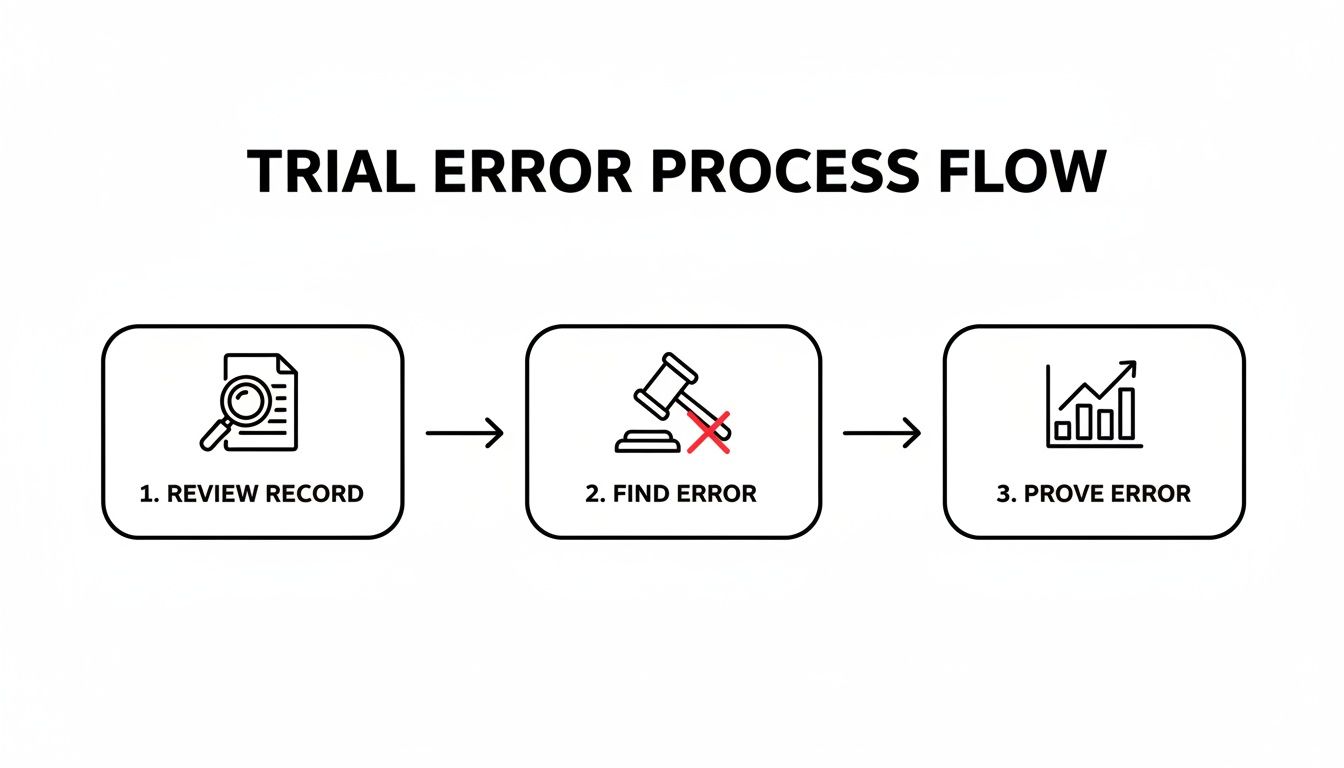
As the graphic shows, a successful appeal is a disciplined process of reviewing the record, identifying a critical error, and proving to the higher court why it matters.
The Final Stages: Oral Argument and the Decision
In some cases, the court will schedule an oral argument. This is a brief session where attorneys argue the case before the panel of justices and answer their direct questions. After the briefs are filed and any arguments are heard, the justices deliberate and issue a formal written opinion that will either affirm, reverse, or remand (send back) the trial court's ruling.
The entire journey requires patience, precision, and an in-depth knowledge of Texas appellate procedure in family law cases.
The High Bar: Proving an "Abuse of Discretion"

The greatest challenge in any custody appeal is overcoming the "abuse of discretion" standard of review. This legal principle means appellate courts give tremendous deference to the trial judge’s decisions. The system assumes the judge who was present in the courtroom to see the witnesses and hear the evidence was in the best position to make the right call.
Our role as appellate attorneys is not to argue that we simply disagree with the judge. We must prove the decision was legally indefensible—that it was arbitrary, unreasonable, or made without reference to the guiding principles of Texas family law.
What Does an Abuse of Discretion Look Like in Practice?
A judge abuses their discretion when a ruling is not grounded in the Texas Family Code and established case law.
For example, a judge deciding which parent’s testimony is more credible is a factual determination an appellate court will rarely second-guess. However, if that same judge ignores undisputed evidence of family violence or fails to consider all the mandatory Holley factors when determining the child's best interest, that is a different matter. When a ruling ignores the rules of the game, it becomes arbitrary and may be an abuse of discretion.
The Holley Factors: A Common Ground for Appeal
One of the most frequent reversible errors involves the trial court’s failure to properly apply the Holley factors—the specific criteria judges must consider when determining a child’s best interest.
Imagine a scenario where a mother presents strong evidence that she has been the child's primary caregiver, providing a stable and nurturing home. The father has a less stable history but recently secured a high-paying job. If the trial judge, impressed solely by the father’s new income, names him sole managing conservator while ignoring all other factors related to the child’s emotional and physical well-being, that could be an abuse of discretion. The error is not in considering financial stability, but in failing to conduct a complete "best interest" analysis as required by law.
An appeal succeeds not by claiming the judge was “unfair,” but by demonstrating with proof from the record that the judge’s reasoning was legally flawed.
Winning on appeal is challenging. Texas appeals courts reverse custody rulings in a minority of cases, but they do happen, especially when clear evidence was ignored. For example, appellate courts affirm significant custody modifications on mcclure-lawgroup.com when child safety evidence is strong, showing that a well-supported argument can succeed. A strategic, analytical approach is essential to dismantling the trial court’s reasoning and showing the appellate justices why the outcome was legally unsupportable.
Why an Appellate Specialist Is Your Strongest Advocate
The skills that win a trial are not the same ones that win an appeal. Trial work is dynamic, focused on storytelling and witness testimony. Appellate advocacy is a more scholarly and strategic discipline, centered on meticulous legal research, logical analysis, and persuasive writing.
An appellate lawyer argues points of law to a panel of justices, not facts to a single judge. This requires a different mindset and skillset.
A Fresh and Strategic Perspective
One of the greatest advantages an appellate specialist brings is a fresh, objective eye. Because we were not involved in the emotional turmoil of the trial, we can dissect the record with cold, hard logic, hunting for the reversible errors that are often missed in the heat of the moment.
Our goal is not to second-guess your trial attorney. Instead, we analyze the trial from a purely legal and strategic viewpoint to find appealable issues and provide an honest assessment of your chances.
This detached approach helps us spot critical mistakes, such as the court misapplying the Texas Family Code or making a ruling that rises to the level of an abuse of discretion.
Understanding the Nuances of Custody Appeals
Appealing a sole managing conservatorship order is a significant challenge because Texas law contains a built-in preference for joint custody. This is a legal presumption under Texas Family Code § 153.131(b). A court may only award sole managing conservatorship if there is proof that joint custody would harm the child's physical or emotional well-being. This is a very high bar to clear. You can discover insights about Texas conservatorship standards on alsandorlaw.com.
An appellate specialist understands these standards intimately. We know how to build a powerful argument showing that the trial court either ignored this high standard or misinterpreted the evidence.
Crafting the Winning Argument
After a thorough review of the record, our job is to build a clear, compelling argument in the appellate brief. We prove the judge was wrong by weaving together facts from the record, the letter of the law, and relevant case history. This combination of a fresh perspective, deep legal knowledge, and strategic writing makes an appellate specialist your most powerful ally in seeking a fair outcome.
Common Questions After an Unfavorable Custody Ruling
After a judge issues a sole managing conservatorship order against you, it’s normal to have many questions. Here are clear, plain-English answers to some of the most common concerns we hear from parents considering an appeal.
How Long Do I Have to Appeal a Sole Managing Conservatorship Order in Texas?
The deadlines to appeal in Texas are strict and unforgiving. You generally have just 30 days from the date the judge signs the final order to file your Notice of Appeal. In some cases, filing a Motion for New Trial can extend this deadline to 90 days, but you cannot rely on this. If you miss the deadline, your right to appeal is almost always lost forever. It is essential to contact an appellate attorney immediately.
Can I Get Temporary Orders to See My Child While the Appeal Is Pending?
Yes. An appeal can take a year or more, and the Texas Family Code allows the trial court to make temporary orders to protect the child's safety and welfare while the case is on appeal. Your attorney can file a motion asking for temporary visitation or a different possession schedule to ensure you maintain a relationship with your child during the process. This can be a lifeline in a lengthy child custody appeal.
What Are My Chances of Winning a Custody Appeal in Texas?
Your odds of success depend entirely on whether a “reversible error” occurred during your trial. While appellate courts give trial judges significant discretion, making reversals statistically challenging, it is far from impossible.
An appeal is won by proving the trial court made a legal mistake so significant that it likely caused the wrong outcome. It isn't a second chance to re-argue the facts. A deep dive into the case record by an experienced appellate lawyer is the only way to know if you have a shot. A free consultation can be the first step in spotting those potential errors.
How Much Does It Cost to Appeal a Sole Managing Conservatorship Case?
The cost of an appeal varies based on the complexity of the legal issues and the length of the trial record. Costs typically fall into three categories:
- Attorney's Fees: For the extensive time required to review the record, conduct legal research, and write the appellate brief.
- Record Preparation: The cost to have the court reporter transcribe the trial testimony and the clerk prepare all filed documents.
- Court Filing Fees: Standard administrative fees charged by the appellate courts.
We believe in transparency. After a free consultation, we will provide a clear estimate of the potential costs so you can make an informed decision.
Take the First Step Toward a Fair Outcome

An unjust custody order does not have to be the end of your fight for a fair outcome. If you believe the trial court misinterpreted the law, overlooked crucial evidence, or made a decision that was not in your child’s best interest, an appeal may be your path to restoring balance.
The appellate process is demanding, but when your relationship with your child is at stake, exploring every option is essential. The first step is to get an honest, professional assessment of your case from an attorney who specializes in family law appeals.
An experienced appellate attorney does more than just file paperwork. They comb through the trial record, hunting for reversible errors and giving you a straightforward, realistic opinion on your chances of success. This initial analysis is your roadmap.
The clock on your right to appeal is already ticking. Texas appellate law is built on strict, unforgiving deadlines, making immediate action critical.
If you believe the court made a mistake in your family law case, our appellate attorneys can help you seek a fair outcome. Contact The Law Office of Bryan Fagan today for a free consultation. We will evaluate your case and discuss a strategic path forward. Visit us at https://familylawcourtappeals.com to get started.