You may feel your divorce case was handled unfairly, especially when it came to dividing your property. An appraisal in a divorce isn't just about getting a number for your house. It’s a professional, objective valuation of significant marital property to determine its fair market value for the purpose of asset division. Think of it as the foundation for a just settlement. Without it, the court is left guessing, which can lead to an unjust outcome and create a critical legal mistake known as a reversible error.
Why a Fair Appraisal Is Critical in a Texas Divorce Appeal

If you are walking away from your divorce feeling like you received an unfair result, a flawed property appraisal may be the reason. Under the Texas Family Code, courts are legally required to divide the community estate in a manner that is "just and right." But a judge cannot achieve a fair division if they do not know what your assets are actually worth.
That's where a professional appraisal comes in. It provides the hard, evidence-based valuation a judge needs to make a legally sound decision.
Without a solid appraisal, judges may be forced to rely on speculation, outdated county tax assessments, or—worst of all—the biased opinion of one spouse. This guesswork introduces a significant amount of risk and can easily result in one person receiving a much smaller share of the marital estate, which can be challenged on appeal.
What You Can Appeal in a Texas Property Division Case
Imagine your marital estate is like a business you are dissolving. You would not just estimate the inventory's value. The same logic applies to dividing assets in a divorce. A professional appraisal establishes a credible, defensible value for all types of property, including:
- The Marital Home: Often a couple's largest asset, its value can change significantly with the market.
- Other Real Estate: Vacation homes, rental properties, or undeveloped land all require a current valuation.
- Complex Assets: A family-owned business, a professional practice, or unique collections of art or classic cars absolutely require an expert opinion to be valued correctly.
In the courtroom, a formal appraisal is not just a suggestion; it is sworn testimony. The appraiser's detailed report becomes a key piece of evidence in the official trial "record"—the complete collection of testimony and documents that an appellate court will later scrutinize if you file an appeal.
When a trial judge bases their decision on a shaky, outdated, or completely unsubstantiated property value, it can amount to a reversible error. This is a legal mistake that can be successfully challenged on appeal because it directly undermines the Texas Family Code's mandate for a just and right division of property.
How an Inaccurate Appraisal Can Lead to a Successful Appeal
Let's say you believe the judge relied on a flawed valuation—perhaps one your ex-spouse provided that was far too low (or conveniently high). This could be the grounds for your appeal. An appellate court will not retry your case but will meticulously review the trial record for significant legal mistakes.
If our attorneys can demonstrate that the judge's decision on property division was based on bad data and resulted in a grossly unfair outcome, we can argue that the judge abused their discretion. Securing a fair, professional appraisal during the trial is your first and most powerful line of defense against an unjust result—and it’s essential for building a solid record for a potential appeal.
Understanding Fair Market Value in a Divorce
When a Texas court divides property in a divorce, the legal standard is not a simple 50/50 split. The standard is what is “just and right.” But to arrive at a just and right division, the court needs a concrete, objective number for every single asset. That number is called fair market value.
It is a legal term that is actually quite straightforward. Fair market value is not what you originally paid for something. It is not about sentimental attachment, and it has nothing to do with what one person hopes an item is worth.
In plain English, fair market value is the price a knowledgeable, willing buyer would pay to a knowledgeable, willing seller, when neither party is under pressure to make a deal. It is the true market price on a level playing field. For a more detailed look, you can find a clear explanation of Fair Market Value.
Distinguishing Community and Separate Property
In a Texas divorce, everything you own falls into one of two categories: separate property or community property. Getting this right is critical because only community property is divided by the court.
- Separate Property: This is anything you owned before the marriage. It also includes property you received during the marriage specifically as a gift or an inheritance. It belongs to you alone.
- Community Property: This is essentially everything else acquired by either you or your spouse during the marriage. Under Texas law, all property owned at the time of divorce is presumed to be community property. It is up to a spouse to prove otherwise with clear and convincing evidence.
The purpose of an appraisal for divorce is to determine the value of the community estate. If you bought a house together during the marriage using your salaries, its entire current fair market value is part of the community estate subject to division.
A common area for disputes is when separate property and community property become mixed. For instance, what happens when one spouse uses inheritance money (separate property) to pay for a major renovation on the community home? Or when a business owned before the marriage (separate property) increases in value due to both spouses' efforts during the marriage? A detailed appraisal is key to untangling these issues so the court can divide the community interest fairly.
The Role of an Appraisal in Establishing Value
Arguments over an asset's worth can stall a divorce and create hostility. One spouse might view the family home as their nest egg, worth top dollar, while the other points to a changing market and insists on a lower value. Without a neutral expert, a judge is left with two conflicting, emotional opinions.
This is where a professional appraisal provides clarity.
An appraiser delivers an unbiased, evidence-based valuation that can be submitted to the court. This formal report gives the judge a credible, defensible number to work with when making decisions about property division. An inaccurate valuation not only leads to an unfair outcome but also builds a flawed record that can be challenged on appeal.
Navigating The Divorce Appraisal Process Step By Step
The idea of an appraisal can seem intimidating, but it is a methodical process. Understanding how it works will give you more control and confidence that the valuation is fair and accurate. You are building a crucial piece of evidence for your case, and it must be solid enough to secure a just outcome at trial and withstand scrutiny if an appeal is necessary.
The entire process follows a clear path: identify the property, have it appraised, and then determine how it fits into the community estate for division.
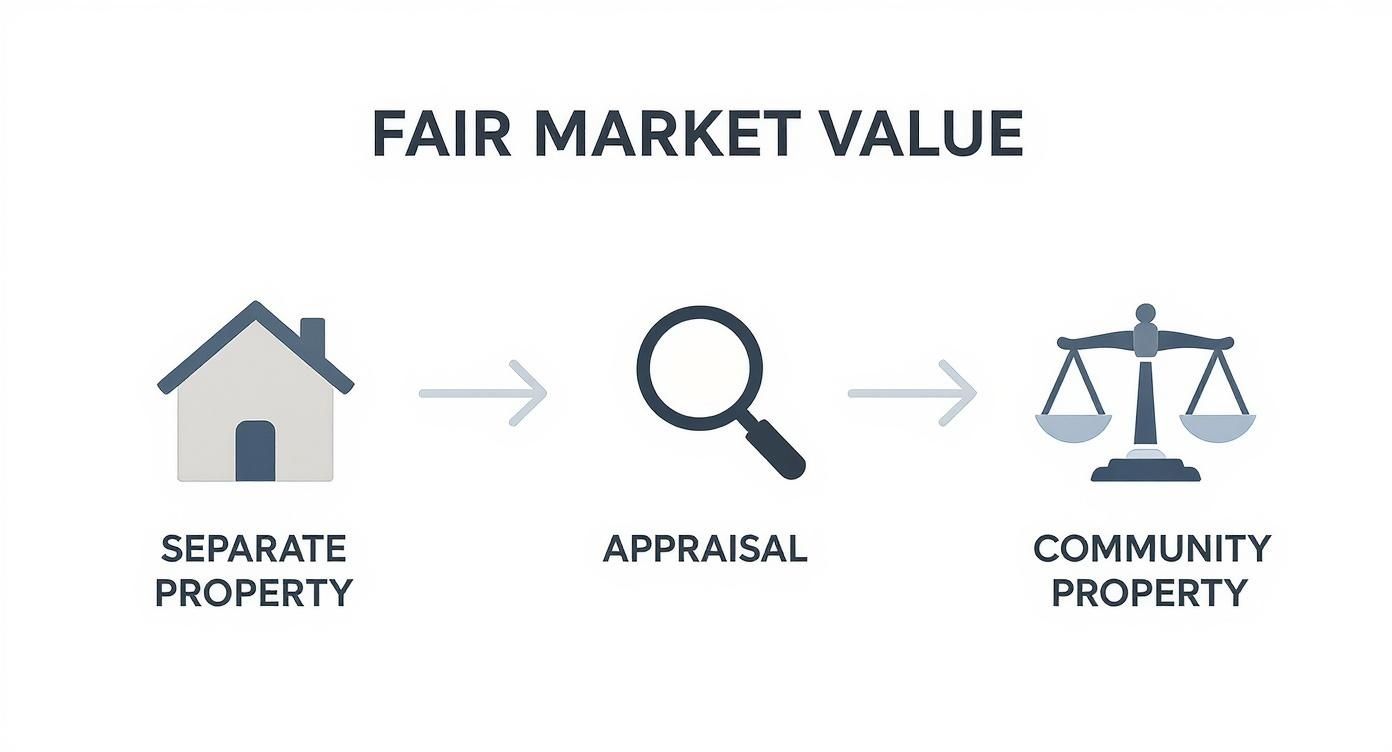
This visual shows why an objective appraisal is so critical. It is the bridge that turns a raw asset into a clearly defined part of the community estate, ready for a fair division by the court.
Here’s a breakdown of the typical journey.
Key Stages of a Divorce Appraisal
This table outlines the typical phases of the appraisal process, what happens during each stage, and your role in it.
| Stage | What the Appraiser Does | What You Should Do |
|---|---|---|
| Initial Engagement | Discusses scope, purpose, timeline, and fees. Requests initial property information. | You or your attorney provides details about the assets and any unique circumstances. Sign the engagement letter. |
| Physical Inspection | Visits the property to measure, photograph, and assess its condition, features, and quality. | Prepare the property to be accessible. Provide a list of recent upgrades, renovations, and any known issues. |
| Market Analysis | Researches recent sales of similar ("comparable") properties. Makes data-driven adjustments for differences. | Cooperate by providing any requested documentation, like renovation receipts or HOA documents. |
| Final Report | Compiles all findings into a formal, detailed report stating the property's fair market value. | Review the report with your attorney to ensure it's accurate and aligns with the evidence needed for your case. |
Understanding these stages helps demystify the process and ensures you are an active, informed participant.
Stage 1: The Initial Consultation and Engagement
The first step is to hire a qualified appraiser. This involves establishing clear goals from the start. You or your attorney will discuss the specific assets that need a valuation, the purpose of the appraisal for divorce, and the deadlines involved.
In this meeting, the appraiser will explain their methods, costs, and exactly what they need from you. It is vital to be completely open about any unique aspects of the property, recent renovations, or known problems. This honest exchange is the foundation for a credible and defensible report.
Stage 2: The Physical Inspection
Next, the appraiser conducts a thorough physical inspection. This is not a casual walkthrough. They will evaluate the asset's condition, features, and overall quality in detail. For a house, that means measuring rooms, noting the floor plan, checking the condition of fixtures, and documenting any upgrades or areas that need repair.
To assist the process, it is a good idea to have a list of any major improvements you've made, along with dates and costs if available. Giving the appraiser this information ensures they have the complete picture, which directly influences the final value.
Stage 3: Market Research and Analysis
With the inspection complete, the appraiser begins the analytical work. This involves deep research to find "comparable" sales—recent sales of similar properties in the same area. They do not just look at the final prices; they make precise, calculated adjustments to account for every difference between your property and the others.
For example, if your home has a new kitchen but a comparable home has an outdated one, the appraiser will adjust the comparable’s sale price upward to account for the difference. This detailed, data-driven approach is what makes a professional appraisal more reliable than a simple online estimate. Understanding the general home appraisal process is key, as real estate is often a major part of a divorce.
A judge's decision is only as good as the evidence presented. A detailed appraisal report, with clear explanations for every adjustment and conclusion, becomes part of the official trial record. If an appeal becomes necessary, our attorneys will scrutinize this record to see if the judge properly considered this crucial evidence or made a reversible error by ignoring it.
Stage 4: The Final Valuation Report
The last step is the creation of the appraisal report. This formal document is the culmination of all the previous work. It will include a detailed property description, photos, a summary of the market analysis, the comparable sales data used, and, most importantly, a clear statement of the property's fair market value on a specific date.
This report is a powerful piece of evidence. In a Texas divorce, a well-researched appraisal gives the court a credible, unbiased foundation for making a just and right property division. If a judge ignores this evidence and relies on a baseless number instead, it could be considered an abuse of discretion—a critical mistake that can be grounds for a successful appeal.
Common Assets That Demand a Professional Appraisal

When you hear "appraisal for divorce," the family home is probably the first asset that comes to mind. While it is often the largest, a truly fair property division considers everything. Many other valuable assets require their own specialized, professional valuation to ensure accuracy.
Skipping this step or guessing at values can throw the entire property division out of balance. This is not just unfair—it is a critical legal mistake that can provide strong grounds for an appeal. You must be thorough when valuing every significant piece of community property.
Real Estate Holdings Beyond the Primary Home
The house you lived in is just the start. Any other real estate acquired during the marriage is community property and needs to be valued. This can include a range of properties, each with its own market dynamics.
It is essential to get a professional appraisal to determine their current fair market value. A common mistake is to use the original purchase price or the county tax assessment. This is a serious error.
- Vacation Properties: A lake house or beach condo operates in a different market. You need an appraiser who knows the local recreational property scene.
- Rental or Investment Properties: These are not just buildings; they are income streams. A specialized appraiser knows how to value both the physical structure and its income-generating potential.
- Undeveloped Land: Raw land's value depends on factors like zoning and location, which requires an appraiser with specific expertise in land valuation.
Business and Professional Practice Valuations
This is where valuations can become incredibly complex. Valuing a family-owned business, a medical practice, or a law firm is one of the most challenging aspects of a divorce. Using the right expert here is non-negotiable. You cannot ask a real estate appraiser to value a business—that would be a significant mistake.
This is a job for a forensic accountant or a certified business appraiser. These professionals go far beyond looking at office furniture. They dive deep into financial statements, cash flow, goodwill (the business's reputation and customer loyalty), and its market position to determine what the enterprise is truly worth.
If a judge accepts a business valuation from an unqualified individual or a report based on a flawed method, that is a major red flag. This is a classic example of an abuse of discretion, where the court's decision is not supported by solid evidence. For an appeal, that is a powerful argument to make.
High-Value Personal Property and Collections
Over the years, a couple often acquires personal items that are too valuable to estimate. Attempting to guess the value of art or jewelry is a sure way for one person to lose out financially.
You need specialized appraisers for these types of assets:
- Fine Art and Antiques: Certified art appraisers can research the history (provenance) and determine the real market value of paintings, sculptures, and antique furniture.
- Jewelry and Watches: A gemologist or a watch expert (a horologist) is needed to provide an accurate valuation for high-end jewelry and luxury timepieces.
- Classic Cars or Other Vehicles: A collector car has a unique market. You need a specialist who understands its condition, rarity, and what buyers are willing to pay.
- Other Collections: This could be anything from rare coins to an extensive wine cellar. Each requires a niche expert to provide a credible appraisal.
Failing to use the right expert for the right asset can leave tens or even hundreds of thousands of dollars unaccounted for. When we evaluate a case for appeal, we comb through the trial record to see if the court relied on proper expert testimony or if it allowed unsubstantiated opinions to drive the final property division.
How Appraisal Errors Can Invalidate a Judgment
A flawed appraisal in a divorce case is not just a simple mistake with numbers—it can lead to a deeply unfair outcome. Texas courts are required to divide property in a “just and right” manner, but that ruling is only as sound as the evidence the judge considers. If a judge relies on a faulty valuation, the entire property division can be called into question, creating solid grounds for an appeal.
It is easy to feel powerless when a judge accepts an appraisal you know is wrong. But the Texas appellate process exists to correct critical mistakes made at the trial level. The first step toward a fair result is understanding what the law considers a reversible error.
Understanding the Standard of Review: “Abuse of Discretion”
In the world of appeals, you will often hear the term “abuse of discretion.” In plain English, this means the trial judge made a decision that was unreasonable, arbitrary, or without reference to any guiding legal rules or principles. This is not about a simple disagreement; it is about a ruling so far outside the bounds of the law that it requires correction.
An abuse of discretion often occurs when a court’s finding is not supported by legally and factually sufficient evidence. When it comes to an appraisal for divorce, this could mean the judge based the entire property division on a valuation that was outdated, unreliable, or presented by an unqualified person.
When our appellate attorneys review a case, this is precisely what we are looking for. We meticulously analyze the trial record, examining whether the judge’s decisions were based on credible evidence. If they were not, we have a powerful argument that a serious error occurred that must be corrected.
Common Reversible Errors in Divorce Appraisals
Certain valuation mistakes appear frequently in divorce appeals. These are not minor oversights; they are significant errors that directly undermine the fairness of the final judgment.
Here are a few clear examples of reversible errors that could be grounds for a successful appeal:
- Relying on an Outdated Appraisal: Let's say the court uses a home appraisal from three years ago. In a volatile real estate market, that value is obsolete. A judge who divides your property based on such stale data has made a decision that is not grounded in the current reality of your assets.
- Ignoring Credible Expert Testimony: Imagine you hire a certified business appraiser who submits a comprehensive report valuing the family business. If the judge disregards that evidence and instead accepts your spouse’s unsupported, "back-of-the-napkin" guess, that is a classic example of an abuse of discretion.
- Accepting Testimony from an Unqualified "Expert": It is a major error when a judge allows, for instance, a residential real estate agent to give an opinion on the value of a complex commercial property or a rare art collection. An expert's qualifications must match the asset being valued.
- Failing to Properly Value a Business: Valuing a business is a specialized field. If the court accepts a valuation that omits key elements like goodwill, uses the wrong methodology, or contains glaring mathematical errors, the resulting property division is built on a flawed foundation. You can read more about these complexities in our guide to business valuation for divorce.
These examples show how a single flawed appraisal can corrupt the entire outcome of your divorce. An appeal is not about being unhappy with the result. It is about strategically identifying these specific legal errors and proving to a higher court why the judgment is unjust and must be corrected.
Challenging an Unfair Property Division on Appeal
https://www.youtube.com/embed/qpaLeYxGxh8
When a divorce is finalized, you expect the property division to be fair. But what happens when you believe a major appraisal error led to a deeply unjust outcome? It can feel like the court simply didn't listen or made a serious mistake. Fortunately, the Texas appellate system offers a path to challenge that result. An appeal is your opportunity to have a higher court review the trial for critical legal mistakes that tipped the scales unfairly.
It is important to understand that an appeal is not a new trial. We do not present new evidence or call new witnesses. Instead, our role as appellate attorneys is to act as legal strategists. We meticulously review the official trial court “record”—the complete file containing every document, appraisal, and word of testimony from your original case.
Pinpointing Reversible Errors in the Record
Our objective is to find a “reversible error.” This is a legal term for a significant mistake made by the trial judge that was so serious it likely caused an improper judgment. When it comes to an appraisal for divorce, this often means proving the judge committed an “abuse of discretion.” This means the judge's decision was arbitrary, unreasonable, or made without regard for the facts and the law.
For instance, a judge might abuse their discretion by:
- Accepting an appraisal that was clearly outdated or prepared by someone without the proper credentials.
- Completely disregarding the credible testimony of a certified valuation expert in favor of flimsy evidence.
- Making a clear mathematical error when calculating the value of a complex asset, like a family business.
Building Your Case Through Strategic Briefing
Once we have identified these types of errors, we build our case in a formal written argument called an appellate “brief.” This is a detailed document filed with the court of appeals that presents the facts from the record, cites the relevant Texas laws and procedural rules, and explains precisely how the judge’s mistakes led to an unfair property division. It is a calm, strategic argument focused entirely on the law and the evidence already in the record.
Our focus is on restoring the fairness the Texas Family Code requires. When a trial court gets the value of your community estate wrong, that balance is lost. We examine every detail to determine if the judge’s decision holds up under legal scrutiny. Understanding how these errors can undermine a judgment is the first step toward correcting an unfair final divorce decree in Texas.
If you are concerned that a flawed appraisal has cost you dearly in your divorce, you must act quickly. The deadlines for filing an appeal, as set by the Texas Rules of Appellate Procedure, are strict, and your window of opportunity to seek justice is short.
A successful appeal can lead the higher court to reverse the trial judge’s decision. The case is often sent back to the trial court with specific instructions to fix the error, which can result in a new, truly fair property division based on the actual value of your marital estate.
Our experienced appellate attorneys are here to provide a clear, honest evaluation of your case. We can help you understand your options and map out the best strategy for protecting your financial future and restoring a just outcome.
Frequently Asked Questions About Divorce Appraisals
When you are navigating the financial complexities of a marriage, it is natural to have questions about the appraisal process. Getting clear answers is the first step toward protecting your rights and seeking a fair outcome. Here, we address some of the most common questions we hear from clients dealing with an appraisal for divorce in Texas.
A solid understanding of these details helps you make smarter, more strategic decisions. A well-executed appraisal not only paves the way for a fair ruling at trial but also builds a strong, clear record that is vital if an appeal becomes necessary.
What Happens if My Spouse and I Disagree on the Appraiser?
It is common for spouses to disagree on who should value their property. If you cannot agree on a single, neutral appraiser, the process does not have to stop. Instead, each of you has the right to hire your own qualified expert.
In that situation, both appraisers will conduct their own analysis, prepare separate reports, and likely testify in court. It is then up to the judge to listen to both experts and decide which valuation is more credible and better supported by the evidence. In some cases, a court may appoint its own neutral appraiser to offer a third, unbiased opinion. If an appeal is filed, an appellate attorney will scrutinize how the judge weighed this conflicting testimony to determine if there was an abuse of discretion.
How Much Does a Divorce Appraisal Cost in Texas?
There is no single price for a divorce appraisal; the cost depends on the complexity of the asset being valued. A standard appraisal for a single-family home might cost a few hundred dollars. However, for more complex assets, the cost and the need for specialized expertise increase.
For instance, valuing a family-owned business, a professional medical practice, or a portfolio of fine art requires a much deeper analysis and could cost several thousand dollars. While it is a significant expense, it is a crucial investment in achieving a fair property division and securing your financial future.
Can I Use an Old Appraisal for My Divorce?
This is a critical point. Using an old appraisal to save time or money is a common mistake that can seriously damage your case. The value of real estate, businesses, and other assets can change dramatically in a short time. To ensure the property division is "just and right," Texas courts require valuations to be current, reflecting the value as of a date close to the trial.
Relying on outdated data is a recipe for an inaccurate property division. If a judge makes a ruling based on an outdated appraisal, it can be a major reversible error and create strong grounds for an appeal.
Is a Divorce Appraisal Different from a Mortgage Appraisal?
Yes, they are fundamentally different. While they sound similar, they serve completely different purposes. A mortgage appraisal is conducted for the lender's benefit—its primary goal is to confirm that the property provides adequate collateral for the loan being issued.
A divorce appraisal, on the other hand, is prepared for the court. Its sole purpose is to determine the fair market value so that the asset can be divided equitably between the spouses. Because of this legal purpose, divorce appraisals are typically far more detailed and must be robust enough to withstand legal scrutiny. This is why the appraiser’s credentials, courtroom experience, and ability to defend their work under oath are so important.
If you believe the court made a mistake in your family law case, our appellate attorneys can help you seek a fair outcome. Contact The Law Office of Bryan Fagan today for a free consultation. https://familylawcourtappeals.com