When a judge signs your final divorce decree in Texas, it is more than just a piece of paper. It is a binding court order that dictates your rights and responsibilities, shaping your future regarding property, finances, and your children. You may feel your case was handled unfairly, and if you are looking at your decree convinced the court got it wrong, understanding what this document represents is the first step toward seeking justice.
What a Final Divorce Decree Really Means for You

It is completely normal to feel that a judge made a major error in your case. That sense of frustration is powerful, especially when the outcome affects your finances and your relationship with your children for years to come. The final divorce decree makes all of the court’s rulings official and legally enforceable.
This document is the ultimate rulebook for your post-divorce life. It spells out everything—who gets the house, who pays which debts, and the exact schedule for seeing your children. Because it carries the full weight of the law, you cannot simply ignore its terms. Doing so can lead to serious legal consequences, such as enforcement actions or being held in contempt of court.
The Power of a Court Order
The decree is a powerful legal tool that dictates what happens next. If you genuinely believe this order is the result of a legal mistake, you have a very narrow window of time to challenge it. An appeal is not a do-over or a second chance to argue your case. It is a specific legal argument that the trial court committed a "reversible error" that must be corrected to ensure a fair outcome.
After reviewing the final decree, you might have concerns like:
- Property Division: You may feel the court wrongly classified your separate property (like an inheritance) as community property, leading to an unjust division of your marital estate.
- Child Custody: Perhaps the possession schedule or the allocation of parental rights does not serve your children’s best interests.
- Financial Support: You might notice that child support or spousal maintenance was calculated using incorrect financial data or a misapplication of Texas law.
Texas Divorce Trends
While the finality of a decree can feel overwhelming, it’s interesting to see how divorce itself is changing in Texas. The state's divorce rate has dropped to around 1.3 to 1.5 divorces per 1,000 residents, making it one of the states with the lowest rates in the country. This is a huge change from the higher rates we saw back in the early 2000s, reflecting a shift in how people approach marriage and family life. You can explore more about Texas divorce statistics to see how these trends have evolved.
If you are facing an unfair judgment, remember you are not out of options. The legal system has built-in pathways to correct mistakes, primarily through the appeals process. The key is to act quickly with a sound legal strategy.
Anatomy of a Texas Divorce Decree
Your Final Divorce Decree is the official rulebook for your new life. It is a legally binding court order that lays out, in painstaking detail, how your finances, property, and parenting will work from this point forward.
For this document to be enforceable, it must be crystal clear and comply with the Texas Family Code. Vague language or missing details can create a nightmare of future legal battles. That's why understanding what should be in your decree is your first line of defense, especially if you believe a legal error occurred and you might need to appeal.
The Division of Your Marital Estate
One of the most critical functions of a final divorce decree in Texas is to untangle your financial lives. It must spell out exactly how your "community property"—all the assets and debts accumulated during the marriage—will be divided.
There can be no room for ambiguity. The decree must be specific, creating a clear inventory of who gets what and who pays what.
- Real Estate: The decree must name who receives the family home or any other real property, including its full legal description, not just a street address.
- Personal Property: Everything from vehicles and bank accounts to furniture and investments must be assigned to one party.
- Debts: It must explicitly state who is responsible for the mortgage, car loans, and credit card balances.
- Retirement Accounts: Splitting complex assets like pensions or 401(k)s requires precise legal language, often in a separate order called a Qualified Domestic Relations Order (QDRO). You can dive deeper into the nuances of dividing a 401(k) in a divorce on our blog.
A significant red flag for a potential appeal is when a judge mischaracterizes property. For instance, if your inheritance (which is your separate property) is mistakenly treated as community property and divided, that is a substantial legal error.
A valid decree must be a complete and unambiguous roadmap for dividing your property. If it's missing assets or describes them vaguely, enforcing it becomes a nearly impossible task.
To better understand the dense legal language in your decree, you might find it helpful to run it through a tool like an AI Legal Contract Analyzer, which can help break down its key clauses.
Below is a table that breaks down the essential parts of a Texas decree, what they do, and common problems to look out for.
Table: Key Components of a Texas Final Divorce Decree
A summary of the mandatory sections and key details that must be included in a final divorce decree to be considered valid and enforceable in Texas.
| Component | What It Specifies | Common Reversible Errors to Watch For |
|---|---|---|
| Asset & Debt Division | Awards specific property and liabilities to each spouse. | Vague descriptions, missing assets, or mischaracterizing separate property as community property. |
| Conservatorship | Defines parental rights and duties (who makes decisions). | Unclear allocation of rights, or orders that are not in the child's best interest. |
| Possession & Access | A detailed calendar of when children are with each parent. | Impractical schedules, ambiguity around holidays, or failure to include required specifics. |
| Child Support | The amount, payor, and details of financial and medical support. | Incorrect income calculations or deviations from state guidelines without proper justification. |
| Spousal Maintenance | Whether one spouse will pay alimony, for how long, and how much. | Awards that don't meet strict legal eligibility requirements under Texas law. |
This table provides a high-level overview. Each of these components involves a complex set of rules that, if misapplied, could be grounds for an appeal.
Orders Affecting Your Children
When children are involved, the divorce decree becomes a comprehensive parenting plan. Every decision a judge makes must pass the "best interest of the child" test—a standard that appellate courts take very seriously.
These orders need to be airtight and provide a stable, predictable routine for your children.
- Conservatorship: This is the legal term for custody in Texas. The decree establishes each parent's rights and responsibilities, naming them as either "joint managing conservators" or appointing one as "sole managing conservator."
- Possession and Access: This is the detailed visitation schedule. It dictates exactly when the children will be with each parent, covering regular weekends, holidays, birthdays, and summer breaks.
- Child Support: The order will state a precise dollar amount for monthly support, who is responsible for paying it, and how medical and dental insurance will be handled.
If a judge creates a possession schedule that is unworkable or fails to properly apply the "best interest" standard, it can be a reversible error. The entire goal is stability for the children, and any part of the decree that introduces chaos or uncertainty is fundamentally flawed.
When Your Divorce Decree Becomes Legally Binding
It is a common misconception that a divorce is final the moment a judge makes a ruling in the courtroom. While it may feel like the end, under Texas law, a judge's spoken words are not the final word. A final divorce decree in Texas only becomes a binding and enforceable order once the judge signs the written document.
This distinction is crucial. The official start date for all critical legal timelines, including the strict deadlines for filing an appeal, is the date the judge signs the written decree, not the date of your final hearing. Until that signature is on the page, the terms are not yet set in stone.
This infographic breaks down the essential components that must be ironed out and documented before a judge can put pen to paper, from property and children to the official signatures that make it all happen.
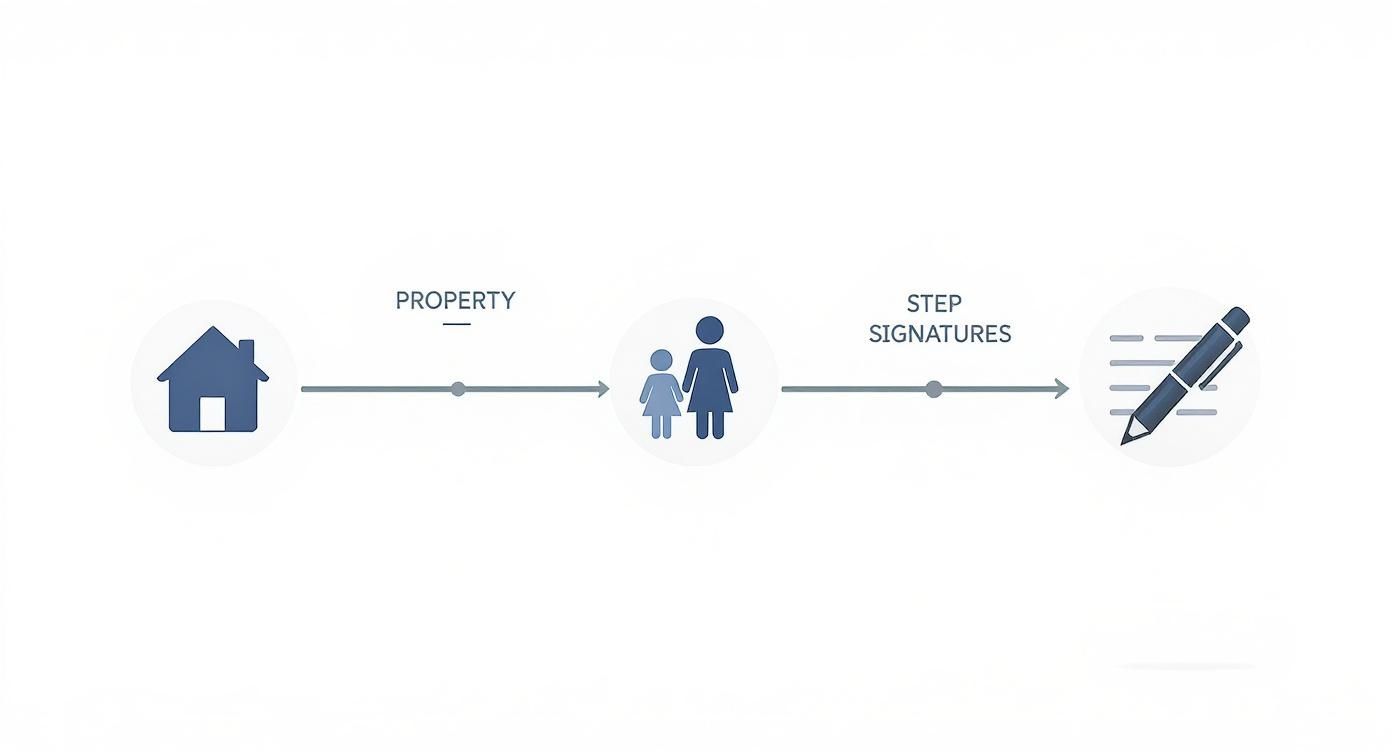
The key takeaway here is that a divorce decree isn't a done deal until every detail is settled and formally written into an order signed by the court.
The Court's Plenary Power
Once the judge signs that decree, a critical countdown begins. According to the Texas Rules of Civil Procedure, the trial court retains what is called plenary power for 30 days.
During this 30-day window, the judge has full authority to modify, correct, or even vacate the final decree. Think of it as a short period where the court can fix its own mistakes. For instance, if a significant error occurred, a party can file a motion for new trial during this time.
Plenary power is the court's final opportunity to correct an error before it loses jurisdiction over the case. Once this 30-day period expires, the decree becomes truly final, and the judge's ability to alter it vanishes.
This is arguably the most important timeline to understand after your divorce is granted. If you believe the court made an error, this is your first—and most powerful—opportunity to act.
Why This 30-Day Window Is So Important
Understanding the plenary power period is absolutely vital if you are considering an appeal. The clock for filing your Notice of Appeal, the first formal step in the appellate process, is tied directly to the date the decree was signed.
Here’s how those deadlines work:
- Standard Deadline: You typically have 30 days from the date the decree is signed to file your Notice of Appeal.
- Extended Deadline: If you file a timely Motion for New Trial or another qualifying post-judgment motion within that initial 30-day plenary power period, the deadline to file your appeal extends to 90 days from the date the original decree was signed.
Missing these deadlines is not a small mistake; it can permanently forfeit your right to appeal. Appellate courts are notoriously strict with these timelines and rarely grant exceptions. If you believe your decree is fundamentally unfair due to a legal error, you cannot afford to wait. The moment that decree is signed, the clock on your rights starts ticking. Consulting with an experienced appellate attorney immediately is the surest way to understand and protect your options.
What Makes a Divorce Decree Legally Unfair? Understanding Reversible Error

After the draining experience of a divorce trial, receiving a final divorce decree in Texas that feels deeply unfair can be devastating. It is easy to feel the judge did not listen or completely missed the point of your case.
However, an appeal requires more than a feeling of injustice. To succeed, you must demonstrate that the trial court made a specific legal mistake, known as a reversible error.
An appeal is not a second trial. You cannot present new evidence or re-argue your case. Instead, it is a focused legal argument demonstrating that the trial judge misapplied the law or misinterpreted the facts in a way that led to an improper outcome. Understanding this distinction is the first step in appellate advocacy.
Defining "Abuse of Discretion"
Much of family law, from dividing property to creating a parenting plan, is governed by a legal standard called abuse of discretion. It is a crucial concept in any family law appeal.
"Abuse of discretion" does not mean the judge acted with bad intentions. It is a legal term meaning the judge's decision was either:
- Arbitrary or Unreasonable: The decision has no basis in the established legal rules or the facts presented in your case.
- A Misapplication of the Law: The judge understood the facts but applied the wrong legal standard to them.
An appellate court reviews the trial judge’s work. They are not asking, "Would we have made the same decision?" Instead, they ask, "Did the judge's decision fall within the zone of reasonable disagreement?" If the ruling is so far outside the bounds of the law that no reasonable judge would have made it, it may be considered an abuse of discretion.
A judge has significant leeway in a family law case. A successful appeal must prove the trial judge's decision was not just different, but legally indefensible.
Examples of Common Reversible Errors in Texas Divorce Cases
What does a reversible error actually look like in a Texas divorce? These are not minor procedural issues but significant legal blunders that fundamentally altered the case's outcome.
- Mischaracterizing Property: A classic error occurs when a judge treats one spouse's separate property—such as an inheritance or a gift received during the marriage—as community property and divides it. This is a direct violation of the Texas Family Code.
- Unequal Property Division Without Justification: Texas law requires a "just and right" division of community property. While this does not always mean a 50/50 split, a disproportionate division must be supported by evidence (e.g., fault in the breakup of the marriage, disparity in earning capacity). A lopsided division without a stated reason is a major red flag for an appeal.
- Ignoring the 'Best Interest of the Child' Standard: In cases involving children, this is the guiding principle. Every decision must be based on what is best for them. If a judge makes a ruling that contradicts this standard—for example, by ignoring evidence of a parent's instability—that decision is vulnerable on appeal.
- Improperly Awarding Spousal Support: The rules for spousal maintenance in Texas are very strict. A judge cannot award it simply because it seems "fair." If they order one spouse to pay support to another who does not meet the legal eligibility requirements, that is a clear reversible error. Our firm offers a deep dive into what spousal support in Texas truly involves.
Identifying these errors requires an appellate attorney to meticulously review the entire trial record—including hearing transcripts, motions, and exhibits. This specialized skill focuses on spotting legal flaws in how the judge handled the case, not just retelling your story.
What Can You Do If the Judge Got It Wrong?
Receiving a final divorce decree in Texas that feels unjust can leave you feeling powerless. It is easy to think it is the end of the road, but that is not always true. When you are convinced the judge made a serious error, the law provides specific remedies. The key is knowing which path to take.
Your two primary options are a modification or an appeal. They may sound similar, but they are fundamentally different legal tools used for entirely different situations. One addresses how life changes in the future, while the other corrects a decision that was flawed from the start.
Modification: For When Life Changes
A modification action looks to the future. You file one when there has been a material and substantial change in circumstances after your decree was signed. Essentially, you are asking the court to update the order because the old rules no longer fit your new reality.
Common examples of a material and substantial change include:
- A parent loses their job or receives a major promotion, significantly altering their income.
- A parent needs to relocate for a new job.
- A child's needs change as they get older, requiring a new possession schedule.
With a modification, you are not arguing the original judge was wrong. You are simply stating that the decree was appropriate for your circumstances at the time, but it is now unworkable or no longer in your child's best interest.
Appeal: For When the Ruling Was Wrong from the Start
An appeal, in contrast, is a direct challenge to the original ruling. It looks backward to argue that the judge made a critical legal mistake and the decree was legally flawed from the very beginning. You are not just unhappy with the outcome; you believe it was legally incorrect.
An appeal is not a do-over. You cannot introduce new evidence or make arguments you failed to raise at trial. The appellate court reviews the existing trial record to determine if a significant legal error was made.
For instance, if the judge incorrectly divided your separate property or miscalculated child support by ignoring the Texas Family Code, those are grounds for an appeal. It is a complex process, and our guide on how to appeal a family court decision can walk you through the specifics.
These legal challenges don't happen in a vacuum. While overall divorce rates have been dropping, Texas has seen a surprising increase in "gray divorces" among those over 50. These later-in-life splits often involve more complex assets and circumstances, leading to more potential for legal disputes. You can find more Texas divorce rate statistics on bryanfagan.com.
The most important thing to remember is that the deadlines for an appeal are incredibly short and unforgiving. If you think the judge made a mistake, you have to act fast to protect your right to challenge the decision.
Common Questions About Texas Divorce Decrees

Even after your divorce is finalized, you are bound to have more questions. The end of the trial is the beginning of a new chapter, and knowing your rights is essential. Let's walk through some of the most common questions people have after receiving their final divorce decree in Texas.
How Long Do I Have to Appeal My Divorce Decree in Texas?
When challenging a court's decision, the clock starts ticking immediately, and the deadlines are strict. According to the Texas Rules of Appellate Procedure, you typically have just 30 days from the date the judge signs the Final Divorce Decree to file a Notice of Appeal.
Missing this deadline can mean forfeiting your right to challenge an unfair ruling forever.
There is one key exception. If you file a timely Motion for New Trial or other qualifying post-judgment motion within that initial 30-day period, the deadline to file your appeal extends to 90 days from the date the original decree was signed. Because these timelines are so unforgiving, it is critical to speak with an appellate attorney as soon as you receive a judgment you believe is legally flawed.
What Can I Do If My Ex-Spouse Ignores the Decree?
A final divorce decree is a court order with the full force of law behind it. If your ex-spouse fails to comply—by not paying child support, refusing to turn over property, or violating the possession schedule—you can take legal action.
The proper remedy is to file an enforcement action. This proceeding asks the court to compel your ex-spouse to follow the existing order. A judge has several tools to ensure compliance, including:
- Imposing fines.
- Ordering the non-compliant party to pay your attorney's fees.
- In serious cases, holding them in contempt of court, which can result in jail time.
Should I Appeal or Modify My Divorce Decree?
This is a crucial question. The answer depends on whether you are trying to fix a past mistake or adapt to a new future. Appealing and modifying are two different legal procedures for two very different problems.
An appeal addresses the past. It argues the judge made a legal error and the original decision was flawed from the start. A modification, on the other hand, looks to the future. It acknowledges the original decree was valid at the time but asks to change it now because life has changed.
You would seek a modification when there has been a "material and substantial change" in your family's circumstances. For example, a significant change in a parent's income or a child's evolving needs could be grounds to modify child support or custody.
You cannot use a modification to relitigate a property division from years ago. That is a job for an appeal, which must be initiated within strict time limits after the decree is signed. Determining the right path for your situation is the first step toward achieving a just outcome.
If you believe the court made a mistake in your family law case, our appellate attorneys can help you seek a fair outcome. Contact The Law Office of Bryan Fagan today for a free consultation. You can reach us at https://familylawcourtappeals.com.