If you own a business or are married to a business owner, you may feel your case was handled unfairly if the final divorce decree gets the company's value wrong. It’s not just about numbers; it’s about your future and financial security. A business is often the most significant asset in a marital estate, and a flawed valuation can create a profoundly unjust division of property, impacting both spouses long after the divorce is final.
When a trial court makes a significant error in valuing a business, the resulting property division is anything but fair. This guide explains how the Texas appellate process can be used to correct these mistakes and help you seek the just outcome you deserve.
What You Can Appeal in a Texas Divorce Case Involving a Business
Texas law requires a "just and right" division of community property in a divorce. However, this standard is impossible to meet if the court bases its decision on an inaccurate value for your most significant asset.
A flawed business valuation can leave one spouse with far less than they are legally entitled to, jeopardizing their financial future. Conversely, it can burden the other spouse with a buyout obligation so large that it threatens the viability of the business itself. When you believe the court made a serious mistake, you are not just disagreeing with an opinion—you are fighting for fairness and due process.
The financial stakes in these disputes are significant. The global market for divorce appraisal services was valued at approximately USD 1.5 billion in 2023 and is expected to grow. This trend highlights how critical accurate valuations are in high-asset divorce cases. You can explore more data on this trend to understand the financial scope of modern divorce litigation.
Your Path to Restoring Fairness
That feeling of an unfair outcome is your starting point. The next step is understanding your remedy: the appeals process. An appeal is not a second trial or a do-over. It is a structured review by a higher court focused on identifying and correcting legal errors made by the trial judge.
Under the Texas Rules of Appellate Procedure, you must show the trial court made a "reversible error"—a mistake significant enough to have likely caused an improper judgment. Common grounds for appeal in a business valuation case include:
- The court relied on a flawed or incomplete expert report.
- The judge mischaracterized business assets, confusing community property with separate property.
- An incorrect or arbitrary valuation date was used, which can dramatically alter the final value.
- The valuation failed to properly separate personal goodwill (which is not divisible) from enterprise goodwill (which is).
These are not minor disagreements. In the language of appellate law, they represent a potential abuse of discretion by the trial court. An appellate court has the power to step in when a judge’s decision is arbitrary, unreasonable, or contrary to established legal rules. Our appellate attorneys are skilled at identifying these reversible errors and building a compelling legal argument to restore a fair balance.
Understanding How a Business Should Be Valued in a Divorce
To successfully challenge a court's decision on appeal, it is essential to first understand how a business is supposed to be valued under Texas law. The process is not arbitrary; it is a detailed financial analysis designed to determine the business's fair market value. This is defined as the price a willing buyer would pay a willing seller, with neither under compulsion to act. When a trial court deviates from accepted valuation principles, the door for a successful appeal opens.
Valuing a business is a complex process, and this complexity is often where reversible legal errors occur. The infographic below outlines the key challenges that arise when a business is a central part of a property division dispute.
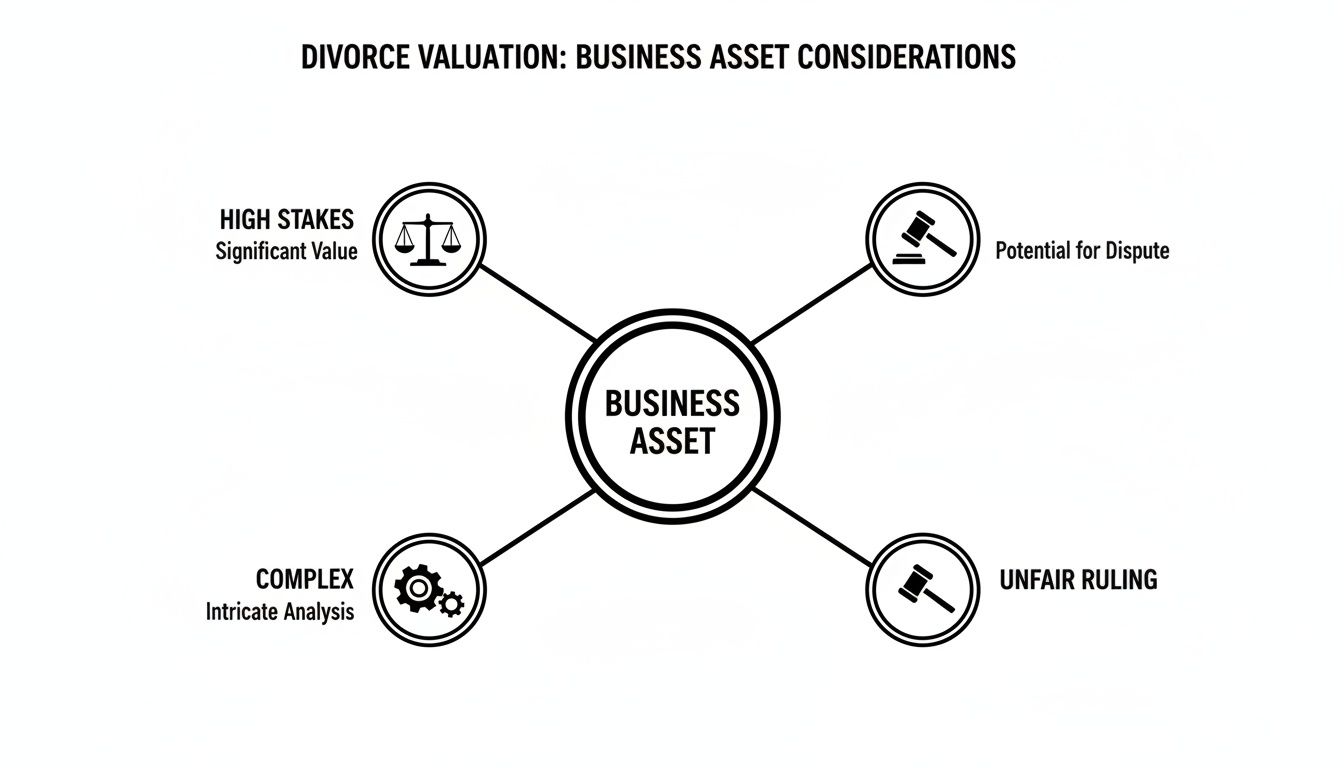
As shown, the combination of high financial stakes and inherent complexity can easily lead to an unfair ruling if the court makes a legal mistake. Understanding the correct valuation methods is the first step in identifying such an error.
The Three Core Valuation Methods
In Texas, forensic accountants and business appraisers typically rely on three standard methods to determine a company's worth. The appropriate method depends on the nature of the business, its industry, and its financial health.
-
The Asset-Based Approach
This is the most straightforward method. The expert calculates the business's net worth by adding up all its assets (cash, real estate, equipment, inventory) and subtracting all its liabilities (debts, loans, accounts payable). The remaining amount is the net asset value. This approach is best suited for businesses whose value is tied primarily to physical assets, such as real estate holding companies. -
The Income-Based Approach
This method focuses on future earning potential. An expert analyzes the company's historical earnings and future projections to estimate the income it is likely to generate. The value is based on this anticipated cash flow. This is the preferred approach for service-based businesses like medical practices, law firms, or consultancies, where the primary asset is the ability to generate consistent revenue. -
The Market-Based Approach
Similar to pricing a house by looking at comparable sales, this method involves finding similar companies that have recently been sold and using their sale prices as a benchmark. The main challenge is finding businesses that are truly comparable, which can be difficult for unique or highly specialized companies.
A common source of reversible error occurs when a trial court adopts a single valuation method when a blended approach is necessary. For example, using only the asset-based method for a profitable service business ignores its most valuable asset: its ongoing earning capacity.
Why Complexity Matters for Your Appeal
A credible business valuation requires more than simple arithmetic. Professionals use these methods as a framework for a highly detailed analysis, reviewing years of financial data and making adjustments for factors like personal expenses paid by the business. This complexity is why business valuations are so frequently disputed in court.
A deep understanding of a company's financial health is at the heart of any solid valuation, which begins with knowing how to read company financial statements. When experts—or the court—misinterpret this data, it can lead to a profoundly unfair property division.
If you suspect the trial court accepted a flawed valuation, you may have strong grounds for appeal in a Texas family law case.
Common Reversible Errors in Texas Family Courts
If the judge’s decision on your business valuation seems fundamentally unfair, it's important to understand what an appeal can achieve. An appeal is not an opportunity to re-argue your case. Instead, it is a focused review of the trial record to find specific legal mistakes the judge made.
When it comes to business valuations in divorce, these errors can invalidate a property division, providing solid grounds to ask a higher court to intervene.

The goal of an appeal is to identify a “reversible error,” a legal term for a mistake so significant that it likely led to an improper outcome. In Texas family law, this often means proving an “abuse of discretion”—a decision that was arbitrary, unreasonable, or made without reference to guiding legal principles.
Mischaracterizing Goodwill
One of the most frequent and costly mistakes involves a business’s “goodwill”—the intangible value derived from its reputation, customer base, and brand recognition. In a Texas divorce, goodwill must be properly characterized.
- Enterprise Goodwill: This value is attached to the business itself and would remain even if the owner-spouse left. It is considered part of the community estate and is subject to division.
- Personal Goodwill: This value is tied directly to a spouse’s individual skills, reputation, and personal relationships. It is considered separate property under Texas law and is not subject to division.
A classic reversible error occurs when a court includes personal goodwill in the community estate. This mistake can artificially inflate the business's value, sometimes by millions of dollars, resulting in an unjust property division. An appeal is the proper remedy to correct this critical legal misstep.
A judge who fails to distinguish personal from enterprise goodwill has misapplied Texas family law. This is a clear legal error, not a matter of opinion, and serves as a powerful basis for an appeal.
Relying on a Flawed Expert Opinion
Since judges are not valuation experts, they rely heavily on expert testimony. However, if a judge bases a ruling on a fundamentally flawed expert report, that decision may constitute an abuse of discretion.
An expert’s report may be legally unreliable if it:
- Uses a valuation method inappropriate for the specific type of business.
- Ignores major industry trends or economic factors.
- Contains significant mathematical errors or relies on inaccurate financial data.
- Fails to account for substantial liabilities or other critical facts.
If your trial attorney effectively challenged a flawed expert methodology but the judge accepted the report anyway, you may have strong grounds for an appeal. The appellate court will review the record to determine if the judge's reliance on that expert was reasonable or if it led to an unjust result.
Using an Incorrect Valuation Date
Timing is critical in business valuation. A company’s value can fluctuate significantly over time. While Texas courts typically value assets on or near the date of trial, the specific date chosen must be fair and supported by the evidence.
A judge may commit a reversible error by selecting a valuation date that is arbitrary or unfairly benefits one party. For instance, valuing a business based on its peak performance a year before trial while ignoring a recent market downturn would lead to an inflated value and an inequitable division. Proving the chosen date was unreasonable is a key strategy in this type of appeal.
Identifying Potential Reversible Errors in Your Case
| Potential Court Error | Why This Mistake Matters for an Appeal |
|---|---|
| Mixed personal and enterprise goodwill. | The law is clear: personal goodwill is separate property. Including it in the marital estate is a misapplication of the law and unfairly inflates the value. |
| Accepted a flawed expert report. | A ruling based on unreliable, unsubstantiated, or irrelevant "expert" analysis lacks a sound evidentiary foundation and may be an abuse of discretion. |
| Chose an arbitrary valuation date. | The date must be fair and equitable. Using an outdated or unrepresentative date that creates a windfall for one party can be a reversible error. |
| Made a mathematical or calculation error. | Simple math mistakes in the final order can have a huge financial impact and are often straightforward to prove and correct on appeal. |
| Ignored key evidence or testimony. | If the court disregarded credible, uncontradicted evidence about the business's value without a valid reason, its decision may be considered arbitrary. |
This is not an exhaustive list. A detailed review of your trial record by an experienced appellate attorney is the only way to determine if a reversible error occurred in your case.
Understanding the Standard of Review: "Abuse of Discretion"
If you feel the judge made a mistake in your property division, it is crucial to understand the legal standard required to succeed on appeal. An appellate court does not simply rehear the case or substitute its judgment for the trial judge's. Instead, the appellate court reviews the record for a specific type of legal mistake known as an “abuse of discretion.”
This is a high standard, but proving it is the key to obtaining a second chance at a fair outcome. It requires showing the trial judge made a decision that was arbitrary, unreasonable, or made without reference to guiding legal rules and principles.
What “Abuse of Discretion” Really Means in Plain English
A trial judge has a "zone of reasonable disagreement." Within this zone, they can weigh conflicting evidence, find one expert more credible than another, and make difficult decisions. An appellate court will not overturn a decision made within this zone, even if it might have viewed the evidence differently.
An abuse of discretion occurs when a judge's decision falls far outside that reasonable zone.
A trial court abuses its discretion when it acts without reference to any guiding rules and principles. In other words, the appellate court must conclude that the trial court's ruling was so arbitrary and unreasonable that it amounted to a clear and prejudicial error of law.
Proving this requires more than just disagreeing with the outcome. It means demonstrating that the judge’s decision had no rational basis in the facts or the law presented in court. Our role as appellate lawyers is to meticulously review the trial record and construct a clear argument showing precisely where the judge crossed that line.
Examples of Reversible Errors in a Business Valuation Case
To illustrate, an appellate court would likely find an abuse of discretion if a trial judge:
- Completely Ignored Credible Expert Testimony: Imagine your valuation expert presented a detailed report valuing a business at $1 million. The opposing expert's methodology was shown to be unreliable during cross-examination. If the judge ignores your expert’s testimony and arbitrarily values the business at $250,000 without explanation, that decision appears to be an abuse of discretion.
- Made a Significant Mathematical Error: Sometimes, the mistake is a simple but costly calculation error. If the final judgment contains a clear mathematical blunder—such as double-counting a $500,000 asset or misplacing a decimal point—the resulting property division is based on a flawed foundation and can be corrected on appeal.
- Misapplied the Law: As discussed, a spouse's personal goodwill is their separate property under Texas law. If the record shows the judge understood this rule but intentionally included personal goodwill in the community estate, that decision was made "without reference to guiding legal principles" and constitutes a reversible error.
Proving an abuse of discretion requires a strategic and methodical analysis of the trial record to identify the specific moments where the judge's reasoning failed. This is the core of appellate advocacy and the only way to seek a just and right division of your marital estate.
The True Cost of an Inaccurate Business Valuation
When a court gets a business valuation wrong, the financial consequences can be devastating and long-lasting. If you believe a critical mistake was made in your divorce decree, you are not just fighting over numbers—you are fighting for your financial future.
For many families, a business is the single largest asset, representing years of shared sacrifice and investment. A flawed valuation is not a minor error; it is a serious miscalculation that can completely alter a person’s life.
The Two Sides of a Devastating Mistake
An incorrect valuation creates a deeply unfair result, whether the value is too high or too low. It leaves a trail of financial hardship that could have been avoided.
An undervaluation cheats one spouse out of their fair share of the community estate. An overvaluation can force the other spouse to make an impossibly high buyout payment, potentially crippling them financially and even destroying the business. This is precisely the type of injustice the Texas appellate process is designed to correct.
When the Business Is Undervalued
If the court accepts an unfairly low valuation, the non-owner spouse is deprived of their rightful portion of the community property. This can jeopardize their ability to live independently, save for retirement, or provide for their children. The financial security they helped build over many years is erased by a legal error. An appeal in this situation is about recovering what is rightfully and legally theirs under the Texas Family Code.
When the Business Is Overvalued
Conversely, an inflated valuation can be equally destructive. This error burdens the business-owning spouse with a massive, unrealistic buyout obligation. To satisfy the judgment, the owner may have to drain essential capital from the company, halt growth, lay off employees, or take on unsustainable debt. In a worst-case scenario, the business itself collapses under the weight of the judgment. An appeal is often the only way to save the company from a valuation that threatens its survival.
An appeal is not a chance to re-argue your case; it is about holding the trial court accountable to the law. It is about ensuring the final decision is based on sound evidence and correct legal principles, not on arbitrary numbers that lead to a profoundly unfair result.
Our appellate attorneys are experienced in untangling complex financial records to pinpoint exactly where a trial court went wrong. We meticulously review every document and transcript to build a powerful argument that the valuation was not just unfair—it was legally incorrect. That is how we fight to restore balance and help you secure the stable financial future you have earned.
How Our Appellate Attorneys Build a Winning Strategy
When a trial court gets the value of your business wrong, it can feel like an insurmountable injustice. This is where our appellate attorneys step in. We transform that sense of unfairness into a powerful, strategic legal argument designed to set things right.
An appeal is a focused mission to prove that a serious legal error was made. Success depends entirely on what is contained in the trial record—every document, exhibit, and word spoken in court. No new evidence can be introduced. Our strength lies in winning with the facts already established.
Meticulous Record Examination and Briefing
The first step in any appeal involving a business valuation in divorce is a thorough review of the trial record. We search for the reversible errors that appellate courts are tasked with correcting.
Our strategic review process includes:
- Expert Reports and Testimony: We deconstruct the expert’s report and testimony to identify flawed methodology, incorrect assumptions, mathematical errors, or deviations from established financial standards.
- Financial Disclosures: We analyze all financial documents, including tax returns and profit-and-loss statements, to find evidence the trial judge may have overlooked or misinterpreted.
- Trial Transcripts: We review court transcripts to confirm that legal issues were properly preserved for appeal through timely objections and to identify any statements by the judge that reveal a misunderstanding of Texas law.
After identifying key errors, we draft the most important document in your case: the appellate brief. This is our written argument to the court of appeals, where we lay out a persuasive, well-researched, and clear case for reversal.
An appellate brief is not a summary of the trial. It is a focused legal argument that methodically demonstrates how the trial judge abused their discretion and why that mistake led to a property division that was fundamentally unjust.
Our attorneys excel at translating complex financial concepts into plain English that resonates with appellate judges. We construct a logical, step-by-step argument, supported by Texas case law, to show precisely where the trial court’s decision deviated from the law. With deep experience in complex financial appeals, we provide a calm, confident, and strategic path toward the just outcome you deserve.
Answers to Your Business Valuation Appeal Questions
Receiving a final divorce decree with a business valuation you know is wrong can be disheartening. You are likely wondering what your options are. Here are answers to some of the most common questions we receive from clients considering an appeal.
Can I Submit a New Business Valuation on Appeal?
No. This is one of the most important distinctions between a trial and an appeal. The appellate process does not allow for the introduction of new evidence.
The court of appeals is limited to reviewing the trial record—the collection of testimony, documents, and expert reports presented to the original judge. Our task on appeal is not to offer a new valuation but to prove the trial court committed a serious legal error based on the information it had. We must demonstrate an abuse of discretion by showing how the judge:
- Relied on a flawed expert report that was properly challenged at trial.
- Misapplied the law to the facts.
- Made a decision that was arbitrary or unreasonable based on the evidence presented.
Success on appeal hinges on exposing the flaws in the original valuation and the judge's reliance on it.
What Is Personal Goodwill and Why Does It Matter So Much?
In a Texas divorce, "goodwill" refers to the intangible value of a business's reputation and customer loyalty. The law requires this value to be separated into two types, and failure to do so is a significant, appealable error.
- Enterprise Goodwill: This is the value that belongs to the business itself, such as brand recognition or customer lists. It would remain even if the owner left. This is community property and subject to division.
- Personal Goodwill: This value is tied directly to one person's unique skills, reputation, or client relationships. It is the value a specific professional brings to the business. Under Texas law, personal goodwill is separate property and is not divisible.
One of the most common reversible errors a trial court can make is to include personal goodwill in the community estate. This mistake can artificially inflate a business's value, leading to an unfair property division. An appeal is the only way to correct this misapplication of the law and protect your separate property.
How Long Do I Have to Appeal a Divorce Decree in Texas?
The deadlines for appealing a court's decision under the Texas Rules of Appellate Procedure are extremely strict. If you miss the deadline, you permanently lose your right to challenge the judgment, no matter how unfair it was.
Generally, you must file a Notice of Appeal with the trial court clerk within 30 days of the date the final divorce decree was signed. This deadline may be extended to 90 days if a timely Motion for New Trial or other similar post-judgment motion is filed.
Because these deadlines are non-negotiable, it is critical to act quickly. If you have received a judgment that you believe is fundamentally flawed, you should contact an appellate attorney immediately. The sooner we can evaluate your case, the more time we have to protect your right to appeal.
If you believe the court made a mistake in your family law case, our appellate attorneys can help you seek a fair outcome. Contact The Law Office of Bryan Fagan today for a free consultation. You can reach us at https://familylawcourtappeals.com.