You may feel your case was handled unfairly. After an emotionally draining trial, a custody ruling that ignores parental alienation feels like a profound injustice. Texas parental alienation is a destructive pattern where one parent systematically undermines a child's relationship with the other. If you believe the trial court failed to recognize this dynamic, or worse, wrongly accused you of it, an appeal may be your most effective path toward justice.
An unjust custody order can feel final, but it doesn't have to be the end of the story. The Texas appellate process was created for this very reason: to provide a structured way to challenge a court’s decision when a serious legal mistake, known as a reversible error, has occurred. It is a critical safeguard designed to ensure the law was applied correctly and the final order truly serves your child's best interests.

An Appeal Is Not a Retrial
Understanding how appeals differ from trials is the first step. An appeal is not a second chance to present your case. You cannot introduce new evidence or call new witnesses. Instead, the appellate court reviews the official trial record—everything said and filed in the original case—to determine if the trial judge made a reversible error.
Reversible Error (in Plain English): A legal mistake made by the trial judge that was so significant it likely led to an incorrect outcome. Proving this error is the sole focus of an appeal.
This changes the focus entirely. The argument is no longer about the facts of what happened at home but about proving that the trial court made a legal or procedural mistake. Our appellate attorneys meticulously analyze every page of the record, from pretrial motions to the final order, searching for the critical errors that could have tipped the scales of justice unfairly. The table below highlights the key differences between a trial and an appeal.
Trial vs. Appeal: Understanding the Difference
| Aspect | Trial Court | Appellate Court |
|---|---|---|
| Purpose | To determine the facts of the case and apply the law to those facts. | To review the trial record for legal errors made by the trial judge. |
| Evidence | New evidence is presented through documents, exhibits, and witness testimony. | No new evidence is allowed. The court only considers the existing record. |
| Key Players | Judge, attorneys, parties, witnesses, and sometimes a jury. | A panel of appellate justices and the attorneys for each side. |
| Focus of Arguments | "Here is what happened, and this is the evidence that proves it." | "The trial judge made a legal mistake, and here is where it happened in the record." |
| Outcome | Issues a final judgment or order (e.g., a custody order). | Affirms, reverses, or modifies the trial court’s judgment. May send the case back for a new trial. |
This distinction is crucial because it shapes the entire legal strategy. The appeal is a technical, rule-driven process that demands a different skillset than trial litigation.
Seeking a Fair Outcome
The ultimate goal of an appeal in a parental alienation case is to protect your child and restore a just outcome. This could mean overturning an order that wrongly limited your time with your child or reversing a decision that failed to address an alienating parent's destructive actions.
The process is governed by strict rules and deadlines found in the Texas Rules of Appellate Procedure. Success depends on crafting a persuasive written argument—called a brief—that methodically demonstrates how the trial court misapplied the law. It is a strategic legal battle to show a higher court why the original decision was flawed and cannot stand.
Defining Parental Alienation Under the Texas Family Code
To build a successful appeal, it is essential to understand how Texas courts define parental alienation. This isn't just a feeling of being treated unfairly; it is a specific, destructive pattern of behavior that the legal system is equipped to address.
While you will not find the specific term "parental alienation" in the Texas Family Code, the concept is embedded in the guiding principle of every custody case: the "best interest of the child."
This standard, established in Texas Family Code Section 153.002, is the primary focus for every judge. All decisions, from possession schedules to parental rights, must prioritize a child's physical and emotional well-being. Alienating conduct is viewed as a direct attack on that well-being because it is a deliberate effort to damage or sever a child’s bond with a parent.

From Abstract Concept to Concrete Evidence
At trial, you cannot simply state that alienation is occurring; you must prove it with evidence. This requires presenting specific, documented actions that show a consistent campaign to undermine the parent-child relationship, not just isolated moments of conflict.
When an appellate court reviews the case, it looks for evidence of these behaviors in the trial record. Your appellate lawyer’s job is to pinpoint how the trial judge either ignored this evidence or failed to give it the proper legal weight, leading to a harmful and incorrect ruling.
Common Alienating Behaviors Recognized by Texas Courts
Judges and mental health professionals are trained to identify recognizable patterns of alienation. These are not simple disagreements but calculated, damaging efforts to poison a child against the other parent.
Common examples that can build a strong parental alienation claim include:
- Badmouthing the Other Parent: Making false, derogatory, or inflammatory comments about the targeted parent in front of the child.
- Interfering with Communication: Routinely blocking phone calls, texts, or video chats without a valid reason.
- Obstructing Visitation: Consistently creating excuses to deny court-ordered possession, such as claiming the child is suddenly "sick" or "too busy."
- Creating False Narratives: Inventing stories of abuse, neglect, or danger to make the child fearful of the targeted parent.
- Forcing the Child to Choose: Placing the child in the middle of adult conflicts and pressuring them to take a side.
When emails, text messages, or witness testimony documenting these actions are part of the trial record, they create a powerful foundation for an appeal if the judge’s ruling failed to address their impact.
The Growing Stakes of Alienation in Texas
Parental alienation is a significant issue in Texas family law. With approximately 50% of all Texas divorces involving children under 18, the stakes are high when one parent's behavior threatens a child's stability and healthy development. You can find more information by reviewing divorce and custody statistics in Texas.
A finding of parental alienation can be devastating, but it is not irreversible. The appellate process is designed to correct judicial errors and ensure that custody decisions are based on a proper application of the law to the facts presented at trial.
Ultimately, Texas law considers a parent's willingness to foster a healthy relationship between their child and the other parent a key factor in determining the child's best interest. If the trial court's order did not protect your child from such conduct—or if you were wrongly accused despite evidence to the contrary—you may have strong grounds for an appeal. The key is demonstrating that the court's decision was a legal error, not just a result you disagree with.
Spotting Reversible Errors in Your Custody Case
Winning an appeal in a Texas parental alienation case is not about retelling your story or persuading new judges that you are the better parent. It is about proving the trial court made a significant legal mistake, or what attorneys call a reversible error. Identifying such errors is the first step toward a successful appeal.
An appeal requires a shift in perspective. You must move from the emotional facts of your case to a purely legal analysis of the trial proceedings. This involves finding procedural missteps and legal flaws—a task where an appellate lawyer's specialized skill is critical.
What is a Reversible Error?
A reversible error is a mistake of law or procedure by the trial judge so serious that it likely caused the wrong judgment to be handed down.
To win your appeal, it’s not enough to just point out that the judge made a mistake. You have to prove the mistake was harmful—that if it hadn't happened, the outcome of your case would likely have been different.
This is a high standard. The appellate court will not overturn a ruling just because they might have decided the case differently. They are looking for fundamental errors that undermine the legal basis and fairness of the original order.
Understanding the Standard of Review: "Abuse of Discretion"
In most family law appeals, especially those involving parental alienation, the most common type of reversible error is an abuse of discretion.
Abuse of Discretion (in Plain English): This legal term means the trial judge made a decision that was unreasonable, arbitrary, or without reference to the guiding legal rules and principles they were required to follow.
This does not imply the judge had bad intentions. It means their ruling fell so far outside the bounds of what Texas law considers reasonable, given the evidence in the trial record, that it cannot be allowed to stand.
Common Reversible Errors in Texas Family Courts
While every case is unique, certain types of errors are common in parental alienation appeals. An appellate review focuses on identifying if one of these occurred in your trial.
-
Ignoring Credible Evidence of Alienation: The judge was presented with clear evidence—emails, texts, an expert’s report—showing a pattern of alienating behavior but failed to give it proper weight in the final ruling. For instance, if a custody evaluator's report detailed systematic interference with visitation and the judge’s order completely ignored those findings without any explanation, that could be an abuse of discretion.
-
Improperly Excluding Key Testimony: Your lawyer attempted to have a therapist or a neutral witness testify about the alienation they observed, but the judge wrongly refused to allow it. This can be devastating, as it prevents the court from hearing information crucial to determining the child’s best interest.
-
Misapplying the "Best Interest" Standard: The court focused on a minor issue while overlooking the severe emotional damage caused by the alienating parent. If a judge prioritizes keeping a child in a preferred school district over stopping documented emotional abuse, their application of the best interest standard is likely flawed. You can see more examples of parental alienation and how they manifest in custody cases.
-
Violating New Legislative Protections: Texas law evolves to better protect children from alienation. In June 2023, House Bill 3783 was enacted, immediately prohibiting courts from ordering coercive "reunification" therapies that could further harm a child, such as sending them out of state or cutting off contact with their trusted parent. If a trial court issued an order that violates these new protections, it is a strong basis for a reversible error claim.
Uncovering these mistakes requires a meticulous review of the entire trial record. An experienced appellate attorney knows what to look for and how to frame these errors into a powerful legal argument that gives the higher court a clear reason to intervene.
Navigating the Texas Appellate Process Step by Step
If you believe the trial court wrongly decided your Texas parental alienation case, the appeal provides a formal, highly structured path to seek justice. This process is guided by a specific set of rules: the Texas Rules of Appellate Procedure. This is not a retrial; it is a careful review of the trial court proceedings for legal error.
Your appellate lawyer will build a powerful written argument based entirely on the existing record to prove the trial court made a significant mistake. Success on appeal depends on mastering the rules, meeting every deadline, and presenting a compelling case of legal error.
Step 1: Filing the Notice of Appeal
The clock starts the moment the judge signs the final order. You have a very short and strict deadline—typically 30 days—to initiate the appeal by filing a document called a Notice of Appeal.
This step is critical. Missing this deadline is a jurisdictional issue, meaning you could permanently lose your right to appeal. It is vital to consult with an appellate attorney immediately after an unfavorable ruling. You can learn more about the requirements in our guide on what a Notice of Appeal entails.
Step 2: Assembling the Official Record
Once the appeal is filed, the next step is to gather all the information the court of appeals is allowed to consider. This is called "perfecting the record," and it becomes the entire universe for the appellate justices reviewing your case. The record consists of two parts:
- The Clerk’s Record: A compilation of every document filed in your case, from the initial petition and motions to discovery responses and the final judgment.
- The Reporter’s Record: The official, word-for-word transcript of everything said during hearings and the trial, prepared by the court reporter.
Your appellate lawyer will meticulously request and review these records, as they are the official account of what happened in the trial court.
Step 3: Briefing the Case
This is where the core advocacy happens. Briefing is the process of crafting persuasive written legal arguments. Your attorney will write an "appellate brief," a detailed document that:
- Identifies the specific, reversible errors the trial judge made.
- Supports every argument with relevant statutes and case law.
- Directs the justices to the exact places in the Clerk’s and Reporter’s Record that prove the errors occurred.
The diagram below illustrates the core elements your attorney will analyze in the record to build a case for reversible error.
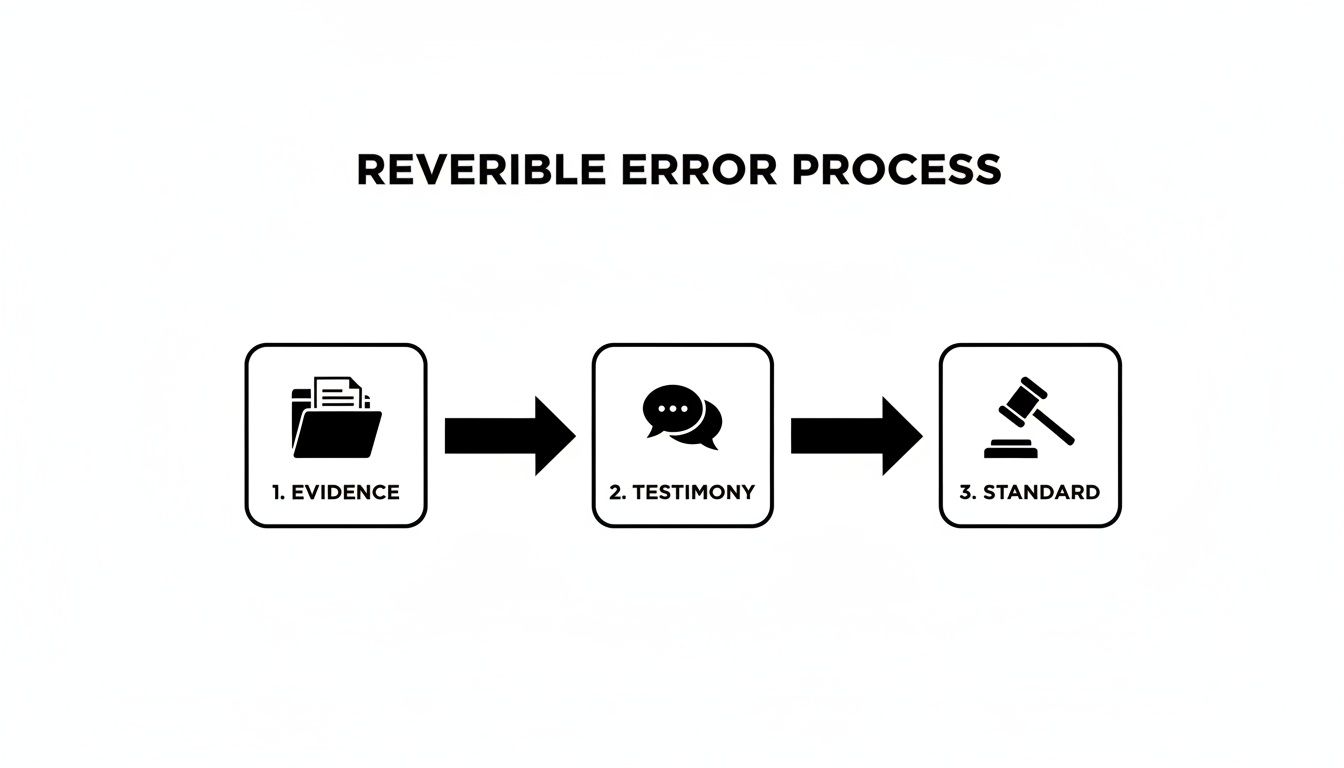
This is how an appellate attorney deconstructs the trial—examining the evidence, testimony, and legal standards to find critical flaws. The opposing party will file a responsive brief, and your attorney may file a final reply brief.
An appellate brief is not just a summary of events. It is a persuasive legal argument that tells the appellate court a story of legal error, guiding the justices through the record to the logical conclusion that the trial court’s decision was wrong and must be corrected.
As legal proceedings evolve, familiarity with essential guidelines on remote proceedings is also important, as some appellate preparations or arguments may occur virtually. After briefing is complete, the court might schedule an oral argument, where attorneys argue their cases before the justices prior to a final decision.
Key Stages of a Texas Family Law Appeal
| Stage | What Happens | Typical Timeframe |
|---|---|---|
| Notice of Appeal | The formal document is filed to start the appeal. | Within 30 days of the final judgment. |
| Perfecting the Record | The Clerk's and Reporter's Records are requested and prepared. | 60-120 days after filing the notice. |
| Appellant's Brief | Your attorney files the main brief outlining the legal errors. | 30 days after the record is filed. |
| Appellee's Brief | The opposing party files their brief responding to your arguments. | 30 days after your brief is filed. |
| Reply Brief (Optional) | Your attorney may file a final brief to rebut the other side's points. | 20 days after the appellee's brief. |
| Oral Argument | Attorneys may argue the case in person before the appellate justices. | Several months after briefing is complete. |
| Final Decision | The court of appeals issues its written opinion. | Can take several months to over a year. |
This table provides a general overview, but every case is unique. Timelines can vary based on requests for extensions, the complexity of the issues, and the court's docket.
Understanding the Standard of Review in Family Law
One of the most critical concepts in an appeal is the standard of review. This is the specific lens the appellate court must use when examining the trial judge’s decision. For most family law cases, especially those involving custody and Texas parental alienation, that standard is abuse of discretion.
Understanding this concept is vital because it frames the entire appeal. The appellate court is not there to second-guess the trial judge or provide a do-over. Its job is to determine if the judge’s decision was legally sound based on the evidence presented in the courtroom.
What Does Abuse of Discretion Really Mean?
An abuse of discretion occurs when the trial judge acts unreasonably, arbitrarily, or without any reference to the guiding legal principles they were sworn to follow. Your appellate lawyer isn't just arguing, "The judge should have seen it our way." They are arguing, "The judge’s ruling was so contrary to the law and facts that it cannot be upheld."
In Plain English: An "abuse of discretion" happens when a trial judge’s decision is so flawed and disconnected from the law and the facts that it is considered legally incorrect. It’s not just a decision you disagree with; it’s a decision that fundamentally misapplies the rules.
How This Standard Plays Out in Alienation Cases
In parental alienation appeals, the appellate court focuses on how the trial judge handled the evidence and applied the "best interest of the child" standard. An abuse of discretion may have occurred if the trial court:
- Ignored substantial documented evidence showing a clear pattern of alienating behavior.
- Dismissed the expert opinion of a court-appointed custody evaluator without a valid legal reason.
- Made a ruling that contradicts the stated goals of the Texas Family Code.
For example, Texas law is founded on the principle that a child benefits from a healthy relationship with both parents. A judge who punishes a parent for protecting their child from emotional manipulation while rewarding the alienator could be found to have acted "without reference to guiding legal principles."
The Impact of New Laws
The legal landscape is always changing, and trial courts must adapt. The 2023 legislative reforms in HB 3783 and SB 500 now explicitly ban coercive practices like "reunification boot camps," isolating a child from family, or forcing them into out-of-state therapy.
If a trial court's order mandates something that these new statutes clearly prohibit, it provides a powerful basis for an abuse of discretion argument. You can learn more about how courts analyze these situations by reviewing the impact of parental alienation on child custody in Texas.
Winning an appeal on these grounds is challenging but achievable. It requires an appellate attorney who can meticulously review the trial record and build a focused legal argument demonstrating that the judge’s decision was not just wrong, but legally indefensible.
How an Appellate Attorney Can Restore Fairness
When a Texas court issues an unjust ruling in a parental alienation case, it can feel like the end of the road. However, an unfair decision does not have to be the final word. The appeals process exists to correct serious legal errors and restore fairness when a trial court's decision fails to protect your child or your parental rights.
An experienced appellate attorney brings a fresh perspective and a different strategy to your case. Their role is not to re-argue the facts but to conduct a meticulous review of the entire trial court record. This in-depth analysis is focused on identifying the precise moments where the judge may have made a reversible error, such as misinterpreting the Texas Family Code or improperly excluding crucial evidence of alienation.
The Role of a Specialist
Family law appeals are a highly specialized field requiring mastery of the Texas Rules of Appellate Procedure and the skill to write a persuasive legal argument known as a brief. This document presents the entire case for why the higher court must intervene.
To build this case, your appellate lawyer will rely on a perfect record of the trial, often using precise legal transcription services to ensure accuracy. An appeal is won or lost only on the evidence and arguments already in the record.
An appellate attorney’s goal is to demonstrate that the trial court’s decision was not just disappointing, but legally flawed. They tell the story of the trial's legal mistakes to a panel of higher court justices, showing exactly how and why the original order was an abuse of discretion.
Our appellate team is dedicated to this focused and demanding work. We know how to take the complex, emotionally charged issues of Texas parental alienation and frame them in a way that resonates with appellate judges. Our mission is to ensure the law is applied correctly so the final outcome truly serves your child's best interests.
A dedicated family law appeal attorney can analyze your trial record for reversible errors and map out a clear strategy for pursuing justice. If you believe the court made a mistake in your family law case, our appellate attorneys can help you seek a fair outcome. Contact The Law Office of Bryan Fagan today for a free consultation.
Common Questions About Parental Alienation Appeals
When a judge gets it wrong in a custody case, especially one involving parental alienation, the sense of injustice can be overwhelming. You're left wondering what comes next. Here are the questions our appellate attorneys get asked most often by parents in your exact situation.
How Long Do I Have to Appeal a Custody Order?
The clock starts ticking the moment the judge signs the final order. In Texas, you have a firm deadline of just 30 days to file a Notice of Appeal.
This isn't a suggestion; it's a hard cutoff. If you miss that window, you almost always lose your right to challenge the decision for good. That's why it's so important to speak with an appellate lawyer immediately after a bad ruling to make sure you don't lose your chance.
Can I Show the Appeals Court New Evidence?
This is a big one, and the answer is no. Many people think an appeal is a chance for a do-over, but it’s not a new trial.
The court of appeals can only look at what was presented to the judge in the original trial—the testimony, the documents, the exhibits. This collection of evidence is called the appellate record. The entire appeal is built on proving the trial judge made a legal mistake based on the information they had in front of them, not on bringing in new facts.
How Long Does an Appeal Usually Take?
Be prepared for a marathon, not a sprint. The appellate process is thorough and moves at a deliberate pace.
From the day you file the Notice of Appeal to the day you get a final written decision, it can easily take several months to more than a year. The timeline depends on how complex the case is and the appellate court's own caseload. There are many steps with strict deadlines, like preparing the official record and writing the detailed legal arguments, called briefs.
The appellate process is designed for careful, methodical review, not speed. It’s a test of patience where solid legal strategy is what truly matters.
What Happens If I Win My Appeal?
A successful appeal doesn't just have one outcome. The court of appeals has a few tools at its disposal. It can:
- Reverse the ruling, which essentially throws out the original custody order.
- Remand the case back to the trial court. This means you get a new trial or hearing, but with specific instructions for the judge to follow to avoid the same legal error.
- Modify the order, changing only the specific part of the ruling that was legally flawed.
If the appeal doesn't succeed, the court will affirm the trial judge's decision, and it will stand. Knowing these possibilities from the start helps set realistic expectations for what lies ahead. Every case is different, and a close look at your trial record is the only way to know the best path forward.
If you believe the court made a mistake in your family law case, our appellate attorneys can help you seek a fair outcome. Contact The Law Office of Bryan Fagan today for a free consultation at https://familylawcourtappeals.com.