Yes, you can appeal a final custody modification order in Texas, but you usually must file your notice of appeal within 30 days after the order is signed, and temporary custody orders generally can't be appealed in the same way. That means the answer is often less about whether relief exists and more about choosing the right procedural path fast enough to protect it.
If you're reading this after a judge changed your custody or visitation order and the result feels unfair, you're not alone. Many parents leave a modification hearing believing the court missed key facts, applied the wrong rule, or gave too much weight to one side's story.
That feeling matters. But in appellate law, the next step involves more than saying the ruling was unfair. The next step is identifying whether the court made a legal error, whether the order is appealable, and whether your complaint belongs in an appeal or in a new modification case based on later events.
A lot of people asking, "Can you appeal a modification order in Texas custody cases?" are really asking two different questions at once. First, can the higher court review what just happened? Second, if life has changed again since that ruling, do you need to go back to the trial court instead? Texas law treats those as separate problems, and mixing them up can cost valuable time.
Appealing an Unfair Custody Modification in Texas
A custody modification order is not the same thing as the original divorce decree or original SAPCR order. It is a later ruling that changes custody, visitation, or related terms after one parent claims something important has changed.
Under Texas modification law, the parent asking for the change must prove both a material and substantial change in circumstances and that the requested change is in the child's best interest, and the case is ordinarily filed in the same court that issued the existing order under the same cause number, as explained in this discussion of Texas custody modification appeals and changed circumstances.

What an appeal does and doesn't do
An appeal does not ask a new court to re-hear your witnesses and decide custody from scratch. It asks an appellate court to review what already happened in the trial court and decide whether the judge made a reversible mistake.
That distinction matters because a modification case and an appeal solve different problems:
| Situation | Likely path |
|---|---|
| You believe the judge applied the law incorrectly in the ruling that was just signed | Appeal |
| You have new facts that arose after the ruling | New modification |
| You want to present new testimony that the appellate court has never seen | Usually not an appeal issue |
Why parents often feel stuck
Parents often think, "The judge got it wrong, so I should appeal." Sometimes that's true. Sometimes the primary issue is that new facts developed after the hearing, and those facts belong in a new modification request, not in the appellate record.
Practical rule: If your complaint is about what the judge did with the evidence already presented, you're likely in appeal territory. If your complaint depends on events that happened later, you're likely in modification territory.
That is why custody appeals require a calm, strategic review of the signed order, the hearing record, and the exact timeline. The question is not just whether the result feels wrong. The question is whether Texas appellate procedure gives you a vehicle to correct it.
Final Orders vs Temporary Orders Which Can You Appeal
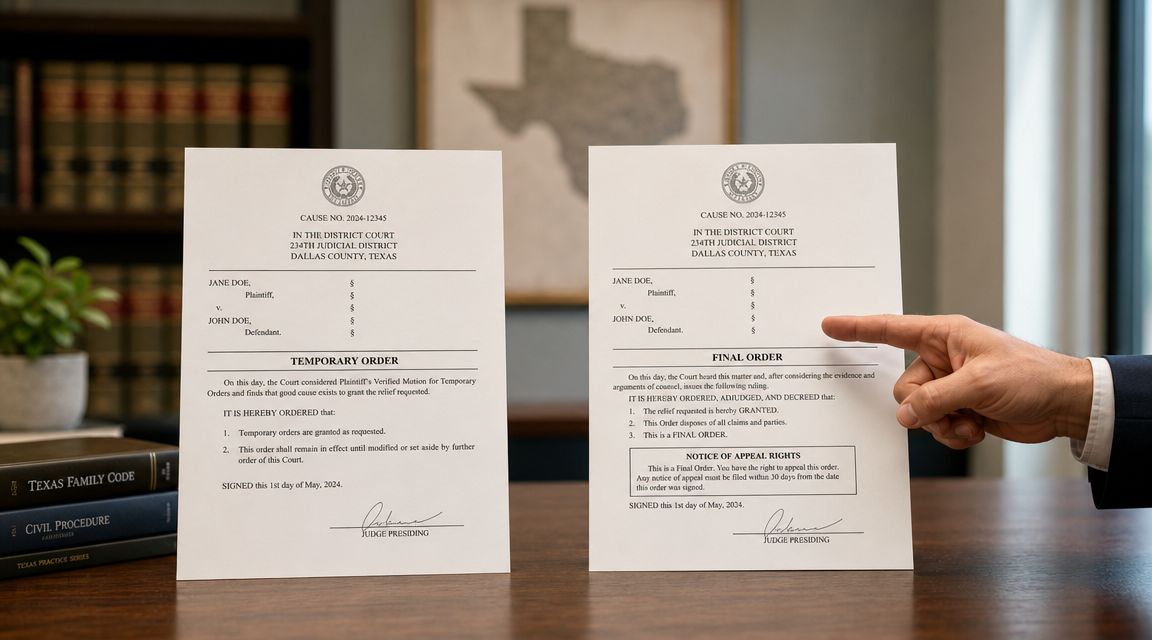
The first question in any Texas custody appeal is simple. Was the order final, or was it temporary?
Final orders are usually appealable
A final order is the order that resolves the issues before the court and leaves little or nothing left for that case stage. If the judge signed a final modification order changing conservatorship, possession, or related custody terms, that order is usually the kind of ruling that may be reviewed on appeal.
A temporary order is different. Temporary orders are often used to hold things together while the case is still pending. In Texas, temporary custody orders are generally not appealable, and the normal deadline to file a notice of appeal from an appealable final order is 30 days from the date the order is signed, according to this overview of Texas child custody appeal deadlines and appealable orders.
Why this distinction causes so much confusion
Parents often hear the word "order" and assume every signed ruling can be appealed immediately. That isn't how Texas appellate procedure works. The label on the paper matters less than the legal effect of the ruling.
If you're unsure whether your ruling is temporary, this guide on appealing a temporary order in Texas family court can help you frame the question for counsel.
Here is the practical difference:
- Final order: Usually opens the door to a traditional appeal.
- Temporary order: Usually requires a different strategy while the underlying case continues.
- Unclear order: Needs immediate legal review, because waiting too long can destroy appellate rights if the order turns out to be final.
The deadline is unforgiving
The 30-day notice deadline is one of the most important rules in the entire process. If you miss it, the appellate court may never reach the merits of your complaint.
That doesn't mean every appeal is filed the same way or that no post-judgment motions matter. It does mean you shouldn't sit with the order for weeks while deciding what to do next.
A parent can lose a strong appellate issue simply by treating the order like one more step in an ongoing custody fight instead of a final judgment that triggered appellate deadlines.
This is also where timing becomes especially dangerous in modification cases. Parents are often emotionally exhausted, still dealing with exchanges, school schedules, and communication breakdowns with the other parent. Meanwhile, the appellate clock is already running.
Before you decide whether the ruling was merely disappointing or legally appealable, it helps to hear a concise explanation of the deadline problem and the final-order issue:
Understanding the Appellate Standard of Review
Most custody appeals become harder the moment clients hear this sentence. An appeal is not a retrial.
Texas appellate courts reviewing custody modification rulings generally focus on whether the trial court abused its discretion, committed legal error, or lacked sufficient support in the record. They do not hear new witnesses or consider fresh evidence. A useful way to think about it is instant replay in sports. The reviewing court studies what already happened and asks whether the call was legally supportable.
What abuse of discretion means
Abuse of discretion is a plain-English phrase with a technical role. It doesn't mean the appellate judges would have ruled differently. It means the trial judge acted outside the range of reasonable choices allowed by law.
A related term is reversible error. That means a mistake significant enough to justify appellate relief. Not every mistake leads to reversal. The error has to matter in a legally meaningful way.
If you want a fuller plain-English explanation, this article on abuse of discretion in Texas family law appeals breaks down why that standard is so central.
What the appellate court actually reads
Appeals are built from the record. The record usually includes the clerk's papers and the reporter's record, which is the transcript of what was said in court.
Your lawyer then prepares a brief. A brief is the written legal argument sent to the appellate court. It explains what happened, identifies the legal errors, cites the governing rules, and asks for a specific remedy.
Here is the basic flow:
- Notice of appeal filed within the required deadline.
- Record prepared from the trial court proceedings.
- Briefing completed by the parties.
- Oral argument, in some cases, if the court requests or allows it.
- Opinion issued by the appellate court.
Why appeal and modification are easy to confuse
Many parents are torn between appealing and filing a new modification because the two procedures can involve the same child, the same parents, and even the same court system. But they ask different questions. An appeal reviews the existing record for legal or procedural error, while a new modification requires proof of new facts showing a material and substantial change in circumstances, as discussed in this explanation of appealing versus modifying a Texas family court order.
If your argument begins with "the judge should have ruled differently based on the evidence at trial," that's usually an appeal argument. If it begins with "since the order was signed, things have changed," that's usually a modification argument.
That difference can decide whether your legal team is writing a brief for the court of appeals or preparing evidence for a new hearing in the trial court.
Common Reversible Errors in Custody Modification Cases
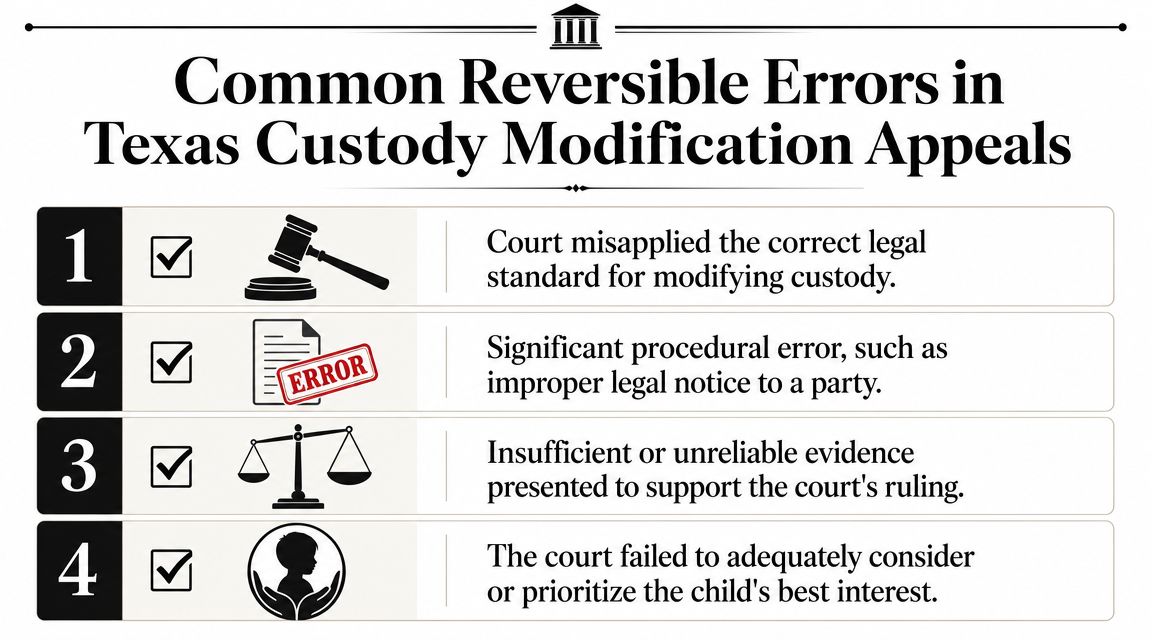
Legal error can sound abstract until you match it to the hearing you lived through. In custody modification cases, the strongest appellate issues often come from a handful of recurring problems.
The court used the wrong legal test
A modification case requires proof of both changed circumstances and the child's best interest. If a judge effectively skips one part of that analysis or treats the case like a fresh custody dispute without applying the proper modification standard, that can create an appellate issue.
A parent might say, "The judge just seemed to decide who he liked more." Standing alone, that feeling isn't enough for reversal. But if the record shows the court applied the wrong legal framework, that may be different.
Important evidence was wrongly excluded or admitted
Sometimes the problem isn't the final ruling. It's what happened before the ruling.
For example:
- Excluded testimony: The court refuses to hear testimony from a counselor, teacher, or other witness whose evidence was properly offered and directly tied to the modification issues.
- Admitted unreliable evidence: The court allows evidence over valid objection when the evidence should not have shaped the outcome.
- Incomplete record problem: A key hearing issue occurred, but nobody preserved the complaint correctly for appeal.
These situations are highly fact-specific. What matters is not whether the evidence felt important, but whether Texas procedure preserved a reviewable complaint.
A procedural error affected fairness
Some appeals arise from process failures rather than custody facts. A party may not have received proper notice. The court may have ruled on a basis that wasn't properly pleaded. The judge may have cut off a party's chance to present a case in a way that affected the outcome.
Courts have broad discretion in family cases, but they still have to follow procedural rules that protect notice, fairness, and the right to be heard.
The evidence didn't legally support the ruling
This issue often appears when the order rests on weak, inconsistent, or legally insufficient support in the record. Appellate courts do not reweigh every credibility dispute. But they can review whether the ruling had enough support under the governing standard.
A simple way to think about common appeal issues is this:
| Potential issue | Why it matters on appeal |
|---|---|
| Wrong legal standard | The judge may have applied the law incorrectly |
| Significant procedural defect | The process may have been unfair |
| Improper evidence ruling | The outcome may have been shaped by legal error |
| Insufficient support in the record | The ruling may not be sustainable under review |
The most effective appeals don't argue that everything was wrong. They identify the few mistakes that were both preserved and important enough to justify relief.
Options for Non-Appealable Orders and Emergencies
You leave court with a temporary custody ruling that changes your weekends, your pickup rights, or where your child will sleep next week. It feels every bit as serious as a final modification order. Yet the first legal question is different. Can this order be appealed now, or do you need a different tool?
When the order isn't appealable in the usual way
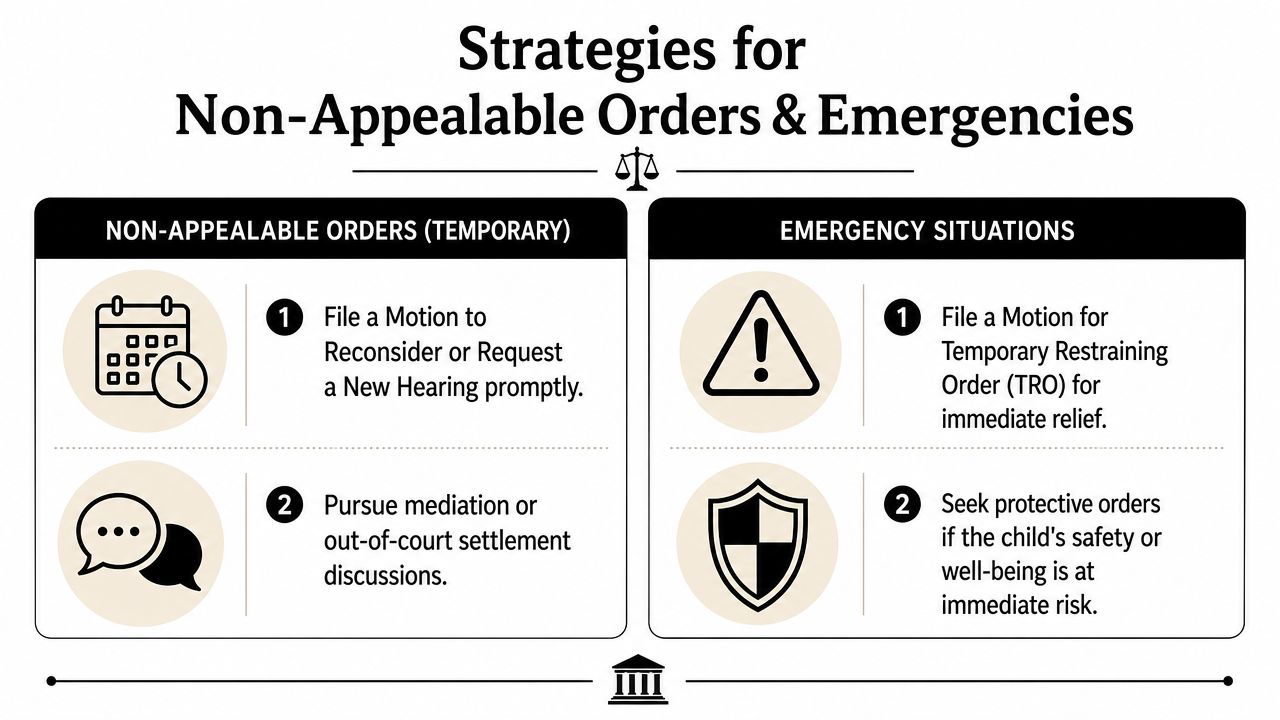
A temporary order in a modification case often does not go up on a normal appeal right away. That distinction matters. An appeal usually targets a final order that ends a stage of the case. A temporary order usually manages the family until the court reaches that final decision.
That does not mean you are stuck.
In narrower situations, a parent may need to ask whether mandamus is available. Mandamus is an extraordinary appellate remedy. It is used when a trial court has clearly abused its discretion and waiting for a normal appeal would not adequately fix the harm. If you need a clearer explanation of that route, this guide on emergency mandamus in Texas custody cases explains when that remedy may fit.
Sometimes the better response is still in the trial court. If the order is unclear, dangerous, or based on an urgent factual change, counsel may consider a motion to clarify, a request for an emergency hearing, or another form of immediate relief allowed by Texas procedure. The right choice depends on the problem you are trying to solve. A legal error, an emergency safety issue, and a scheduling breakdown do not call for the same remedy.
What if a modification is filed while an appeal is already pending
This issue confuses many parents because it seems backward at first. If an appeal is already pending, people often assume the trial court cannot touch custody again until the appellate court finishes. Family cases are rarely that simple.
A pending appeal usually asks a backward-looking question. Was the earlier modification order legally correct based on the record already made? A new modification filing asks a different, forward-looking question. Have circumstances changed enough since then to justify a new order? Those are separate inquiries, even if they involve the same child and the same parents.
An appeal works like a review of a snapshot. A new modification asks whether the picture has changed since that snapshot was taken.
Texas courts may still face emergency requests, enforcement disputes, or later modification claims while the earlier appeal is underway. As discussed in this article about jurisdiction to modify custody while an appeal is pending, the answer turns on what the trial court is being asked to do and whether the new request rests on new circumstances rather than a disguised attempt to relitigate the same ruling.
That creates a strategic risk. A poorly timed new filing can muddy the issues, create inconsistent positions, or distract from the appellate record. On the other hand, waiting too long can be a mistake if the child's situation has genuinely changed or immediate protection is needed. The key is to keep each track clear.
- The appeal challenges the signed order already entered.
- The new modification addresses later facts that may support different relief.
- The emergency request seeks prompt action because a child cannot wait for the ordinary pace of litigation.
Building a practical plan
At this stage, parents often need a map more than a slogan. Start by identifying the order in front of you. Is it temporary or final? Then identify the harm. Is the problem legal error, immediate danger, or a new development that happened after the ruling?
Those questions usually point toward one of three paths: appellate review of a final modification order, extraordinary relief from a non-appealable temporary ruling, or a new request in the trial court based on changed circumstances. The Law Office of Bryan Fagan, PLLC handles family law appellate review and can evaluate whether the issue is better framed as an appeal, a mandamus request, or a separate modification strategy.
Matching the remedy to the problem is what protects your position. If the order is temporary, a standard appeal may not be available yet. If the child faces immediate risk, ordinary appellate timing may be too slow. If the court signed a final modification order that was legally flawed, preserving appellate deadlines remains the priority.
How to Protect Your Rights and Prepare for an Appeal
The judge signs a custody modification order on Friday. By Monday, one parent is still focused on what was said in the courtroom, while the appellate clock is already tied to the written order in the file. That gap causes trouble in modification cases more often than parents expect.
Start with the paper, not the memory. A custody modification appeal rises or falls on the signed order, the date it was signed, and the record showing what the trial court did. In other words, the written order is the map. If the map is wrong, every later decision can head in the wrong direction.
Get a complete copy of the signed order right away. Read it line by line. Compare it to what the court announced at the hearing. In modification cases, small wording differences matter because the order may change possession terms, decision-making rights, geographic restrictions, or support-related provisions in ways that affect both appeal rights and next steps in the trial court.
Then focus on three practical questions:
- What was signed? Identify the exact relief the court granted and denied.
- When was it signed? Appellate deadlines usually run from the signing date, not from the hearing date.
- What kind of order is it? A final modification order is treated differently from a temporary order, and that difference controls whether a standard appeal is available now.
Next, protect the record while the details are still clear. An appeal is not a new trial. The court of appeals usually reviews the existing record to decide whether the trial judge made a legal error. That makes your file the toolbox. If key tools are missing, even a strong complaint can be hard to prove.
A useful first-round file should include:
- The signed order and docket sheet
- Any notice of hearing, motions, responses, and proposed orders
- Reporter information for each hearing that matters
- Exhibits admitted, or excluded after objection
- Your own dated notes about what happened, who testified, and what objections were made
If there was more than one hearing, note that clearly. Modification cases often unfold in stages, and appellate counsel needs to know which hearing produced which ruling.
It also helps to separate two different categories of facts. The first category is what happened before the order was signed. Those facts may support an appeal if they show legal error. The second category is what happened after the order was signed. Those newer events usually do not belong in the appeal record. They may support a new modification request instead. Keeping those categories separate is especially important if another modification gets filed while the appeal is pending. The appeal challenges the existing final order. The new case addresses later changes. Mixing them together can blur both strategies.
Get appellate advice early, even if trial counsel plans to stay involved. Trial work and appellate work use different skills. A trial lawyer builds evidence and persuades a judge in real time. An appellate lawyer studies preservation, deadlines, standards of review, and whether the record shows reversible error. A modification order also raises case-specific questions that do not always appear in appeals from an original decree, such as whether the required change in circumstances was properly proved and whether the trial court applied the modification standard correctly.
One careful consultation can answer the questions that matter most. Is this order final? Were objections preserved? Does the record support an appeal, or is mandamus or a new modification request the better path? If a fresh modification has already been filed, should the appeal continue, should the trial court case be limited to new facts, or should both tracks proceed with clear boundaries?
Calm procedure protects rights better than panic. Parents often want to act fast, and that instinct is understandable. The stronger approach is to act in the right order.
If you believe the court made a mistake in your family law case, our appellate attorneys can help you seek a fair outcome. Contact The Law Office of Bryan Fagan, PLLC today for a free consultation.